
The landscape of motorcycle transportation is undergoing its most significant transformation in over a century. Where combustion engines once reigned supreme, a convergence of electric powertrains, intelligent infrastructure, and environmental awareness is redefining what it means to ride. This shift isn’t just about swapping fuel tanks for batteries—it encompasses how we navigate cities, how we maintain our machines, and how we calculate the true cost of two-wheeled mobility.
Whether you’re navigating congested urban corridors, evaluating the economics of motorcycle commuting, or simply curious about where the industry is headed, understanding the interconnected dynamics of energy and mobility has become essential. This article explores the technological evolution, practical realities, environmental considerations, and economic factors that are reshaping motorcycle transport for riders across all experience levels.
The most visible change in motorcycle mobility centers on how machines generate motion. Traditional internal combustion engines, refined over decades, now share showroom space with electric alternatives that operate on fundamentally different principles.
Electric motorcycles eliminate many components riders have taken for granted. There’s no clutch to feather, no gearbox to shift through, and no combustion cycle requiring precise fuel-air mixtures. Instead, electric motors deliver instant torque from zero RPM, creating an acceleration experience that feels more like a rollercoaster launch than a traditional motorcycle pull. This simplification doesn’t just change the riding experience—it dramatically reduces the number of wear components requiring regular maintenance.
The absence of gears initially surprises new electric riders. Where a conventional bike might require fifteen gear changes navigating through city traffic, an electric motorcycle uses a single-speed transmission. The motor simply varies its speed across an extraordinarily wide RPM range, maintaining efficiency whether you’re crawling through parking lots or merging onto highways.
Not all innovation points toward electrification. Synthetic fuels—created through processes that combine captured carbon with hydrogen—offer a pathway for preserving combustion engines while reducing lifecycle emissions. These fuels can run in existing engines with minimal modification, making them particularly attractive for riders who’ve invested in high-performance combustion machines they’re reluctant to retire. The technology remains expensive and production-limited, but it represents a bridge between the motorcycle heritage many riders cherish and the environmental imperatives we collectively face.
The theoretical advantages of electric motorcycles meet practical reality when you actually live with one daily. Range anxiety, charging logistics, and weather sensitivity shape the ownership experience in ways combustion riders never consider.
Battery chemistry doesn’t care about your schedule. When temperatures drop below freezing, lithium-ion batteries lose 20-40% of their effective capacity. A motorcycle that delivers 100 miles of range in summer might barely manage 60 miles on a winter morning. Savvy electric riders learn to precondition batteries while still connected to chargers, warming the cells before departure to minimize this penalty. They also discover that aggressive acceleration and highway speeds deplete batteries far faster than urban cruising at moderate speeds.
Home charging transforms how electric riders think about refueling. Instead of weekly gas station visits, you simply plug in overnight, starting each day with a full charge. Workplace charging adds convenience, but its availability varies dramatically. Some employers install dedicated motorcycle charging stations in covered parking areas; others offer nothing beyond standard automotive chargers that require adapters and patience.
Public fast-charging networks continue expanding, but coverage remains inconsistent. Urban areas generally offer multiple options, while rural routes may have gaps exceeding typical electric motorcycle ranges. Successful long-distance electric riders plan routes around charging locations the way adventure riders plan around fuel stops in remote regions—it becomes part of the journey’s rhythm rather than an afterthought.
Modern motorcycles increasingly function as software-defined vehicles, where updates delivered wirelessly can improve performance, add features, or enhance safety systems. This connectivity extends beyond the motorcycle itself to encompass how bikes interact with urban infrastructure.
V2X technology enables motorcycles to communicate with traffic signals, other vehicles, and infrastructure systems. Imagine approaching an intersection where your display warns of a car running a red light before you even see the vehicle, or receiving real-time notifications about slippery conditions reported by other riders ahead. These systems transform motorcycles from isolated machines into networked participants in intelligent transportation ecosystems.
Electric motorcycles produce minimal mechanical noise, making them ideal candidates for urban quiet zones where noise pollution faces increasing regulation. Some cities now restrict combustion vehicles during certain hours in residential areas or near hospitals, while electric vehicles gain unrestricted access. This acoustic advantage extends beyond regulation—it creates a fundamentally different riding experience where you hear your environment rather than your engine.
True sustainability extends beyond tailpipe emissions to encompass the entire lifecycle of motorcycling, from manufacturing through disposal.
Comparing the environmental impact of electric versus combustion motorcycles requires examining manufacturing emissions, energy source composition, and end-of-life disposal. An electric motorcycle charged primarily from coal-fired power plants may offer minimal environmental advantage over an efficient combustion bike. Conversely, when charged from renewable sources, electric motorcycles dramatically reduce total lifecycle emissions despite the higher manufacturing footprint of battery production.
Commute footprint comparisons reveal surprising insights. A single rider on a fuel-efficient motorcycle often produces fewer emissions per mile than a single occupant in an electric car, simply due to the massive weight difference. Small electric motorcycles optimized for urban delivery create even smaller footprints, carrying cargo through congested streets with remarkable efficiency.
Sustainability challenges exist across all motorcycle types. Tire waste remains problematic—worn motorcycle tires contain steel belts and synthetic compounds that resist decomposition. Progressive manufacturers now offer take-back programs, but implementation varies by region. Riding gear presents similar challenges; textile and leather garments with armor inserts resist simple recycling processes, though specialized facilities can separate and process these materials.
Battery recycling infrastructure is developing rapidly as electric vehicle adoption accelerates. Modern lithium-ion packs contain valuable materials—cobalt, nickel, lithium—that justify recovery economics. Specialized facilities can reclaim over 95% of battery materials, though the processes remain energy-intensive. Emerging solid-state battery technology promises improved energy density and potentially simpler recycling pathways, though widespread commercial availability remains several years away.
Understanding the true cost of motorcycle transportation requires analysis beyond simple fuel comparisons.
Return on investment calculations for motorcycle commuting must account for multiple factors. Initial purchase price represents just the beginning. Electric motorcycles typically command premium pricing but require dramatically less maintenance—no oil changes, no valve adjustments, no clutch replacements. Over five years, these maintenance savings can offset significant portions of the purchase premium, particularly for high-mileage commuters.
Parking costs create another economic variable. Many urban areas offer free or reduced-rate parking for motorcycles in spaces where cars pay premium rates. Some cities provide dedicated motorcycle parking zones, while others permit filtering through traffic, delivering substantial time savings during peak congestion hours. These time savings translate to real economic value when you calculate the opportunity cost of hours spent in traffic.
Combustion motorcycles follow well-established depreciation curves, typically losing 20-30% of their value in the first year before stabilizing. Electric motorcycles present more complex resale dynamics. Battery degradation concerns suppress values for older models, while technological advancement makes previous generations feel obsolete more quickly than combustion equivalents. However, low-mileage electric bikes with documented battery health can retain value surprisingly well, particularly as charging infrastructure improves and range anxiety diminishes.
The question of whether to own or share increasingly influences how riders access motorcycle transportation. Urban scooter-sharing programs proliferate in dense cities, offering on-demand rental through smartphone apps. For occasional riders or those testing electric motorcycles before committing to purchase, these services provide low-barrier entry points.
The economics favor sharing for infrequent use—why maintain insurance, registration, and parking for a vehicle used twice weekly when you can rent on-demand? Conversely, regular commuters quickly find that ownership costs less than frequent rental fees. The break-even point typically occurs around three rides per week, though this varies based on local rental rates and ownership costs.
The physical and regulatory environment supporting motorcycle mobility continues evolving to accommodate new technologies and urban planning priorities.
Charging infrastructure development follows an uneven pattern. Progressive employers recognize that providing motorcycle charging stations encourages sustainable commuting while requiring minimal space investment compared to automotive charging. A single car parking space can accommodate four motorcycles with individual charging connections, making the space-to-benefit ratio highly favorable in congested urban cores.
Public charging networks face the challenge of standardization. Multiple connector types and charging protocols create compatibility complications, though industry consolidation gradually addresses these issues. Fast-charging technology continues advancing, with the newest systems delivering meaningful range in 15-20 minute charging sessions—roughly equivalent to a coffee break rather than a meal stop.
Environmental regulations increasingly shape motorcycle design and access. Emissions standards tighten progressively, making modern combustion engines remarkably clean compared to predecessors from even a decade ago. Some jurisdictions now mandate zero-emission zones in historic city centers, effectively requiring electric propulsion for access during peak hours.
Retrofitting older motorcycles with electric powertrains represents one compliance pathway, though the economics and technical challenges remain daunting for most riders. Preserving the last generation of combustion motorcycles becomes a passion project for enthusiasts who view these machines as mechanical heritage worth maintaining despite regulatory headwinds.
Small electric motorcycles and scooters are revolutionizing last-mile delivery and urban transport. Their compact dimensions, zero local emissions, and low operating costs make them ideal for congested environments where cars struggle. Delivery services increasingly deploy electric motorcycle fleets, reducing both costs and environmental impact while navigating narrow streets and heavy traffic with ease.
Integration into smart city ecosystems positions motorcycles as solutions rather than problems. When properly accommodated with dedicated parking, charging infrastructure, and regulatory frameworks that recognize their efficiency advantages, motorcycles enhance urban mobility rather than complicating it. This requires city planners to look beyond car-centric infrastructure and embrace the space efficiency and environmental benefits that modern motorcycles deliver.
The transformation of motorcycle energy and mobility isn’t a distant future scenario—it’s unfolding right now in cities worldwide. Whether you embrace electric propulsion, optimize combustion efficiency, or blend both approaches, understanding these interconnected changes empowers you to make informed decisions about your own riding future. The technology will continue evolving, but the fundamental appeal of two-wheeled mobility—freedom, efficiency, and connection to your environment—remains timeless.
Treating the decision as a pure financial investment reveals that motorcycle commuting consistently outperforms car commuting in Total Cost of Ownership (TCO) when all direct and indirect variables are quantified. Time saved is a quantifiable asset, adding thousands to your…
Read more
For a delivery rider, the battery swapping model is demonstrably superior to traditional charging because it maximizes Operational Uptime, the single most critical metric for profitability. Swapping eliminates charging downtime and the “cognitive load” of range management, allowing for more…
Read more
Navigating urban restrictions is no longer just about avoiding fines; it’s about understanding a new urban operating system where compliant motorcycles gain new privileges. Restrictions like Low Emission Zones (LEZ) and noise enforcement are now paired with new opportunities like…
Read more
The true environmental cost of a motorcycle is determined less by its powertrain and more by its entire lifecycle, from manufacturing to disposal. Electric motorcycles carry a significant upfront “carbon debt” from battery production, which must be “paid back” over…
Read more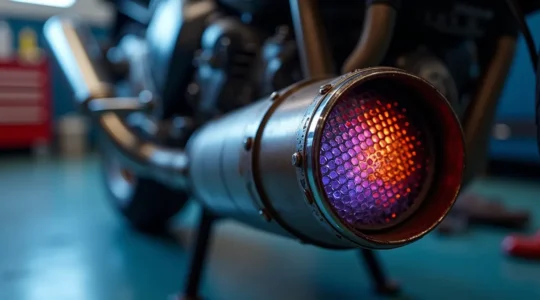
Removing your bike’s catalytic converter doesn’t just make it illegally loud; it actively damages its real-world performance by destroying the low-end torque essential for city riding. Modern engines are complex, balanced systems; the cat is integral to performance tuning, not…
Read more
The spec sheet isn’t a lie, it’s just a different language; true EV range is about managing a predictable energy budget. Cold weather is your single biggest range debit, often reducing your available miles by 25-30% before you even start…
Read more
The spec sheet is misleading: an electric motorcycle’s “fast” sensation comes not from horsepower, but from a perfectly flat, unwavering torque curve that combustion engines cannot replicate. Electric motors deliver 100% of their torque from 0 RPM, eliminating the build-up…
Read more
In summary: Treat your commute like a tactical mission, focusing on efficiency and survival, not just speed. Master the physics of lane splitting and the psychology of drivers to move through traffic safely. Adopt an “invisible rider” mindset, constantly managing…
Read more