
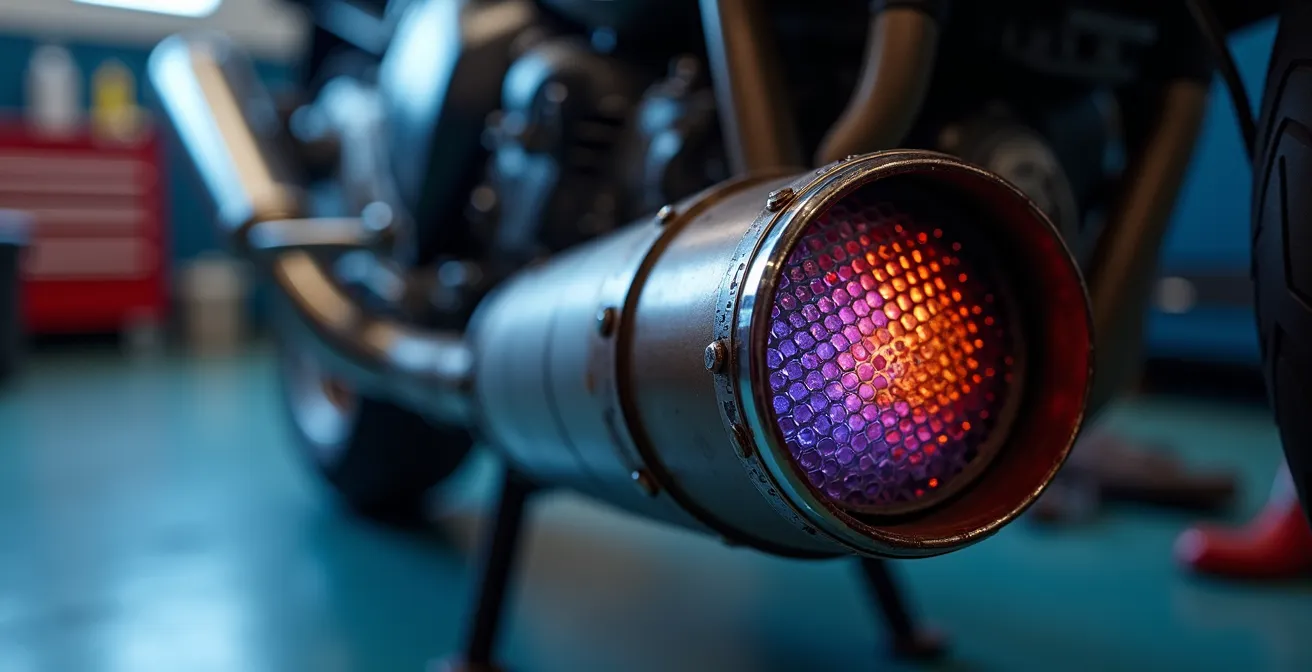
Removing your bike’s catalytic converter doesn’t just make it illegally loud; it actively damages its real-world performance by destroying the low-end torque essential for city riding.
- Modern engines are complex, balanced systems; the cat is integral to performance tuning, not just an emissions device.
- You will fail any legitimate emissions test, and manufacturers have solid grounds to deny engine-related warranty claims.
Recommendation: Before taking a grinder to your exhaust, understand the engineering you’re fighting. Opt for a professionally tuned, compliant aftermarket system if you must make a change.
The siren song of a loud, aggressive exhaust note is a powerful one for many riders. The internet is filled with advice suggesting the quickest path to that sound is to simply remove the catalytic converter—a “de-cat.” This is often presented as a simple modification that unleashes sound and hidden horsepower. But as someone who sees the aftermath of these decisions in a tuning shop, the reality is far more complex and often, far more damaging. It’s not just about noise or breaking the law.
The fundamental misunderstanding is viewing the catalytic converter as a simple “choke point” or filter that stifles the engine. On a modern motorcycle, it’s a deeply integrated component of a finely tuned system. Removing it isn’t an upgrade; it’s an act of engineering sabotage. It throws the delicate balance of exhaust gas velocity, backpressure, and fuel mapping into chaos. This doesn’t just impact emissions; it directly degrades the rideability and performance characteristics that engineers spent thousands of hours perfecting.
This isn’t about being anti-modification. It’s about being pro-performance. Before you consider this irreversible step, you need to understand what you’re actually giving up. This article will break down the real-world consequences, moving beyond the simple “it’s illegal” warning to explore how modern emissions standards have shaped engine performance, the nightmare of trying to pass an inspection, the myths about horsepower gains, and the very real risks to your warranty and your bike’s long-term health.
To fully grasp the implications, this guide explores every facet of the catalytic converter’s role, from its function in meeting stringent emissions laws to its surprising impact on your daily commute. The following sections will provide a comprehensive overview for any rider considering this modification.
Summary: Why De-Catting Your Motorcycle is a Technical & Legal Mistake
- Euro 5 vs Euro 5+: What Do the New Emission Tiers Mean for Bike Performance?
- Cat Theft: Are Motorcycles Targets for Precious Metal Thieves?
- The Sniffer Test: How to Ensure Your Older Bike Passes Emissions Testing?
- Decibels vs CO2:How to Cut Your Morning Commute Time by 20% in Heavy City Traffic?
- Is It Possible to Add a Catalytic Converter to a Vintage Bike for Eco-Zones?
- Will Installing an Aftermarket Exhaust Void Your Factory Warranty?
- Euro 5 Regulations: Why Air-Cooled Engines Are Disappearing Forever?
- Manufacturing Impact: Does Building an EV Bike Create More Carbon Than a Gas Bike?
Euro 5 vs Euro 5+: What Do the New Emission Tiers Mean for Bike Performance?
Modern emissions regulations like Euro 5 and the even stricter Euro 5+ are the primary reason catalytic converters have become so sophisticated. These aren’t just about filtering out more pollutants; they’ve forced a revolution in engine design. To meet these targets without sacrificing power, manufacturers have integrated complex technologies that rely on the entire exhaust system functioning as designed. This creates a systemic imbalance the moment you remove a key component like the cat.
Engineers now use advanced tools to hit performance marks while staying clean. These include:
- Variable valve timing systems (like BMW’s ShiftCam) that optimize the combustion cycle across the rev range.
- Advanced ride-by-wire throttle maps that adjust fuel delivery with microsecond precision.
- Complex exhaust valves (like EXUP) that actively manage backpressure to create torque at low RPMs and horsepower at high RPMs.
- Increasingly sophisticated and “locked” Engine Control Units (ECUs) that monitor and adjust for hundreds of parameters, including data from O2 sensors placed before and after the catalytic converter.
When you remove the cat, you’re not just creating a straight pipe; you’re feeding the bike’s brain nonsensical information. The ECU can no longer maintain the correct air-fuel ratio, the exhaust valve loses its intended effect, and the engine’s volumetric efficiency plummets, especially at lower revs. The bike becomes less efficient, less smooth, and ironically, often less powerful where you need it most.
Cat Theft: Are Motorcycles Targets for Precious Metal Thieves?
Beyond the legal and performance issues, removing your catalytic converter won’t necessarily make you immune to a different kind of problem: theft. Catalytic converters are targets for thieves because of the precious metals they contain, such as platinum, palladium, and rhodium. While cars are the most common victims due to the larger size of their converters and relative ease of access, motorcycles are not entirely safe.
The exposed nature of a motorcycle’s exhaust system can make the catalytic converter a tempting and visible target. For a thief, it can be a quick job with a portable angle grinder or pipe cutter, causing hundreds or even thousands of dollars in damage.
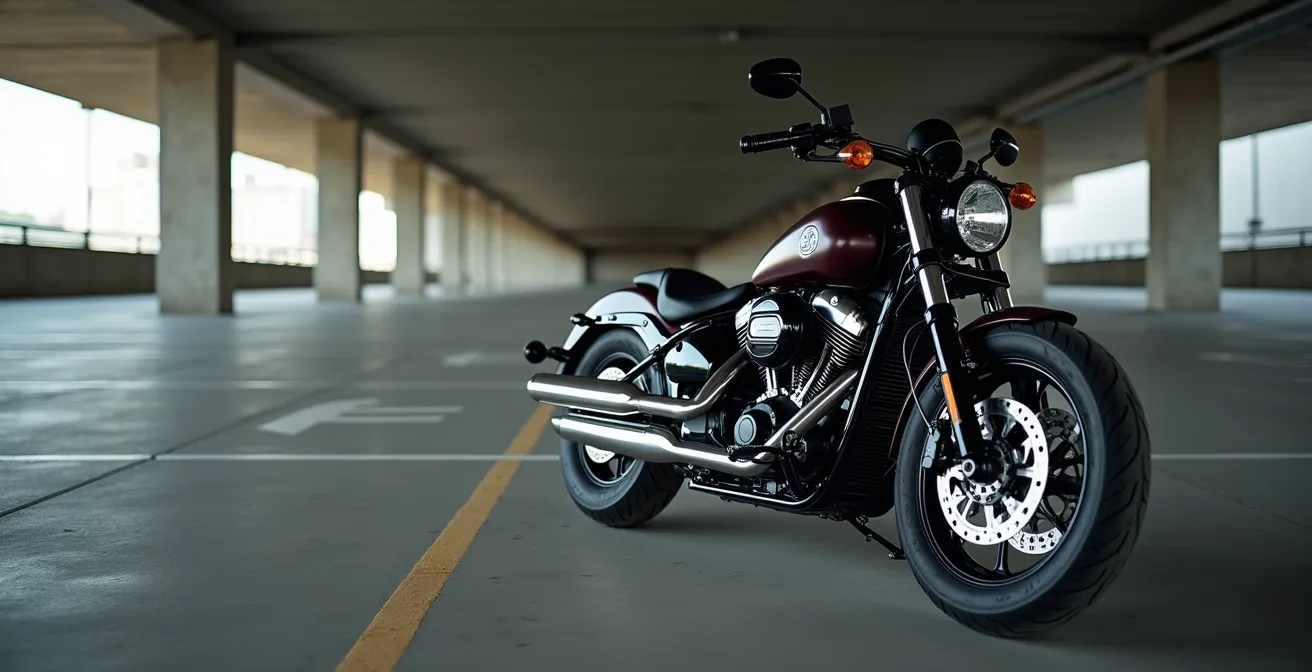
As this image illustrates, the location of the cat on many bikes—often low-slung and accessible from the side—presents a clear vulnerability. Even if you’ve replaced your stock system with a de-catted aftermarket pipe, you’re not out of the woods. A thief might not know the difference and could cut into your expensive new exhaust looking for precious metals that aren’t there. The result is a damaged bike and a costly repair bill, all stemming from a problem that is becoming increasingly common in urban areas.
The Sniffer Test: How to Ensure Your Older Bike Passes Emissions Testing?
If you remove your catalytic converter, you have zero chance of passing a legitimate emissions inspection, often called a “sniffer test.” But it’s instructive to see just what it takes for a perfectly legal, stock bike to stay compliant. The process isn’t always straightforward, especially for older models. The catalytic converter is a chemical reactor, and its efficiency depends on a perfectly running engine and reaching a specific temperature.
As the technical team at ECS Tuning notes, the chemistry of a catalytic converter is highly temperature-dependent. Their analysis states that “the catalytic converter and exhaust gasses have to be at high temperatures” before the reactions that neutralize pollutants can even begin. This is why a bike that has been sitting cold will often fail a test that it would pass after a good, hard ride. For a bike without a cat, no amount of warming up will help.
Keeping a compliant bike in good health for testing requires diligence. The following checklist outlines the essential steps a technician would recommend before an official emissions test.
Action Plan: Pre-Emissions Test Preparation
- Inspect and replace the air filter if it’s dirty, as this directly affects the critical air-fuel mixture.
- Check the spark plugs for correct gapping and signs of wear to ensure complete combustion.
- Perform an “Italian tune-up”—a period of sustained high-RPM riding to burn off carbon deposits from the exhaust and cat.
- Ensure the engine and catalytic converter are fully up to operating temperature immediately before the test is performed.
- Consider using a quality fuel system cleaner with PEA (polyetheramine) detergents to clean internal carbon buildup.
Seeing the preparation required for a legal bike highlights the futility of trying to pass a sniffer test after removing the single most important piece of emissions equipment.
Decibels vs CO2:How to Cut Your Morning Commute Time by 20% in Heavy City Traffic?
The title is misleading, because removing your cat will likely make your commute *worse*. Here is one of the biggest myths about de-catting: that the increased “flow” automatically equals more usable power. While you might see a small gain in peak horsepower at the very top of the rev range, you almost always sacrifice something much more important for street riding: low-end torque. This is due to the misunderstood physics of exhaust backpressure.
Properly tuned backpressure helps create what’s known as an “exhaust scavenging” effect. The pressure waves in the pipe help pull spent gases out of the cylinder and can even help draw the new air-fuel mixture in, improving volumetric efficiency at low to mid RPMs. This is what gives you that satisfying punch when you accelerate from a stoplight. When you remove the cat and replace it with a straight pipe, you kill this tuned effect. The exhaust gas velocity drops, the scavenging disappears, and the bike feels sluggish and weak off the line.
Case Study: The Urban Torque Trade-Off
Performance testing on various motorcycles consistently reveals a crucial trade-off. Removing the catalytic converter can result in gains of 15-30 horsepower, but these gains are typically found only near the engine’s redline. Conversely, this same modification often leads to a noticeable reduction in torque below 4,000 RPM. Riders frequently report that their de-catted bikes feel “boggy” or “lazy” in stop-and-go city traffic, requiring more clutch slipping and higher revs to get moving—the exact opposite of what you need for an efficient urban commute.
While some automotive engineering research shows that even minimal 2 to 5 psi of *unwanted* exhaust backpressure can hurt peak performance, this doesn’t mean all backpressure is bad. A well-designed exhaust system, including the cat, creates the *right* amount of pressure at the *right* time. Removing it is a step backward in performance engineering for any street-ridden machine.
Is It Possible to Add a Catalytic Converter to a Vintage Bike for Eco-Zones?
To further understand why a catalytic converter is not a simple “bolt-on” part, it’s useful to look at the problem from the opposite direction: trying to retrofit one onto a bike that never had one. As more cities introduce low-emission zones (LEZs) that restrict or ban older vehicles, some vintage bike owners explore adding a cat to become compliant. This process is an engineering nightmare and perfectly illustrates the concept of systemic imbalance.
A vintage engine with a carburetor was never designed to handle the backpressure and heat a catalytic converter introduces. Simply welding a universal cat into the exhaust pipe can cause a cascade of problems, from poor running and overheating to severe engine damage. The carburetor’s fuel mixture, ignition timing, and the exhaust’s physical dimensions were all tuned to work without this component.
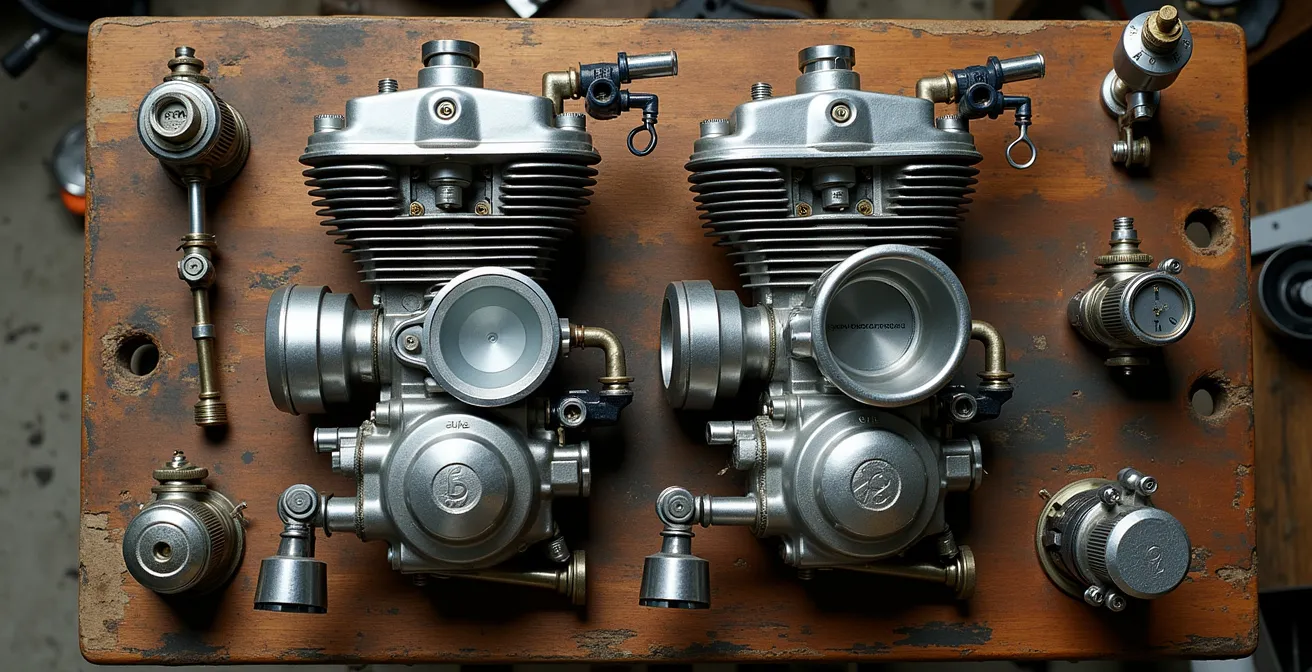
For owners of these classic machines, achieving compliance is a complex puzzle. As a comparative analysis from tuning forums demonstrates, retrofitting a cat is often the least effective and most dangerous option.
| Solution | Cost | Effectiveness | Risk |
|---|---|---|---|
| Retrofit catalytic converter | $500-900 | Low – backpressure issues | High – engine damage |
| Professional carburetor tuning | $200-400 | Medium – cleaner burn | Low |
| Electronic ignition upgrade | $150-300 | Medium – better combustion | Low |
| Ethanol-free fuel use | $0.50/gal extra | Low-Medium | None |
This data from discussions among classic bike enthusiasts clearly shows that improving the engine’s fundamental combustion process through tuning and upgrades is a far better path than attempting to force a modern emissions device onto a vintage system.
Will Installing an Aftermarket Exhaust Void Your Factory Warranty?
This is a major concern for any rider with a newer bike, and the answer is nuanced. In the United States, your warranty is protected by the Magnuson-Moss Warranty Act, which has parallels in consumer protection laws in other countries. The core principle is that a manufacturer cannot void your entire warranty simply because you installed an aftermarket part.
The manufacturer, not the consumer, must prove the aftermarket part directly caused the specific failure they are refusing to cover.
– Edge Autosport Technical Advisory, Catalytic Converters and Modifying Guide
However, this is where removing the catalytic converter puts you in a very weak position. If you install a full exhaust system that eliminates the cat and then experience an engine failure—be it a burnt valve, a failed sensor, or piston damage—the manufacturer has a very strong and direct case. They can argue that by removing the cat, you fundamentally altered the engine’s operating parameters (backpressure, temperature, air-fuel ratio), which led directly to the failure. In this scenario, your warranty claim will almost certainly be denied.
A simple “cat-back” slip-on muffler is much safer, as it doesn’t alter the core emissions and engine management system. If you choose to modify your exhaust, taking strategic steps can help protect you, though removing the cat remains the highest-risk modification you can make.
- Always keep all original parts for potential reinstallation before a warranty claim.
- Document all work with receipts, especially from professional installers.
- If possible, choose “cat-back” systems that retain the stock catalytic converter.
- Understand your rights under local consumer protection laws.
Euro 5 Regulations: Why Air-Cooled Engines Are Disappearing Forever?
The demise of the classic, purely air-cooled engine is another direct consequence of modern emissions standards, and it offers a perfect lesson in why the catalytic converter is part of a larger system. An air-cooled engine’s temperature fluctuates significantly based on ambient temperature and riding conditions (e.g., sitting in traffic vs. cruising on a highway). This lack of precise temperature control is its Achilles’ heel.
As we’ve learned, a cat is a chemical reactor that needs a stable environment to function. Crucially, emissions testing data confirms that catalytic converters require stable 300-400°C operating temperatures to effectively convert harmful gases like NOx, CO, and hydrocarbons into less harmful substances. An air-cooled engine simply cannot guarantee this stability. In hot, slow traffic, the engine and exhaust can get too hot; on a cold day at speed, they may not get hot enough.
Manufacturers made valiant efforts to save air-cooling. Suzuki’s SACS (Suzuki Advanced Cooling System) and Ducati’s innovative “dual-cooled” engines used oil as a targeted liquid coolant for the hottest parts of the engine, like the cylinder heads. These were brilliant engineering compromises. However, they were ultimately transitional technologies. These systems still couldn’t provide the rock-solid thermal stability that liquid cooling offers, which is essential for meeting the stringent on-demand efficiency required by Euro 5 and beyond. The need for a perfectly controlled operating temperature for the catalytic converter, in essence, signed the death warrant for the traditional air-cooled performance engine.
Key Takeaways
- Removing the catalytic converter destroys tuned backpressure, sacrificing the low-end torque crucial for street rideability.
- A de-catted bike will automatically fail any emissions test and gives manufacturers strong legal grounds to deny engine-related warranty claims.
- Modern bikes are integrated systems; the cat is a key component linked to the ECU, sensors, and even engine cooling design.
Manufacturing Impact: Does Building an EV Bike Create More Carbon Than a Gas Bike?
Some riders justify removing their cat with the argument that the environmental impact is minimal, or that a “greener” solution like an electric vehicle has its own hidden carbon footprint. While it’s true that the lifecycle of an EV is complex, this doesn’t absolve the immediate and illegal pollution caused by a de-catted gasoline engine. It’s important to look at the whole picture without using one issue to excuse another.
The debate over the total carbon footprint—from manufacturing to disposal—is nuanced. A gasoline-powered motorcycle has a smaller manufacturing footprint, but an EV produces zero tailpipe emissions during its operational life. The “break-even” point, where the EV’s cleaner operation overtakes its higher manufacturing emissions, depends heavily on the source of the electricity used to charge it.
However, factors like repairability and lifespan add another layer to the discussion. A simple gas engine can often be repaired for decades, while current EV battery technology has a more defined lifespan and complex recycling process. The following table provides a high-level comparison of the lifecycle factors.
| Factor | EV Motorcycle | Gas Motorcycle |
|---|---|---|
| Manufacturing emissions | 8-12 tons CO2 | 3-5 tons CO2 |
| Battery/Engine lifespan | 8-10 years | 20-30 years |
| Consumables replacement rate | 2x tires/brakes (weight) | Standard rate |
| End-of-life recycling | Complex battery disposal | 90% recyclable metal |
| Repairability score | 3/10 | 8/10 |
Ultimately, choosing to knowingly and illegally pollute by removing a catalytic converter cannot be justified by pointing out the flaws in an alternative technology. The purpose of the cat is to mitigate the proven, immediate harm caused by combustion engine emissions in our towns and cities. Defeating it is a step in the wrong direction, regardless of the broader debate on future transportation.
Before you take a grinder to your exhaust, understand the engineering you’re fighting. Your bike was designed as a complete, balanced system. Respect that engineering, make an informed choice based on facts, not myths, and avoid a modification you will almost certainly regret at your next service appointment or on your daily commute.