
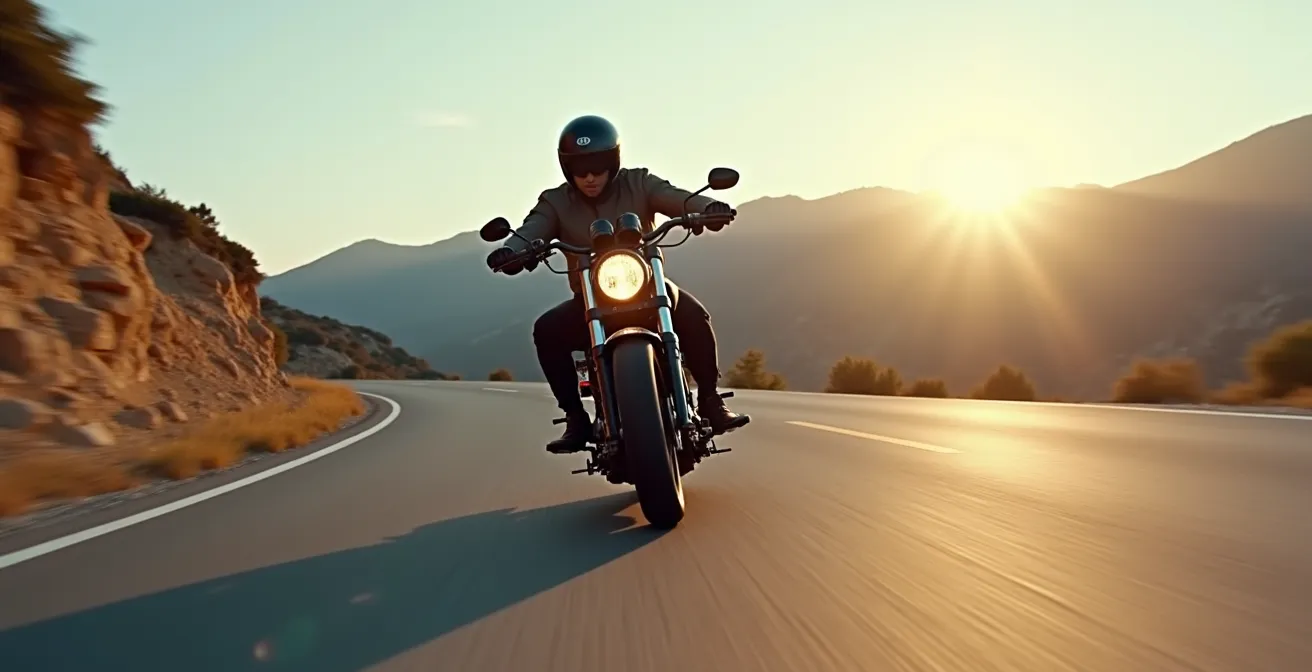
Scraping pegs on your new cruiser is a sign your sportbike muscle memory is fighting the bike’s design, not a lack of skill.
- Cruisers require a “Captain” mindset (steering from above) versus a sportbike “Pilot” mindset (becoming one with the bike’s lean).
- Adapting to changes—from passengers and EV torque to your own flexibility—is the core skill of a master rider.
Recommendation: The solution is to consciously manage weight through the seat and apply deliberate counter-pressure on the bars, unlearning the instinct to hang your body off.
The sound is unmistakable: the harsh scrape of metal on asphalt, a sound no rider wants to hear mid-corner. For a lifelong sportbike rider, transitioning to a cruiser with forward controls can be a humbling experience. You know the principles of cornering—look through the turn, smooth throttle, proper entry speed—yet your footpegs are grinding on pavement you used to clear with inches to spare. The frustration is real, and it stems from a fundamental conflict: your body is still trying to fly a fighter jet when you’re now at the helm of a battleship.
Most advice simply states the obvious: “cruisers have less ground clearance” or “use more rear brake.” But this fails to address the core issue. The problem isn’t a lack of knowledge; it’s deeply ingrained muscle memory. Your sportbike instincts to hang off, shift weight to the inside, and integrate your body into the lean angle are now working directly against the motorcycle’s geometry. This is the Pilot-to-Captain shift. You must transition from being an integrated part of the machine’s lean to being the captain who directs its mass from a stable command platform.
This guide isn’t about unlearning how to ride. It’s about recalibrating your expert skills for a new dynamic reality. We’ll deconstruct the ergonomic differences and provide a new framework for cornering with confidence on a forward-control cruiser. Furthermore, we’ll explore how this principle of adaptation is the true hallmark of an expert rider, applying it to various scenarios you’ll encounter in your riding life, from carrying a passenger to riding an electric motorcycle.
This article explores the essential adaptations every experienced rider must master. From managing a passenger’s weight to recalibrating for an EV’s instant torque, each section provides the insights needed to ride any bike, in any situation, with skill and confidence. The following summary outlines the key challenges we will address.
Summary: The Rider’s Ultimate Guide to Skill Adaptation
- The Heavy Pillion: How Your Braking and Steering Inputs Must Change?
- Standing Up: Why You Must Re-Learn Throttle Control for Off-Road ADV Riding?
- Riding After 60: How to Modify Your Bike to Accommodate Reduced Flexibility?
- The Instant Torque Shock: How to Re-Calibrate Your Right Hand for EV Riding?
- The Rusty Rider: How to Rebuild Confidence After 10 Years Off the Bike?
- Sport Tourer or ADV: Which Handles 500-Mile Days Better on Paved Roads?
- Why Your Gearbox Clunks When Shifting into First Gear?
- How to Read the Vanishing Point to Predict Corner Severity on Unknown Roads?
The Heavy Pillion: How Your Braking and Steering Inputs Must Change?
Carrying a passenger is one of the most common yet challenging adaptations a rider faces. It’s not just about the extra weight; it’s about how that weight fundamentally alters your motorcycle’s dynamics. The center of gravity shifts upward and rearward, which has a dramatic effect on braking and steering. While this shift reduces the risk of a forward flip under hard braking, it also demands a complete recalibration of your inputs. Suddenly, your bike feels slower to turn in and requires more physical effort to hold a line.
Your braking strategy must evolve. With more weight over the rear wheel, the rear brake becomes significantly more effective. You must learn to use it more assertively in concert with the front brake to stabilize the chassis and manage pitch. Analysis shows that the altered physics can be beneficial; a study by the British Superbike School confirms the rearward center of gravity shift allows up to 1.3g of deceleration without flipping, but only if both brakes are used optimally. Steering also requires more deliberate input. The initial counter-steering push on the handlebars needs to be firmer and more sustained to overcome the bike’s increased inertia and reluctance to change direction.
A smooth ride with a pillion begins before you even start the engine. A nervous or unprepared passenger can work against you, shifting their weight unpredictably and upsetting the bike. A pre-ride briefing is non-negotiable. It builds trust and ensures your passenger works with you, not against you, turning a potential challenge into a shared, enjoyable experience. This briefing is your first step in managing the dynamic load of a passenger.
Action Plan: Pre-Ride Pillion Briefing
- Communication Protocol: Establish clear, simple hand signals for “slow down,” “stop,” and “I need to adjust.” Ensure they know to tap you, not grab you.
- Leaning Dynamics: Instruct the passenger to look over your inside shoulder in a turn and to lean *with* the bike and rider as a single unit, not staying upright or leaning against the turn.
- Mounting/Dismounting Procedure: Explain that they should only get on or off the bike after you’ve given a clear “go-ahead” signal, with the bike stable and both your feet firmly planted.
- On-Road Conduct: Brief them to avoid sudden movements, to keep their feet on the pegs at all times, and to hold onto the grab rails or your waist, not your shoulders or arms.
- Gear Check: Before setting off, perform a final check to ensure their helmet is secured, and they have appropriate jacket, gloves, and footwear for the ride.
Standing Up: Why You Must Re-Learn Throttle Control for Off-Road ADV Riding?
Transitioning from pavement to dirt on an adventure bike introduces a dramatic change in body position: standing on the footpegs. This single act transforms your relationship with the motorcycle’s controls, especially the throttle. When seated, your hand is isolated from most chassis movements. When standing, your entire body—from ankles to shoulders—becomes part of the bike’s suspension system. Every bump and shift in terrain is transmitted through your legs and core, creating a high potential for unintended throttle inputs.
This is why re-learning throttle control is not just advisable; it’s essential for safety and control. As riding coach Dusty Wessels of West 38 Moto Training explains, the problem often isn’t a clumsy hand. In his words:
When standing, your legs and ankles become the primary suspension. Unwanted throttle inputs are often caused by body movements, not a clumsy hand.
– Dusty Wessels, West 38 Moto Training
Mastering this requires you to isolate your right wrist from the movements of your body. This means maintaining a light grip, keeping your elbow bent and flexible, and using your core to absorb impacts rather than letting them travel up to the handlebars. The goal is to make your throttle hand an independent platform, capable of delivering smooth, deliberate inputs regardless of what the terrain is doing underneath you. This is the off-road version of the “Captain” mindset: your body manages the ship’s stability while your hand guides its power.
Case Study: Throttle Management in Sand
The challenge of throttle control is magnified in loose surfaces like sand. A demonstration from ADVMotoSkillZ with large adventure bikes highlights this perfectly. On sand, momentum is your best friend. Chopping the throttle causes the front end to dive and dig in, often leading to a crash. They teach a “traction-seeking throttle” technique, which involves maintaining steady, gentle power to keep the front wheel light and skimming across the surface. This contrasts with a “momentum-maintaining throttle” used for obstacles, where you need a burst of power. This shows that off-road throttle control is not one-size-fits-all but a dynamic skill adapted to the specific terrain.
Riding After 60: How to Modify Your Bike to Accommodate Reduced Flexibility?
Riding is a lifelong passion, but our bodies change over time. Reduced flexibility, joint stiffness, and decreased stamina can make the riding position of a once-comfortable motorcycle a source of pain. However, this doesn’t mean you have to hang up your helmet. Instead, it’s an opportunity to adapt the machine to fit the rider, not the other way around. Strategic ergonomic modifications can transform a challenging bike into a comfortable long-distance companion, allowing you to ride for many more years.
The key is to adjust the “rider triangle”—the relationship between the handlebars, seat, and footpegs. Even small changes can have a huge impact. Bar risers bring the controls closer and create a more upright posture, relieving strain on the back and shoulders. Adjustable levers allow for a customized reach, reducing hand fatigue. For many, lowering the footpegs can be a game-changer, opening up the angle of the hips and knees to alleviate cramping and discomfort on longer rides. These aren’t “comfort” accessories; they are essential modifications for rider longevity and safety.
This image highlights some of the key adjustment points on a motorcycle’s controls. Focusing on these areas allows a rider to fine-tune the ergonomics for a more comfortable and sustainable riding posture.
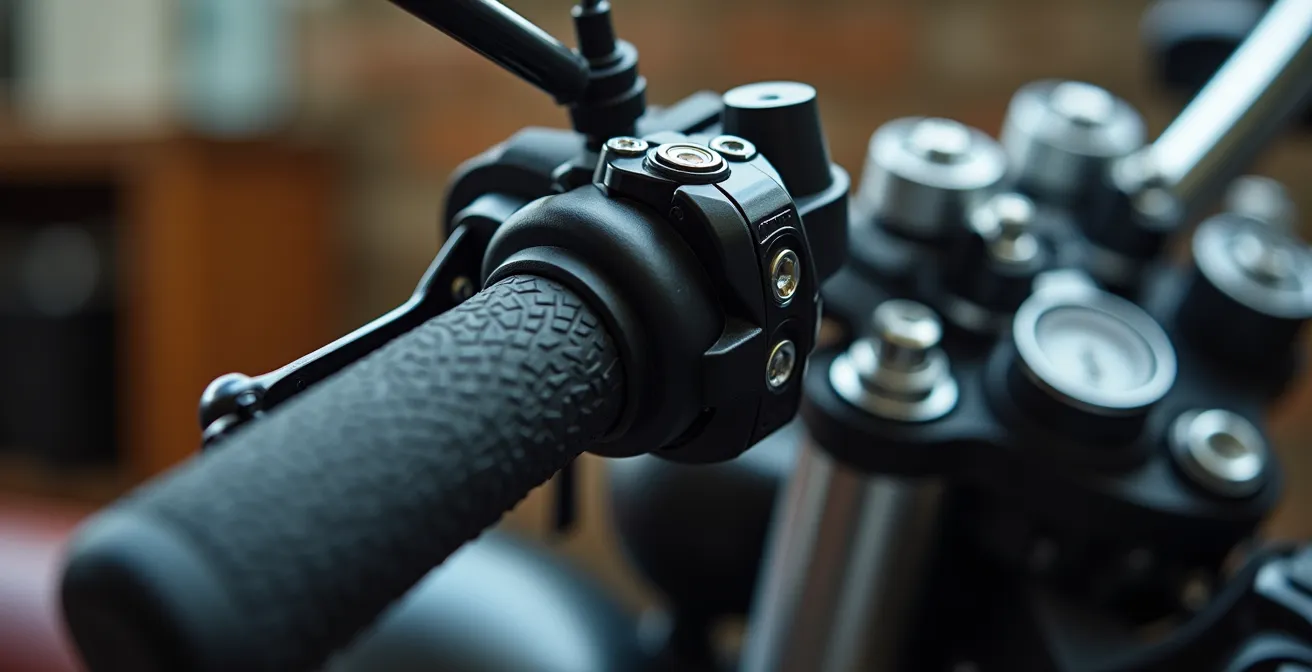
By investing in these modifications, you are not just improving comfort; you are enhancing control. A rider who is not fighting pain is a more focused, attentive, and safer rider. The goal is to create a seamless interface between you and the machine, regardless of age.
This table outlines some of the most effective modifications mature riders can make to enhance comfort and control, along with their primary benefits. As shown in an ergonomic analysis by ADVMotoSkills, even simple changes can yield significant results.
| Modification | Benefit | Installation Difficulty |
|---|---|---|
| Bar Risers | Upright position, reduced back strain | Easy |
| Adjustable Levers | Reduced hand fatigue | Easy |
| Forged Wheels | Lower unsprung mass, easier steering | Complex |
| Quick-shifter | Eliminates clutch work | Moderate |
| Lowered Footpegs | Reduced hip/knee tension | Moderate |
The Instant Torque Shock: How to Re-Calibrate Your Right Hand for EV Riding?
The first time you twist the throttle on an electric motorcycle, everything you know about power delivery is rewritten. There is no revving, no clutch engagement, no gradual build-up of power. There is only an instantaneous, silent, and often shocking surge of torque. This “instant torque shock” is a defining characteristic of EVs and requires a fundamental recalibration of your right hand, the most sensitive instrument a rider possesses.
Internal combustion engines (ICE) telegraph their power through sound and vibration, giving you a rich tapestry of sensory feedback. EVs are silent assassins. A bike like the Verge TS Pro delivers an astonishing 737 lb-ft of torque from the very first degree of throttle turn. Without the familiar roar of an engine, it’s incredibly easy to misjudge your speed and the amount of power you’re applying. Your brain’s internal speedometer is suddenly broken, and you must learn to rely on new cues: the rush of wind, the blur of your peripheral vision, and a heightened sense of the bike’s acceleration.
This recalibration extends to deceleration as well. Many EVs feature aggressive regenerative braking, which slows the bike down as soon as you roll off the throttle. This creates a “one-pedal riding” experience that can be jarring at first.
Case Study: Adapting to Regenerative Braking
English Electric Motor Co. explains that mastering EV riding means learning to use adjustable regenerative braking as a tool. Bikes like the Zero SR/F allow riders to customize the level of “regen,” from a gentle coasting feel similar to an ICE bike to aggressive deceleration that acts like a powerful brake. This requires riders to completely recalibrate their corner entry strategy. Instead of relying solely on the brakes, you learn to modulate the throttle roll-off to achieve the desired entry speed, a subtle but profound change in technique that, once mastered, offers incredibly smooth control.
The Rusty Rider: How to Rebuild Confidence After 10 Years Off the Bike?
Returning to motorcycling after a long hiatus is an exciting prospect, but it’s often accompanied by a dangerous illusion. Your mind remembers the skilled rider you once were, but your body’s muscle memory has atrophied. This gap between your perceived skill and your actual ability is where mistakes happen. Rebuilding confidence isn’t about jumping back on and “seeing if you’ve still got it”; it’s about a structured, humble approach to re-acquiring atrophied skills.
The most crucial step is to reframe your mindset. You are not the same rider you were a decade ago. The team at MCrider Training captures this perfectly with a powerful piece of advice for returning riders:
The rider’s memory of their former skill level is often much higher than their current, atrophied ability. This is dangerous. Treat yourself as a ‘knowledgeable beginner’.
– MCrider Training, MCrider Field Guide
This “knowledgeable beginner” mindset is the key to a safe return. You understand the theory, but you lack the recent practice. Start by enrolling in a basic rider course, even if you’re fully licensed. It’s the perfect environment to shake off the rust on fundamental skills like clutch control, slow-speed maneuvers, and emergency braking in a controlled setting. From there, progress methodically. Spend hours in an empty parking lot practicing U-turns and figure-eights. Then, move to short, frequent rides on familiar roads, focusing on a single skill at a time, such as the classic slow-look-press-roll cornering sequence. Confidence is a byproduct of demonstrated competence, built one successful ride at a time.
Sport Tourer or ADV: Which Handles 500-Mile Days Better on Paved Roads?
When the mission is to conquer long-distance pavement, two classes of motorcycles rise to the top: the Sport Tourer (ST) and the Adventure bike (ADV). Both are designed for travel, but they approach the 500-mile day with fundamentally different philosophies. Choosing between them depends entirely on your priorities and the type of roads you plan to ride. There is no single “better” bike; there is only the right bike for the specific task.
The Sport Tourer is a specialized tool, a scalpel designed for devouring miles of smooth asphalt. Its strengths lie in its aerodynamic efficiency and engine character. A full fairing provides superior wind protection, reducing rider fatigue at highway speeds. The engines, often smooth inline-fours, deliver effortless power for high-speed cruising. With 17-inch wheels shod in sport-touring tires, they offer maximum grip and precise handling on good-quality pavement. However, their focused, slightly forward-leaning riding position and limited suspension travel can become taxing on broken or poorly maintained backroads.
The Adventure bike, in contrast, is the versatile multi-tool. Its defining feature is a long-travel suspension that soaks up road imperfections, making it far more comfortable on the less-than-perfect roads that often make up a cross-country journey. The upright, “heads-up” riding position offers excellent visibility and all-day comfort for many riders. However, this versatility comes with compromises on the pavement. The larger 19 or 21-inch front wheels and dual-sport tires offer less outright grip than an ST’s setup, and the taller profile can lead to more wind buffeting at speed. Engine character, often a vibey V-twin, can be more engaging but less placid than an ST’s inline-four.
The choice ultimately comes down to a trade-off between specialized performance and all-road capability. The following table breaks down the key differences to help guide your decision, based on common characteristics within each class.
| Factor | Sport Tourer | ADV |
|---|---|---|
| Wind Protection | Superior full fairing | Adjustable screen, more buffeting |
| Engine Character | Smooth inline-4 | Vibey twin |
| Tire Grip | 17-inch sport-touring optimal | 19/21-inch less grip, more compliance |
| Suspension Travel | Limited but precise | Long-travel absorbs poor roads |
| Riding Position | Focused forward lean | Upright heads-up style |
Why Your Gearbox Clunks When Shifting into First Gear?
It’s a sound familiar to nearly every motorcyclist: the loud, definitive “clunk” when shifting from neutral into first gear at a stop. While it can be alarming for new riders, this noise is, in most cases, a normal and even reassuring characteristic of how motorcycle transmissions are designed. It’s not a sign of a problem, but rather a confirmation that the gearbox is doing its job robustly.
Unlike the synchronized transmissions in cars, most motorcycles use a constant-mesh sequential gearbox. This design prioritizes strength, light weight, and quick shifts over silent operation. Instead of delicate synchronizers, it uses sturdy interlocking tabs called “dogs” to engage the gears. That clunk is the sound of these robust dogs locking securely into place. You’re hearing the sound of durability.
The volume of the clunk can be affected by several factors, most notably oil temperature and clutch drag. When the oil is cold, it’s more viscous, which can cause the clutch plates to stick together slightly, even when the clutch lever is pulled in. This “clutch drag” keeps the transmission’s input shaft spinning. When you select first gear, you are forcing the stationary output gear to instantly match the speed of the spinning input shaft, resulting in a more pronounced engagement noise.
Case Study: The Mechanics of a “Dog Box”
An analysis of motorcycle transmission mechanics clarifies the source of the noise. In a constant-mesh “dog box,” the gears themselves are always in contact, but they only transmit power when the dogs on an adjacent gear slide over and lock into them. The large clearances necessary for this system to work quickly and reliably are what create the audible clunk on engagement. It’s a sign of a positive, secure lock-up, which is exactly what you want when transmitting power to the rear wheel.
While the clunk is normal, you can minimize it. Techniques include pulling in the clutch and waiting a few seconds before shifting to allow the input shaft to slow down, rocking the bike slightly to help the dogs align, or ensuring your clutch cable is properly adjusted to minimize drag. But ultimately, embracing the clunk is part of understanding and appreciating the elegantly simple and effective engineering of your machine.
Key Takeaways
- The “Pilot-to-Captain Shift” is essential: Sportbike riders must stop trying to lean with their cruiser and start steering it from above with deliberate inputs.
- Adaptation is a universal skill: Whether managing a passenger, a silent EV, or your own changing body, the best riders constantly recalibrate their inputs.
- Fundamentals remain crucial: Skills like reading the vanishing point are the foundation upon which all other adaptations are built.
How to Read the Vanishing Point to Predict Corner Severity on Unknown Roads?
Of all the skills a rider can master, the ability to accurately read the road ahead is the most critical. On an unfamiliar, winding road, your safety depends on your ability to predict a corner’s radius and adjust your speed *before* you enter it. The most powerful tool for this is the “vanishing point”—the furthest point you can see where the two edges of the road appear to converge. The behavior of this single point tells you everything you need to know about what’s coming next.
Reading the vanishing point is a dynamic process, not a static observation. Its movement relative to you is the key. If the vanishing point is rushing towards you, it means the corner is tightening, and you must reduce your speed immediately. If it is moving away from you at a steady pace, you are in a constant-radius turn and can maintain your speed. If it begins to accelerate away from you, the corner is opening up, and you can begin to gently roll on the throttle. This technique allows you to set your entry speed perfectly, eliminating mid-corner panic and adjustments.
This is not a theoretical exercise; it has a profound impact on safety and smoothness. An analysis of cornering techniques by MCN found that riders who consistently use the vanishing point to set entry speed reduce corner exit errors by 80%. This is because a correct entry speed is the foundation of a good corner. It allows you to be smooth on the controls and maintain a stable chassis, leaving you with plenty of mental capacity to handle any unexpected hazards. You should always corroborate this information with secondary cues like the angle of telephone poles or fence lines, but the vanishing point is your primary and most reliable guide.
To make this a practical habit, follow these steps on every corner:
- Approaching You: The corner is tightening. Brake more.
- Steady Pace: The corner is a constant radius. Maintain speed and lean angle.
- Accelerating Away: The corner is opening up. Prepare to accelerate smoothly.
The ultimate goal is to adjust your speed so that you can see the corner’s exit *through* the vanishing point before you commit to your turn-in. This single discipline will transform you from a reactive rider into a proactive and exceptionally smooth one.
Ultimately, becoming a better rider isn’t about the bike you’re on; it’s about your capacity to adapt. Every new motorcycle, every passenger, and every year of experience presents a new dynamic problem to solve. By embracing a mindset of constant learning and recalibration, you ensure that your passion for riding will not only endure but grow stronger and safer for decades to come.