
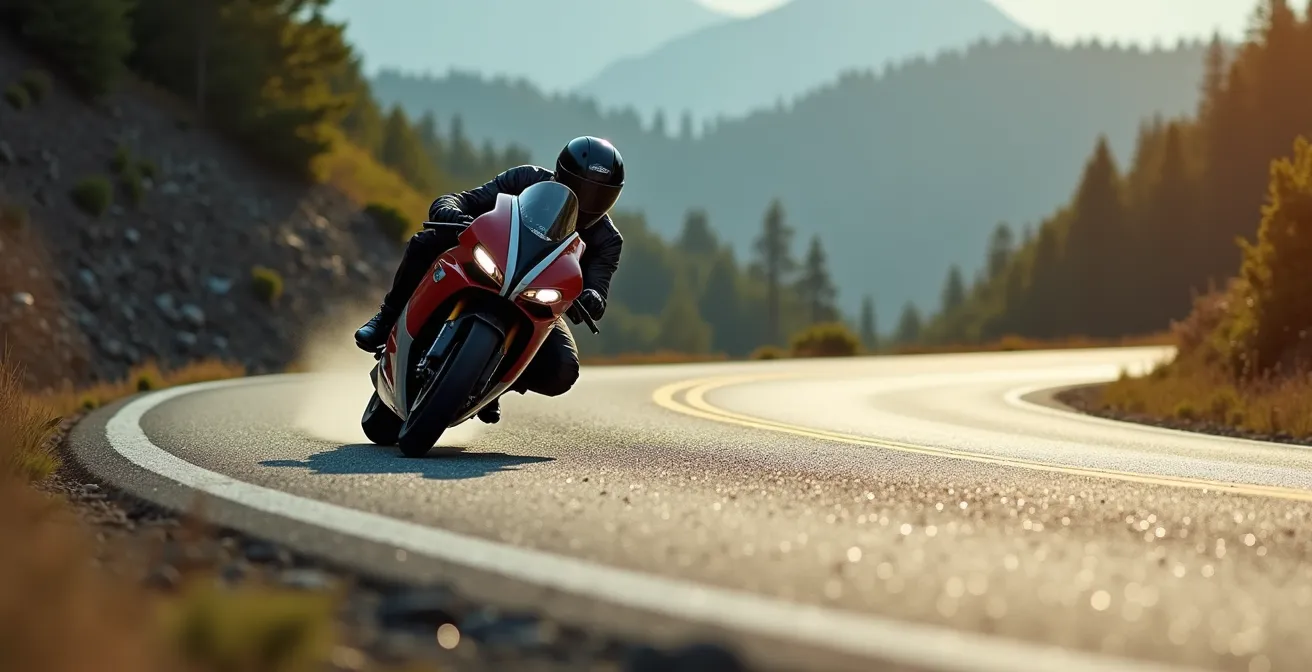
That sudden flash of gravel in a corner triggers a panic response that makes you chop the throttle and grab the brakes—the worst possible reaction. This guide teaches you how to override those flawed survival instincts. By applying counter-intuitive techniques from off-road riding, you’ll learn to use smooth, deliberate inputs to maintain control, turning a moment of fear into a managed, predictable event.
There it is. That shimmer of sand or patch of gravel, right in the middle of your perfect line. Your brain screams DANGER, your hands instinctively want to chop the throttle and grab a fistful of front brake. It’s a primal survival reflex, and on a motorcycle leaned over in a turn, it’s a direct recipe for a crash. I see this all the time with street riders: they have the skill to ride, but their instincts betray them when the pavement isn’t perfect.
The common advice to “stay calm” or “look where you want to go” is true, but it’s useless in the split-second a panic response takes over. The real problem isn’t the gravel; it’s your reaction to it. The secret isn’t about having faster reflexes, but about replacing your flawed instincts with trained, deliberate actions. Many riders think they need to avoid these situations, but the truth is, you need to learn how to ride *through* them.
But what if the key wasn’t better braking or swerving, but a fundamental shift in how you control the bike? This is where the world of off-road and ADV riding provides the answer. The solution is to retrain your brain and hands to do what feels wrong but is mechanically right: stay neutral on the throttle, use body position to help the bike, and understand the physics that are actually keeping you upright. This article will break down the most common road hazards and give you the specific, repeatable techniques to turn your panic response into a planned response.
For those who prefer a different kind of visual medium, the following remastered official music video offers a classic presentation.
To master these situations, we will deconstruct each type of hazard, from slick metal surfaces to invisible diesel spills. This guide provides a clear roadmap, explaining not just what to do, but why it works, helping you build the confidence and muscle memory to handle anything the road throws at you.
Summary: Handling Unexpected Road Hazards on a Motorcycle
- Manhole Covers and Train Tracks: How to Cross Slippery Metal Safely in Rain?
- Why Do Tar Snakes Feel Like Ice in the Heat and How to Ride Over Them?
- The Wiggle Effect: Why Bridge Grates Scare You but Aren’t Dangerous?
- The Rainbow Streak: How to Identify Invisible Diesel Spills on Wet Roads?
- What to Do When You Can’t Avoid Hitting a 2×4 on the Highway?
- Standing Up: Why You Must Re-Learn Throttle Control for Off-Road ADV Riding?
- Mid-Corner Gravel: How to Stand the Bike Up Safely Without Running Wide?
- Asphalt vs Concrete: How Surface Composition Changes Your Stopping Distance in the Rain?
Manhole Covers and Train Tracks: How to Cross Slippery Metal Safely in Rain?
Wet metal surfaces like manhole covers and railway tracks are the classic urban booby trap. Your brain sees the dark, slick metal and correctly identifies a low-traction zone. The fear of a slide is valid, but the data might surprise you. While it feels treacherous, an analysis of accident statistics shows that less than 2% of motorcycle accidents occur in rainy weather, suggesting perceived risk is often higher than actual risk. The key is to manage that brief moment of reduced grip with a clear plan, not a panicked reaction.
The goal is to minimize the work the tires have to do. Your tires have a finite “traction budget” that they spend on accelerating, braking, or turning. When you cross a slippery surface, that budget shrinks dramatically. Therefore, you must cross it with as few inputs as possible. This means getting your braking and positioning done *before* you reach the hazard. Aim to cross the metal surface with the bike as upright as possible, even if it means taking a slightly less-than-ideal line. A moment of upright travel over a slippery patch is far safer than maintaining lean angle.
The technique is simple: look ahead, slow down early, and cross with neutral inputs. Spot the hazard as early as possible. Gently reduce your speed with smooth braking, primarily using the rear brake to avoid unsettling the front suspension. As you’re about to cross, ensure you are off the brakes and maintaining a steady, neutral throttle. Do not accelerate, decelerate, or make any steering inputs while your tires are on the metal. Let the bike track across it, and only resume normal inputs once both wheels are back on asphalt. This turns a scary moment into a non-event.
Why Do Tar Snakes Feel Like Ice in the Heat and How to Ride Over Them?
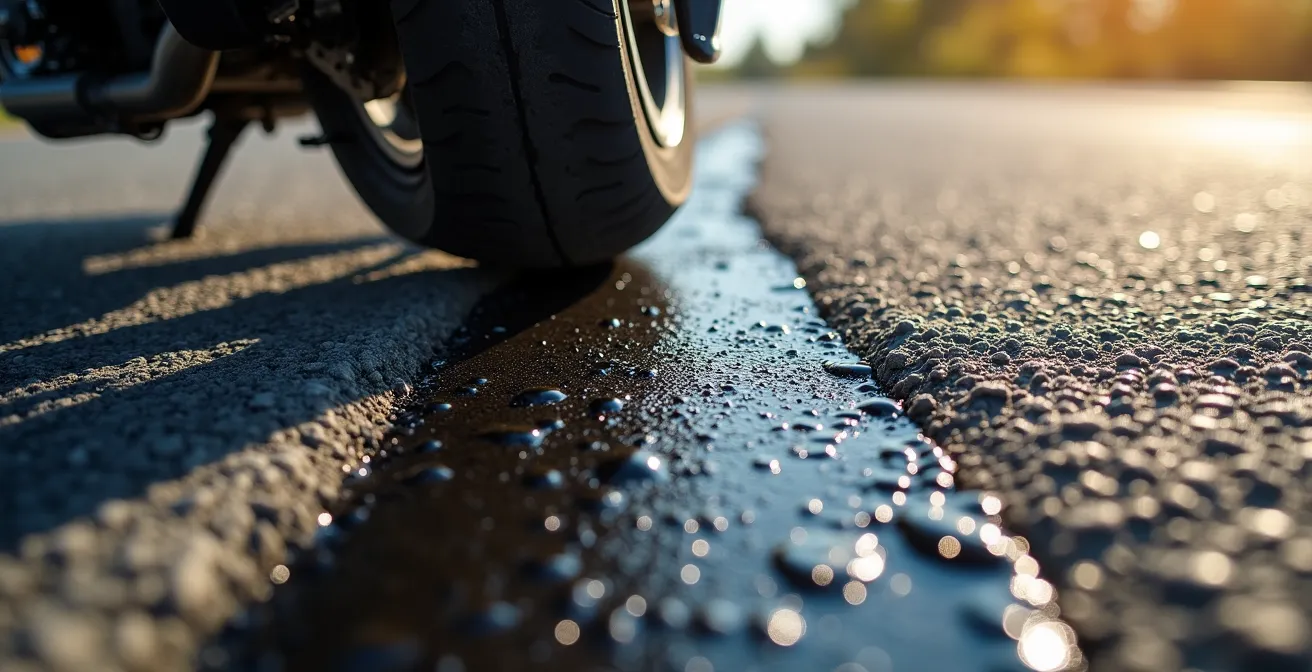
Tar snakes—those shiny black lines of crack-filler on the road—are a unique hazard. They’re mostly harmless in the cold, but on a hot day, the thermoplastic material softens and can become incredibly slick, mimicking the feeling of hitting a patch of ice. The problem isn’t just the slipperiness; it’s the surprise. You’re riding on what appears to be high-grip, hot asphalt, and suddenly a tire loses and regains traction in a fraction of a second, causing a disconcerting twitch.
The mistake riders make is reacting to that twitch. A sudden, jerky steering correction or an abrupt change in throttle is a survival reflex that can turn a minor slip into a major slide. A case study of a track day incident at Brands Hatch illustrates this perfectly: a rider who tried to maintain hard throttle while leaned over and crossing multiple tar snakes caused a rear-wheel slide and crashed. The combination of lean angle and throttle input over the heated, slick surface was too much for the tire’s traction budget. When crossing these, the rule is the same as with wet metal: minimize all inputs.
Visually, these snakes are a clear indicator of a potential traction change. The technique is to treat them with the same respect as a wet manhole cover.
As you approach, especially if you are in a corner, try to square up the crossing by reducing your lean angle as much as is safely possible. Maintain a steady, neutral throttle. Don’t accelerate, but don’t chop the throttle either. Engine braking can be just as disruptive as grabbing the brakes. Let the bike move and wiggle underneath you. That small movement is just the tire conforming to the surface and is not a sign of an impending crash. Trust the bike’s chassis and geometry to keep things in line, and focus your vision far down the road.
The Wiggle Effect: Why Bridge Grates Scare You but Aren’t Dangerous?
Riding over a steel bridge grate is one of the most unnerving experiences for many riders. The bike starts to weave and “tramline,” following the grooves in the metal. This “wiggle effect” feels like the bike is about to lose control completely. This is a classic case of sensory dissonance: what you feel is dramatic, but what is actually happening is mechanically stable. Your brain is receiving conflicting signals, but the bike is not in danger.
The key is to understand the physics at play. As explained in a technical analysis of motorcycle dynamics, the feeling is unnerving, but powerful forces are working to keep you safe. An expert analysis puts it this way:
Gyroscopic forces are keeping the bike stable despite the unnerving sensory input
– Life at Lean Technical Analysis, Motorcycle Dynamics and Bridge Grate Interaction Study
Your wheels, spinning at speed, act like gyroscopes. They want to stay upright and in-line. The weaving you feel is just the tires tracking the small grooves, but these forces are constantly self-correcting. The worst thing you can do is fight it. A tight “death grip” on the handlebars and rigid body posture will only amplify the weaving and make the bike unstable. The solution is to relax. Keep a light grip on the bars, keep your arms and elbows loose, and look far ahead to where you want to go, not down at the grate. Let the bike do its thing.
Not all grates are the same, and understanding the differences can help you anticipate the bike’s behavior. A comparative look at grate types reveals how to adjust your technique slightly.
| Grate Type | Effect on Bike | Handling Technique | Risk Level |
|---|---|---|---|
| Longitudinal Grates | Causes weaving/tramlining | Light hands, let bike self-correct | Low |
| Diamond Pattern Steel | High-frequency buzz vibration | Maintain steady throttle | Very Low |
| Transverse Grates | Brief front wheel deflection | Stand slightly on pegs | Medium |
The Rainbow Streak: How to Identify Invisible Diesel Spills on Wet Roads?
Of all the hazards, a diesel spill on a wet road is perhaps the most insidious. It’s nearly invisible and offers almost zero traction. The only tell-tale sign is the distinctive “rainbow streak” sheen it creates on the water’s surface, similar to oil in a puddle. The problem is that by the time you see the rainbow, you’re often already in it. This is where you must shift from a reactive mindset to a proactive one: you have to become a hazard hunter.
Diesel spills are not random. They occur in predictable locations where heavy commercial vehicles are most likely to leak fuel. Intersections, roundabouts (especially at the exits), uphill corners, and the first few hundred meters outside of truck stops or industrial parks are all high-risk zones. Your job is to actively scan these areas, looking for that tell-tale sheen before you commit to a lean angle. When it’s raining, your default assumption in these zones should be that a spill is present until you can confirm it’s clear.
If you do ride through diesel, the immediate danger is over, but a secondary one emerges: your tires are now contaminated. A recovery protocol is essential before you attempt any significant lean angle again. The technique, often used by professional riders, involves finding a safe, straight stretch of road and performing a series of gentle, progressive weaves for several hundred yards. This action effectively “scrubs” the contaminant off the entire surface of the tire, restoring its grip. It’s critical to use a steady throttle during this process to maintain stability.
Your Hazard Hunting Checklist: Spotting Diesel Before It’s Too Late
- Roundabouts: Scan for dark, slick patches at entry and exit points where fuel sloshes in truck tanks.
- Uphill Corners & Intersections: Look for the tell-tale rainbow sheen where trucks brake, accelerate, or lean.
- Truck Stop & Industrial Exits: Be extra vigilant for the first 500 meters, checking for fresh spills from recently filled tanks.
- Bus Stops & Delivery Zones: Inspect pavement for chronic staining from vehicles that idle or maneuver frequently.
- Visual Confirmation: When in doubt, look for the rainbow colors on the wet surface. If you see it, assume zero grip.
What to Do When You Can’t Avoid Hitting a 2×4 on the Highway?
Sometimes, despite your best scanning, an obstacle appears with no time to swerve. A piece of tire tread, a block of wood, or other debris is directly in your path. This is a high-stakes situation; NHTSA crash analysis shows that a staggering 76% of motorcycle crashes involve a frontal impact. Your survival instinct might be to grab the brakes, but this is the worst thing you can do. Braking hard loads the front suspension, compressing the forks and reducing their ability to absorb the impact. Hitting an object with compressed forks can send the force directly into the frame, potentially causing a loss of control or even vaulting you over the handlebars.
The correct technique is counter-intuitive and comes directly from off-road riding: you need to actively help your suspension do its job. The goal is to hit the obstacle with the front suspension as extended (unloaded) as possible. This involves a quick, deliberate action: a brief, sharp application of the front brake to compress the forks, followed by an immediate release just before impact. This release causes the forks to rebound and extend, “lightening” the front end as it strikes the object.
At the moment of impact, you must also use your body as additional suspension. Rise up off the seat slightly into a standing “attack position,” with your knees and elbows bent and loose. This allows your legs to absorb a huge amount of the impact energy, preventing it from upsetting the bike’s chassis.

This entire sequence—quick brake, release, stand up—happens in a second or two. It requires practice to become an automatic response, but it can turn a potentially catastrophic impact into a manageable thud. After clearing any significant obstacle, always pull over when safe to inspect your wheels and tires for damage.
Standing Up: Why You Must Re-Learn Throttle Control for Off-Road ADV Riding?
For street riders, standing on the pegs is an emergency technique. For ADV and off-road riders, it’s the default position for controlling the bike over any loose or unpredictable terrain. But simply standing up isn’t enough; it fundamentally changes the way you interact with the motorcycle’s controls, especially the throttle. When you’re seated, you use the throttle for speed. When you’re standing, you use the throttle for steering and stability.
When you stand, you lower the bike’s overall center of gravity while raising your own. This separation allows the bike to move and pivot underneath you. You are no longer rigidly attached to it. On a loose surface, this is a massive advantage. A small slide or deflection from the front or rear wheel can be absorbed by your legs and a shift in body weight, rather than being transmitted directly to your entire mass. The bike can “dance” over the terrain while you remain stable and in control.
This is where throttle control becomes a fine art. A smooth, consistent roll-on of the throttle transfers weight to the rear wheel, increasing its traction and driving the bike forward. This action helps to lighten the front end, allowing it to float over obstacles rather than plow into them. Chopping the throttle has the opposite effect: it throws weight forward, digs the front tire in, and can easily cause it to wash out on a loose surface. You must learn to trust the throttle to pull you through a turn, not just propel you on a straight. As editorial experts at Motorcycle.com note, having a finger resting on the brake lever while managing the throttle can reduce your reaction time if you need to make a quick adjustment.
Mid-Corner Gravel: How to Stand the Bike Up Safely Without Running Wide?
We’ve arrived at the central problem: you’re leaned over in a corner, and you spot that patch of gravel right on your intended line. Your every instinct screams at you to sit up, brake, and get away from it. The problem is that standing the bike up while at speed will cause it to run wide, potentially into oncoming traffic or off the road. So how do you get the bike more upright to safely cross the gravel without widening your arc?
The answer is another counter-intuitive technique: use a gentle drag of the rear brake. While the front brake is a no-go while leaned over, a light and progressive application of the rear brake has a magical effect. It gently scrubs off speed without dramatically compressing the front suspension, and it has a secondary effect of helping the bike to tighten its line. This directly counteracts the widening effect of reducing your lean angle.
Here is the sequence: 1. Look Through the Hazard: Do not fixate on the gravel. Look where you want to go—to the exit of the turn. 2. Stay off the Throttle: Do not chop it, but don’t add any either. Maintain a neutral throttle to keep the chassis stable. This pause allows the bike to slow naturally. 3. Smoothly Stand the Bike Up: As you approach the gravel, apply gentle, positive counter-steering pressure to reduce your lean angle. 4. Apply Gentle Rear Brake: Simultaneously, apply a light, steady pressure to the rear brake pedal. This is not a panic stop; it’s a gentle drag. You will feel the bike start to tighten its turning radius. 5. Cross and Exit: Cross the gravel patch with the bike as upright as possible. Once clear, you can smoothly roll back on the throttle to settle the suspension and exit the turn.
This technique, as analyzed in case studies of line correction, effectively allows you to slow down and stand the bike up at the same time, without the disastrous consequence of running wide. It is a planned, controlled response that overrides the panic instinct.
Key Takeaways
- Your primary enemy is your own survival instinct (chopping the throttle, grabbing brakes), which must be replaced with trained, counter-intuitive techniques.
- Maintain a neutral, steady throttle when crossing any low-traction surface. Abrupt inputs are what cause a loss of control.
- Use your body as active suspension by standing on the pegs to absorb impacts and allow the bike to move freely beneath you.
Asphalt vs Concrete: How Surface Composition Changes Your Stopping Distance in the Rain?
Not all pavement is created equal, especially when it’s wet. Understanding the surface you’re riding on is fundamental to managing your traction budget. Research consistently shows a 20-30% reduction in tire grip on wet roads, but that’s just an average. The specific material—asphalt or concrete—and its age can drastically change that number. Your ability to stop or turn depends entirely on this interaction.
Asphalt is generally more porous and offers better grip in the wet than concrete. The small gaps in the aggregate give the water somewhere to go, allowing the tire to maintain better contact with the surface. However, this changes with age. Old, polished asphalt, worn smooth by traffic, can be as slick as glass. Conversely, new asphalt is rich in oils that can rise to the surface during the first rain, creating an unexpectedly greasy condition.
Concrete is a different beast. It is far less porous. When wet, a film of water sits on top, creating a perfect scenario for hydroplaning. Grooved concrete offers channels for water to escape, providing moderate grip, but it also creates the “tramlining” effect we discussed earlier. The most dangerous surface of all is smooth, non-grooved concrete, often found on bridges, in tunnels, or on older highways. When wet, it provides almost no grip and must be treated with extreme caution, especially during the first rain after a dry spell, when accumulated oil and dust turn into a slick film.
Knowing how to identify these surfaces visually is a critical skill for any all-weather rider. This knowledge allows you to mentally adjust your “traction budget” in real-time, dictating your following distance, entry speed for corners, and braking intensity.
| Surface Type | Visual ID | Wet Grip Level | First Rain Risk |
|---|---|---|---|
| New Asphalt | Rich black color | Good initially | Moderate |
| Old Asphalt | Gray and polished | Poor | Low |
| Grooved Concrete | Visible line pattern | Moderate | Very High |
| Smooth Concrete | White when wet | Very Poor | Extreme |
Mastering your motorcycle is not about conquering the road; it’s about mastering yourself. Every hazard we’ve discussed, from a slick manhole cover to mid-corner gravel, presents a test not of your bike’s limits, but of your ability to override your own flawed instincts. The skills of steady throttle, relaxed inputs, and proactive body positioning are the building blocks of a new, safer set of reflexes. This isn’t knowledge you can just read; it must be practiced. Find a safe, controlled environment like an empty parking lot or an off-road training course to begin turning these concepts into muscle memory. True confidence doesn’t come from avoiding danger, but from knowing you have a plan to manage it.