
In summary:
- Treat your commute like a tactical mission, focusing on efficiency and survival, not just speed.
- Master the physics of lane splitting and the psychology of drivers to move through traffic safely.
- Adopt an “invisible rider” mindset, constantly managing threats and escape routes.
- Optimize your bike and body for urban combat to reduce fatigue and maintain peak awareness.
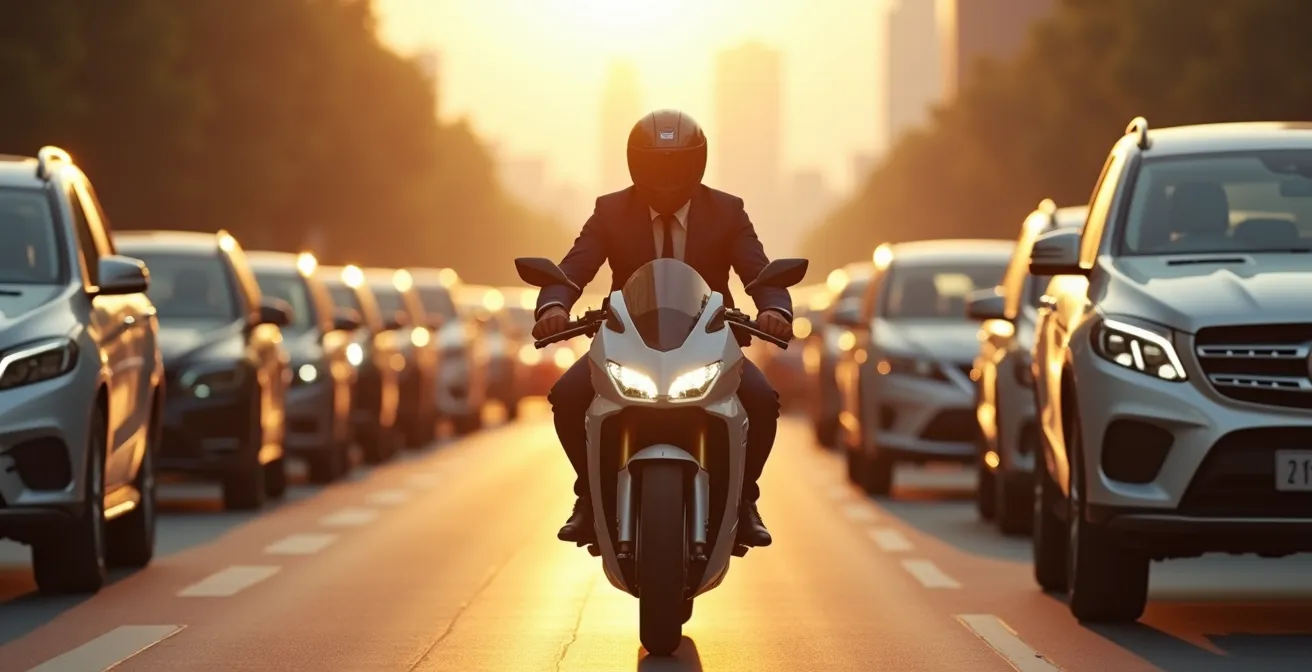
You’re sitting in a river of red taillights, engine getting hot, clock ticking. Every day, the same story. You bought a motorcycle to beat the gridlock, but you’re still a prisoner to it. Most advice you’ll hear is generic fluff: “be aware,” “wear bright colors.” That’s kindergarten stuff. It won’t shave a single minute off your commute or keep you from becoming a statistic. The pros, the couriers who live and breathe this asphalt jungle, don’t just “ride through” traffic. They dismantle it.
The truth is, beating the city is a game of physics, psychology, and proactive threat assessment. It’s about understanding why your bike chugs fuel in stop-and-go traffic and how to fix it. It’s knowing the precise speed differential that makes lane splitting a strategic advantage instead of a gamble. It’s about reading the city’s body language—the flicker of a dome light, the angle of a front wheel—to anticipate danger before it materializes.
Forget what you think you know about defensive riding. This isn’t about being defensive; it’s about going on the offensive against inefficiency and complacency. This guide is your new playbook. We’re going to break down the urban commute into a series of tactical problems and provide the field-tested solutions. We will analyze everything from fuel dynamics and cargo ergonomics to the brutal calculus of risk versus reward. By the end, you won’t just be a commuter; you’ll be an operator, moving through the city with purpose and precision.
This article dissects the core strategies used by professional urban riders to reclaim their time and guarantee their arrival. Below is the roadmap to transforming your daily gridlock battle into a decisive victory.
Summary: How to Master the Urban Commute and Reclaim Your Time
- Why Your MPG Drops Drastically During Rush Hour and How to Fix It?
- Lane Splitting Etiquette: How to Pass Stopped Cars Without Angering Drivers?
- Backpack or Top Case: Which Suits a Laptop-Carrying Professional Best?
- The “Dooring” Threat: How to Spot an Opening Car Door 3 Seconds Early?
- When to Detour: Is Adding 3 Miles Worth Avoiding 10 Minutes of Traffic?
- Why Your Neck Hurts After 45 Minutes of Highway Riding on a Naked Bike?
- Why “Being Right” Can Get You Killed: The Graveyard Is Full of People Who Had the Right of Way
- The “Invisible Rider” Mindset: How to Ride Like Nobody Can See You?
Why Your MPG Drops Drastically During Rush Hour and How to Fix It?
Your bike is supposed to be a fuel-sipping champion, yet in rush hour, it drinks like a V8. The reason isn’t just the stopping and starting; it’s a cascade of inefficiency. Constant hard acceleration from a standstill, an engine overheating without airflow, and improper tire pressure all conspire to destroy your miles-per-gallon. A smaller engine isn’t always the answer; an underpowered bike working overtime can burn more fuel than a larger, properly managed one. It’s not about the bike’s spec sheet; it’s about your technique.
The core of urban fuel efficiency is smoothness and anticipation. Every jerky throttle movement is wasted gas. Look ahead, predict traffic flow, and aim for a “low-power glide” rather than a series of sprints and stops. Maintaining momentum, even at walking speed, is vastly more efficient than coming to a complete halt. Furthermore, your bike’s setup is critical. Cargo weight, and especially its balance, forces the engine to work harder. The goal is to make your machine as mechanically efficient as possible, so your riding technique can have the maximum impact.
Think of your motorcycle as an athlete. You wouldn’t ask a sprinter to run a marathon without proper preparation. Getting your bike’s basic health in order is the first step to winning the urban efficiency game. The following checklist covers the non-negotiable points to audit before you even think about advanced techniques.
Action Plan: Your Pre-Ride Fuel Efficiency Audit
- Engine Sizing: Assess if your engine is constantly struggling. An underpowered bike that’s always at high RPMs is inefficient.
- Tire Pressure Check: Use a quality gauge to ensure tires are inflated to the manufacturer’s recommendation. This is the single easiest fix for reducing rolling resistance.
- Throttle Control Practice: Dedicate a ride to practicing feather-light acceleration from a stop. The goal is fluid motion, not a drag race.
- Heat Management Awareness: Be conscious of engine temperature. If you’re stuck for more than a couple of minutes, consider shutting off the engine.
- Cargo Optimization: Analyze your load. Is it balanced? Can it be lighter? Every extra pound is a fuel penalty.
Lane Splitting Etiquette: How to Pass Stopped Cars Without Angering Drivers?
Lane splitting—or filtering—isn’t just a perk; it’s a core urban tactic. Done right, it slashes commute times and, counter-intuitively, can be safer than sitting in traffic. But there’s a razor-thin line between flowing through traffic and inciting road rage. The key isn’t just that it’s legal in places like California; it’s about understanding the psychology of the drivers you’re passing. You are an unexpected element entering their space. Your mission is to be predictable, smooth, and almost forgettable.
The most critical factor is your speed differential. You are not a missile. You are water flowing through rocks. The goal is a steady, constant pace, not aggressive bursts of speed. Aggressive revving, sudden movements, or hugging a car’s bumper are rookie mistakes that trigger a driver’s fight-or-flight response. Your positioning is also part of this non-verbal communication. Stay in the highest-visibility part of the gap, typically between the #1 and #2 lanes, where drivers are more accustomed to seeing you.
Case Study: The Science of Safe Speed Differentials
A landmark 2015 study from UC Berkeley provided hard data on this. After analyzing nearly 6,000 motorcycle collisions, researchers found that when riders were lane splitting, they were markedly safer if they maintained a speed no more than 15 MPH faster than the surrounding traffic. The injury risk increased significantly once that speed differential went above 25 MPH. The takeaway is clear: the data proves that a 15 MPH speed difference is the sweet spot for balancing progress with safety.
This shows that lane splitting isn’t about raw speed, but controlled, methodical progress. It is a calculated maneuver, not a race. Remember, while a survey might show that the majority of riders in California lane split, it also reveals that nearly half of drivers don’t even know it’s legal. You are the professional in this interaction; it’s your job to manage their potential ignorance with smooth, predictable riding.
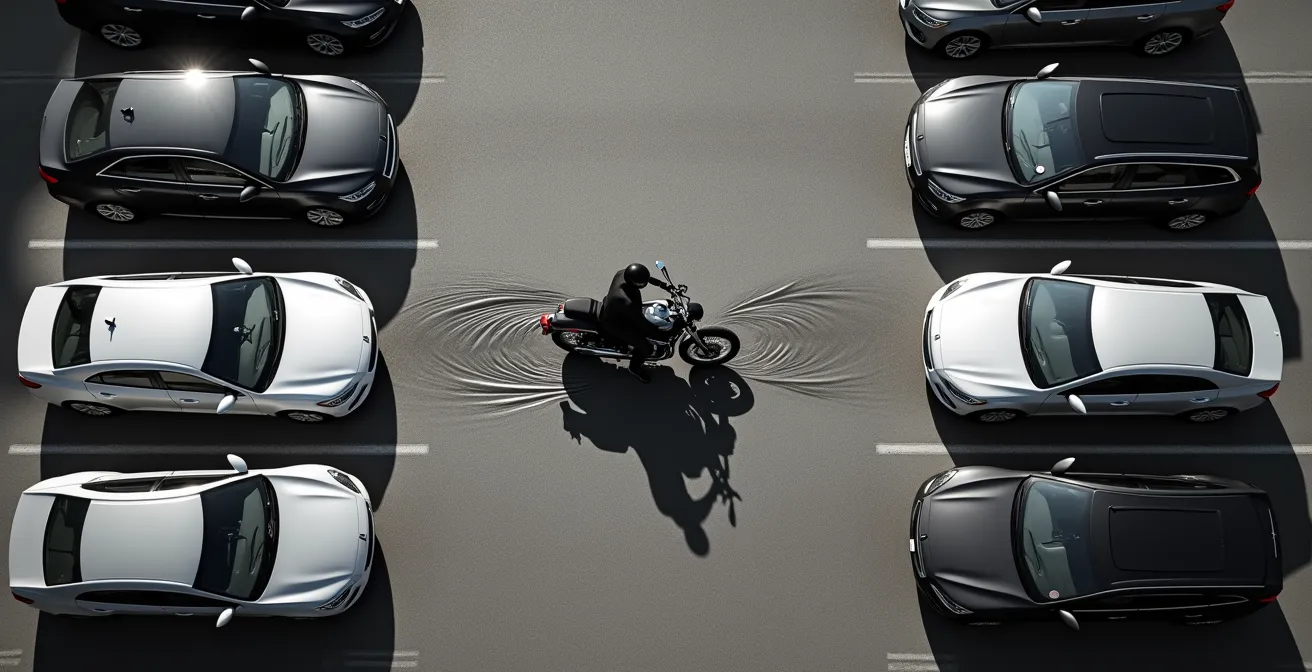
As seen from above, the ideal path is a fluid line, not an aggressive charge. You’re part of the traffic flow, just moving at a slightly different tempo. Every car you pass is a potential hazard, and your smooth technique is what de-escalates that threat before it can even form. The goal is to be so non-threatening that by the time a driver has processed your presence, you’re already gone.
Backpack or Top Case: Which Suits a Laptop-Carrying Professional Best?
For the commuting professional, carrying a laptop and daily gear is a non-negotiable reality. The choice between a backpack and a hard top case isn’t just about style; it’s a critical decision that impacts fatigue, safety, and your bike’s handling dynamics. Many riders default to a backpack out of habit, but this is often a significant tactical error. While a quality motorcycle backpack is designed for the job, it fundamentally alters your relationship with the machine.
A backpack places the weight high and directly on your body. This raises your combined center of gravity, which can subtly affect the bike’s agility. More importantly, it transfers every bump and vibration directly to your spine, shoulders, and neck. Over the course of a 45-minute commute, this creates cumulative fatigue. A tired rider is a compromised rider. A top case, on the other hand, isolates the weight on the bike’s subframe, where it was designed to be. Your body remains free and unburdened, allowing you to stay loose and react faster. The bike carries the load, not you.
The argument against a top case is often aesthetics or the fear of it affecting handling. While a poorly mounted or overloaded case can impact high-speed stability, for urban commuting, the benefits far outweigh the negatives. It offers weather protection, security when parked, and most importantly, it offloads the physical burden from you, the operator. As experts who test gear for a living note, rider fatigue is a major safety liability.
A heavy backpack raises the rider’s center of gravity and causes cumulative fatigue in the shoulders, neck, and back. A tired rider has slower reaction times and makes poorer decisions.
– HiConsumption Testing Team, Tested: The Best Motorcycle Backpacks For Commuting
For the professional who rides daily, the choice is clear. A backpack is a tool for occasional use. A top case is a strategic investment in reducing fatigue and improving your endurance for the daily grind. It allows you to arrive at your destination fresh and focused, not sore and worn out before the workday has even begun.
The “Dooring” Threat: How to Spot an Opening Car Door 3 Seconds Early?
Of all the threats in the urban jungle, the “dooring” incident is one of the most sudden and vicious. It comes with no warning and offers almost no escape. But that’s not entirely true. A parked car is not a static object; it’s a container of potential threats, and it gives off subtle clues before it acts. Learning to read this “car language” is the difference between a near-miss and a trip to the emergency room. Your eyes should be constantly scanning parked cars, not just looking at them, but hunting for pre-incident indicators.
The key is to train your brain to recognize patterns that precede an opening door. Don’t look at the door itself; look *through* the car. Is there a shadow of movement inside? Can you see an interior dome light flicker on through the rear window? These are tell-tale signs of an occupant preparing to exit. Look at the front wheels. Are they turned towards the curb? That indicates a recent parking maneuver. Pay special attention to ride-share vehicles (Lyft/Uber stickers are a dead giveaway), as their passengers exit suddenly and without looking. Another pro-tip is to watch for exhaust vapor on a cold day or heat shimmer from the hood on a warm one—it means the engine was just running and the driver is likely still inside.
California Highway Patrol guidelines emphasize maintaining visibility and buffer zones for a reason. Lingering beside a row of parked cars is placing yourself in a kill zone. Your lane position should be a conscious choice to maximize your distance from this threat. Treat every parked car as if it has a person inside about to fling the door open. By actively searching for these specific clues, you can turn a 2-second reaction time into a 4-or-5-second head start, which is an eternity in traffic.
- Exhaust Vapor/Heat Shimmer: Indicates a recently parked car and an occupant still inside.
- Interior Dome Lights: A light flickering on is a primary signal of imminent exit.
- Turned Front Wheels: A sign the driver has just finished parking.
- Ride-Share Stickers: High-risk vehicles for abrupt passenger exits.
- Shadows of Movement: Look through windows for any sign of an occupant shifting.
- Brake Lights Off: When brake lights extinguish after stopping, it often means the car is now in ‘Park’.
When to Detour: Is Adding 3 Miles Worth Avoiding 10 Minutes of Traffic?
Navigation apps make it simple: this route is 10 minutes faster. For a car driver, the choice is obvious. For a motorcyclist, the calculus is far more complex. A “10-minute delay” on a map doesn’t tell the whole story. As a rider, you have to decode the *type* of delay. A 10-minute jam on a multi-lane highway where you can safely filter might actually be faster and less stressful than a “5-minute delay” on a single-lane arterial road that means a complete, engine-cooking standstill. The decision to detour isn’t just about time; it’s an efficiency calculus involving fuel, heat, fatigue, and risk.
The veteran courier develops an instinct for this. Is the traffic stopped dead, or is it a slow crawl? A crawl is manageable; a dead stop on a hot day with an air-cooled engine is torture. Is the detour on wide-open roads or through a school zone at 3 PM? Adding three miles of flowing, 45-MPH road is often preferable to one mile of stop-and-go agony, even if the app says it’s “slower.” You’re not just managing time; you’re managing your mental state and the bike’s mechanical health.
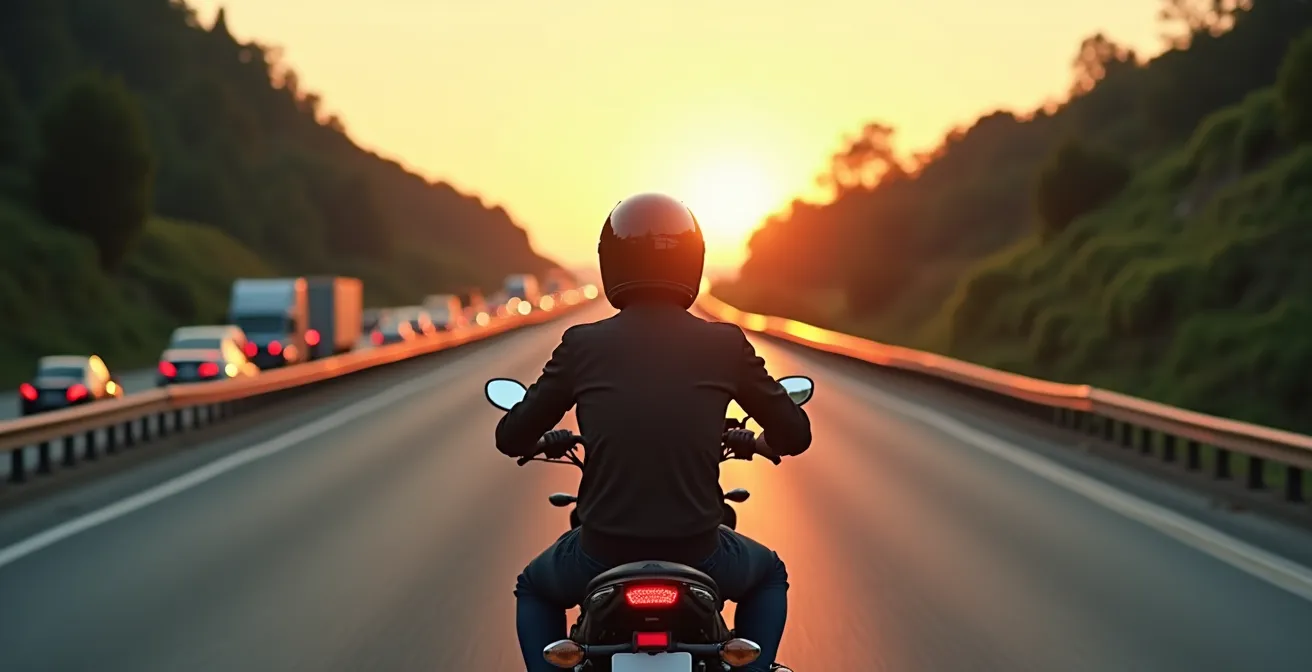
This is the moment of truth every commuter faces. The app says left is faster, but your gut, honed by experience, knows the road to the right means constant movement, cleaner air, and less clutch work. This is where you override the algorithm. You choose flow over frustration. The goal is not always the shortest time, but the most *efficient journey*. A route that keeps you moving, keeps the engine cool, and keeps your mind clear is often the superior tactical choice, even if it adds a few miles to the odometer.
This decision-making process becomes second nature. You learn to weigh the variables in a split second. A red line on Google Maps is not a uniform threat. You must learn to dissect it and determine if it’s a “filterable red” or a “hard-stop red.” One is an opportunity; the other is a trap to be avoided at all costs.
Why Your Neck Hurts After 45 Minutes of Highway Riding on a Naked Bike?
You bought a naked bike for its raw style and upright ergonomics, perfect for dicing through the city. But hit the highway for more than a few miles, and a burning pain starts to creep into your neck and shoulders. This isn’t a sign of weakness; it’s a predictable consequence of physics. A naked bike, by definition, lacks a windscreen. At speeds over 50-60 MPH, your head and chest are acting as a parachute, catching the full force of the wind. Your neck muscles are in a constant, isometric battle to keep your head from being pushed back.
This is a battle you will always lose. The continuous strain leads to muscle fatigue, pain, and reduced focus. Unlike a sport touring bike with its aerodynamic fairings or a standard bike with a windscreen, the naked bike offers zero wind deflection. The “comfortable” upright riding position actually exacerbates the problem by presenting a larger, flatter profile to the wind. To survive on a naked bike at speed, you can’t just sit there and take it. You have to change your technique and actively manage the force of the wind.
The solution is to turn your body into a more aerodynamic shape and use your core, not just your neck, to support your upper body. A slight forward lean from the hips (not a hunch in the back) can make a significant difference. Gripping the tank firmly with your knees creates a stable anchor, allowing your upper body to stay more relaxed. It’s about distributing the load across your entire torso instead of letting your neck do all the work. Think of it as going from a rigid pole to a supple spring, absorbing and deflecting the energy instead of fighting it head-on.
- Adopt a Forward Lean: Hinge at your hips to present a smaller profile to the wind.
- Grip the Tank: Use your knees to stabilize your lower body and anchor yourself to the bike.
- Relax Your Arms: Keep your elbows bent and loose; your hands are for control, not for supporting your body weight.
- Engage Your Core: Use your abdominal and back muscles to support your torso, taking the strain off your neck and shoulders.
- Perform Stretches: At every stoplight, do gentle shoulder rolls and neck stretches to release tension.
- Use a Chin-Down Tuck: Periodically tucking your chin down can provide a brief respite and stretch tired neck muscles.
Key Takeaways
- Survival over Ego: Your primary mission is to get home safely, not to prove you were right.
- Proactive Threat Scanning: Don’t just see traffic; analyze it for patterns, escape routes, and pre-incident indicators.
- Master Your Kinetic Signature: Ride in a way that is smooth, predictable, and intentionally visible to other road users.
Why “Being Right” Can Get You Killed: The Graveyard Is Full of People Who Had the Right of Way
In any conflict between a two-ton car and your 400-pound motorcycle, physics doesn’t care about the traffic laws. You can have the right of way, the green light, and a dozen witnesses, but you will still lose the physical confrontation. This is the single most important rule of urban survival: your ego is your greatest liability. The need to be “right”—to hold your line because a car *should* yield, to accelerate into a gap because you *can*—is a fatal flaw in judgment. The graveyard is full of riders who had the right of way.
You must operate under the assumption that you are completely invisible and that every other vehicle on the road is actively trying to kill you. This isn’t paranoia; it’s a professional mindset. It forces you to take full responsibility for your own safety. A car turning left in front of you isn’t an “injustice”; it’s a predictable hazard that you should have anticipated and planned an escape route for. According to legal experts who analyze these collisions, bikers are almost 30 times more likely to be killed in a crash. With that kind of statistic, you simply cannot afford to gamble on another driver doing the right thing.
This mindset fundamentally changes how you ride. You no longer hug the center line; you command your lane, moving to the right or left to create buffer zones. You don’t just follow; you create space. Safety experts recommend a four-second following distance in city traffic, double the old two-second rule. This isn’t passive; it’s an aggressive claim on your survival space. It gives you the time and room to react when—not if—another driver makes a mistake. Letting go of the need to be right and embracing the need to be safe is the final evolution of an urban rider.
The “Invisible Rider” Mindset: How to Ride Like Nobody Can See You?
High-visibility gear helps, but relying on it is a critical mistake. The “Invisible Rider” mindset assumes your brightly-colored jacket and reflective helmet provide zero protection. It’s a mental state where you ride with the absolute certainty that no one else sees you. This forces you to create your own visibility through action, not appearance. You have to generate a “kinetic signature”—a pattern of movement that actively cuts through the visual noise of the city and registers in a driver’s peripheral vision.
This means abandoning straight-line, passive riding. When approaching an intersection or a potential threat, a gentle, deliberate S-curve within your lane makes you a moving target that is much harder for the human eye to ignore than a static object. It means using your position strategically. The golden rule is: if you can’t see the driver’s face in their mirrors, they absolutely cannot see you. Your job is to constantly adjust your lane position to stay out of their blind spots, never lingering beside a car for more than a few seconds. A quick flash of your headlight is often more effective than a horn, as it’s a visual signal that can be processed faster than an auditory one.
Field Technique: The “Urban Flow” Concept
Advanced urban riders develop what is known as “flow.” They treat heavy traffic like a fluid dynamics problem, finding the path of least resistance. This isn’t about aggressive weaving, but about making a series of smooth, predictable movements that cause minimal disruption to the surrounding traffic pattern. By maintaining constant awareness of multiple escape routes and making their intentions clear through body language and bike positioning, they reduce risk by never startling other drivers. It’s a state of heightened awareness where you are part of the traffic, but not trapped by it.
Adopting this mindset is the ultimate expression of tactical commuting. It combines all the other principles: you’re managing threats, creating space, and using your machine with a level of intention that goes far beyond simple transportation. You are no longer hoping to be seen; you are ensuring you are accounted for through your deliberate actions.
You now have the playbook. The daily commute is no longer a passive crawl but a tactical operation you can control. By applying these principles of efficiency, threat assessment, and ego-neutral riding, you can transform your relationship with the city. The next step is to get out there and start implementing these strategies, one ride at a time.