
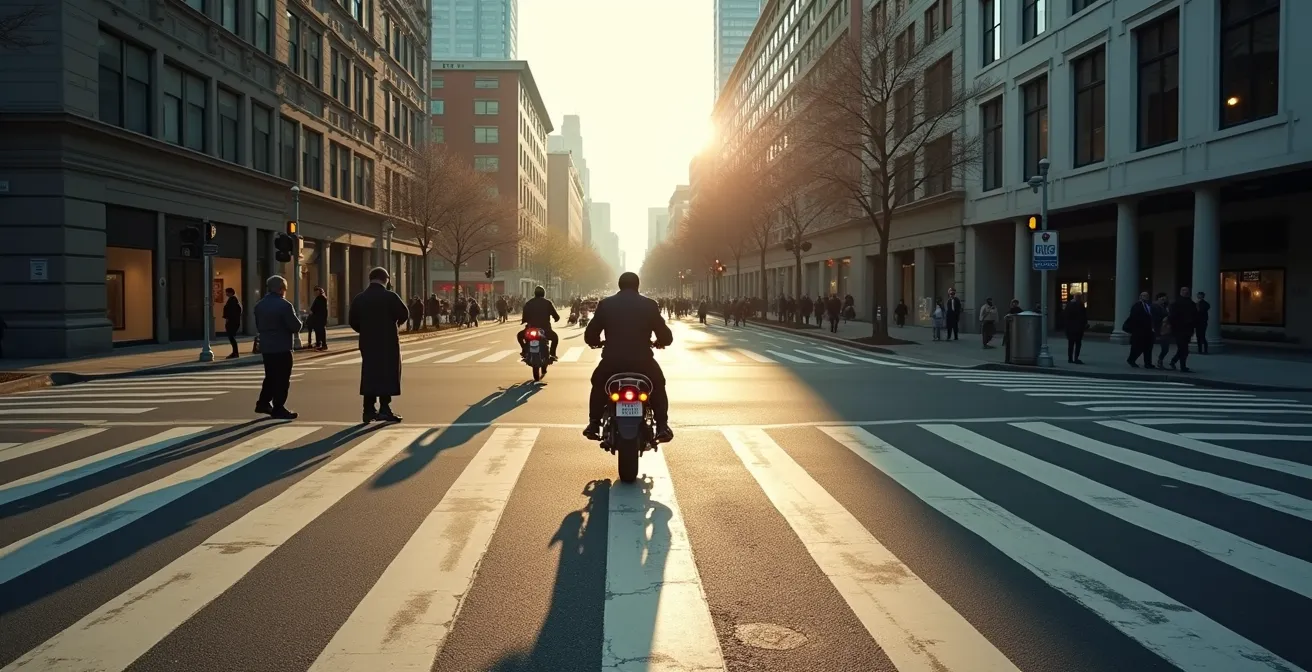
That heart-stopping moment when a pedestrian steps out from behind a truck is a common fear for urban riders. The solution isn’t just faster reflexes, but a shift in mindset. This guide moves beyond generic advice, teaching you to become a risk assessor who decodes the subtle “micro-cues” in the environment—from a driver’s posture to a rainbow sheen on the asphalt—to anticipate and neutralize dangers before they ever fully materialize.
The urban landscape is a chaotic symphony of movement. For a motorcyclist, it can feel like a constant barrage of near-misses, with the most jarring being the pedestrian who emerges from nowhere. You’re riding along, hyper-aware, when a person suddenly steps off the curb from between two parked cars. Your heart leaps into your throat, you swerve, you brake hard, and the rest of your ride is tainted by adrenaline and anxiety. Common advice tells you to “be visible” and “cover your brakes,” and while these are valid, they are fundamentally reactive. They prepare you for a hazard that has already manifested.
But what if the key wasn’t simply reacting faster, but seeing the future? The truth is, the urban environment speaks a hidden language. It’s a language of micro-cues: the subtle shift in a pedestrian’s weight before they step, the slight turn of a car’s front wheel, the texture of the pavement in a shadow. These are the tell-tale signs that predict a hazard seconds before it becomes a life-or-death situation. Mastering this language transforms you from a passive victim of circumstances into a proactive urban risk assessor.
This article will not rehash the basics. Instead, it will provide a framework for decoding these crucial signals. We will explore how to identify treacherous road surfaces, interpret the subtle body language of drivers and pedestrians, and strategically position yourself to see what is currently unseen. It’s about turning observation into a form of prediction, giving you the time and space needed to ride with calm confidence, not constant fear.
For those who prefer a visual summary, the following video offers an excellent overview of the mindset required for motorcyclist invisibility training, a perfect complement to the detailed cues we will discuss.
To help you navigate this deep dive into urban risk assessment, we have structured this guide around the most critical scenarios you will face. Each section breaks down a specific hazard and teaches you the micro-cues needed to forecast and neutralize it.
Summary: A Rider’s Guide to Urban Hazard Forecasting
- How to Spot Black Ice vs Wet Tarmac: Visual Cues for Winter Riding?
- The “Creeping Wheel” Sign: Knowing When a Car is About to Pull Out?
- Deer Panic: Why They Freeze and How to Brake When You See Eyeshine?
- Why Brake Lights 5 Cars Ahead Are Your Signal to Slow Down Now?
- What Lies Beyond the Hill: How to Position Yourself for the Unseen?
- The Rainbow Warning: How to Spot Diesel Spills at Bus Stops Before You Lean?
- The Silent Danger: How to Ride When Pedestrians Can’t Hear You Coming?
- Mirrors Are Not Enough: Why the “Head Check” Is Your Only Guarantee Against Blind Spots?
How to Spot Black Ice vs Wet Tarmac: Visual Cues for Winter Riding?
One of the most insidious winter dangers is black ice, precisely because it masquerades as a harmless wet patch. Relying on a last-second reaction is a losing strategy. The key is to develop a “thermal mapping” mindset, predicting where ice is most likely to form before you even see it. An analysis of winter motorcycle crashes is revealing; it shows that 97% of fatalities occur in clear or cloudy conditions when riders least expect ice. The proactive rider knows that bridges and overpasses freeze first, often being 3-5°F colder than the road surface. Shaded areas, especially on north-facing slopes or behind buildings, can also hold ice for hours after sunny spots have cleared.
Beyond predicting location, you can learn to read the surface in real-time. This involves a multi-sensory assessment:
- Watch Tire Spray: A wet road will cause the tires of cars ahead to kick up a consistent mist. If that spray suddenly disappears, yet the road ahead still looks wet, you are likely looking at ice.
- Listen for Silence: Your tires produce a distinct ‘hiss’ on wet tarmac. A sudden, complete silence is a primary audio cue that you’ve transitioned onto a sheet of ice. This is your immediate signal to reduce all inputs: no braking, no turning, no acceleration.
- Observe Vehicle Tracks: On a truly wet road, tire tracks from the car in front will disappear almost instantly as water fills them back in. If you can see distinct, lasting tracks that remain visible for more than a few seconds, it suggests the “wet” surface is actually a frozen one.
By combining this predictive thermal mapping with active visual and auditory cues, you shift from being surprised by ice to anticipating its presence and adjusting your riding long before you reach it. This proactive approach is fundamental to managing your traction budget in cold weather.
The “Creeping Wheel” Sign: Knowing When a Car is About to Pull Out?
Intersections are the highest-risk zones for any urban rider. In fact, official crash statistics reveal that 65% of motorcycle fatalities in multiple-vehicle crashes involve another vehicle violating the rider’s right-of-way, often at intersections. Waiting for a car to start moving into your path is too late. The secret is to identify “commitment indicators”—the micro-cues that signal a driver’s intent to move before the action begins.
The most reliable of these is the “creeping wheel”. When a car is waiting to pull out of a side street or make a left turn, watch its front tires. A driver who is patiently waiting will have their wheels pointed straight ahead. A driver who is anxious to go will begin to turn their wheels in their intended direction of travel. This is often followed by a slight “creep” forward, as they release pressure on the brake. This combination of a turned wheel and a slow creep is a near-certain sign they are about to pull out, often because they haven’t seen you.
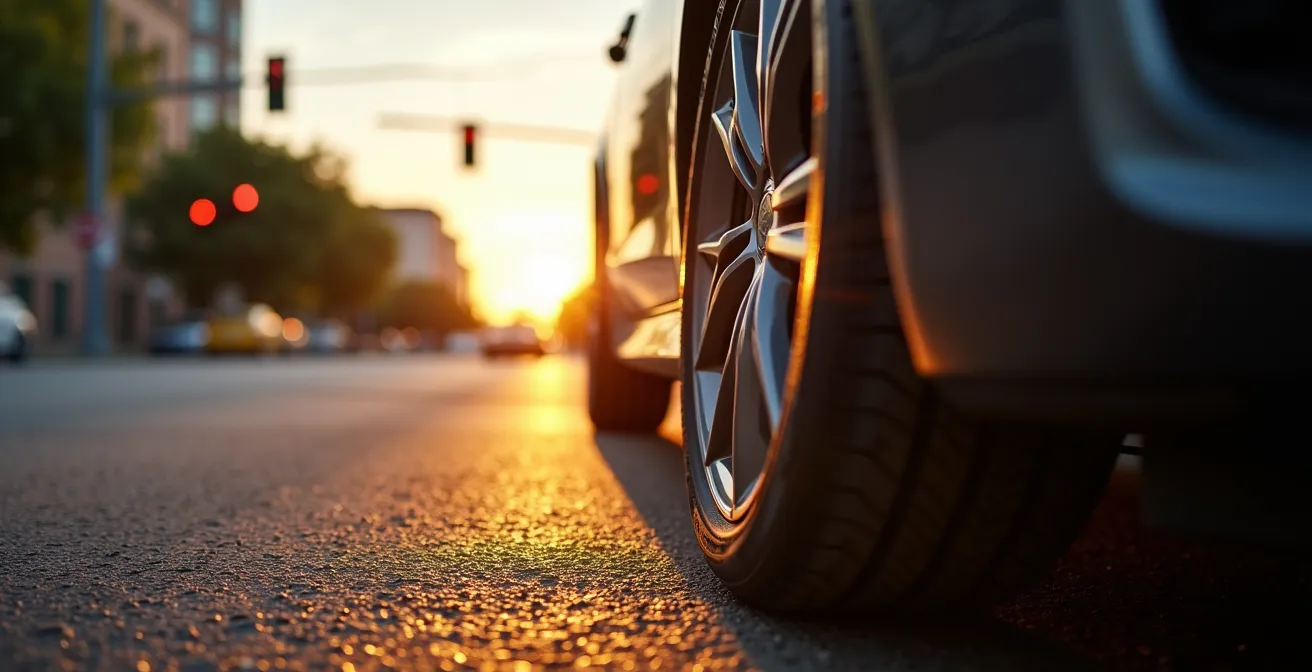
Other commitment indicators include the driver’s head movement—are they looking left and right, or are they staring fixedly in one direction (away from you)? Is their body posture relaxed, or are they leaning forward over the steering wheel? Reading these signals together gives you a powerful predictive ability. When you see the creeping wheel, you don’t just “cover the brake”; you actively reposition in your lane for visibility, adjust your speed, and prepare an escape route. You are no longer reacting to a car pulling out; you are responding to the *intention* of it pulling out.
Deer Panic: Why They Freeze and How to Brake When You See Eyeshine?
While often associated with rural roads, deer and other large animals are increasingly common in suburban and even urban fringe areas, especially at dawn and dusk. The most dangerous and confusing behavior they exhibit is freezing in the headlights. This is not a sign of stubbornness; it’s an involuntary response to being overwhelmed by bright light. A deer’s eyes are designed for low-light vision, and sudden, intense brightness causes temporary blindness and confusion, leading them to freeze in place.
When you see the tell-tale eyeshine reflecting your headlight, your first instinct must be to slow down immediately and smoothly. Do not assume the deer will stay put or run away from you. The “freeze” is often temporary, and it can be followed by an explosive, unpredictable bolt in any direction. Your goal is to scrub off as much speed as possible to maximize your reaction time for whatever comes next. It is also critical to apply the “trailing deer” protocol: where there is one deer, there are almost always more. Scan the sides of the road for other sets of eyes.
To move from reacting to predicting, you can learn to read a deer’s body language even before it panics:
- Ears forward + head up: The deer is alert and aware of you. It’s likely to move suddenly, so be prepared.
- Ears back or sideways: This indicates confusion or agitation. Movement is imminent and will be highly unpredictable.
- Head down grazing: A lower immediate threat, but continue to monitor its posture.
- Tail up (“flagging”): This is a clear alarm signal. The deer is frightened and prepared for erratic flight.
By understanding why they freeze and learning to interpret their posture, you can better anticipate their next move and create the time and space needed to avoid a collision.
Why Brake Lights 5 Cars Ahead Are Your Signal to Slow Down Now?
In dense city traffic, focusing only on the car directly in front of you is a recipe for disaster. This is because of the “traffic wave” or accordion effect. When the first car in a line brakes, there’s a cumulative reaction delay that cascades backward. The driver directly behind them reacts, then the next, and so on. By the time the brake lights on the car directly in front of you come on, you may have lost several critical seconds of response time and a significant portion of your safe following distance.
The solution is to raise your gaze and look “through” the cars ahead of you, scanning for information far down the road. You should be watching the brake lights three, four, or even five cars ahead. When you see those distant red lights illuminate, that is your signal to begin smoothly rolling off the throttle and preparing to brake. You are not waiting for the immediate threat; you are responding to the *start* of the traffic wave. This proactive move buys you precious seconds and meters, allowing for a controlled, gentle stop instead of a panicked one.
This table illustrates the stark reality of cumulative reaction delays in a line of traffic. As a rider in the “5th car” position, observing far ahead grants you a massive time advantage.
| Vehicle Position | Cumulative Reaction Delay | Available Response Time |
|---|---|---|
| 1st car (initiates braking) | 0 seconds | Immediate |
| 2nd car | 1-2 seconds | Very limited |
| 3rd car | 2-4 seconds | Moderate |
| 4th car | 3-6 seconds | Good if watching ahead |
| 5th car (motorcycle position) | 4-8 seconds | Excellent with forward observation |
This technique doesn’t just protect you from rear-ending someone; it also makes you less likely to be rear-ended yourself. By braking early and smoothly, you give the driver behind you more time to react to your own brake lights, reducing the risk of a chain reaction. It’s a cornerstone of hazard forecasting in a high-density environment.
What Lies Beyond the Hill: How to Position Yourself for the Unseen?
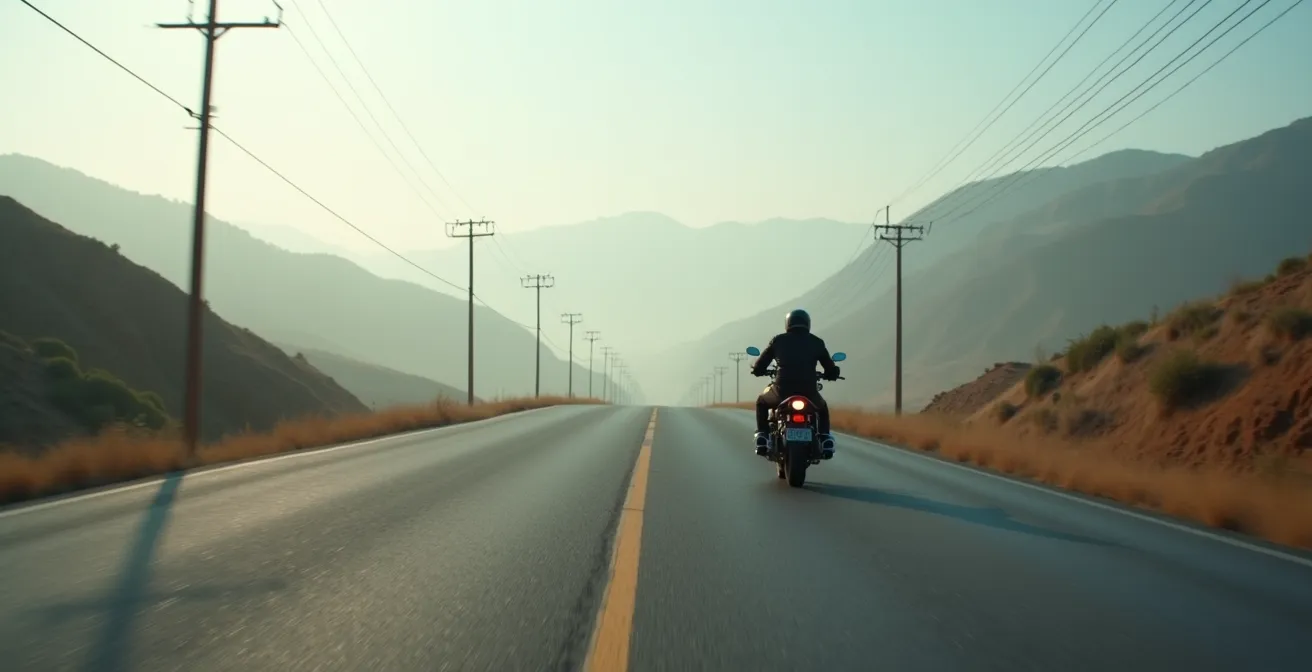
Blind crests and sharp corners present a unique challenge: the threat is completely invisible. Approaching these situations requires a deliberate strategy of “sightline management.” This means positioning yourself on the road not for the fastest line, but for the line that gives you the earliest possible view of what’s ahead. The goal is to maximize information. Before you even reach the crest, you should be actively scanning for clues about the road beyond.
Look at the skyline. Can you see the tops of telephone poles or the roof of a truck? These indicate where the road continues. On a clear day, you might see a dust cloud from a farm vehicle. At night, you might see the glow of headlights reflecting off trees or signs before the car itself is visible. These are all clues you can use to build a mental picture of the unseen. Your lane position is your most powerful tool in this scenario.
A disciplined protocol for navigating blind crests involves several key steps:
- Positioning: Before the crest, move to the outside edge of your lane (e.g., the right portion for a left-hand curve over a hill). This opens up your line of sight around the curve as you approach the top.
- Speed Reduction: Proactively reduce your speed by 20-30% from your normal cruising pace. You should always be able to stop within the distance you can see to be clear.
- Line Selection: Use the classic “outside-inside-outside” line, but with a focus on vision. As you come over the crest and the road ahead is revealed, you can then move towards the inside of the turn to complete the corner smoothly.
This isn’t about being timid; it’s about being smart. By actively managing your sightlines and speed, you are buying information and time, ensuring you are never surprised by a stopped car, a deer, or a patch of gravel just over the rise.
The Rainbow Warning: How to Spot Diesel Spills at Bus Stops Before You Lean?
Few things can steal a motorcyclist’s traction as suddenly and completely as a diesel fuel spill. These spills are most common in predictable “high-risk zones” that a savvy rider can mentally map and approach with caution. An analysis of urban riding incidents shows these are not random occurrences. Bus stops, for instance, show the characteristic rainbow sheen of diesel in a high percentage of cases. Other hotspots include the exits of truck stops, uphill sections leading to traffic lights where heavy vehicles strain and may spill fuel, and the entrances to agricultural facilities.
The most obvious micro-cue is the vibrant rainbow sheen on wet pavement. This indicates a fresh, extremely hazardous spill. However, as diesel ages and soaks into the asphalt, its appearance changes, though the risk remains. A proactive rider learns to identify the different stages of a spill. The table below provides a quick reference for assessing the age and corresponding risk of a potential spill.
This comparative analysis helps in assessing risk on the fly.
| Spill Appearance | Age Estimate | Traction Loss Risk | Visual Indicators |
|---|---|---|---|
| Vibrant rainbow, sharp edges | 0-2 hours | Extreme (90% loss) | Liquid sheen, strong odor |
| Faded rainbow, spreading edges | 2-24 hours | High (60% loss) | Partial absorption, mild odor |
| Dark stain, no rainbow | 24+ hours | Moderate (30% loss) | Absorbed into asphalt, minimal odor |
| Wet appearance on dry day | Variable | High (50%+ loss) | Soaked porous surface |
When you identify one of these high-risk zones or spot any of these visual cues, the rule is simple: ride as if the spill is there. This means keeping the bike as upright as possible, avoiding any significant lean angle, and ensuring all braking and acceleration inputs are exceptionally smooth and gentle. Riders who mentally map these zones and preemptively adjust their riding style report significantly fewer traction-loss incidents. It’s a perfect example of using environmental cues to manage your traction budget proactively.
The Silent Danger: How to Ride When Pedestrians Can’t Hear You Coming?
This is the core challenge for the urban rider. In a world of noise-canceling headphones and smartphone distractions, you must assume that pedestrians cannot hear you approaching. The traditional auditory warning of an engine is becoming increasingly ineffective. Data on pedestrian safety underscores the urban risk, with pedestrian crash data revealing that 67% of fatalities occurred in urban areas. Your safety, therefore, depends on your ability to spot a pedestrian’s *intent* to cross before they ever leave the curb.
A comprehensive NYC motorcycle safety analysis has identified a series of predictable pre-crossing behaviors—the micro-cues that give away a pedestrian’s next move. Riders who learn to recognize these patterns can dramatically reduce conflicts. Look for these signs:
- The Weight Shift: A person about to step into the street will unconsciously shift their weight to the balls of their feet 1-2 seconds before moving. It’s a subtle “loading of the spring.”
- The Rhythm Break: A person walking with a rhythmic head bob to music will often stop that movement abruptly just as they decide to cross. The break in rhythm is your cue.
- The One-Way Glance: The most dangerous pedestrian is the one who performs a quick, cursory glance only in the direction of the closest lane of traffic before stepping out, completely oblivious to your approach from further away.
- The Phone Drop: A person engrossed in their phone will often lower it from their face to their side just before they cross, a final physical action before the commitment to move.
When you spot these micro-cues, you gain a massive time advantage. You can sound your horn, adjust your lane position to create a wider buffer, and cover your brakes, all based on a prediction of behavior rather than a reaction to a person already in your path. This skill transforms terrifying surprises into manageable, predictable events.
Key Takeaways
- Proactive hazard forecasting is superior to reactive driving; it’s about reading the environment to neutralize threats early.
- Mastering micro-cues—like a car’s creeping wheel, a pedestrian’s weight shift, or the lack of tire spray on a wet-looking road—gives you a critical time advantage.
- Your strategy should always involve managing your sightlines and traction budget, positioning yourself for maximum information and grip.
Mirrors Are Not Enough: Why the “Head Check” Is Your Only Guarantee Against Blind Spots?
After learning to decode the external world of micro-cues, the final layer of your safety system must be an unwavering, disciplined check of your own immediate surroundings. All the prediction in the world is useless if you initiate a lane change into a vehicle hiding in your blind spot. Mirrors, even with wide-angle additions, have inherent limitations. They can be misaligned, objects can be deceptively small in them, and there are always zones they simply cannot cover.
As veteran trainer Kevin Morris of MCRider Motorcycle Training explains, the problem is also cognitive:
The physical act of a head check forces your brain to actively look for and register a hazard. Motion-induced blindness can make even large objects temporarily disappear from peripheral vision.
– Kevin Morris, MCRider Motorcycle Training
This is why the physical “head check” or “lifesaver check” is non-negotiable. It is the only way to get a true, real-time picture of the space you intend to occupy. It’s not just a glance; it’s a sharp, deliberate turn of the head to look over your shoulder into the blind spot. This action breaks the spell of motion-induced blindness and confirms with certainty whether the lane is clear. This action should be an automatic, ingrained part of every single lateral move you make, from a simple lane change to merging onto a highway. It is your ultimate guarantee.
Your Action Plan: The Complete Head Check Sequence
- Mirror 1: Begin by checking your mirror on the side of your intended move to see what is behind you.
- Mirror 2: Check your other mirror to build a complete picture of the traffic pattern around you.
- Signal: Activate your turn indicator only after checking your mirrors. This signals your *intention*.
- Lifesaver Check: Perform a crisp, physical head turn to look directly into the blind spot of your intended path. This is the crucial confirmation step.
- Execute: Only after you have confirmed a clear path with both your mirrors and your head check, initiate the maneuver smoothly.
By making this sequence an unbreakable habit, you close the final gap in your defensive strategy. You pair predictive observation of the world ahead with verifiable confirmation of the space around you.
Adopting the mindset of an urban risk assessor isn’t about adding fear to your ride; it’s about replacing it with skill. By learning to read the subtle language of the road, you empower yourself to see what’s coming and act with calm, decisive control. The next step is to consciously practice identifying one new micro-cue on every ride, building your predictive vocabulary until it becomes second nature.