
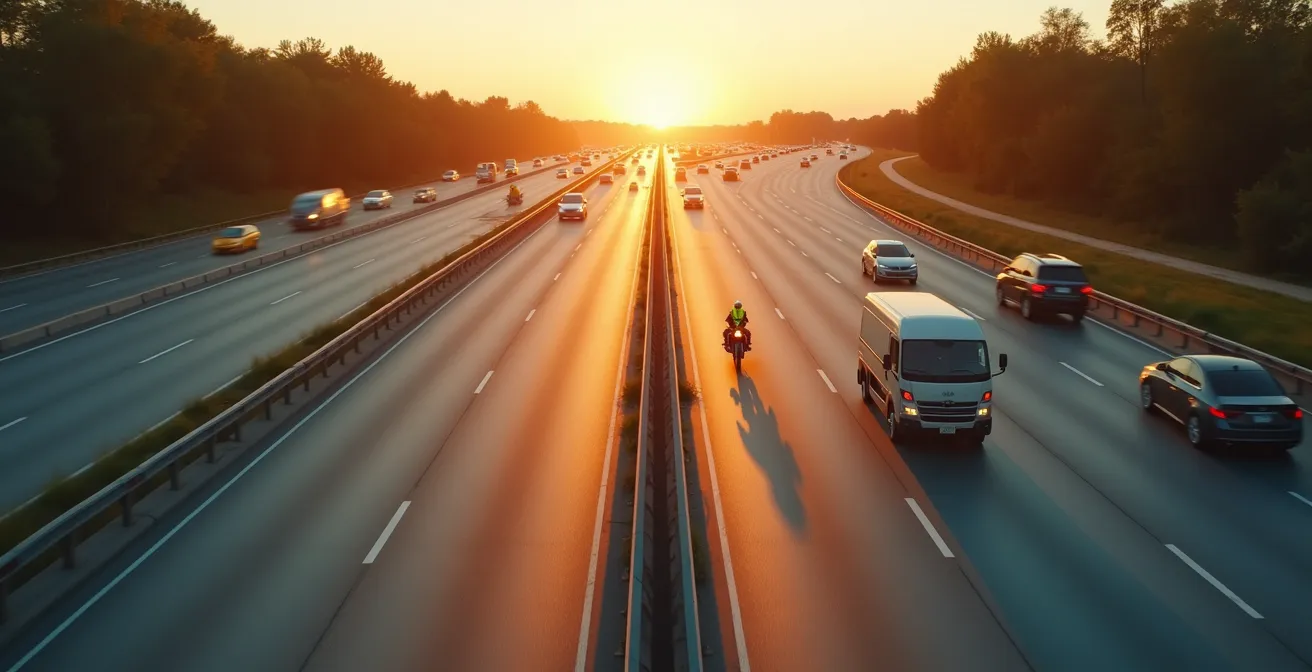
Navigating the legal gray area of lane splitting and filtering requires more than knowing the statute; it demands a deep understanding of risk management and non-verbal communication with other drivers.
- The critical safety factor isn’t your absolute speed, but maintaining a speed differential of no more than 15 mph from surrounding traffic.
- Your lane position is your primary communication tool, signaling intent and creating a buffer zone long before you begin to filter.
Recommendation: Treat every filtering opportunity not as a right, but as a temporary social contract you must actively negotiate with surrounding vehicles through predictable behavior and heightened awareness.
For any motorcycle commuter, the sight of congested, multi-lane traffic is a familiar frustration. The temptation to glide between rows of stopped or slow-moving cars is immense, promising a quicker, more efficient journey. This practice, known broadly as lane splitting or filtering, is one of the most debated topics in the motorcycling world. Many riders assume the primary question is simply, “Is it legal in my state?” While crucial, this question is dangerously incomplete. The internet is filled with generic advice to “check local laws” or “be careful,” but this fails to address the core challenge for riders in states with vague or non-existent statutes: how to operate in a legal gray area without attracting a ticket or, worse, causing a collision.
The true art of navigating between lanes lies not in exploiting a legal loophole, but in mastering a complex interplay of risk assessment, legal interpretation, and social etiquette. The distinction between “splitting” at speed and “filtering” through stopped traffic is just the beginning. The real difference between a safe commute and a roadside conversation with law enforcement is your ability to interpret traffic dynamics, communicate your intentions without words, and operate with a level of caution that demonstrates a clear commitment to safety. This is not about aggression or entitlement; it’s about surgical precision and social intelligence.
This guide moves beyond the simplistic legal definitions to provide a strategic framework for the cautious rider. We will deconstruct the core principles of safe lane positioning, merging, group riding dynamics, and the psychological traps that lead to common errors. By understanding the “why” behind the rules and the data that informs safe practices, you can build a defensive strategy that minimizes both legal and physical risk, turning a legally ambiguous maneuver into a calculated, predictable, and safer way to commute.
To help you master this skill, this article breaks down the essential components of safe and legal lane navigation. The following sections provide a detailed analysis of everything from highway positioning to the specific etiquette required to coexist with other road users.
Summary: A Strategic Guide to Lane Filtering and Splitting
- Left, Center, or Right: Which Third of the Lane is Safest on Highways?
- The Acceleration Lane: Why You Must Match Highway Speed Before Merging?
- Staggered Formation: Why Riding Side-by-Side is Dangerous for Rookies?
- The Left Turn Trap: Why You Should Never Turn Wheels While Waiting?
- Target Fixation and Lane Drift: Why You Veer Toward What You Look At?
- Lane Splitting Etiquette: How to Pass Stopped Cars Without Angering Drivers?
- EV Privileges: Can Electric Motorcycles Legally Use Bus/Taxi Lanes?
- State Minimums vs Real Risk: Why Being “Legal” Might Bankrupt You After a Crash?
Left, Center, or Right: Which Third of the Lane is Safest on Highways?
The concept of “owning the lane” is fundamental to motorcycle safety, but it’s not about stubbornly holding one spot. A rider’s lane position is a dynamic tool for visibility, communication, and defense. On a highway, the lane is typically divided into three conceptual “thirds”: left (LP1), center (LP2), and right (LP3). Many riders default to the center, but this is often the most dangerous position, accumulating oil and debris from vehicles. The left and right thirds offer better pavement and, more importantly, strategic advantages. LP1 (left third) generally offers the best visibility to the driver ahead via their side-view mirror, making you a more prominent presence.
When considering filtering or splitting, your lane position becomes even more critical. Positioning in LP1 as you approach slower traffic makes you highly visible to drivers behind you and clearly signals your potential path. It creates a predictable line of travel. Conversely, LP3 can be useful for creating a buffer from traffic in the adjacent lane but may place you in a driver’s blind spot. The key is to think of your position not as a static choice but as an active communication device. Your movement between these thirds should be deliberate and gradual, signaling your awareness and intent to surrounding traffic.
This strategic positioning is not just theoretical; it has proven safety benefits. When performed correctly in slow or stopped traffic, filtering significantly reduces a rider’s risk of being rear-ended, a common and often severe type of collision. In fact, an influential study confirms the practice’s safety advantages, finding that lane-splitting motorcyclists are 50% less likely to suffer head injuries compared to their non-splitting counterparts in similar traffic conditions. This underscores that safe filtering, beginning with correct lane positioning, is a vital defensive riding technique.
The Acceleration Lane: Why You Must Match Highway Speed Before Merging?
The on-ramp, or acceleration lane, is one of the most critical decision points for any road user, but it’s especially high-stakes for a motorcyclist. Its sole purpose is to allow you to match the speed of highway traffic *before* you merge. Entering the flow of traffic at a significantly lower speed creates a dangerous obstacle, forcing fast-approaching vehicles to brake or swerve suddenly. For a rider, this is an invitation for disaster. Your vulnerability is at its peak when there is a large speed differential between you and the vehicles around you.
Proper merging technique requires aggressive, yet controlled, acceleration. Use the full length of the ramp to get up to speed. As you accelerate, perform quick head checks to identify a gap in traffic and watch the vehicle you plan to merge in front of. Your goal is to slot into a gap smoothly, becoming part of the traffic flow rather than disrupting it. Hesitation is your enemy here. A timid merge is an unpredictable merge, and unpredictability is what causes accidents. A confident, decisive merge at speed is paradoxically the safest maneuver.
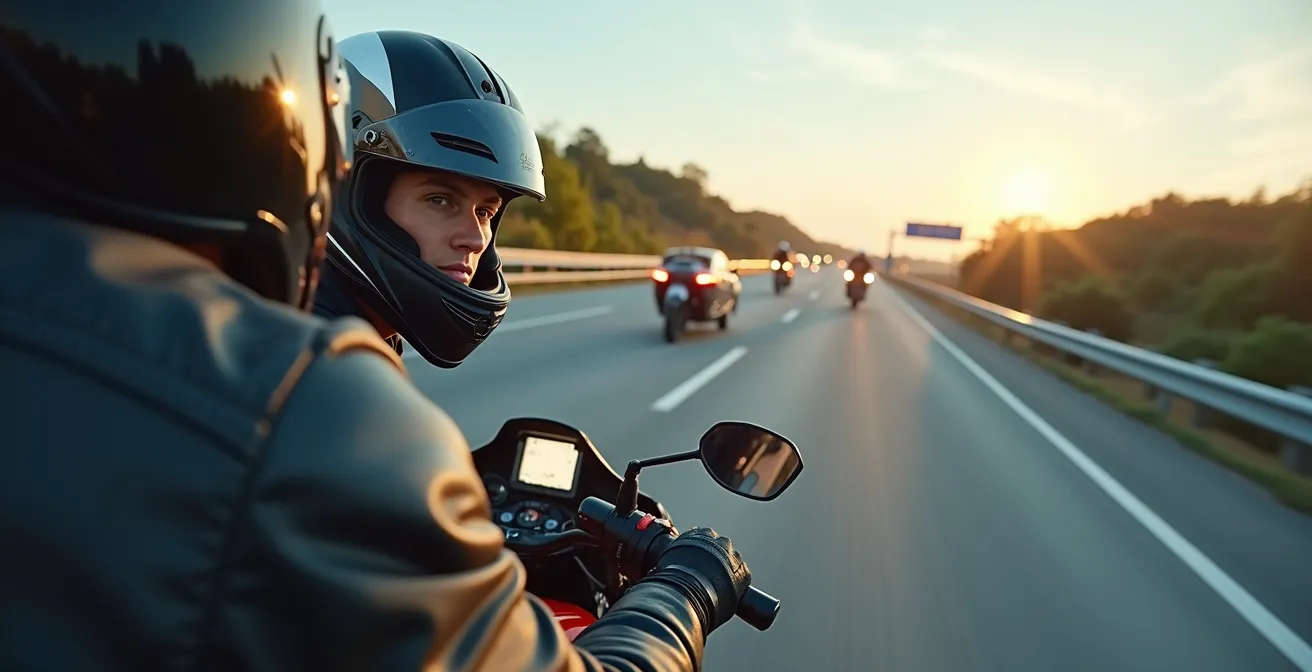
This principle of matching speed and minimizing the speed differential is a legal and safety cornerstone that extends directly to lane filtering. Just as a slow merge is illegal and dangerous, filtering at a speed excessively greater than surrounding traffic is reckless. Vehicle codes are built on the principle of predictable and safe interaction. For example, when Colorado legalized lane filtering, its law was highly specific, requiring that the motorcycle speed must not exceed 15 mph and traffic must be stopped. This illustrates how lawmakers view speed differential as the primary metric of safety, a principle that applies to every high-risk maneuver, including merging.
Staggered Formation: Why Riding Side-by-Side is Dangerous for Rookies?
Riding with a group can be one of the great joys of motorcycling, but it introduces a layer of complexity that demands strict discipline, especially regarding formation. The two primary formations are staggered and side-by-side. For new riders, and in almost all traffic situations, riding directly side-by-side is exceptionally dangerous. It completely removes any margin for error. A sudden pothole, a patch of gravel, or an unexpected swerve from a car leaves neither rider an escape path. Each rider’s safety buffer is effectively zero.
The professionally recommended and much safer alternative is the staggered formation. In this setup, the lead rider takes the left third of the lane (LP1), and the next rider follows at a one-second distance in the right third (LP3). The third rider then takes LP1, two seconds behind the leader, and so on. This formation gives each rider a full lane’s width for maneuvering in an emergency. It maintains group cohesion while maximizing individual safety zones. Single-file formation is reserved for situations like tight curves, poor visibility, or entering/exiting highways, as it provides the maximum possible space for each rider.
When a group encounters traffic dense enough to consider filtering, these formations become critically important. Attempting to filter from a side-by-side or even a staggered formation is complex and hazardous, requiring a level of coordination that is often unrealistic. The safest protocol is for the group to transition to a single-file line well in advance of the filtering zone. This creates a predictable, snake-like presence that is easier for drivers to understand and navigate around.
The challenge of coordinating a group maneuver in dense traffic is a recognized issue in advanced riding circles. As the Lane Filtering Research Team noted in a 2025 study:
The Group Filtering Conundrum addresses the complex legality and etiquette of multiple motorcycles filtering together.
– Lane Filtering Research Team, Skilled Motorcyclist Association Study 2025
This complexity is best illustrated by comparing the formations directly in the context of filtering preparedness.
| Formation Type | Safety Rating | Best Use Case | Filtering Transition Difficulty |
|---|---|---|---|
| Single File | Highest | Pre-filtering preparation | None – already aligned |
| Staggered | Medium | Highway cruising only | Complex – requires coordination |
| Side-by-Side | Lowest | Never recommended | Dangerous – unpredictable |
The Left Turn Trap: Why You Should Never Turn Wheels While Waiting?
Intersections are statistically the most dangerous places for motorcyclists, and one of the most insidious hazards is the “left turn trap.” This scenario occurs when a rider is waiting in an intersection to make an unprotected left turn. The common, and highly dangerous, habit is to pre-turn the handlebars and wheels in the direction of the intended turn while waiting for a gap in oncoming traffic. This seemingly efficient habit creates a loaded spring. If the motorcycle is struck from behind, even by a low-speed impact, the angled front wheel will propel the rider and bike directly into the path of oncoming traffic.
The correct and defensive procedure is to keep the motorcycle’s wheels pointing straight ahead until you are clear to accelerate through the turn. With the wheels straight, a rear-end impact will push you forward in a straight line, which is far more manageable and less likely to result in a catastrophic secondary collision. This single piece of discipline can be the difference between a fender-bender and a life-altering incident. The risk is not hypothetical; rear-end collisions are a significant threat to stationary riders. For context, state traffic data from Utah showed that over 1,200 motorcyclists were rear-ended between 2011 and 2017, highlighting the real-world danger of being a stationary target.
This principle of maintaining a neutral, defensive posture while stopped is directly applicable to lane filtering. When you are stopped between lanes of cars, your handlebars should be straight. This provides maximum stability and ensures you don’t inadvertently drift into a car. Your positioning should be deliberate, often at a slight angle to the flow of traffic to provide an escape route, but your controls should remain neutral until the moment you decide to move. Covering your brakes and clutch allows for an instant response, but the bike’s orientation should remain defensively neutral.
Target Fixation and Lane Drift: Why You Veer Toward What You Look At?
One of the most counter-intuitive principles of riding a motorcycle is this: you go where you look. This phenomenon, known as target fixation, is a psychological and physiological response where a rider becomes so focused on a hazard (a pothole, a car door, the guardrail) that they unconsciously steer directly towards it. Your brain tells your body to go where your eyes are locked. In a high-stress situation like cornering or emergency braking, this instinct can be fatal. The only way to combat it is through conscious, deliberate training: always look at your escape path, not the obstacle.
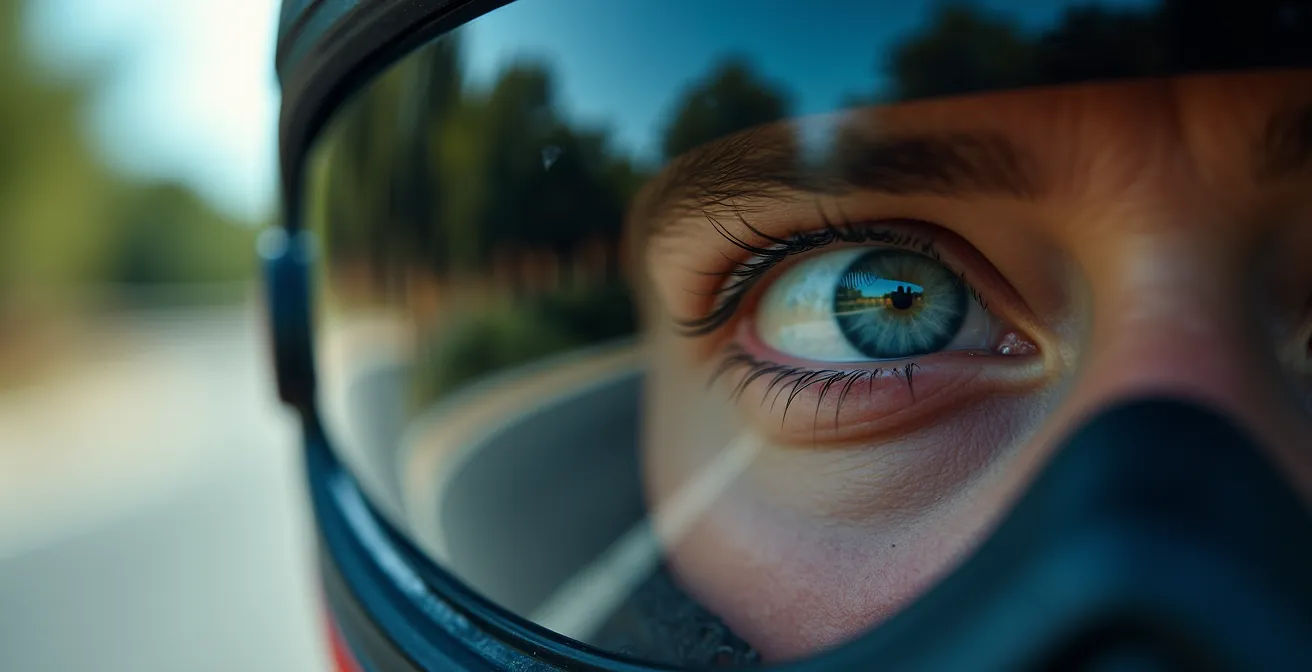
This principle is the absolute bedrock of successful lane filtering. When riding between two rows of cars, the natural tendency is to fixate on the mirrors or bumpers of the cars beside you. This is a recipe for lane drift and a potential collision. The correct technique is to keep your head and eyes up, looking far ahead down the “corridor” you are creating between the vehicles. You are not steering to avoid the car on your left; you are steering toward the open space 15 yards ahead. By focusing on your intended path, your inputs on the handlebars will be smoother and more precise, keeping you centered in your lane of travel.
This visual discipline must be paired with another critical factor: speed management. The safety of lane filtering is almost entirely dependent on the speed differential between the motorcycle and the surrounding traffic. An extensive UC Berkeley study, which analyzed nearly 6,000 motorcycle-involved collisions, provided the most crucial data point in this debate. It found that filtering is a comparatively safe practice when traffic is moving at 50 mph or less and the motorcyclist is traveling no more than 15 mph faster than surrounding traffic. As the speed differential decreases, safety increases. This 15-mph rule is the single most important metric for any rider to internalize. It provides a concrete, data-backed safety margin that can be used to self-govern your riding, regardless of what the local law (or lack thereof) might say.
Lane Splitting Etiquette: How to Pass Stopped Cars Without Angering Drivers?
If the legality of lane filtering is a matter of vehicle code, the *acceptance* of it is a matter of social contract. Successfully and peacefully filtering through traffic is less about what is legal and more about what is perceived as courteous and predictable. The reality is that many drivers are not educated on the practice and may view it as aggressive or unfair. A 2014 UC Berkeley study revealed that 61% of car drivers opposed the practice of lane splitting. This statistic should be a wake-up call for any rider: you are operating in an environment where the majority may not approve of your actions. Therefore, etiquette is not just polite; it’s a critical safety strategy.
The primary goal of filtering etiquette is to be as unobtrusive and predictable as possible. This means maintaining a steady, low speed (again, the 10-15 mph differential is key) and avoiding abrupt movements or loud, aggressive revving. Your approach should be smooth and confident, not startling. Acknowledge drivers who move over to give you space with a simple, quick acknowledgment wave or nod. This small gesture transforms you from an anonymous helmet into a fellow human being and reinforces cooperative behavior.
It’s also crucial to read the “body language” of the cars around you. Watch for drivers checking their mirrors, turning their wheels slightly, or closing the gap. These are all signs they are aware of you and potentially uncomfortable. In these moments, it is often wisest to hold back rather than force the issue. While it’s true that most drivers are not malicious, startling an unaware or nervous driver can cause them to swerve unpredictably. As the landmark 1981 Hurt Report noted, “Deliberate hostile action by a motorist against a motorcycle rider is a rare accident cause.” Incidents are far more likely to stem from surprise and panic than from malice. Your job is to minimize surprise at all costs.
Your Action Plan: De-escalation Techniques for Filtering Riders
- Use a two-finger acknowledgment wave when drivers create space – timing is crucial.
- Maintain a steady speed between 10-15 mph to appear predictable, not aggressive.
- Watch for anti-filtering body language: mirror checking, slight wheel turns, gap closing.
- Position yourself to be visible in mirrors before attempting to filter past.
- Avoid weaving between lanes; maintain a straight and predictable line whenever possible.
EV Privileges: Can Electric Motorcycles Legally Use Bus/Taxi Lanes?
The rise of electric motorcycles (EVs) introduces new variables into the urban commuting equation. Their silent operation and instant torque offer a different riding experience, but also create unique challenges and questions, particularly regarding special lane access. Many jurisdictions have bus, taxi, or high-occupancy vehicle (HOV) lanes to manage congestion. Whether a motorcycle, electric or not, can use these lanes is highly specific to local signage and ordinances. A sign indicating “Buses and Taxis Only” means just that. However, if the lane is designated as an HOV lane, motorcycles are often permitted by federal law, but state law can add its own restrictions.
For electric motorcycles, the question of special privileges is often conflated with perks given to electric cars. In most cases, an electric motorcycle is legally classified simply as a motorcycle. It does not automatically inherit the EV car privileges, like access to certain lanes or free parking, unless the local law explicitly includes two-wheeled vehicles. Therefore, a rider should never assume they have special access. The rule is simple: obey the signage for a motorcycle, regardless of its powertrain.
The silent nature of an EV motorcycle is a significant factor when filtering. Other drivers often rely on the sound of a motorcycle’s engine as an audible cue to its presence. An EV rider must compensate for this lack of sound by being even more visually assertive through their lane positioning and use of lights. Your visibility is your only warning system. This legal and practical reality is further complicated by the diverse range of two-wheeled electric vehicles. Lawmakers are often forced to be very specific about what constitutes a “motorcycle” for the purposes of a given law.
Case Study: Colorado’s Vehicle Definitions for Filtering
In clarifying its lane filtering law, Colorado specified that three-wheeled motorcycles, Vespas, and mopeds are permitted to filter. However, the law explicitly excludes e-bikes and electric scooters. The legal distinction was based on the vehicle code’s definition of a motorcycle, which requires handlebars connected to the front wheel and a seat the rider sits astride. This demonstrates how critical precise legal definitions are and why riders of non-traditional vehicles must be extra diligent in understanding their local codes.
Key Takeaways
- The primary factor for safe filtering is not absolute speed, but maintaining a speed differential of no more than 15 mph from surrounding traffic.
- Your lane position is your most effective form of non-verbal communication, signaling your intentions and establishing a safety buffer.
- Legal compliance is the minimum standard; true safety comes from mastering the social contract with other drivers through predictable and courteous behavior.
State Minimums vs Real Risk: Why Being “Legal” Might Bankrupt You After a Crash?
Operating within the law is the first step, but it is not a comprehensive safety or financial strategy. One of the most significant risks riders take is carrying only the state-mandated minimum liability insurance. These minimums are often woefully inadequate to cover the costs of a serious accident, especially one involving injury. If you are found at fault in a filtering incident, even a minor one, the damages can easily exceed a $25,000 property damage or bodily injury limit. This could leave you personally liable for tens or even hundreds of thousands of dollars.
Being “legal” in the sense that your state doesn’t explicitly outlaw filtering does not absolve you of liability. In a crash, insurance companies and courts will look at the specifics of the situation. Were you traveling at a safe speed differential? Were you being reckless? Was your maneuver predictable? The rider who adheres to the data-backed principles of safe filtering (like the 15-mph speed differential) is in a much stronger legal position than one who was simply “not breaking an explicit law.” Your insurance coverage should reflect the real risks of riding, not just the bare minimum to be legally on the road. Carrying higher limits of liability, along with uninsured/underinsured motorist coverage, is a critical piece of defensive financial planning.
Furthermore, it’s important to acknowledge that while filtering reduces the risk of being rear-ended, the same UC Berkeley study found it introduces other risks. The data indicates that lane-splitting riders are more likely to rear-end other vehicles themselves compared to non-splitters. This underscores the need for constant vigilance and a deep understanding that you are trading one set of risks for another. The ultimate goal is to be so prepared, both in skill and in financial protection, that you are insulated from the worst-case scenario. This preparation includes knowing exactly what to do in the moments after an incident to protect your legal rights.
Checklist: Post-Incident Protocol for Filtering Accidents
- First 60 seconds: Stay calm, assess for injuries, and do not admit fault under any circumstances.
- Document everything: Take photos of vehicle positions, road conditions, damage, and identify any potential witnesses.
- Limit statements to facts only: Tell law enforcement “I was filtering at approximately X mph in stopped traffic.” Avoid explanations, justifications, or emotional statements.
- Exchange driver’s license, registration, and insurance information without discussing the circumstances of the crash.
- Contact your insurance company immediately to open a claim, but provide only factual information, not speculation.
Ultimately, a rider’s best defense is a proactive mindset. This involves not only mastering the physical skills of motorcycle control but also adopting the strategic foresight of a risk manager. Assess your insurance coverage, understand the nuances of your local vehicle code, and commit to a riding style that prioritizes predictability and de-escalation. By doing so, you transform lane filtering from a gamble into a calculated and defensible part of your urban mobility toolkit.
Frequently Asked Questions about Lane Filtering and Splitting
Can electric motorcycles use bus lanes for filtering?
You can use bus lanes with a motorcycle only if the signage does not designate them as “bus-only” or otherwise restrict motorcycle access. If motorcycles are permitted, this is not technically “filtering,” as you are simply using a lane you are legally allowed to be in. Always remain vigilant for vehicles turning across the bus lane.
How does the silent approach of EVs affect filtering safety?
Electric motorcycles lack the engine and exhaust noise that many drivers subconsciously rely on for awareness of a nearby motorcycle. This “silent approach” requires the EV rider to be more visually assertive. This means using strategic lane positioning to remain in drivers’ mirrors, employing high-visibility gear, and potentially using the horn with a quick, polite tap when necessary to announce your presence.
Is there different insurance liability for EV filtering?
Generally, insurance liability considerations for an electric motorcycle are the same as for a gasoline-powered one. However, in the event of an incident during a filtering maneuver, the unique characteristics of the EV, such as its silent operation, may become a factor in determining fault. An argument could be made that the EV rider has a higher duty of care to ensure they are seen, which is why a robust understanding of defensive positioning is so critical.