
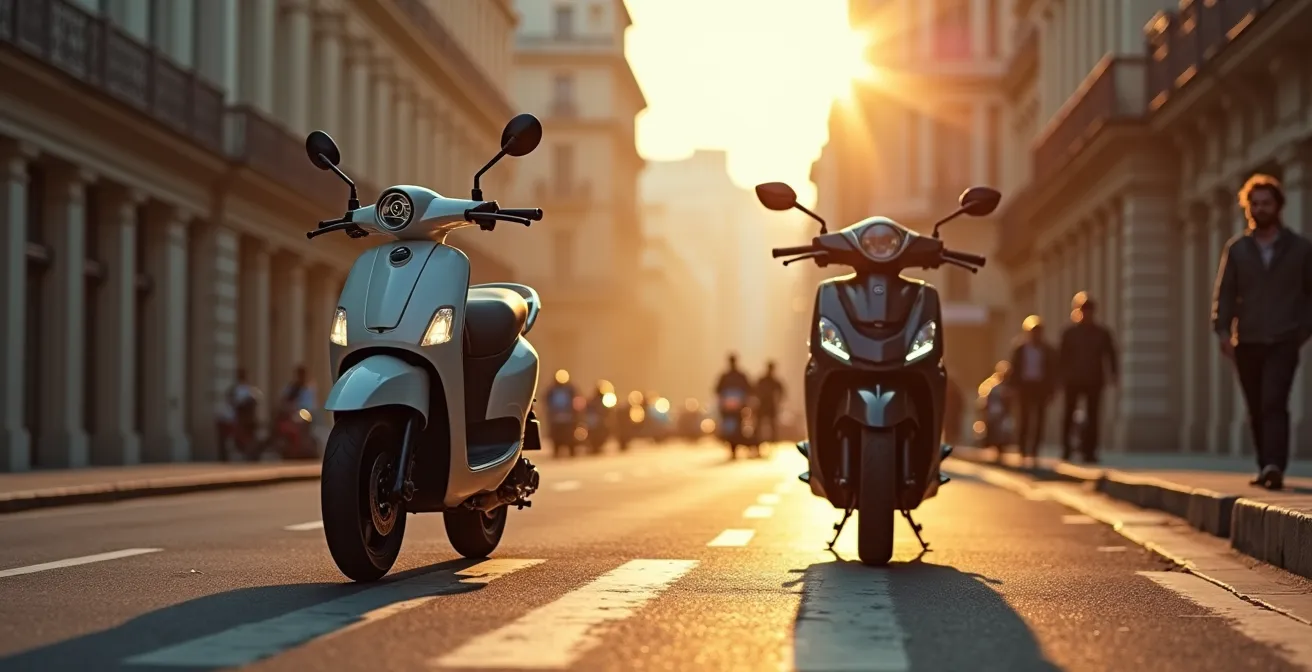
Navigating urban restrictions is no longer just about avoiding fines; it’s about understanding a new urban operating system where compliant motorcycles gain new privileges.
- Restrictions like Low Emission Zones (LEZ) and noise enforcement are now paired with new opportunities like bus lane access and dedicated parking for electric vehicles.
- Future-proof mobility involves integrating your ride with smart city infrastructure (V2X) and multi-modal transport options.
Recommendation: Shift your mindset from compliance-as-a-burden to strategic integration to unlock the full potential of two-wheeled travel in modern cities.
For any rider living in a European capital, the feeling is familiar: a confusing patchwork of new zone maps, acronyms like LEZ and ULEZ, and the looming question, “Is my bike still welcome here?” The instinct is to focus on the restrictions, the potential fines, and what you might lose. Many guides will simply tell you to check your city’s website or confirm your bike’s Euro-norm rating. This is necessary, but it’s only half the story.
The reality is more complex and, frankly, more interesting. Cities are not just building walls; they are rewriting their entire transportation “operating system.” This shift creates a new landscape of both penalties and privileges. While older, noisier, or more polluting bikes face increasing restrictions, a new class of compliant and electric motorcycles is gaining access and advantages previously unheard of. The key is to stop seeing this as a simple ban and start understanding it as a systemic evolution.
But what if the true key wasn’t just checking if your bike is compliant, but understanding how to leverage this new system to your advantage? This guide moves beyond the simple “banned or not banned” question. We will explore the emerging privileges for electric motorcycles, the future of connected vehicle technology, the reality of noise enforcement, and how to intelligently integrate your ride into a larger, multi-modal transport strategy. It’s time to decode the new rules of the urban game.
This article will guide you through the key facets of this new urban environment for motorcyclists. Below is a summary of the topics we will cover, from the immediate perks of EV ownership to long-term strategies for integrating your bike into the city of the future.
Summary: Navigating the New Urban Operating System for Riders
- EV Privileges: Can Electric Motorcycles Legally Use Bus/Taxi Lanes?
- EV-Only Parking: Are You Allowed to Park There If You Aren’t Charging?
- Vehicle-to-Everything: How Will Your Bike Talk to Traffic Lights in the Future?
- Noise Radar Enforcement: How e-Mobility Solves the Problem of Night Bans?
- Integration: How to Combine Your Ride with Train Travel using Mobility Apps?
- When to Detour: Is Adding 3 Miles Worth Avoiding 10 Minutes of Traffic?
- Is It Possible to Add a Catalytic Converter to a Vintage Bike for Eco-Zones?
- Folding E-Bikes vs Compact Motos: Which Fits in Your Apartment Elevator?
EV Privileges: Can Electric Motorcycles Legally Use Bus/Taxi Lanes?
One of the most immediate and tangible benefits of the shift towards cleaner urban transport is the potential for motorcycles to gain access to bus lanes. For decades, this has been a contentious issue, but the rise of emissions-based regulations is changing the conversation. It’s a prime example of a new privilege granted to those who adapt to the city’s evolving rules. Local authorities, who ultimately control access, are increasingly viewing compliant motorcycles not as a problem, but as part of the solution to congestion.
London provides a leading example. On the city’s critical “Red Routes,” solo mopeds and motorcycles are permitted in many bus lanes, a policy that Transport for London states “provides consistency for riders, avoiding confusion and unnecessary risk.” This isn’t a blanket rule, as local councils retain authority, but the trend is clear. Public support is overwhelmingly in favor; a 2024 Department for Transport consultation revealed that 95% of 14,000 public responses supported universal motorcycle access to bus lanes. While the UK government has not yet made this a universal law, the data shows a powerful mandate for change.
The logic is simple: a motorcycle, particularly a quiet and zero-emission electric one, occupies minimal space and contributes to traffic flow when allowed in these lanes. For the urban rider, this translates directly into faster, safer, and less stressful journeys. It’s a strategic advantage earned by aligning with the city’s goals of reducing congestion and pollution.
EV-Only Parking: Are You Allowed to Park There If You Aren’t Charging?
The privileges for electric vehicles extend beyond the bus lane and into one of the most challenging aspects of urban life: parking. As cities incentivize EV adoption, dedicated parking and charging bays are becoming more common. For electric motorcycle riders, this presents a significant opportunity. However, it also introduces a new layer of etiquette and regulation. The cardinal rule is straightforward: EV-only parking spots are for active charging, not just convenient parking. Using a charging bay as a simple parking spot, an act known as “ICEing” (from Internal Combustion Engine), is not only poor form but is increasingly subject to fines.
The real advantage for electric motorcycles lies in their inherent space efficiency. A single car parking bay can be reconfigured to accommodate multiple motorcycles, transforming urban parking infrastructure. This concept of a high-density charging hub is where the future is headed.
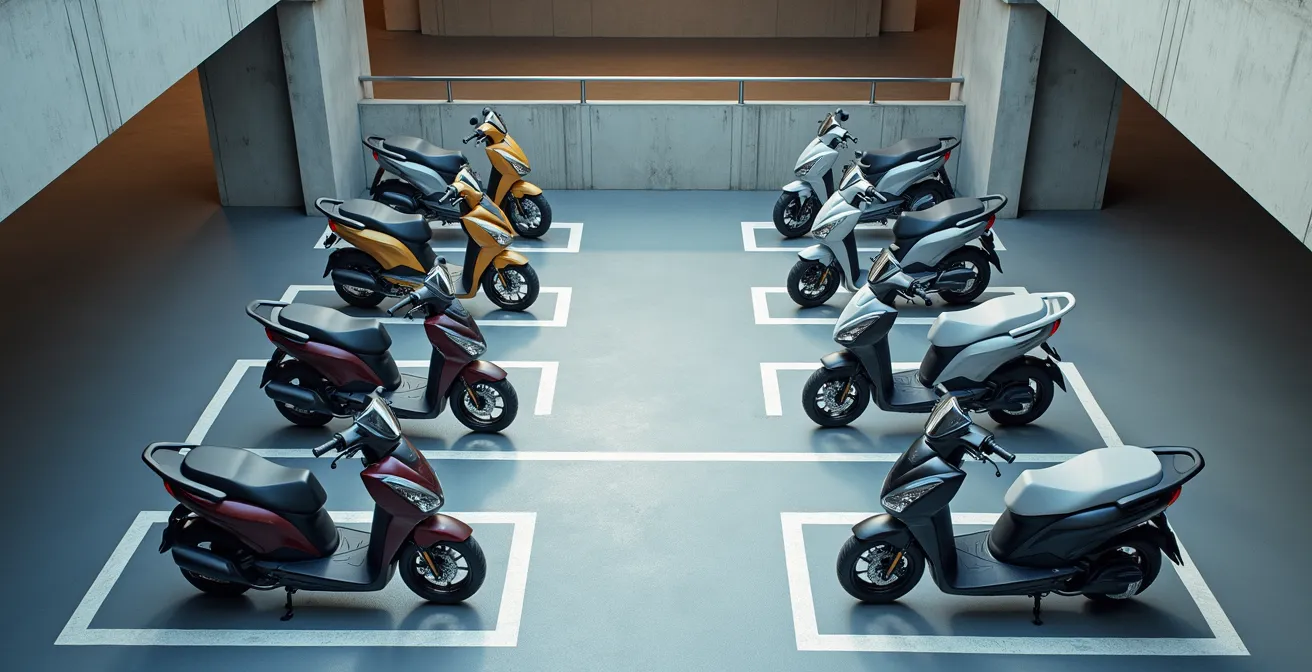
As the image illustrates, the spatial footprint of a motorcycle is a key asset. Planners can design charging hubs that cater specifically to two-wheeled vehicles, dramatically increasing the capacity of a given area. This efficiency is a powerful argument for city planners to invest in dedicated motorcycle charging infrastructure, a trend that benefits riders directly.
The comparative advantage becomes even clearer when looking at the data. An electric motorcycle not only takes up less space but often requires less time to charge than an electric car, increasing the turnover and availability of charging points for everyone.
Vehicle-to-Everything: How Will Your Bike Talk to Traffic Lights in the Future?
Beyond the immediate perks of bus lanes and parking, the integration of motorcycles into smart cities is heading towards a much more profound level: direct communication with the urban infrastructure itself. This is the world of Vehicle-to-Everything (V2X) technology. Imagine your motorcycle digitally “talking” to traffic lights to optimize flow, receiving alerts about a pedestrian crossing a blind corner, or being warned of a vehicle about to run a red light. This isn’t science fiction; it’s the next logical step in the urban operating system.
The primary driver for V2X is safety. The technology enables vehicles to broadcast their position, speed, and direction to other vehicles (V2V), to infrastructure (V2I), and to pedestrians (V2P). For motorcyclists, who are inherently more vulnerable in traffic, this creates a digital safety net. The U.S. Department of Transportation estimates that V2X could lead to an 80% reduction in crashes where drivers are not impaired. Projects like the large-scale deployment in Ann Arbor, Michigan, which included motorcycles alongside cars and trucks, have already proven that the technology is interoperable and effective.
This digital handshake between your bike and the city’s infrastructure represents the ultimate form of systemic integration. It moves the rider from being a passive user of the road to an active, connected node in a dynamic, responsive network.
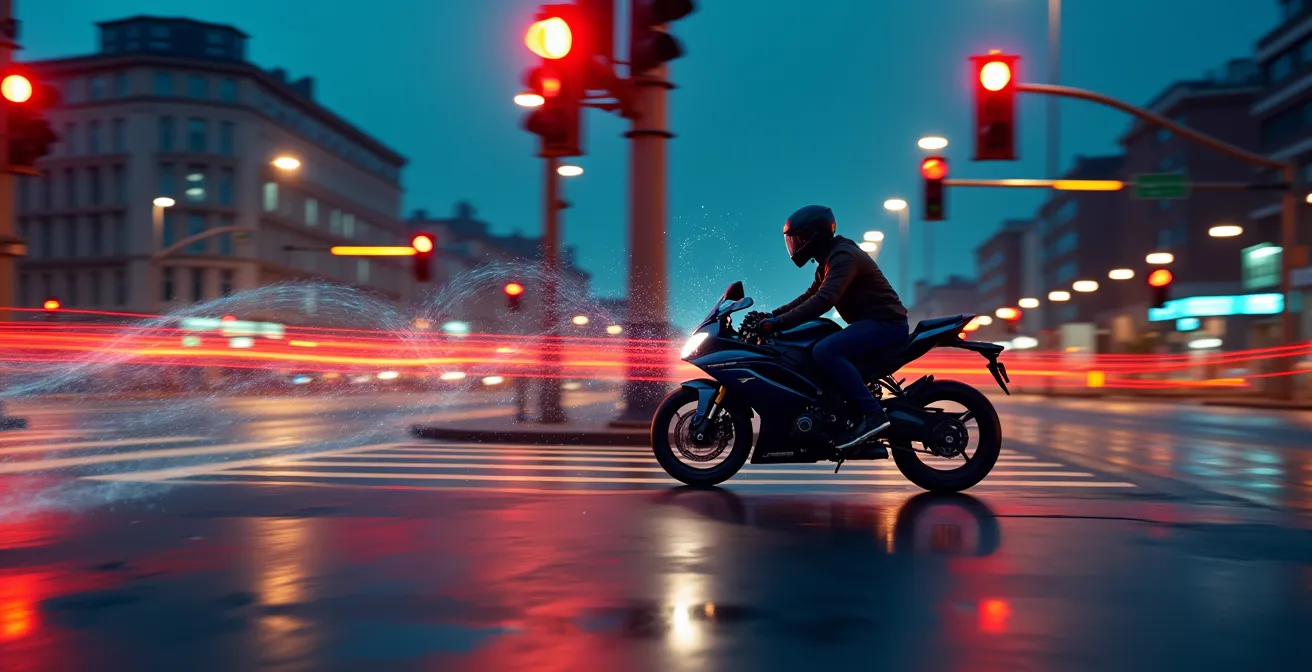
While widespread adoption is still a few years away, the foundational technologies are being deployed now. As an urban rider, understanding the concept of V2X is crucial to appreciating the long-term vision for smart cities, where technology will be as important as horsepower for navigating the urban environment efficiently and safely.
Noise Radar Enforcement: How e-Mobility Solves the Problem of Night Bans?
While clean air is the primary driver of Low Emission Zones, there is another critical factor shaping the future of urban motorcycling: noise. For many residents, the disruptive sound of loud exhausts is a greater nuisance than emissions. In response, cities and regions are deploying a new form of enforcement: noise radar. These devices can pinpoint a specific vehicle and measure its decibel level, leading to automated fines and, in some cases, riding bans on certain roads or at certain times.
The Federation of European Motorcyclists’ Associations (FEMA) highlights this growing issue clearly. They explain that for motorcycles, the problem is often not exhaust emissions but noise, which can lead to significant access restrictions. As their report states:
The ordinary environmental zones (Umweltzonen) are freely accessible for motorcycles. The problem here is not the exhaust emissions, but the noise, which causes both roads, villages and cities to be closed for motorcycles at certain times, days or even permanently
– FEMA (Federation of European Motorcyclists’ Associations), LEZ Report 2018
This is not a theoretical threat. In Austria, for instance, parts of the Tyrol province have implemented strict rules, where a stationary noise level above 95 decibels is no longer permitted on certain popular routes. This represents a significant “penalty” within the new urban operating system. For riders of many traditional combustion engines, especially those with aftermarket exhausts, these areas are becoming off-limits.
Here, the solution is starkly clear: e-mobility. Electric motorcycles are virtually silent, making them completely immune to noise-based restrictions. For a rider concerned with guaranteed access, especially for night-time travel or journeys through sensitive areas, an electric bike is no longer just an environmental choice—it’s a strategic one for ensuring total freedom of movement.
Integration: How to Combine Your Ride with Train Travel using Mobility Apps?
The most advanced level of navigating the new urban operating system is to see your motorcycle not as your sole mode of transport, but as a vital component in a larger, multi-modal journey. This means strategically combining the flexibility of your bike with the speed and reach of public transport like trains. This “park and ride” strategy allows you to use your motorcycle for the first and last miles of your commute, bypassing the most congested central zones entirely while still enjoying the ride.
Cities are actively encouraging this behavior. In London, for example, there is a focus on providing secure motorcycle parking at suburban rail and tube stations on the outskirts of the Ultra Low Emission Zone (ULEZ). This allows riders to easily transition from road to rail. This approach is highly effective; Transport for London’s monitoring shows that the vast majority of motorcycles entering the city are already compliant, demonstrating that riders are adapting. The goal is no longer just to get from A to B on two wheels, but to find the most efficient and intelligent combination of transport modes.
This requires a new set of tools and skills, moving beyond traditional navigation to integrated mobility platforms. These apps are the key to unlocking seamless multi-modal travel.
Your Action Plan: 5 Steps to Seamless Multi-Modal Commuting
- Download integrated mobility apps like Whim or Jelbi that support multi-modal journey planning, combining private and public transport.
- Use apps to locate secure motorcycle parking facilities at major transit hubs, ideally with real-time availability data.
- Look for and utilize app-enabled lockers or moto-hubs at stations for convenient helmet and gear storage.
- Plan routes using AI-optimized combinations of motorcycle and public transport to find the true fastest path.
- Set up unified payment systems within these apps to create a single subscription for all your transport needs.
By embracing this integrated approach, the urban motorcyclist transforms from a simple commuter into a sophisticated navigator of the complete mobility network, using the right tool for each part of the journey.
When to Detour: Is Adding 3 Miles Worth Avoiding 10 Minutes of Traffic?
Every urban rider faces this classic dilemma: your GPS flags a 10-minute traffic jam ahead, but offers a 3-mile detour on clear roads. The intuitive answer for a car driver might be to sit and wait. For a motorcyclist, however, the calculation is fundamentally different. This is the “mobility calculus” in action—a decision-making process that must weigh factors far beyond simple time and distance.
For a motorcycle, sitting in stop-and-go traffic is not just frustrating; it’s mechanically and physically demanding. It puts significant wear on the clutch, causes the engine to build up heat, and increases rider fatigue due to the constant need to balance and operate controls. In contrast, a detour at a steady speed, even if longer, is often less stressful for both the machine and the rider. Furthermore, accident risk is statistically higher in dense, slow-moving traffic than on an open road.
Analyzing the trade-offs reveals a clear picture. The minimal extra fuel cost of a detour is often a small price to pay for avoiding significant component wear and reducing mental and physical strain.
| Factor | 3-Mile Detour | 10-Min Traffic |
|---|---|---|
| Fuel Cost | $0.50 | $0.30 (idling) |
| Engine Wear | Minimal (constant speed) | High (heat stress) |
| Clutch Wear | None (cruising) | Significant (stop-go) |
| Rider Fatigue | Low | High (balance/clutch work) |
| Accident Risk | Low (clear roads) | Higher (dense traffic) |
This calculus is a microcosm of the larger strategic thinking required to thrive as an urban rider today. It’s about understanding the unique characteristics of your vehicle and making informed decisions that optimize for efficiency, safety, and longevity, not just the shortest route on a map.
Is It Possible to Add a Catalytic Converter to a Vintage Bike for Eco-Zones?
For owners of classic or vintage motorcycles, the expansion of Low Emission Zones can feel like an existential threat. These machines are often cherished for their history and character, but they were built long before modern emissions standards. The question then becomes: can an old bike be taught new tricks? The answer is a qualified yes, with several pathways available to keep historic bikes on the road.
The first and most important path is exemption. Many regulatory frameworks, including London’s ULEZ, recognize the cultural value of classic vehicles. In the UK, if a motorcycle is over 40 years old, it is considered a historic vehicle and is exempt from the ULEZ charge. This 40-year rolling classification is a crucial lifeline for the classic bike community. It’s essential for owners to check the specific exemption rules in their city, as they can vary.
For bikes that are too young to be “historic” but too old to be compliant, the path is more complex. Retrofitting a modern catalytic converter is technically challenging. Unlike cars, motorcycles have tightly packaged exhaust systems where space is at a premium, and the tuning is highly sensitive. While not impossible, it’s often not an off-the-shelf solution. However, there are specialists who can help. As the Bikesure guide points out, some firms like Riverbank Motorcycles are able to finely tune an engine to bring its emissions just under the required limit, making it compliant. This is a bespoke solution for machines that are borderline non-compliant. The increasing pressure from cities like Barcelona, which has banned older bikes, is driving the economic case for these innovative retrofitting solutions over forced replacement.
Key takeaways
- The urban environment is a new “operating system” with both penalties (LEZs, noise bans) and privileges (bus lane access, EV parking).
- Electric motorcycles are not just an environmental choice but a strategic one, granting immunity from noise restrictions and access to special perks.
- True urban mobility mastery involves integrating your ride into a multi-modal system, using technology and smart planning to optimize every journey.
Folding E-Bikes vs Compact Motos: Which Fits in Your Apartment Elevator?
The final frontier of urban integration is the “last mile” problem—bridging the gap between a transport hub and your final destination. For apartment dwellers, this extends right to their front door, and often, the limiting factor is the size of the building’s elevator. This has given rise to a new class of ultra-compact personal electric vehicles, blurring the lines between bicycle and motorcycle. The choice between a premium folding e-bike and a new-wave compact electric moto comes down to a trade-off between portability, performance, and regulation.
The engineering focus has become extreme. The goal is to create a vehicle with meaningful performance on the road that can shrink down to an almost unbelievable size for storage and transport. The details of the folding mechanisms—the precision hinges and locking parts—are marvels of modern design.
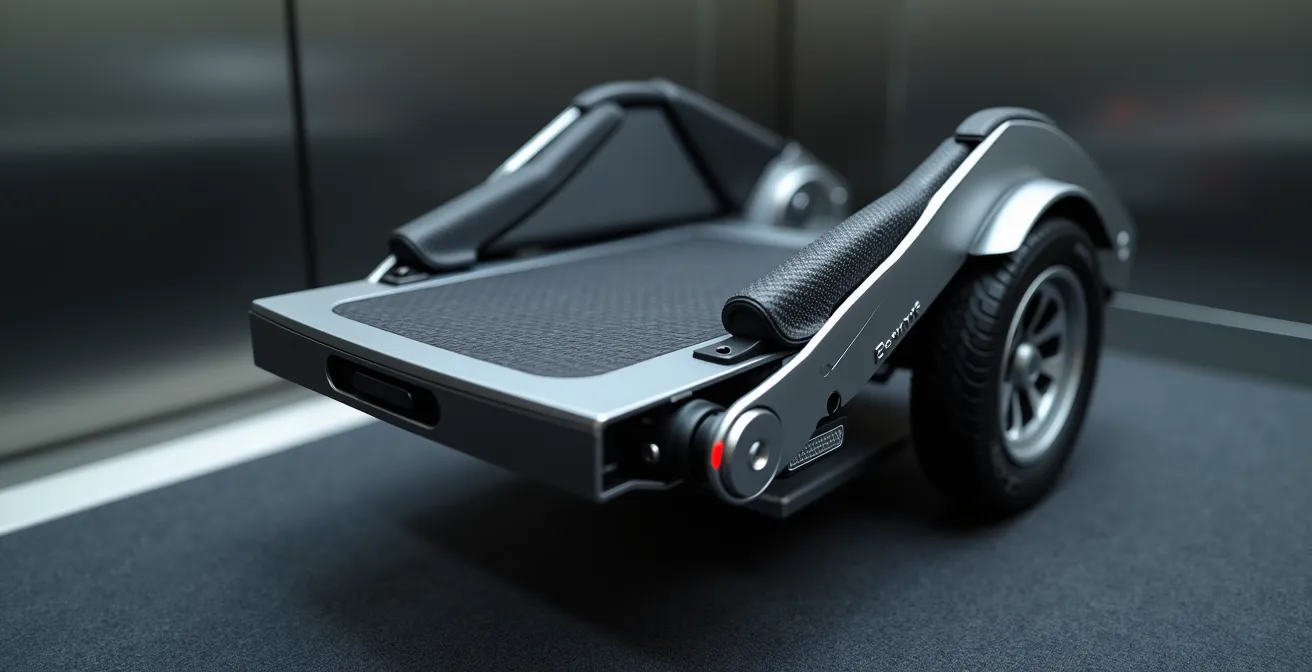
Some designs, like the innovative Tatamel bike, push the boundaries of this concept. It’s a road-legal electric motorcycle that, when folded, shrinks to the dimensions of a large suitcase. According to a report, the machine’s folded size of 69 × 69 × 26 cm makes it a true last-mile machine that you can roll directly into an elevator. However, at 63 kg, its weight is a significant factor compared to a folding e-bike.
The decision involves a clear set of variables: speed, weight, licensing requirements, and, crucially, folded dimensions. Each option occupies a unique space in the urban mobility matrix.
| Vehicle Type | Folded Size | Weight | Speed | License Required |
|---|---|---|---|---|
| Honda Motocompacto | 74 x 53 x 9cm | 41 lbs | 15 mph | No |
| Colibri M22 | 88 x 128cm | 66 lbs (no battery) | 60 mph | Yes |
| Premium Folding E-Bike | 80 x 70 x 40cm | 45-55 lbs | 20-28 mph | No |
| Tatamel Bike | 69 x 69 x 26cm | 139 lbs | 25 mph | Yes |
Ultimately, successfully riding in the modern city requires a new perspective. Instead of viewing regulations as mere obstacles, start seeing them as the programming of a new urban operating system. By understanding the code—the rules, the penalties, and the emerging privileges—you can transform from a confused commuter into a master navigator of the urban landscape, fully leveraging the unparalleled efficiency and freedom of two-wheeled transport.