
The true environmental cost of a motorcycle is determined less by its powertrain and more by its entire lifecycle, from manufacturing to disposal.
- Electric motorcycles carry a significant upfront “carbon debt” from battery production, which must be “paid back” over thousands of miles.
- Rider behavior—how you ride, charge, and maintain your bike—is a massive multiplier that can either erase or deepen the initial environmental impact.
Recommendation: Instead of asking “which bike is greener?,” the eco-conscious rider should ask “how can I manage my bike’s total lifecycle impact?” This guide provides the data to do just that.
For the eco-conscious rider, the choice between a gasoline-powered motorcycle and its electric counterpart seems simple. One has tailpipe emissions, the other does not. Yet, this binary view overlooks a far more complex and critical reality. The true environmental footprint of any vehicle is not merely what comes out of its exhaust but is the sum of its entire existence—a concept known as a lifecycle assessment (LCA). This includes the carbon-intensive mining of raw materials, the energy consumed in manufacturing, the impact of its operational life, and the often-problematic disposal of its components at the end.
Most discussions stall on the obvious: gas bikes burn fossil fuels, while EV batteries require significant resources to produce. While true, these are just two data points in a much larger equation. The central thesis of this analysis is that a motorcycle’s green credentials are not fixed at the point of sale. They are a dynamic variable heavily influenced by factors like the energy grid used for charging, rider maintenance habits, and the infrastructure available for recycling. The initial manufacturing impact, particularly the lifecycle carbon debt of an EV battery, is a crucial starting point, but it’s not the final word.
This article moves beyond the tailpipe to provide a data-driven comparison of the entire system. We will dissect the hidden environmental costs and benefits at every stage, from the difficult end-of-life realities of helmets and tires to the granular decisions that dictate battery longevity and fuel efficiency. By understanding these variables, a rider can make an informed choice not just about what to buy, but how to own it responsibly.
Contents: A Lifecycle Analysis of Motorcycle Carbon Impact
- End of Life: What Should You Do With Old Helmets and Textile Jackets?
- Rubber Waste: Why Motorcycle Tires Are Harder to Recycle Than Car Tires?
- Bike vs Car vs Bus: Is Riding a Motorcycle Actually Greener Than Public Transit?
- Oil and Coolant: How to Ensure Your DIY Waste Doesn’t End Up in Groundwater?
- Greenwashing in Moto: How to Identify Brands That Truly Use Recycled Materials?
- Why Your MPG Drops Drastically During Rush Hour and How to Fix It?
- Why Are Hybrid Motorcycles So Rare Compared to Hybrid Cars?
- Lithium-Ion Longevity: How to Charge Your Battery to Make It Last 10 Years?
End of Life: What Should You Do With Old Helmets and Textile Jackets?
A motorcycle’s environmental story doesn’t end when the engine stops; it extends to the gear that protects the rider. Helmets and jackets are complex composites of plastics, foams, fabrics, and adhesives, making them a significant end-of-life challenge. A helmet, for safety reasons, has a finite lifespan of roughly five years, and with research showing that over 40% of motorcyclists may be using helmets that need replacement, the scale of this waste stream is substantial. Simply discarding them in a landfill means these durable materials will persist for centuries.
The core problem is material separation. A helmet’s outer shell (often fiberglass, carbon fiber, or polycarbonate) is bonded to an expanded polystyrene (EPS) foam liner. Textile jackets fuse durable outer layers with waterproof membranes and armor. Disassembling these fused materials is labor-intensive and often not economically viable for municipal recycling centers. This is a classic example of a material failure point in the circular economy, where a product designed for performance and safety was not designed for disassembly.
However, responsible disposal options are emerging. Some forward-thinking manufacturers are tackling this issue head-on. For instance, Dainese launched a European initiative to recycle thermoplastic helmets, aiming to extract and transform the plastic components into new products. This addresses the challenge by creating a dedicated waste stream. For the individual rider, several actions can prevent a helmet from ending up in a landfill:
- Donate for Training: Emergency services (fire departments, EMTs) often accept old helmets to practice safe removal techniques on accident victims. This gives the helmet a valuable second life.
- Manual Disassembly: If you’re willing to put in the effort, you can separate the components. Cut the straps, remove the EPS liner, and check if the outer shell is made from a recyclable plastic like PET. Contact your local recycling facility to see if they accept the separated parts.
- Upcycling: After cutting the chin straps to ensure it can never be used for riding again, a helmet can be repurposed as a unique planter or a piece of workshop art.
For textile jackets, look for brands with take-back programs or consider donating them to charities if they are still in wearable condition. The key is to shift the mindset from “throwing away” to “re-routing” these complex items.
Rubber Waste: Why Motorcycle Tires Are Harder to Recycle Than Car Tires?
Tires represent one of the most significant and stubborn waste problems in the automotive world, and motorcycle tires present a unique set of challenges. Unlike their automotive counterparts, motorcycle tires are not just smaller; they are engineered with complex, multi-compound structures to provide grip at extreme lean angles. This involves layering different rubber formulations—a harder, more durable compound in the center for longevity and softer, stickier compounds on the shoulders for cornering traction. This intricate construction is a major hurdle for recycling.
The process of vulcanization, which gives rubber its durability by cross-linking polymers with sulfur, makes tires extremely difficult to break down into their original raw materials. While car tires are recycled in large volumes (often shredded into “crumb rubber” for use in asphalt, playgrounds, or fuel), the smaller market and more complex composition of motorcycle tires make dedicated recycling streams less common. The presence of multiple rubber compounds, along with embedded materials like nylon, rayon, or steel belts, complicates the shredding and sorting process.
Furthermore, the environmental impact of tires isn’t limited to disposal. As they wear, tires shed microscopic particles of synthetic rubber, fillers, and chemicals onto roadways. These microplastics are a major source of environmental pollution, washing into waterways and soil. The very nature of a high-performance motorcycle tire, designed to trade rubber for grip, exacerbates this issue.
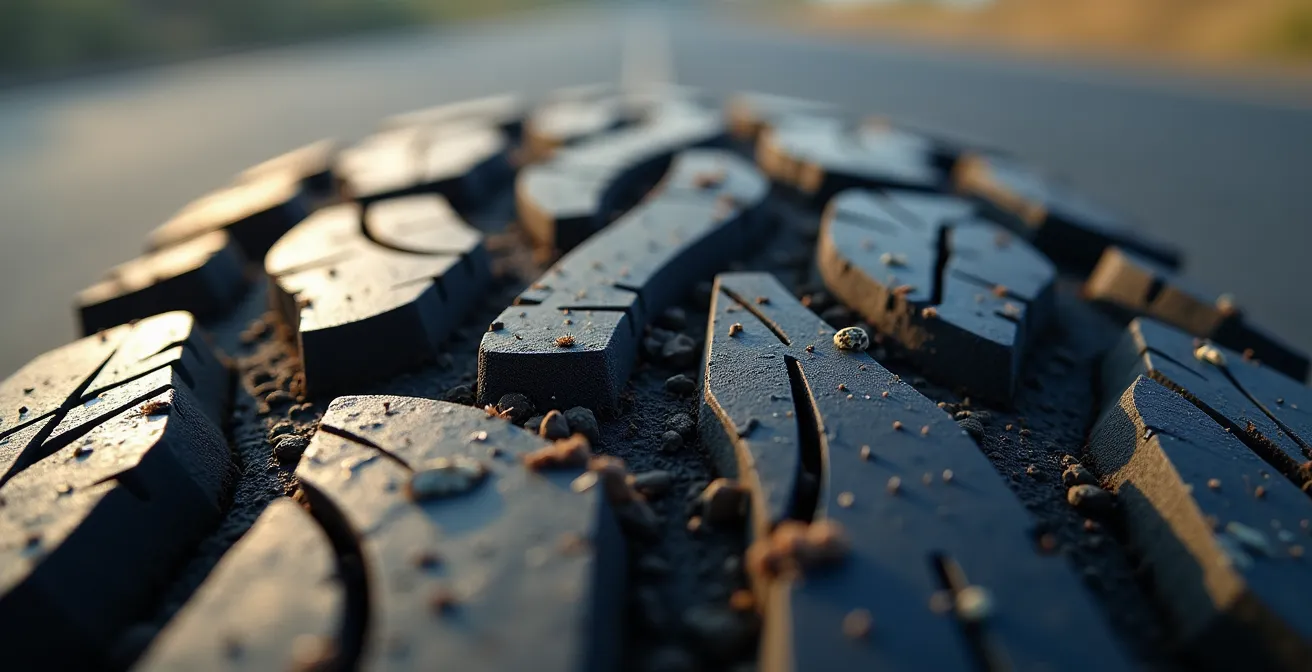
As this visualization shows, the breakdown of tire tread is a physical process of shedding material into the environment. This form of non-exhaust emission is a critical part of a motorcycle’s total environmental footprint, regardless of whether it’s powered by gas or electricity. The solution is not simple, but it starts with acknowledging that tire wear is a direct release of pollutants. Choosing more durable, touring-oriented tires over soft, racing-compound tires can reduce the rate of this shedding. Supporting manufacturers who are exploring alternative materials and promoting extended producer responsibility are crucial long-term steps.
Bike vs Car vs Bus: Is Riding a Motorcycle Actually Greener Than Public Transit?
The long-standing argument for motorcycles as an eco-friendly choice centers on fuel efficiency. A gas-powered motorcycle that achieves 50 MPG is intuitively better than a 25 MPG car. When we introduce electric motorcycles, the operational benefits become even more pronounced. On a direct emissions basis, an EV bike is orders of magnitude cleaner than any internal combustion vehicle. But how does it stack up against the benchmark of urban green mobility: public transportation?
The answer depends entirely on the metrics and boundaries of the analysis. If we only consider tailpipe CO2, an electric motorcycle is a clear winner, producing zero emissions during operation. However, the “greener” choice is a question of systemic efficiency. A city bus, while consuming a large amount of fuel, can transport 50 people. Its per-passenger carbon footprint can be significantly lower than a single-occupant car and, in some cases, even a single-occupant gas motorcycle, especially during rush hour when engine inefficiency skyrockets.
Electric motorcycles change this calculation. Their extreme efficiency means their operational carbon footprint is tied solely to the carbon intensity of the electrical grid used to charge them. Even on a relatively carbon-intensive grid, their impact is minimal. The following table provides a clear comparison of the operational CO2 emissions and energy efficiency across different transport modes.
This data, drawn from a recent comparative analysis of transport modes, starkly illustrates the efficiency of electric two-wheelers. The electric motorcycle’s efficiency, measured in Miles Per Gallon equivalent (MPGe), dwarfs all other options.
| Transport Mode | MPGe/Efficiency | CO2 per km |
|---|---|---|
| Electric Motorcycle | 400 MPGe | 20g |
| Tesla Model 3 | 141 MPGe | Variable by grid |
| Gas Motorcycle | 40-60 MPG | 110g |
| Gas Car | 25-35 MPG | 150-200g |
While the table confirms an EV bike’s superior operational efficiency, it doesn’t account for the manufacturing footprint or the impact of carrying just one person. Therefore, while riding an EV motorcycle is almost certainly “greener” than driving a gas car alone, it may not be greener than taking a well-occupied bus or train. The truly optimal choice depends on vehicle occupancy, traffic conditions, and the carbon intensity of the local power grid.
Oil and Coolant: How to Ensure Your DIY Waste Doesn’t End Up in Groundwater?
For owners of internal combustion motorcycles, routine maintenance is a fact of life, and with it comes the responsibility of handling hazardous fluids. Used motor oil and coolant are not just messy; they are potent environmental contaminants. A single oil change can produce a gallon of used oil, which, if disposed of improperly, can contaminate a million gallons of fresh water. This is a direct and preventable environmental impact where the rider impact multiplier is at its highest.
Used motor oil is laden with heavy metals like lead, cadmium, and arsenic, along with other toxic organic compounds that accumulate during engine operation. When poured down a storm drain, onto the ground, or tossed in the trash, these substances can seep into the soil and ultimately contaminate groundwater—the source of drinking water for many communities. Coolant, typically containing ethylene glycol, is toxic to humans and animals and also poses a significant threat to aquatic ecosystems.
The responsibility for preventing this contamination lies entirely with the individual performing the maintenance. Fortunately, proper disposal is straightforward and often free. The key is to never mix different fluids and to follow a clear process:
- Containment: Always use a designated drain pan to catch the old oil or coolant. Never use containers that previously held other chemicals, like bleach or pesticides, as this can contaminate the waste stream.
- Storage: Transfer the used fluid into a clean, sealable container. The original product bottle or a dedicated reusable jug is ideal. Ensure it is clearly labeled.
- Find a Collection Center: Most auto parts stores (like AutoZone, Advance Auto Parts, or O’Reilly Auto Parts in the US) accept used motor oil for free as part of their recycling programs. Many municipal waste facilities or local mechanic shops also have designated collection points for both oil and coolant.
- Never Mix: Do not mix used oil with coolant, brake fluid, or solvents. This can make the entire batch unrecyclable and create a more hazardous mixture.
This is one area where the environmental choice is unambiguous. The few minutes it takes to transport used fluids to a proper collection facility prevents significant and long-lasting environmental damage. It is a fundamental responsibility of owning a gasoline-powered vehicle.
Greenwashing in Moto: How to Identify Brands That Truly Use Recycled Materials?
As consumer awareness of environmental issues grows, terms like “sustainable,” “eco-friendly,” and “recycled” are becoming powerful marketing tools. This has led to a rise in “greenwashing,” where brands make misleading claims about their environmental practices to attract eco-conscious buyers. In the motorcycle industry, this can range from overstating the use of recycled materials in apparel to making vague claims about “clean manufacturing” without providing any supporting data. The challenge for the consumer is to perform transparency verification.
A truly sustainable brand is not afraid of specifics. Instead of using broad, undefined terms, they provide quantifiable data and transparent reporting. When evaluating a brand’s claims, look for these indicators of genuine commitment versus marketing fluff:
- Material Traceability: A brand claiming to use recycled materials should be able to specify what percentage of the final product is recycled, what the source of that material is (e.g., post-consumer plastic bottles), and ideally provide certification from a third party like the Global Recycled Standard (GRS).
- Lifecycle Assessments (LCA): The gold standard of environmental transparency is publishing a lifecycle assessment. This is a comprehensive report that measures the environmental impact of a product from raw material extraction to end-of-life. A brand willing to publish an LCA is demonstrating true accountability.
- Specific, Measurable Goals: Vague promises to “be more sustainable in the future” are a red flag. A credible brand sets public, time-bound goals, such as “reduce manufacturing emissions by 30% by 2030” or “use 50% recycled polyester across our entire jacket line by 2025.”
- Focus on Durability and Repair: One of the most effective ways to reduce environmental impact is to extend the life of a product. Brands that offer robust warranties, provide repair services, or sell replacement parts are actively fighting against a throwaway culture.
A prime example of this transparency comes from the electric motorcycle manufacturer CAKE. Rather than just advertising their bikes as “zero-emission,” they have publicly detailed their efforts to measure and reduce their total carbon footprint. As their CEO stated, this commitment to data is non-negotiable for real progress.
To understand and tackle our own impact, we have measured the emissions from our entire production chain for one CAKE Kalk OR and started to decarbonize every step to a minimum by 2025.
– Stefan Ytterborn, CEO of CAKE, on transparency in manufacturing
This approach—measuring, reporting, and setting concrete goals—is the hallmark of a company that is genuinely integrating sustainability into its core strategy, rather than just its marketing department.
Why Your MPG Drops Drastically During Rush Hour and How to Fix It?
For a gasoline motorcycle, nothing kills fuel efficiency faster than stop-and-go traffic. An engine is most efficient when running at a steady speed in a high gear, where it requires minimal power to maintain momentum. Rush hour traffic is the exact opposite of this ideal state. The constant cycle of accelerating from a stop, only to brake moments later, wastes a tremendous amount of energy and fuel. This is where the rider impact multiplier becomes glaringly obvious.
The physics are simple: every time you apply the brakes, you are converting kinetic energy (your forward motion) into waste heat. You then have to burn more fuel to recreate that kinetic energy from a standstill. Idling at a red light also consumes fuel without covering any distance, causing your effective MPG to plummet. The thermal imaging visualization below shows the heat generated by idling vehicles in traffic, a direct representation of wasted energy.
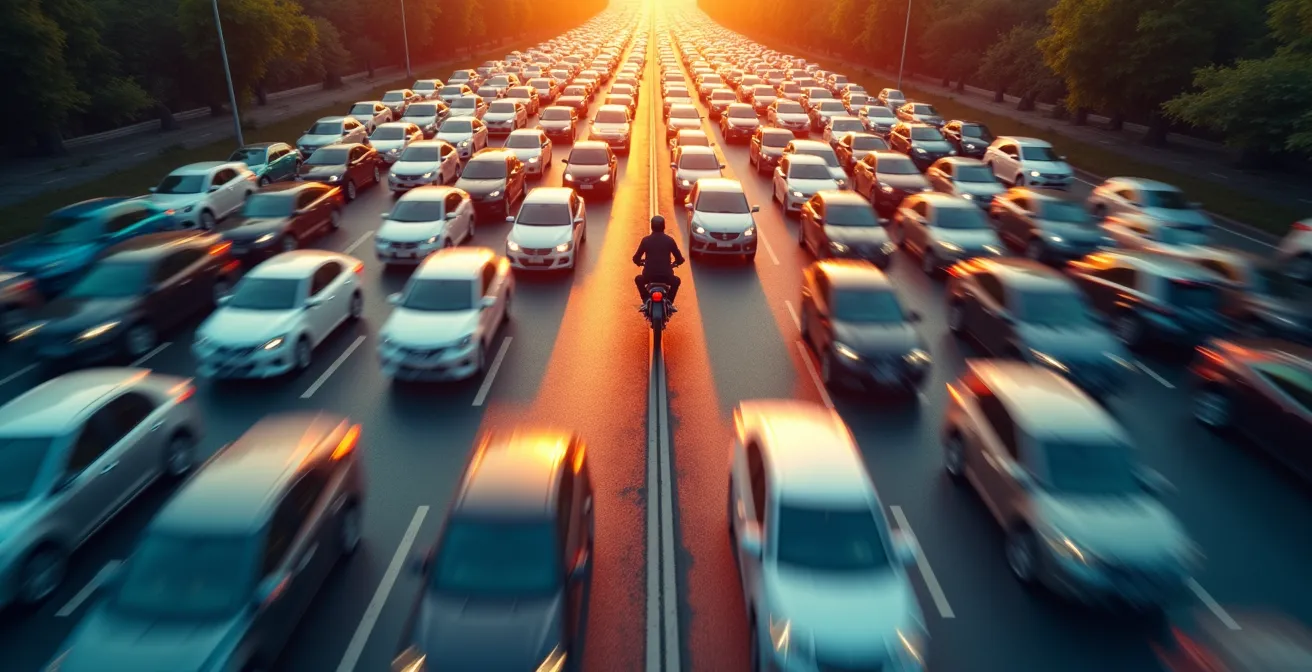
While you can’t control the traffic, you can control how you ride through it. By adopting techniques focused on preserving momentum, a rider can significantly mitigate the efficiency losses of congested traffic. This involves thinking several cars ahead and treating the throttle and brakes as tools for fine-tuning speed rather than on/off switches. Adopting these “momentum riding” habits can yield tangible improvements in fuel consumption:
- Read Traffic Patterns: Look far down the road to anticipate slowdowns and traffic light changes. If you see traffic stopping ahead, ease off the throttle early and coast rather than braking at the last second.
- Maintain a Buffer Zone: Avoid tailgating. Leaving space between you and the vehicle in front allows you to smooth out their jerky inputs, maintaining a more constant speed.
- Use Engine Braking: Downshifting and using the engine to slow down (where appropriate) consumes no fuel, unlike applying the brakes and then re-accelerating.
- Smooth Acceleration: Avoid rapid, “jack-rabbit” starts. Roll on the throttle gradually to build momentum efficiently.
- Optimize Gear Selection: Keep the engine’s RPMs in its most efficient range. Lugging the engine in too high a gear or revving it excessively in too low a gear both waste fuel.
These techniques not only save fuel and reduce emissions but also lead to a smoother, safer, and less stressful ride. They empower the rider to actively manage their environmental impact on every single journey.
Why Are Hybrid Motorcycles So Rare Compared to Hybrid Cars?
If hybrid systems have become a mainstream, efficiency-boosting solution for cars, why have they failed to gain traction in the motorcycle world? The answer lies in a complex interplay of cost, weight, space, and a diminishing return on investment. While a motorcycle that pairs a small gas engine with an electric motor seems like a logical best-of-both-worlds solution, the engineering and economic realities make it an impractical choice for most manufacturers and consumers.
The primary obstacles are weight and complexity. A motorcycle’s design is a masterclass in packaging efficiency, where every component fights for limited space. A hybrid system requires not one, but two powertrains: an internal combustion engine, a fuel tank, an electric motor, a battery pack, and a complex control unit to manage them. This adds significant weight and bulk, which are antithetical to the very essence of a motorcycle’s performance, handling, and agility. This added mass would blunt acceleration and make the bike feel ponderous, while the complexity would drive up both the purchase price and maintenance costs.
Furthermore, the economic case is weak, as illustrated by a direct comparison between a leading electric model and its gas-powered equivalent. This analysis provides a clear explanation for market resistance.
Case Study: Zero SR/F vs. Yamaha MT-09 Economics
As detailed in an economic analysis of EV versus gas models, the Zero SR/F electric motorcycle has a starting price of around $19,000, while a comparable gas-powered Yamaha MT-09 costs about $9,000. Despite the EV’s lower operating costs (fuel and maintenance), the more than double upfront price and limited range of 100-150 miles create significant market resistance. Adding a hybrid system would only increase this cost and complexity, pushing the price even higher for a marginal gain in range that most consumers are unwilling to pay for.
Ultimately, manufacturers have largely concluded that it’s more effective to focus on optimizing one powertrain type—either making gas engines more efficient or making EV batteries cheaper and more energy-dense. The hybrid motorcycle, for now, remains a solution to a problem that is better solved by fully committing to one technology or the other. It’s a prime example where adding complexity does not yield a proportional benefit in the unique context of a two-wheeled vehicle.
Key Takeaways
- An electric motorcycle’s “green” credential begins with a significant manufacturing carbon debt, primarily from its battery, that must be “paid back” through emission-free operation.
- Rider behavior is a critical impact multiplier. Riding style for gas bikes and charging habits for electric bikes can dramatically alter their true environmental footprint.
- The end-of-life stage is a major failure point. Complex materials in helmets and tires are difficult to recycle, meaning disposal practices are a key part of a rider’s environmental responsibility.
Lithium-Ion Longevity: How to Charge Your Battery to Make It Last 10 Years?
For an electric motorcycle, the battery is the heart of the vehicle and its most carbon-intensive component. The energy and resources required to manufacture it create the lifecycle carbon debt that the bike must “pay back” over its operational life. Therefore, the single most effective action an EV rider can take to minimize their environmental impact is to maximize the lifespan of their battery. A battery that lasts 10 years instead of 5 effectively halves its proportional manufacturing footprint.
The key to lithium-ion battery longevity is managing stress. The primary stressors are extreme states of charge (fully charged or fully depleted) and high temperatures. Charging a battery to 100% and leaving it there, or running it down to 0%, puts significant strain on the battery’s chemical components, accelerating degradation and reducing its total number of effective charge cycles. The difference is not trivial; it is measurable and significant. For example, battery research shows charging to lower voltages extends life to 600-1,000 cycles at 4.10V per cell (around 90% charge) compared to just 300-500 cycles when regularly charged to 4.20V per cell (100% charge).
This data is the foundation of the widely cited “20-80 rule.” Keeping a battery within this charge window for daily use dramatically reduces stress and can double its lifespan. This principle is not just a theory; it is a guideline promoted by battery manufacturers themselves.
Daily charging to around 80% is considered optimal for long-term health. Most lithium-ion batteries, including LiFePO4, perform best when they avoid extreme high or low states of charge.
– Super B Battery Systems, Smart Charging Guidelines
Implementing a smart charging strategy is the most powerful tool an EV owner has. It requires a slight shift in habits but pays massive dividends in both battery health and reduced environmental impact. The following checklist outlines the essential best practices for extending your battery’s life well beyond the norm.
Your Action Plan: Battery Longevity Best Practices
- Adhere to the 20-80 Rule: For daily commuting and regular use, keep the battery’s state of charge between 20% and 80%. Only charge to 100% immediately before a long trip where maximum range is essential.
- Manage Temperature During Charging: Avoid fast charging the bike immediately after a long, hard ride when the battery is hot. Let it cool down first. Similarly, try to charge in a temperature-controlled environment (like a garage) and avoid charging in extreme heat or freezing cold (keep within 0-45°C or 32-113°F).
- Use Appropriate Charging Rates: While fast charging is convenient, consistently using the highest possible speed generates more heat and stress. When time permits, use a slower, more moderate charging rate (often referred to as Level 1 or Level 2 charging).
- Calibrate the BMS Monthly: Once a month, perform a full charge cycle (from a low state of charge up to 100%). This helps the Battery Management System (BMS) recalibrate and provide accurate range estimates, but should not be standard daily practice.
- Follow Long-Term Storage Protocols: If you are storing the bike for an extended period (e.g., over winter), do not leave it fully charged or fully depleted. The ideal storage state is between 50-60% charge, kept in a cool, dry place.
Ultimately, the most environmentally friendly motorcycle is not a specific model you can buy, but a system you consciously manage. By extending the life of your gear and vehicle, disposing of waste responsibly, and optimizing your riding and charging habits, you become the most critical factor in the environmental equation.