
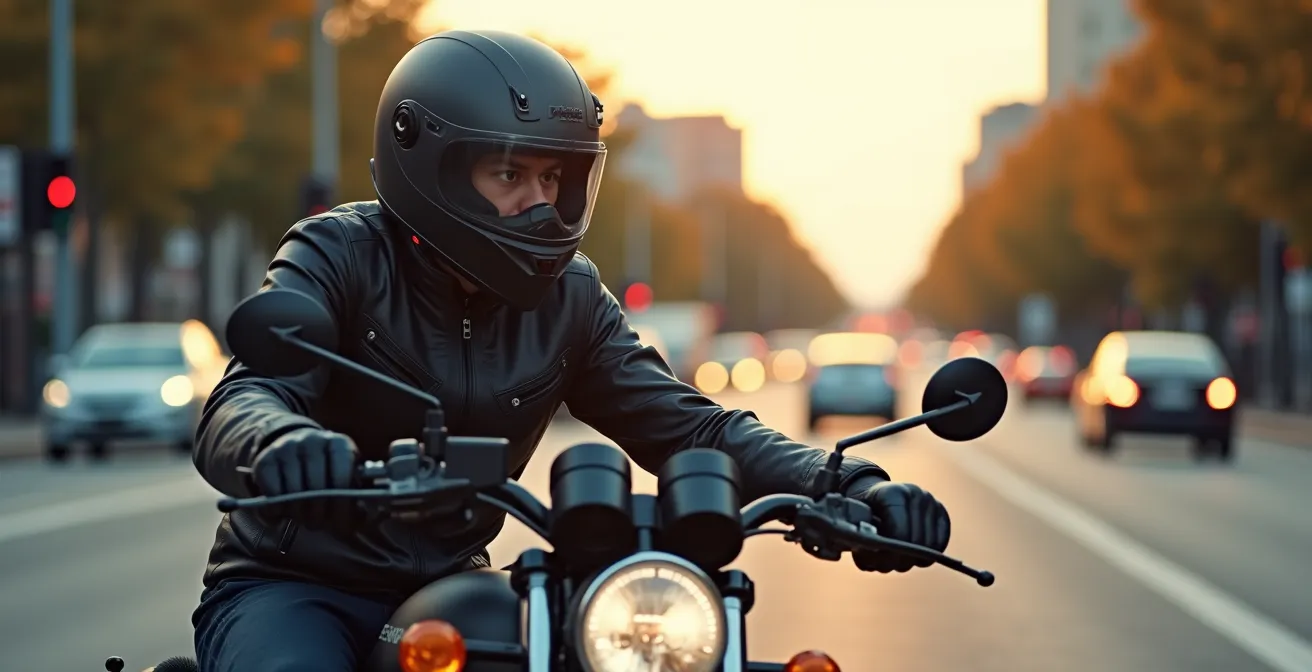
Relying solely on your mirrors is not just a bad habit; it’s a systemic failure in your observation protocol that makes accidents inevitable.
- Mirrors create a false sense of security by distorting distance and hiding vehicles in significant blind spots.
- The physical head check is not an optional extra; it is the primary, mandatory procedure that provides 100% verification of the space you intend to occupy.
Recommendation: Re-train your habits immediately. Demote mirrors to an advisory role and make the head check a non-negotiable action before every single directional change.
You saw the gap. You checked your mirror—it was clear. You began the merge, only to be met with the blare of a horn and the terrifying sight of a Tesla’s front bumper exactly where you thought empty space existed. That jolt of adrenaline is a final warning. Your observation process is flawed, and your implicit trust in your mirrors has created a critical vulnerability. This is not a minor oversight; it is a fundamental misunderstanding of motorcycle dynamics and road survival.
Many riders believe the solution lies in stick-on convex spotters or a high-visibility jacket. These are supplemental aids, not primary safety systems. They address the symptoms, not the root cause of the problem. The core issue is a passive reliance on reflected images, which are inherently incomplete and deceptive. The belief that mirrors provide a complete picture of the environment is a dangerous myth, one that contributes to a staggering number of preventable incidents. According to NHTSA data, over 800,000 blind spot accidents occur annually in the US, a testament to failed observation across all vehicle types.
The true fix is not technological, but procedural. It requires a complete shift in mindset, from passively glancing at a reflection to actively clearing and verifying space. This guide deconstructs the systemic failure of a mirror-centric approach. We will dissect why mirrors fail, analyze the most lethal “no-zones” on the road, and establish the head check not as a helpful tip, but as the only guarantee against the unknown. It is time to rebuild your observation protocol from the ground up, treating it with the seriousness it demands.
This article provides a structured examination of the critical observation protocols required for safe riding. Each section methodically breaks down a key aspect of visibility and threat detection, moving from equipment setup to on-road strategy.
Summary: A Procedural Guide to Total Road Awareness
- The “Shoulder Tip” Rule: Are Your Mirrors Aimed Too Far Inward?
- Convex Mirrors: Do Stick-On Spotters Distort Distance Too Much?
- The “No-Zone”: Why Riding Alongside a Semi-Trailer is a Suicide Mission?
- Is Aftermarket Blind Spot Radar Worth the $300 Investment?
- Where to Lane Position So You Are Never in a Car’s Blind Spot?
- The “Creeping Wheel” Sign: Knowing When a Car is About to Pull Out?
- Does Painting Your Bike Neon Yellow Actually Reduce Accident Risk?
- Lane Filtering vs Splitting: What Is Legal and How to Do It Without getting Ticketed?
The “Shoulder Tip” Rule: Are Your Mirrors Aimed Too Far Inward?
The most common setup error is aiming mirrors to include a portion of your own shoulders or the bike’s tail. This is done for a sense of orientation, but it is a critical waste of reflective real estate. Your mirrors’ sole purpose is to show you the space you *cannot* see, not to confirm your own presence. A mirror filled with 20% of your jacket is a mirror that is 20% blind to an adjacent threat. This creates a significant blind spot directly off your flank, precisely where vehicles lurk before overtaking.
Proper adjustment is a non-negotiable first step in building a correct observation protocol. The goal is to position the mirrors to cover the lanes beside you, starting exactly where your peripheral vision ends. Anything less is a compromise on safety. The “Lean Out & Set” method is a simple, effective procedure to achieve this.
- Sit on your motorcycle in your normal riding position.
- Lean your torso to the left until your head is above your left footpeg.
- Adjust the left mirror so you can just barely see the flank of your motorcycle on the mirror’s inner edge.
- Return to your upright riding position. The mirror will now show the lane next to you, not your shoulder.
- Repeat the process on the right side, leaning out to the right.
This method ensures your mirrors are aimed outward, minimizing the portion of your own bike you see and maximizing the view of the adjacent lane. It dramatically reduces, but does not eliminate, the blind spot. It is the foundation upon which the mandatory head check is built.
Convex Mirrors: Do Stick-On Spotters Distort Distance Too Much?
Many riders turn to stick-on convex mirrors or full convex replacements to widen their field of view. While these accessories do indeed capture a larger area, they introduce a dangerous new variable: distance distortion. The curved surface that provides a panoramic view also makes objects appear smaller and therefore farther away than they actually are. A car that seems a safe distance behind in a convex mirror may be right on your tail, preparing to merge into you.
This creates a false sense of security. You believe you have more time and space than you do, a critical miscalculation when fractions of a second matter. The trade-off between a wider field of view and accurate distance perception must be understood. Aspheric mirrors offer a compromise, with a flat surface on the inner portion for true distance and a curved outer edge to reveal the blind spot, but they still require interpretation.
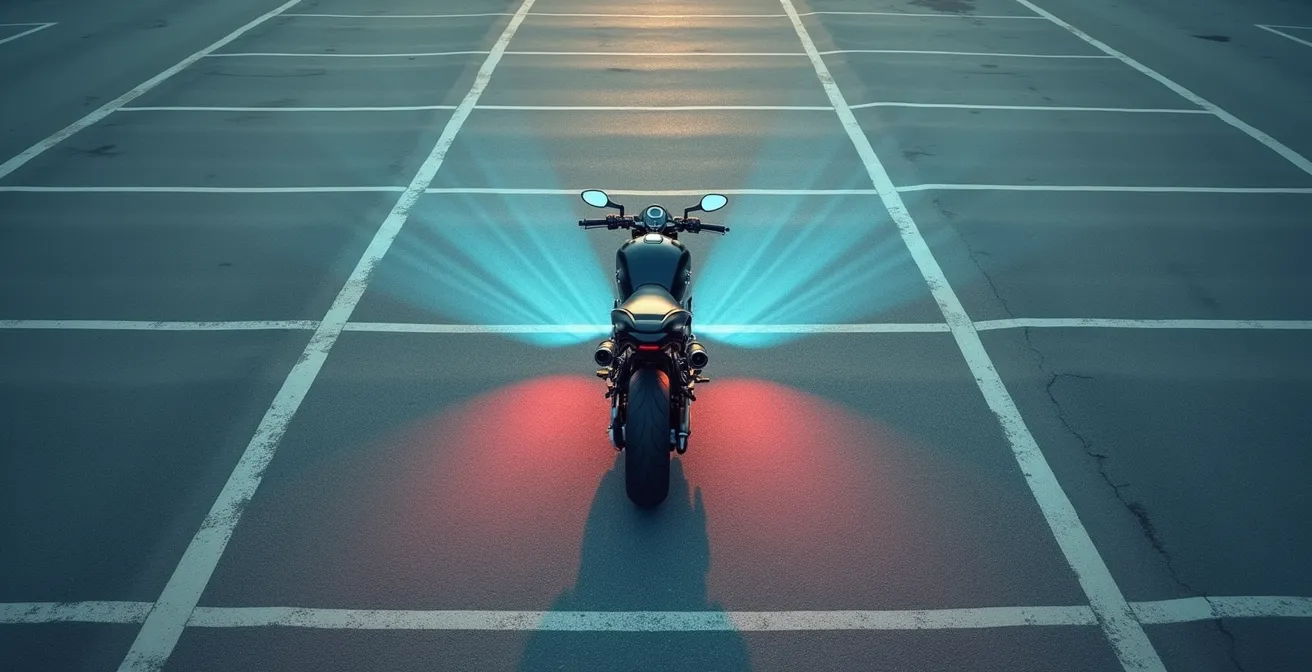
As the visual comparison shows, different mirror types offer vastly different coverage. The standard flat mirror provides an accurate but narrow view. The convex mirror provides a wide but distorted view. This choice has direct safety implications, as detailed in the comparison below.
This data from a comparative analysis of mirror technologies highlights the compromises inherent in each design. There is no single perfect mirror.
| Mirror Type | Field of View | Distance Accuracy | Vibration Resistance | Night Glare |
|---|---|---|---|---|
| Flat Mirrors | Standard (narrow) | Excellent | Good | Low |
| Convex Mirrors | Wide (150°+) | Poor (objects appear farther) | Better | Medium |
| Aspheric | Progressive (variable) | Good in center, distorted at edges | Good | Low to Medium |
The “No-Zone”: Why Riding Alongside a Semi-Trailer is a Suicide Mission?
The space alongside a large commercial truck, or semi-trailer, is not a lane; it is a “No-Zone.” This is the single most dangerous place for a motorcycle to be. A truck driver’s blind spots are immense, extending dozens of feet to the sides and rear. On the right side, the blind spot can swallow an entire car, let alone a motorcycle. To linger in this area is to trust your life to a driver who is physically incapable of seeing you. Data confirms the heightened risk; according to the NHTSA, in 2019, large trucks were involved in 15% of motorcyclist fatalities.
The only correct procedure when encountering a large truck is to minimize your time within its “No-Zone.” This means either staying far behind, where the driver can see you clearly in their mirrors, or overtaking decisively and quickly. There is no middle ground. Pacing a truck is a gamble you will eventually lose.
Case Study: The “Slingshot” Overtake Technique
The Motorcycle Safety Foundation (MSF) formalizes a rapid overtaking maneuver for passing large vehicles. The protocol is to position yourself well behind the truck, select a lower gear for maximum acceleration, and execute the pass with a speed differential of at least 10-15 mph. The entire maneuver should be completed in a few seconds, minimizing exposure to the massive blind zones. The technique requires decisive action, not hesitation, and is a critical skill for highway riding.
Executing this maneuver correctly requires situational awareness and commitment. It is the antithesis of passive riding and a core component of a defensive, survival-oriented mindset.
Is Aftermarket Blind Spot Radar Worth the $300 Investment?
The market now offers aftermarket blind spot detection (BSD) systems for motorcycles, typically using 24GHz or 77GHz radar to monitor adjacent lanes. These systems provide a visual or haptic alert—a light in your mirror or a vibration in the handlebars—when a vehicle is detected in your blind spot. While this technology can be a useful safety layer, it must be viewed as a supplemental warning, not a substitute for physical observation.
The primary concern is over-reliance. A rider who begins to trust the warning light exclusively will inevitably stop performing head checks, degrading their core skills. Furthermore, the effectiveness of these systems can vary. Cheaper 24GHz systems have shorter ranges and may be more susceptible to weather, while more robust 77GHz systems come at a higher cost. These systems add a layer of electronic surveillance, but they are not infallible.
This table, based on data from an analysis of available BSD systems, shows the trade-offs in the current market.
| System | Frequency | Detection Range | Field of View | Price Range | Weather Performance |
|---|---|---|---|---|---|
| INNOVV ThirdEYE | 77-79 GHz | 50m | 150° | $300-400 | All-weather (IP67) |
| Generic 24GHz Systems | 24 GHz | 30m | 130° | $100-200 | Weather-resistant |
| OEM Triumph System | 77 GHz | Not specified | Not specified | $1,900 (package) | All-weather |
The cost of factory-installed systems further complicates the decision. As a report from RevZilla highlights, adding this feature at the OEM level is a significant expense.
The most direct comparison is Triumph’s Tiger 1200 GT Explorer, which has blind spot detection but no adaptive cruise. Not only does the bike cost $23,795, but it tacks $1,900 onto the 1200 GT Pro’s $21,895 asking price.
– RevZilla, On the radar: Blind spot detection systems for all bikes
Ultimately, a radar system can be a valuable co-pilot, but the rider remains the pilot-in-command, responsible for final verification through a head check.
Where to Lane Position So You Are Never in a Car’s Blind Spot?
Your position within a lane is not a static choice; it is an active, dynamic strategy to manage visibility—both for you and for others. The fundamental error is to ride passively in the center of the lane, which often places you squarely in the blind spot of adjacent vehicles. The correct approach is to actively position yourself to be seen. This means using your lane position to place yourself directly in the driver’s side-view or rear-view mirror.
This strategy is often called “proactive presence” or “owning your lane.” It is an assertive but non-aggressive way of managing the space around you. If you are in the left lane, riding in the right portion of your lane (LP3) makes you more visible to cars on your right. Conversely, riding in the left portion (LP1) increases your visibility to traffic behind and to your left. The golden rule is simple: if you cannot see the driver’s face in their mirror, you must assume they cannot see you.
Case Study: The “Proactive Presence” Lane Positioning Strategy
Safety experts advocate for maintaining a position where you can make eye contact with a driver via their mirror. This act of “owning the lane” involves constantly adjusting your position based on traffic flow to remain in a driver’s line of sight. It’s not just about avoiding their blind spot; it’s about confirming your visibility. This strategy also involves creating a safety buffer, a cushion of empty space around you, by managing your following distance and avoiding lingering next to other vehicles.
This is not a passive act of being seen; it is the active process of ensuring you are seen. It requires constant scanning and adjustment, turning your lane into a flexible zone of control rather than a fixed path.
The “Creeping Wheel” Sign: Knowing When a Car is About to Pull Out?
The most dangerous blind spots are not always beside you; they are often in front of you, at intersections and driveways. A driver waiting to pull into traffic may look, but their view can be obscured by other cars, pillars, or glare. They may simply fail to register a motorcycle. The NHTSA found that 41% of all motorcycle crashes involve another vehicle turning into the rider’s right-of-way. You must assume you are invisible.
Relying on a driver to see you is a failed strategy. Instead, you must become an expert in predictive analysis, reading the subtle cues that signal a driver’s intent. The most reliable indicator is the “creeping wheel.” When a stationary car’s front wheels begin to turn or inch forward, it is a definitive sign of imminent movement. Other cues include a driver’s head turning, a lack of eye contact, or the sound of a revving engine. Recognizing this constellation of threats allows you to prepare—covering your brakes and planning an escape route—before the vehicle even begins its maneuver.
This level of awareness requires a disciplined scanning protocol, especially when approaching intersections, which are high-threat environments.
Your Action Plan: Intersection Scan Protocol for Threat Detection
- Adopt a consistent scan pattern: Left-Far, Left-Near, Right-Far, Right-Near, and then check for Forward-Threats.
- Look for a constellation of cues: creeping wheels, driver head movement, and a notable lack of eye contact.
- Listen for auditory clues like revving engines that signal a driver’s intent to move immediately.
- Cover your brakes and clutch as a default action upon identifying any potential threat.
- Position yourself where your headlight is most likely to shine directly on a driver’s mirrors to maximize your visibility.
This protocol transforms you from a passive victim of circumstance into an active threat assessor, identifying and neutralizing danger before it materializes.
Does Painting Your Bike Neon Yellow Actually Reduce Accident Risk?
The conventional wisdom is that bright, fluorescent colors—so-called “high-visibility” or “hi-viz” gear—make you more visible and therefore safer. While there is some truth to this, the science of conspicuity is far more nuanced. Visibility is not about absolute brightness; it is about contrast against the background. A neon yellow jacket can be highly effective against a dark, rural backdrop but can easily blend into a complex urban environment filled with yellow signs, construction vehicles, and advertisements.
More effective than static color is the principle of “biomotion.” Research indicates that the human eye is exceptionally good at detecting biological movement patterns. This is why reflective material placed on a rider’s moving parts—ankles, wrists, helmet, and especially rotating wheels—is far more effective at capturing a driver’s attention than a solid block of color on a static torso. The unique, oscillating motion of reflectors on your ankles or the circular pattern of tape on your wheel rims creates a visual signature that is unlike anything else on the road, triggering a primal “what is that?” response in a driver’s brain.
Case Study: The Science of Conspicuity
Studies highlighted by the MSF and other safety organizations show that strategically placed reflective materials that emphasize the human form and its motion are more powerful than simple coloration. A rider in a dark jacket with reflective strips on their boots and gloves is often more conspicuous in a driver’s peripheral vision than a rider in a solid hi-viz vest, especially at night. The goal is not just to be bright, but to create a pattern of light and movement that is impossible to ignore or misinterpret.
Therefore, while a bright helmet can help, a strategy based on biomotion is a more scientifically sound approach to being seen. Focus on making your movements, not just your presence, visible.
Key Takeaways
- Mirrors are advisory tools, not primary sources of truth; they create a distorted and incomplete picture.
- The physical head check is a non-negotiable, mandatory procedure before any lateral movement to verify the space is clear.
- Proactive threat anticipation, through lane positioning and reading driver cues, is more effective than relying on passive visibility aids.
Lane Filtering vs Splitting: What Is Legal and How to Do It Without getting Ticketed?
The terms “lane filtering” and “lane splitting” are often used interchangeably, but they describe different actions with distinct legal implications. Lane splitting is riding between lanes of moving traffic. Lane filtering is riding between lanes of stopped or slow-moving traffic, typically at a light or in a traffic jam. Understanding the specific laws in your jurisdiction is the first and most critical step, as an illegal maneuver will invalidate any insurance claim and result in a citation, regardless of fault.
Legality, however, is not a guarantee of safety. Executing this maneuver requires a heightened state of awareness and a specific skillset. The primary danger comes from surprising drivers. A driver in stopped traffic is not anticipating a vehicle to appear between them and the next car. Sudden lane changes by cars trying to get a better position are common. The key is to be smooth, deliberate, and predictable.
The legality of these practices varies dramatically, as this table based on a 2024 review of US state laws illustrates.
| State | Status | Speed Limit | Conditions |
|---|---|---|---|
| California | Full Lane Splitting | No specific limit | Follow speed limits and traffic laws |
| Arizona | Filtering Only | 15 mph max | Traffic stopped, roads ≤45 mph |
| Colorado | Filtering Only | 15 mph max | All traffic stopped |
| Montana | Filtering | 20 mph max | Traffic ≤10 mph |
| Utah | Filtering Only | 15 mph max | Traffic stopped, roads ≤45 mph |
| Minnesota | Legal from July 2025 | 25 mph max | 15 mph speed differential |
Even where legal, a safe filtering protocol is essential. The core principle is “surprise is the enemy.” You must announce your presence and anticipate the unpredictable.
- Maintain a speed differential of no more than 10-15 mph from the traffic you are passing.
- Scan the “cell” of cars around you, watching for turn signals or driver head movements two or three cars ahead.
- Cover your horn, but use it as a courtesy tap, not an aggressive blast. Never rev your engine to intimidate.
- As soon as traffic begins to move, merge smoothly back into a standard lane position. The gap you were using is about to disappear.
Mastering these observation protocols is not an optional exercise; it is the fundamental duty of every rider. Your next step is to methodically practice these procedures on every ride, in every situation, until the head check is as automatic as breathing. Your survival depends on it.