
Motorcycling performance extends far beyond raw horsepower figures and top speed claims. The intricate balance between suspension compliance, aerodynamic efficiency, engine characteristics, and rider input determines how effectively a motorcycle translates mechanical potential into real-world capability. Whether navigating urban congestion, carving canyon roads, or exploring the limits on a closed course, understanding the principles of performance and tuning empowers riders to optimize their machines for specific conditions and riding styles.
This comprehensive exploration covers the fundamental systems that define motorcycle performance. From chassis dynamics and suspension tuning to fuel mapping and rider positioning, each element plays a crucial role in the complete package. The following sections provide the knowledge foundation necessary to make informed decisions about modifications, setup adjustments, and riding technique refinements that genuinely enhance your motorcycle experience.
The suspension system serves as the critical interface between tire contact patches and the rider, managing forces that constantly attempt to upset stability and traction. Modern motorcycles employ sophisticated damping and spring systems that require proper configuration to perform optimally across varied conditions.
Suspension tuning revolves around three primary adjustments: preload, compression damping, and rebound damping. Preload determines the initial spring compression and affects ride height and sag measurements. Compression damping controls how quickly the suspension compresses when encountering bumps, while rebound damping manages the extension speed after compression. Urban riders facing deteriorated pavement benefit from softer compression damping that allows the suspension to absorb impacts without transferring harsh forces to the chassis. Conversely, track-focused setups typically employ firmer damping to maintain geometry stability during aggressive cornering and braking.
The concept of sag—the amount the suspension compresses under the rider’s weight—provides the starting point for all suspension tuning. Race sag typically targets 25-30mm at the front and 30-35mm at the rear, though these values vary based on motorcycle type and intended use. Sport touring applications often run slightly more sag to prioritize comfort over ultimate responsiveness.
The chassis functions as the skeleton connecting all performance elements, with modern sportbikes increasingly using the engine as a stressed member—a structural component that reduces overall weight while maintaining rigidity. This approach eliminates redundant frame material, concentrating mass near the center of gravity for improved handling response.
Weight distribution profoundly affects handling characteristics. Motorcycles with forward weight bias typically exhibit stable, confidence-inspiring steering at the expense of rear traction under acceleration. Rear-biased designs reward throttle control precision with explosive acceleration but may feel vague during initial turn-in. Understanding your motorcycle’s natural balance helps inform riding technique adjustments and modification priorities.
Swingarm construction represents a constant compromise between rigidity, weight, and adjustability. Single-sided designs offer maintenance convenience and visual appeal but typically add weight compared to conventional double-sided configurations. Longer swingarms enhance stability and straight-line traction, making them popular for drag racing applications, while shorter designs prioritize corner agility. The pivot point location relative to the front sprocket determines anti-squat characteristics—how effectively the chassis resists compression under acceleration forces.
Wind resistance increases exponentially with speed, becoming the dominant force limiting top velocity and significantly impacting fuel consumption above highway speeds. A rider’s body represents the largest surface area facing oncoming air, making position optimization one of the most cost-effective performance improvements available.
Tucking behind the windscreen reduces frontal area—the projected surface presented to airflow—potentially decreasing drag by 30-40% compared to an upright position. This translates directly to higher speeds from the same power output or reduced throttle input to maintain velocity. However, sustained tucking demands core strength and creates ergonomic challenges for street riding, where traffic awareness and comfort take precedence over ultimate efficiency.
Modern sportbikes increasingly feature winglets—small aerodynamic appendages that generate downforce at high speeds. While these devices provide measurable benefits above 100 mph by increasing tire loading and stability, their effectiveness in typical street riding remains negligible. The forces generated require sustained high velocity to overcome the added weight and complexity, making them primarily relevant for track day enthusiasts and racers.
Body position also affects handling balance. Shifting weight forward during braking loads the front tire, increasing available grip for deceleration and turn-in. Moving rearward under acceleration transfers load to the rear contact patch, maximizing traction. Skilled riders continuously modulate position throughout corner sequences, using body weight as an additional tuning parameter beyond suspension and throttle inputs.
Engine performance extends beyond peak horsepower figures to encompass the entire powerband characteristics—how smoothly and predictably power arrives across the rev range. Modern fuel injection systems allow precise control over combustion parameters, enabling optimization for specific fuels, modifications, and riding conditions.
Fuel mapping adjusts the air-fuel mixture ratio and ignition timing across throttle positions and engine speeds. Factory mappings prioritize emissions compliance and broad usability, often sacrificing smoothness at partial throttle openings where riders spend the majority of time. Custom mapping can eliminate lean surges, improve throttle response, and optimize power delivery for aftermarket exhaust systems that alter backpressure characteristics.
Increasingly stringent Euro emissions standards have driven manufacturers toward sophisticated engine management strategies, including ride-by-wire throttle systems that interpolate rider input through electronic filters. While these technologies enable features like traction control and riding modes, they can introduce artificial delays between throttle rotation and engine response. Understanding these systems helps riders distinguish between mechanical issues and intentional calibration choices.
Traditional mechanical engines—particularly carbureted designs—offer visceral feedback and direct control absent in heavily electronic systems. Many enthusiasts celebrate this mechanical soul, valuing the unfiltered connection despite sacrificing the precision and adaptability of modern fuel injection. The choice between approaches reflects personal priorities: raw engagement versus optimized performance and efficiency.
Mechanical modifications provide diminishing returns without corresponding skill development. Refined technique extracts the performance potential that setup and tuning create, transforming theoretical capabilities into practical advantages.
Smooth, progressive throttle application maintains chassis stability and traction, particularly mid-corner where suspension compression and lean angle create complex loading scenarios. Abrupt inputs upset the delicate balance between available grip and demanded forces, potentially breaking traction or forcing the motorcycle wide of the intended line. The ideal approach involves maintaining steady or gently increasing throttle through the apex, allowing suspension to settle and directing weight rearward as lean angle decreases.
The friction zone—the clutch engagement range where power begins transferring to the rear wheel—provides crucial control for low-speed maneuvering and technical riding. Mastering friction zone modulation enables precise speed control without continuous brake application, particularly valuable for urban navigation and parking lot agility. This skill becomes essential when managing race-bred machines on public streets, where aggressive clutch engagement and peaky powerbands challenge smooth operation at city speeds.
Choosing appropriate gearing keeps engine speed within the optimal powerband range where torque delivery remains predictable and responsive. Lower gears provide engine braking assistance and instantaneous acceleration response but require frequent shifting. Higher gears reduce mechanical involvement but may place the engine below its effective operating range, creating sluggish response or forcing downshifts during overtaking maneuvers.
Technical riding—tight corners, elevation changes, and variable-radius turns—benefits from lower gearing that maintains engine speeds above the torque peak. This provides consistent drive character and allows throttle modulation to fine-tune corner speed without clutch manipulation. The appropriate gear keeps the engine singing rather than lugging, with crisp response to input changes.
Transitioning a street motorcycle for closed-course use requires systematic preparation addressing safety requirements, performance optimization, and regulatory compliance. The process reveals how street-focused compromises limit ultimate performance while highlighting the engineering constraints manufacturers navigate.
Most track day organizations mandate removing street equipment including mirrors, license plates, and turn signals to reduce hazards during incidents. Beyond regulatory requirements, this weight reduction—often 5-10 pounds—raises the power-to-weight ratio and shifts mass distribution. More significantly, removing unnecessary components reduces failure points and simplifies post-session inspections.
Suspension settings appropriate for public roads rarely translate effectively to smooth track surfaces. Race circuits eliminate potholes, expansion joints, and surface irregularities, allowing stiffer damping and reduced compliance that would create a punishing street experience. Track-specific suspension tuning prioritizes geometry stability during maximum-effort cornering and braking over bump absorption, accepting some high-frequency harshness in exchange for precise control and feedback.
The psychological demands of track riding differ fundamentally from street environments. Managing physical exertion across 20-minute sessions in full protective gear requires cardiovascular fitness and mental focus. Track day psychology involves balancing the desire for progression against safety margins, accepting that consistency produces faster lap times than occasional heroic efforts punctuated by mistakes. Many riders discover that their street-legal superbikes possess far more capability than their current skill level can access safely, making rider training more valuable than additional modifications.
Available traction determines the maximum forces a motorcycle can generate for acceleration, braking, and cornering. Understanding grip limitations and reading surface conditions prevents exceeding available adhesion—the primary cause of loss-of-control incidents.
Stopping physics governs the distances and forces involved in deceleration. The front brake typically provides 70-80% of total stopping power due to weight transfer that loads the front tire during braking. Maximum deceleration occurs at the threshold where tire slip approaches but doesn’t exceed available grip—approximately 1g on dry pavement with modern tires. Exceeding this threshold causes tire lockup or ABS intervention, often increasing stopping distances while eliminating directional control.
Road surface texture profoundly affects available grip. Fresh asphalt with sharp aggregate provides excellent mechanical interlock with tire rubber. Polished concrete or worn pavement with smooth aggregate reduces friction coefficients substantially, sometimes halving available traction. Reading these visual cues—shine indicating polish, color variations suggesting contamination—allows proactive reduction of corner speed and braking forces before discovering grip limitations through loss of control.
Environmental hazards introduce additional complexity:
Developing the skill to predict grip based on surface observation and environmental conditions transforms riding from reactive survival to proactive risk management. This awareness allows maintaining appropriate safety margins rather than discovering traction limits through uncomfortable experiences.
Performance tuning frequently intersects with aesthetic preferences, as modifications that enhance capability often alter appearance. The challenge lies in balancing visual goals with functional impacts, ensuring style choices don’t compromise the engineering compromises manufacturers carefully calibrated.
Upgrading rolling stock—wheels and tires—offers simultaneous performance and appearance benefits. Lightweight wheels reduce unsprung mass and rotational inertia, improving suspension response and acceleration. Wider rear tires provide increased contact patch area and aggressive stance but may slow steering response and limit tire choices. The visual impact of wheel design significantly affects overall aesthetic, with intricate multi-spoke patterns reading as performance-oriented while simpler designs suggest classic restraint.
Matching aesthetics to era creates cohesive builds that respect design heritage. Modern LED lighting and angular bodywork clash visually with round-case engines and wire-spoke wheels. Successful custom builds either commit fully to a period-correct approach or deliberately contrast elements to create intentional visual tension. The growing interest in hybrid concepts—classic styling wrapped around modern mechanical components—demonstrates that aesthetic preferences need not dictate technology acceptance.
Some riders prioritize celebrating the mechanical soul of traditional engines through modifications that enhance visibility and sound. Removing side covers, installing open clutch covers, or fitting individual velocity stacks transforms the engine into a visual centerpiece rather than hiding mechanical components behind bodywork. These choices sacrifice weather protection and sometimes performance for visceral appeal and mechanical transparency.
Ultimately, personalization reflects individual values. Some riders view motorcycles as appliances requiring only reliability and efficiency. Others see them as canvases for expression, accepting practical compromises in pursuit of distinctive character. Neither approach holds inherent superiority—the optimal balance depends entirely on how you intend to use and enjoy your machine.
Performance and tuning encompass far more than simple modifications or adjustments. The interaction between suspension compliance, aerodynamic efficiency, power delivery, rider technique, and environmental conditions creates a complex system where changes ripple through multiple domains. Building expertise requires understanding these connections, recognizing that optimizing one element often demands compensating adjustments elsewhere. The journey toward extracting your motorcycle’s full potential begins with knowledge, progresses through systematic experimentation, and ultimately rewards both enhanced capability and deeper appreciation for the engineering excellence these machines represent.

The choice between engines isn’t just technical; it’s a decision about the kind of conversation you want to have with your motorcycle’s mechanical soul. Desirable vibration is engineered character that connects you to the combustion event; bad vibration is just…
Read more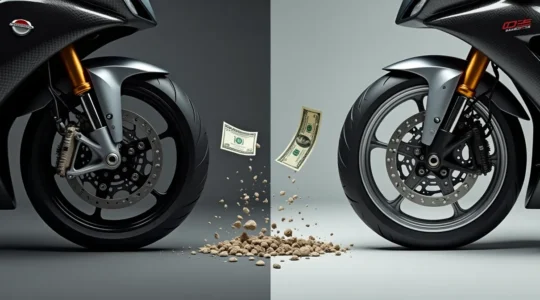
The $3,000 investment in carbon fiber wheels is justified not by simple weight loss, but by the disproportionate performance gains governed by the physics of rotational inertia and suspension dynamics. Reducing mass at the wheel’s perimeter (rotational inertia) has a…
Read more
The fundamental difference between asphalt and concrete is just the beginning; true wet-weather mastery comes from decoding the micro-hazards that overlay any surface. Surface porosity is key: Porous asphalt drains water from the contact patch, while non-porous concrete and road…
Read more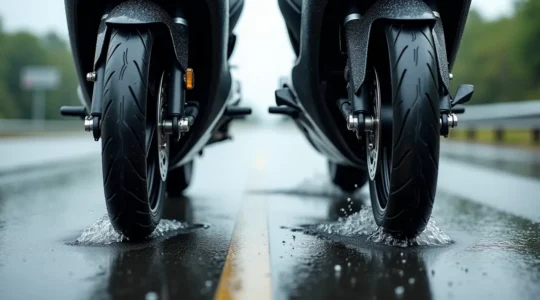
Anti-lock Braking Systems (ABS) do more than prevent lock-ups; they fundamentally alter the physics of braking to maximize available grip and maintain crucial steering control, a difference most critical on wet surfaces. ABS allows a rider to apply maximum braking…
Read more
The debate over frame material is a distraction; a motorcycle’s handling character is dictated by the entire chassis functioning as an integrated dynamic system, not just the metal it’s made from. Engineered flex is a design tool for managing grip…
Read more
Passing tech inspection isn’t about a checklist; it’s about adopting a professional’s mindset to ensure absolute system integrity before you hit the track. Your bike’s systems (brakes, suspension, tires) will be pushed beyond street limits, and stock components often represent…
Read more
The intense heat blasting your leg isn’t a flaw; it’s the most obvious symptom of your superbike’s racing DNA and the first “performance tax” you’ll pay for owning a thoroughbred. Managing a superbike on the street is less about eliminating…
Read more
Helmet buffeting isn’t caused by wind hitting you, but by the low-pressure ‘vacuum’ pulling your head into turbulent air pockets. The goal is to manage airflow to create a stable, quiet pocket, not just block the wind with a larger…
Read more