

The spec sheet isn’t a lie, it’s just a different language; true EV range is about managing a predictable energy budget.
- Cold weather is your single biggest range debit, often reducing your available miles by 25-30% before you even start the bike.
- Highway speed costs significantly more energy than city riding due to aerodynamic drag, turning a “100-mile” bike into a “60-mile” bike.
Recommendation: Stop chasing the sticker number and start thinking like a pilot: know your bike’s real-world consumption in different conditions to plan your commute with confidence.
You’ve seen the spec sheets: “100-mile city range,” “80 miles combined.” You’ve done the math, and that 50-mile round-trip highway commute should be easy, with plenty of juice to spare. But a nagging voice, fueled by stories of stranded drivers, keeps asking: what if it’s not? This is the core of “range anxiety,” a feeling that keeps many potential commuters from making the switch to electric. The internet is full of generic advice, telling you that range “depends on many factors” like speed, weather, and riding style. While true, this isn’t helpful. It doesn’t give you the confidence to leave for work on a cold morning knowing you’ll make it home.
The secret that experienced EV owners learn is to stop thinking about a fixed range and start managing an “energy budget.” The number on the brochure is a perfect-world fantasy. The number that matters is the “street truth,” and it’s something you can learn to predict and control. It’s not about hypermiling in the slow lane or never riding in the rain. It’s about understanding the predictable “range debits”—the non-negotiable energy costs of real-world riding—and factoring them into your daily plan. This guide is your owner’s logbook, translated. We’ll break down exactly where those advertised miles disappear and give you the tools to build an energy budget that makes range anxiety a thing of the past.
To give you a complete and practical overview, we will explore the key factors that influence your real-world range, from environmental conditions to software updates and charging standards. This structured approach will help you build a comprehensive understanding of what it truly means to live with an electric motorcycle.
Summary: The Real Owner’s Guide to Electric Motorcycle Range
- The Winter Penalty: Why Your EV Range Drops 30% Below Freezing?
- Over-the-Air Updates: Can a Software Patch Suddenly Change Your Bike’s Performance?
- Why Is Insurance for Electric Bikes Sometimes Higher Than Gas Equivalents?
- Workplace Charging: How to Convince Your Boss to Let You Plug In?
- 80% Capacity Guarantee: What Exactly Constitutes a “Failed” Battery Warranty Claim?
- Torque vs Horsepower: Why Electric Motorcycles Feel Faster Than the Numbers Suggest?
- Why Your MPG Drops Drastically During Rush Hour and How to Fix It?
- Type 2 vs CCS vs J1772: Which Plug Does Your Motorcycle Actually Need?
The Winter Penalty: Why Your EV Range Drops 30% Below Freezing?
The first and most shocking “range debit” every new EV owner discovers is the winter penalty. Leaving home with a 100% charge only to see your estimated range plummet is a common, and frightening, first-time experience. This isn’t a fault in your bike; it’s the simple physics of lithium-ion batteries. Cold temperatures slow down the chemical reactions inside the battery, making it harder to release energy. The effect is dramatic: Consumer Reports testing reveals a 25% range reduction at 16°F (-9°C) compared to mild weather. For a commuter, this is a non-negotiable energy budget deduction before you’ve even twisted the throttle.

This “cold soak” effect means a battery left outside overnight is starting at a significant disadvantage. Part of your precious energy will be used by the Battery Management System (BMS) just to warm the cells to an efficient operating temperature. This is a crucial safety and performance feature, but it comes directly out of your range budget. Understanding this allows you to plan for it, rather than be surprised by it. A bike that comfortably does 60 miles in the summer might realistically only offer 40-45 miles on a freezing winter morning.
Your Action Plan: Winter Commuting Strategy
- Precondition: Warm the battery and cabin/seat while still plugged into the charger. This uses grid power, not your range budget, and can save 10-15% of your battery.
- Heated Gear Focus: Use heated grips and seats instead of blasting a cabin heater (if your bike has one). They use up to 90% less energy for the same perceived warmth.
- Moderate Speed: Reducing highway speed from 75mph to 65mph can add 15% or more range back, a crucial trade-off in cold weather.
- Tire Pressure: Check tire pressure weekly. It can drop by 1 PSI for every 10°F temperature decrease, increasing rolling resistance and draining energy.
- Plan Charging Stops: If your commute is on the edge, plan your route to include a charging stop at an indoor parking garage, where the battery can warm up slightly.
Over-the-Air Updates: Can a Software Patch Suddenly Change Your Bike’s Performance?
Yes, and it’s a double-edged sword that every modern EV owner needs to understand. Over-the-Air (OTA) updates are a fantastic feature, allowing manufacturers to fix bugs, add features, and even improve efficiency without a trip to the dealer. However, they can also be a source of unexpected changes to your bike’s “personality” and, crucially, its range. An update to the battery management algorithm could refine range estimates to be more accurate, which might look like you’ve suddenly “lost” 15 miles of range overnight. In reality, the bike is just giving you a more honest number based on new data—the “street truth” has been updated.
A real-world example from a Zero SR/S motorway test highlights this variability; a 58.7-mile journey consumed 77% of the battery, falling short of the claimed 82-mile highway range. The manufacturer noted that firmware versions, which can be changed via OTA updates, directly affect battery management and thus the real-world range. This isn’t a defect; it’s a variable in your energy budget calculation that didn’t exist with gas bikes. You must pay attention to release notes and be prepared to re-learn your bike’s habits after a major update.
| Update Type | Potential Benefits | Potential Risks | Mitigation Strategy |
|---|---|---|---|
| Range Algorithm | More accurate estimates | 15-20 mile ‘loss’ overnight | Monitor before long trips |
| Power Management | Extended battery life | Reduced acceleration | Check release notes |
| Safety Systems | Enhanced stability | Restricted top speed | Test in safe area first |
| Critical Firmware | Bug fixes | Potential bricking | Update only on full charge |
Why Is Insurance for Electric Bikes Sometimes Higher Than Gas Equivalents?
After you’ve calculated your potential fuel savings, it can be a shock to find that insurance premiums for an electric motorcycle can be higher than for a comparable gasoline-powered bike. Industry analysis shows annual premiums for electric models can range from $600-$950, while gas equivalents often fall between $500-$800. This price difference isn’t arbitrary; it reflects the insurer’s assessment of risk, which is based on two primary factors: the cost of replacement parts and the complexity of repairs. Your EV isn’t just a bike; it’s a sophisticated piece of technology on two wheels.

The battery pack, motor, and controller are highly specialized, high-cost components. A minor accident that might just dent a gas tank on a traditional bike could potentially damage the battery casing or sensitive electronics on an EV, leading to a much more expensive repair or even a total write-off. As an expert from the Diablo Valley Insurance Agency points out, “The advanced technology, high-capacity batteries, and specialty components all contribute to higher insurance premiums.” Insurers also have to factor in the need for specialized mechanics qualified to work on high-voltage systems, which are less common than traditional motorcycle mechanics. This higher perceived risk translates directly into your premium.
Workplace Charging: How to Convince Your Boss to Let You Plug In?
To convince your boss, you need to frame the request not as a personal favor, but as a low-cost, high-value business initiative. The key is to proactively address their likely concerns: cost, safety, and fairness. By presenting a well-researched, professional proposal, you can transform their “no” into a “yes.” Your goal is to make it incredibly easy for them to approve your request by demonstrating that the benefits to the company far outweigh the negligible costs.
Start by demystifying the cost. Calculate the exact electricity usage for your daily commute charge, which is often less than a dollar. Then, shift the conversation to the significant intangible benefits. According to a case study, companies that implement simple EV charging solutions can see a notable increase in employee satisfaction scores and can burnish their sustainability credentials, which is valuable for attracting and retaining talent. You are not just asking to charge your bike; you are offering your company a chance to participate in a green initiative with excellent PR value for a minimal investment. Presenting a structured plan shows you’ve thought through the implications.
Your Proposal to the Boss should include:
- The Cost-Benefit Analysis: Present the daily electricity cost (e.g., “$0.80 per charge”) versus the PR value of being a “green” employer.
- The Safety Protocol: Offer to use a timer-controlled, UL-certified smart charger with automatic safety cutoffs, and compare its liability to that of employees charging laptops or phones.
- The Etiquette Guide: Propose written charging rules, such as only charging during off-peak hours or up to an 80% limit to free up the outlet.
- The Trial Period: Suggest a 3-month trial to demonstrate the minimal impact and track usage, giving them a low-risk way to agree.
80% Capacity Guarantee: What Exactly Constitutes a “Failed” Battery Warranty Claim?
This is one of the most misunderstood parts of EV ownership. That “8-year, 80% capacity” warranty sounds like a fantastic safety net, but making a successful claim is not as simple as saying, “My bike doesn’t go as far as it used to.” Manufacturers have very specific, technical definitions of what constitutes a “failed” battery, and the burden of proof is often on the owner. The key thing to understand is that the warranty typically covers the battery’s ability to hold a specific amount of energy (measured in kWh), not its ability to achieve a certain range (measured in miles). Range is affected by countless external factors, but capacity is a direct measure of the battery’s physical health.
To validate a claim, a dealer will use a diagnostic tool to measure the battery’s State of Health (SOH) directly. If your 14 kWh battery can now only hold 11.1 kWh (about 79% of its original capacity), it would likely qualify. If it holds 11.3 kWh (81%), it would not, even if your real-world range has dropped by 30% due to other factors. Furthermore, owners are expected to maintain the battery properly. Things like using non-approved chargers, storing the bike for months at 0% or 100% charge, or missing critical software updates can void your warranty entirely. Diligent record-keeping is your best ally in this process.
While degradation is inevitable, it’s usually slow. Industry testing shows that most EV batteries retain 70-80% of their capacity even after 30,000 miles, which is well outside the typical warranty period for many riders. The warranty is there to protect against a catastrophic, premature failure, not the gradual, expected decline in performance over the bike’s lifespan.
Torque vs Horsepower: Why Electric Motorcycles Feel Faster Than the Numbers Suggest?
If you’ve test-ridden an electric motorcycle, you’ve felt it: that immediate, silent, and relentless shove forward from the moment you twist the throttle. You then look at the spec sheet and see a horsepower number that seems modest compared to a 600cc gas bike, leaving you confused. The answer to this paradox lies in the fundamental difference between torque and horsepower, and how electric motors deliver it. Torque is the rotational force—the initial “punch” you feel. Horsepower is a calculation of how fast that force can do work (torque x RPM). A gas engine needs to build up revolutions to reach its peak torque and horsepower. An electric motor does not.
An electric motor delivers 100% of its available torque from 0 RPM. There is no clutch to slip, no revs to build, no powerband to find. The moment you ask for power, the full turning force is applied to the wheel. This is what creates that “connected” feeling and allows an EV to leap off the line and surge between traffic lights with an intensity that can surprise riders of more powerful gas bikes. A real-world test of a Zero SR/F, for example, noted that despite its “only” 84kW power rating, the instant torque made it feel faster and more responsive in city traffic than bikes with much higher horsepower figures. The flat, unwavering torque curve eliminates the power dips and surges inherent in a combustion engine’s powerband.
So, while horsepower determines your ultimate top speed on an open road, torque determines how quickly and authoritatively you get there. For a commuter, who spends most of their time accelerating from 0-60mph, torque is the number that translates directly to real-world, usable performance and fun.
Why Your MPG Drops Drastically During Rush Hour and How to Fix It?
For decades, gas-powered vehicle owners have known that city driving is less efficient than highway cruising. With electric motorcycles, this rule is turned completely upside down. Your EV is most efficient in stop-and-go city traffic and least efficient when cruising at high speed on the highway. This is the single most important concept for a potential highway commuter to grasp. The culprit is aerodynamic drag—the force of the wind pushing against you. This force increases exponentially with speed. It takes far more energy to push through the air at 70mph than it does at 30mph.
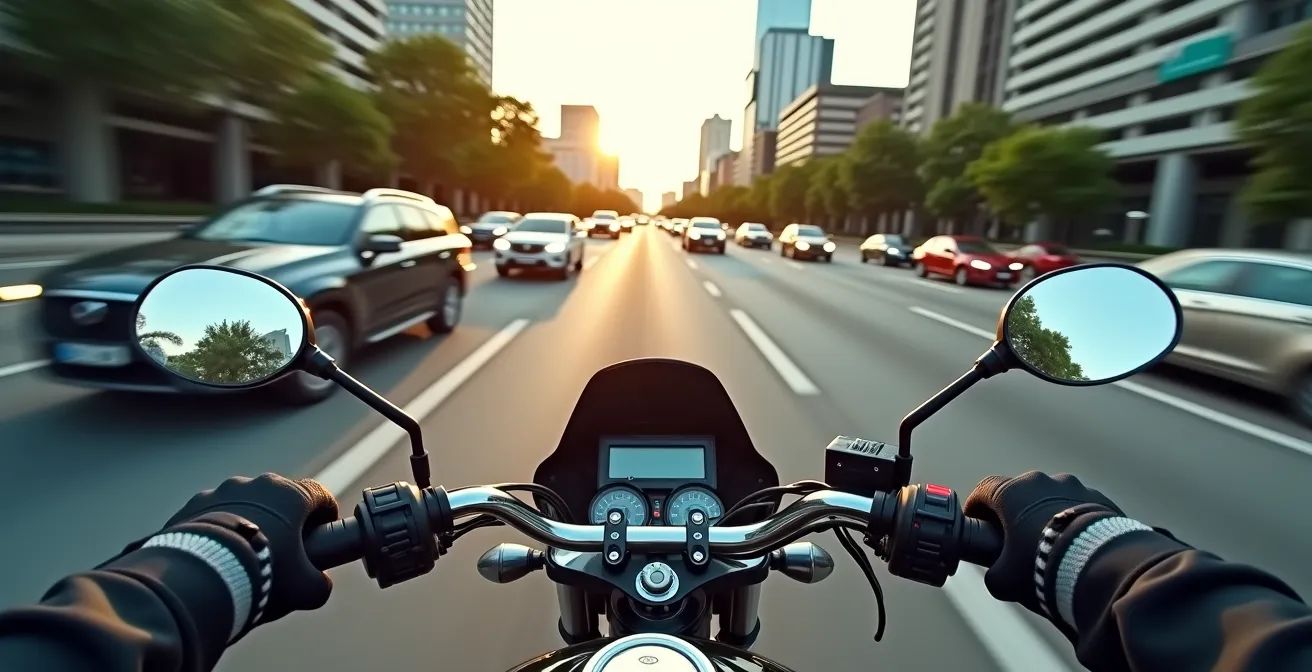
As a result, sustained high speeds are the biggest drain on your energy budget after a cold-soaked battery. Research demonstrates a staggering 30-40% range reduction when traveling at highway speeds compared to lower-speed city riding. That “100-mile” city bike might only deliver 60-65 miles of real-world range on the highway. In city traffic, you benefit from regenerative braking (“regen”), which captures energy during deceleration and puts it back into the battery. On the highway, you’re just in a constant battle against the wind. However, you can actively manage this energy debit.
Highway Commuting Efficiency Strategies:
- Manage Speed: This is your primary tool. Riding at 65mph instead of 75mph can improve your range by as much as 25%. Find the sweet spot for your commute that balances time and energy.
- Pulse and Glide: A technique where you accelerate to your target speed (e.g., 70mph) and then coast with minimal or zero throttle down to a lower speed (e.g., 60mph) before repeating. It’s more efficient than holding a constant speed.
- Drafting (with extreme caution): Following a large vehicle like a truck can significantly reduce aerodynamic drag, but it requires intense focus and a safe following distance.
- Route Planning: If an alternative route with a 55mph speed limit only adds 10 minutes to your commute, it might add 20 miles of range, making it a worthwhile trade-off.
Key Takeaways
- Your bike’s range isn’t a fixed number; it’s a flexible “energy budget” that you learn to manage.
- Cold temperatures and high speeds are your two largest, most predictable “range debits.” Plan for them.
- Confidence comes not from the spec sheet, but from keeping a mental “logbook” of your bike’s real performance in different conditions.
Type 2 vs CCS vs J1772: Which Plug Does Your Motorcycle Actually Need?
Navigating the world of EV charging can feel like learning a new language, with an alphabet soup of acronyms like J1772, CCS, and Type 2. For a motorcycle owner, however, it’s simpler than it seems. The vast majority of electric motorcycles in North America use the J1772 plug for Level 1 and Level 2 AC charging. This is the standard plug you’ll find at most public charging stations in shopping centers, workplaces, and homes. Level 1 is simply plugging into a standard wall outlet (slow), while Level 2 is the 240V power used by most public chargers (faster).
For highway travel, some premium motorcycles are equipped with DC Fast Charging, which typically uses the Combined Charging System (CCS) plug. This is the “gas station” equivalent for EVs, allowing for a rapid charge (e.g., 0-80% in 30-45 minutes). Type 2 is the European AC standard, so you’ll only encounter it on European-spec models. The most critical piece of information, however, is not the plug, but your bike’s on-board charger. As one engineering analysis from an Electric Motorcycle Charging Infrastructure Report states, “The bike’s on-board charger dictates the maximum AC charging speed, regardless of how powerful the station is.” This means if your bike has a 3.3kW on-board charger, it will only draw 3.3kW of power, even from a 22kW station. Knowing this prevents you from paying a premium for a high-speed charger that your bike can’t even use.
| Plug Type | Charging Level | Speed | Best Use Case | Motorcycle Compatibility |
|---|---|---|---|---|
| J1772 | Level 2 AC | 3-7kW | Home/Work charging | Most common standard |
| Type 2 | Level 2 AC | 7-22kW | European standard | Euro models only |
| CCS | Level 3 DC | 50-150kW | Highway fast charging | Premium models only |
| CHAdeMO | Level 3 DC | 50kW | Legacy Japanese | Rare on motorcycles |
Now that you have a realistic understanding of the factors at play, the next logical step is to move from theory to practice. Take what you’ve learned about the energy budget, find a local dealer, and book a test ride on a cold day. Experience the street truth for yourself.
Frequently Asked Questions about Electric Motorcycle Batteries & Warranty
What documentation do I need for a warranty claim?
Keep a log of charging cycles, monthly photos of dashboard range at 100% charge, records of consistent test routes showing degradation trend, and all software update confirmations.
What voids the battery warranty?
Using non-approved chargers, storing bike for extended periods at 0% or 100% charge, missing mandatory software updates, or any unauthorized battery modifications.
Is ‘capacity’ measured in kWh or range?
Most warranties measure actual kilowatt-hours the battery can hold, not achievable range which varies by conditions. Manufacturers use diagnostic tools to test raw battery capacity.