
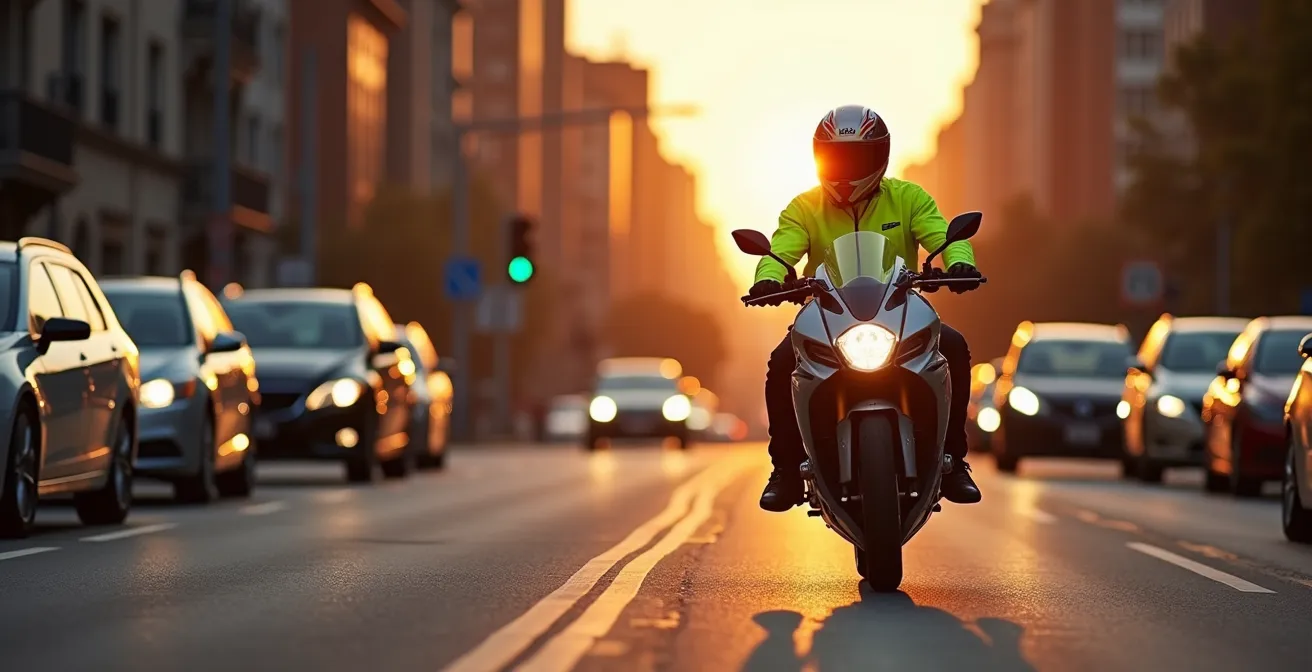
Riding like you’re invisible isn’t about passive defense; it’s about actively hunting for information to neutralize threats before they form.
- Most accidents happen because riders react to dangers, rather than predicting them.
- The key is to shift from a victim’s mindset to an “Information Predator’s” mindset, constantly reading micro-clues in the environment.
Recommendation: Stop just looking at traffic and start analyzing it. Identify escape routes, predict driver intentions from wheel angles, and treat every ride as a data-gathering mission.
Every rider has heard the advice: “Ride like you’re invisible.” It’s a well-intentioned mantra meant to foster defensive riding. But this philosophy has a fundamental flaw: it positions you as a passive victim, hoping to survive the actions of others. For the commuter who has felt the gut-wrenching lurch of a close call, hope is not a strategy. The truth is, a car can look directly at you and still not “see” you. Your survival depends not on being seen, but on your ability to see, interpret, and act before a situation becomes critical.
This is the core of the “Invisible Rider” mindset. It’s not about being a ghost; it’s about becoming an information predator. It’s a radical shift from passively reacting to a dangerous world to actively hunting for the micro-clues that telegraph danger. It’s about understanding the psychology of drivers, the physics of traffic, and the geometry of escape. This approach transforms riding from an exercise in anxiety to a discipline of supreme situational awareness. It empowers you with a system to control your environment, rather than be controlled by it.
This guide will deconstruct that system. We will move beyond slogans and into tactical, life-saving habits. You will learn to read traffic not as a collection of vehicles, but as a dynamic data field full of patterns, signals, and predictable behaviors. By mastering this mindset, you don’t just reduce risk; you seize control of your safety.
This article provides a structured approach to developing the “Invisible Rider” mindset. Each section builds upon the last, taking you from fundamental readiness to advanced environmental analysis, creating a complete system for urban survival on two wheels.
Summary: The “Invisible Rider” Mindset: How to Ride Like Nobody Can See You?
- Why You Should Never Sit in Neutral at a Red Light?
- How to Always Keep an “Out” When Trapped Between Cars?
- The Wheel Turn: How to Predict a Left-Turning Car Before It Moves?
- When to Use Your Horn: Alerting Drivers vs Startling Them?
- Why “Being Right” Can Get You Killed: The Graveyard Is Full of People Who Had the Right of Way
- The Silent Danger: How to Ride When Pedestrians Can’t Hear You Coming?
- Decompression Time: Why Arriving at Work Alert Beats Arriving Stressed?
- How to Read “Micro-Clues” in Urban Environments to Predict Jaywalkers?
Why You Should Never Sit in Neutral at a Red Light?
The most dangerous moment for a stationary rider isn’t from the front, but from behind. A distracted driver approaching a red light is one of the highest-probability threats you will face. Sitting in neutral, relaxed, with your hands off the controls, transforms you from a rider into a stationary target. It introduces a fatal delay between perceiving a threat and being able to react. Your goal is to eliminate that delay entirely.
Adopting the “Information Predator” mindset begins here, at a full stop. This is not downtime; it is a moment of heightened alert. Staying in first gear with the clutch pulled in is non-negotiable. This single habit shaves off the 1-2 critical seconds it would take to shift from neutral, a time you do not have if a car is bearing down on you at 40 mph. Your bike is not parked; it’s a coiled spring, ready to launch into a pre-planned escape path at a moment’s notice.
This state of readiness must be your default. Your head should be on a swivel, constantly checking your mirrors. You are not waiting for the light to turn green; you are actively “threat hunting,” monitoring the approach speed and deceleration patterns of the vehicles behind you. Position your bike to one side of the lane, not in the center, to create an immediate escape path between the cars in front of you. Being in gear is the physical manifestation of a prepared mind. It is the first and most fundamental rule of survival at an intersection.
This simple, conscious choice to remain engaged transforms a moment of high vulnerability into one of controlled readiness. It’s the first step away from being a victim of circumstance and toward becoming the master of your own safety.
How to Always Keep an “Out” When Trapped Between Cars?
Once in motion, the principle of readiness evolves into managing space. Many riders think of a “space cushion” as a simple buffer, a defensive gap. The Information Predator sees it differently: as “escape geometry.” It’s not just about the space you have, but what you can *do* with it. Being trapped between cars, especially in heavy traffic, removes your options and puts your fate entirely in the hands of others. Your primary mission is to never allow this to happen.
This means actively managing your lane position to maximize your escape routes. Avoid riding directly in the center of a lane, which often aligns with the oil slick and offers no lateral movement. Instead, ride in the left or right portion, creating a natural path to either the shoulder or the space between lanes. You must always maintain what advanced training programs call a “bubble of freedom.” The goal is to have at least two viable escape routes at all times: one to the left, one to the right. As traffic shifts, your geometry must shift with it. You are constantly solving a dynamic spatial puzzle.
This isn’t paranoia; it’s proactive risk management. Advanced rider training from organizations like Team Oregon has shown that riders who actively manage their space cushion and maintain escape routes can reduce close-call incidents by up to 60%. This demonstrates a direct correlation between conscious spatial management and survival. The illustration below visualizes this concept, showing how strategic positioning creates clear vectors of escape from potential threats.
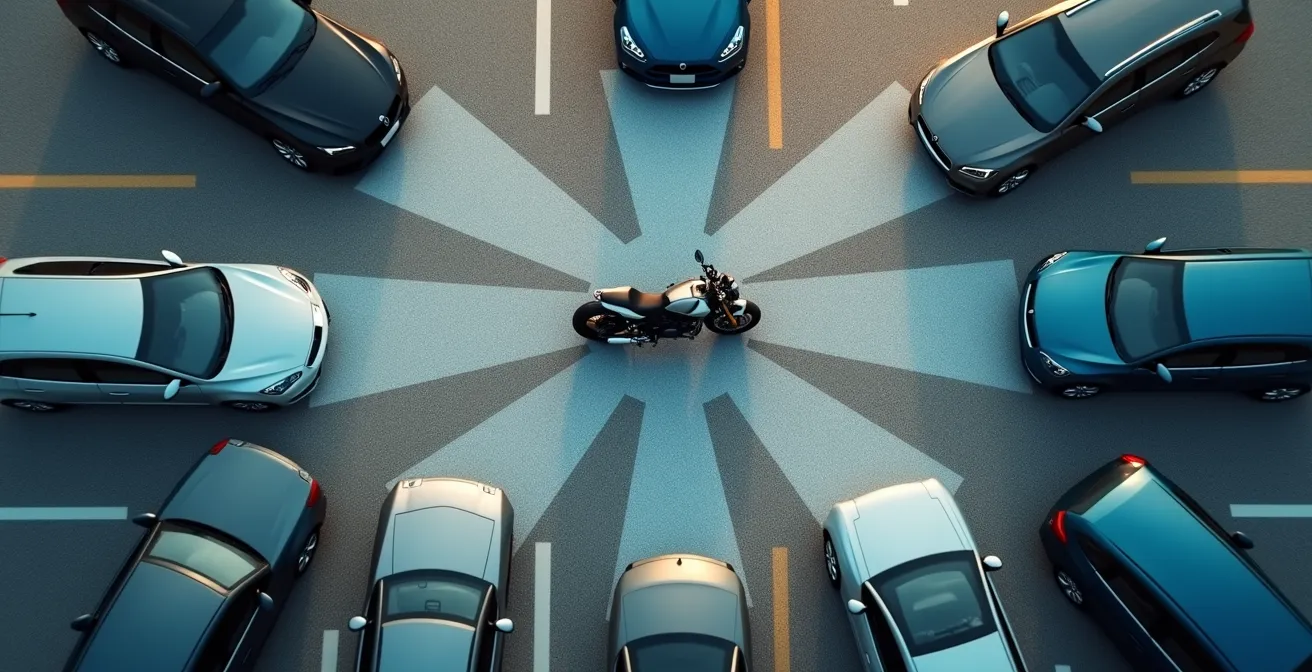
As the image shows, your position is not random. It is a deliberate choice designed to maintain options. A rider in the center of the lane is boxed in. A rider in the left tire track has a clear path to the space between lanes. Your space cushion is not empty space; it is your maneuvering room. Protect it, manage it, and always know how you’re going to use it.
Ultimately, keeping an “out” is a continuous process of assessment and repositioning. It is the practical application of foresight, ensuring you are never cornered into a crisis you cannot escape.
The Wheel Turn: How to Predict a Left-Turning Car Before It Moves?
The single most dangerous situation for a motorcyclist is a car turning left in front of them. This scenario is responsible for a catastrophic number of accidents, with federal data confirming that left-hand turns account for a significant portion of the 3,052 fatal two-vehicle motorcycle crashes in 2021. The common refrain is “the driver didn’t see me,” but the Invisible Rider mindset demands a more proactive approach. You must assume the driver will turn, and your job is to hunt for the micro-clues that predict the action before it begins.
The most reliable predictor is not the turn signal—which is often forgotten or misused—but the angle of the car’s front wheels. As a driver prepares to turn, they will almost invariably begin to angle their wheels in the intended direction of travel. This is your earliest and most reliable indicator. While the car is still stationary, a slight turn of the wheels is a massive red flag. It telegraphs intent. Your eyes must be trained to scan for this specific clue: car, driver’s head, and, most importantly, the front wheels. This is the “tell-trinity” of threat hunting.
The psychological phenomenon at play is called inattentional blindness. As safety experts from the Politis & Matovina Law Firm point out in their analysis:
Drivers may look directly at you while you are seated on your motorcycle but not ‘see’ you because they never register your presence in their mind
– Politis & Matovina Law Firm, Motorcycle Safety Awareness Study
Because you can never trust that you’ve been “seen,” you must rely solely on your own powers of prediction. The wheel turn is a physical commitment from the driver that you can observe and act upon. The moment you see it, you must immediately reduce speed, cover your brakes, and prepare your escape route. The image below highlights exactly what to look for.
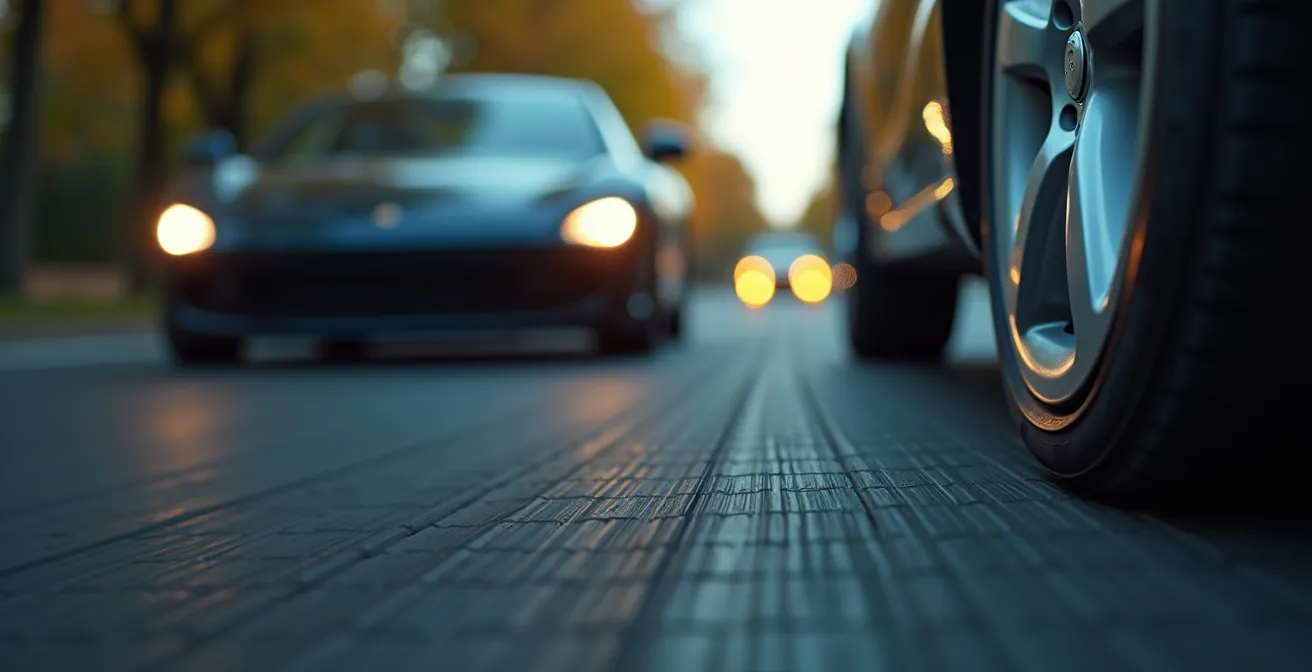
This subtle shift in angle is the beginning of the action. By seeing it and reacting to it, you move your response time from the moment of the turn to the moment of intent, gaining precious seconds that can mean the difference between a close call and a collision.
This is not just defensive driving; it is predictive analysis. You are no longer just a rider; you are a profiler of driver behavior, using concrete evidence to forecast and neutralize the greatest threat on the road.
When to Use Your Horn: Alerting Drivers vs Startling Them?
The horn is one of the few active tools in a rider’s arsenal, yet it is often misused or neglected. Many riders are hesitant, fearing they will startle or anger a driver. Others use it only as a last-ditch, panicked blast. The Information Predator uses the horn strategically, as a communication device to manage threats, not just a panic button. The goal is to make other drivers aware of your presence *before* they make a critical error.
The key is understanding the difference between an alert and an alarm. A sustained, angry blast is an alarm. It can startle a driver, causing them to brake erratically or swerve unpredictably—sometimes making a bad situation worse. The strategic use of the horn is the “acoustic tap”: two quick, friendly beeps. This is not an accusation; it is an announcement. It says, “I’m here,” without provoking an aggressive response.
This technique is a cornerstone of the “invisible rider” philosophy taught by experts like Kevin at MCrider. His training emphasizes using these quick taps preemptively. Are you about to enter a car’s large blind spot? Acoustic tap. Are you approaching an intersection where a driver is waiting to pull out? Acoustic tap. This method is about confirming your existence in their awareness bubble. Evidence from his rider community suggests that this kind of strategic horn usage can reduce SMIDSY (“Sorry Mate I Didn’t See You”) incidents by approximately 30% when combined with proper lane positioning. It is a proven, effective tactic.
Your horn protocol should be a hierarchy. The pre-emptive acoustic tap is for awareness. The sustained emergency blast is reserved for imminent, life-or-death collision threats only. Knowing the difference and using the right tool for the job is crucial. In some situations, a quick engine rev can serve as an alternative audio signature, especially in low-speed environments where a horn might be overly startling. The goal is always controlled, deliberate communication to manage your environment.
By using your horn as a proactive signaling device, you are no longer just hoping to be seen. You are actively inserting yourself into the consciousness of the drivers around you, taking another step to control your own safety.
Why “Being Right” Can Get You Killed: The Graveyard Is Full of People Who Had the Right of Way
In traffic law, there are rules. In a collision between a two-ton car and a 400-pound motorcycle, there is only physics. This is the most sobering and critical lesson for any rider: the right of way is a legal concept, not a physical shield. Insisting on it in the face of a driver’s mistake is a gamble you cannot afford to take. The “Invisible Rider” mindset requires a fundamental shift in priority from being right to being alive.
The statistics are brutally clear. The fatality rate for motorcyclists is nearly 22 times higher than for passenger vehicle occupants per mile traveled, according to the National Safety Council. This disparity means that in any conflict, the consequences fall almost entirely on you. The driver who violates your right of way might get a ticket or an insurance claim. You might get a hospital stay or worse. Therefore, your primary directive is to avoid contact at all costs, regardless of who is at fault.
This means you must be willing to yield, even when you shouldn’t have to. It means anticipating that the driver will pull out from the side street, will change lanes without signaling, and will complete their left turn in front of you. You must ride with the absolute expectation of others’ errors. As the collective wisdom of the FortNine community succinctly puts it in their discussions on invisibility training:
The best choice is to never let a car touch you, no matter who is in the right, because the consequences for collision fall disproportionately on motorcyclists
– FortNine Community, Invisibility Training Discussion
This is not about surrendering or riding timidly. It is the ultimate form of empowerment. It is the conscious decision to take your safety entirely into your own hands, refusing to entrust it to the competence or awareness of others. Ego has no place on a motorcycle. Your pride in being “right” is worthless in an emergency room. Let the car go. Let them make their mistake. Your victory is not winning the intersection; it’s arriving at your destination safely.
Swallowing your pride to avoid a conflict is the highest form of riding skill. It is the signature of a true survivalist who understands that the only point that matters is the one you get for finishing the ride.
The Silent Danger: How to Ride When Pedestrians Can’t Hear You Coming?
Our threat-hunting model has so far focused on vehicles, but in urban environments, the most unpredictable elements are often on foot. Pedestrians, conditioned for decades to associate the sound of an engine with the danger of a vehicle, are often completely oblivious to the near-silent approach of a modern motorcycle, especially an electric one. This “silent danger” creates a new class of risk that requires a specific set of tactics.
The problem was tragically highlighted in the UK, where a motorcyclist’s death led the Driver and Vehicle Standards Agency (DVSA) to create new training materials. Their research found that pedestrians, particularly those distracted by phones or headphones, have a deep-seated reliance on auditory cues. When that cue is absent, their awareness bubble shrinks to almost zero. You must assume that if a pedestrian hasn’t made direct eye contact with you, they have absolutely no idea you are there.
Your strategy must therefore shift from being heard to being seen and anticipated. This involves a few key adaptations. First, drastically reduce your speed in any high-density pedestrian area like parking lots, crosswalks, or busy downtown cores. Your goal is to be able to stop in half the distance you can see clearly. Second, re-introduce an auditory signature. A gentle, periodic “throttle blip” or a light tap of the horn can serve as a substitute for engine noise, drawing heads up from phone screens. Your visual scanning must also become more granular. You are no longer just looking for people; you are looking for signs of distraction: the white flash of earbuds, the glow of a phone screen, the erratic movement of a child.
This isn’t just about crosswalks. A worn path in the grass between apartment buildings or a bus stop with a crowd are unofficial crossing zones. You must treat them with the same caution as a marked intersection. The burden of awareness is entirely on you, because the pedestrian is operating in a different sensory world.
By recognizing that your auditory presence is diminished or non-existent, you can adapt your visual and tactical approach to compensate, effectively managing one of the most unpredictable risks of urban riding.
Key takeaways
- The “Invisible Rider” is not a passive victim but an active “Information Predator” who hunts for threats.
- Constant readiness is key: stay in first gear at stops, and always maintain multiple escape routes.
- Survival is more important than being right; yield the right of way to avoid any collision, regardless of fault.
Decompression Time: Why Arriving at Work Alert Beats Arriving Stressed?
The ride doesn’t end when you turn the key off. The mental state in which you arrive at your destination is as important as the ride itself. A commute filled with close calls and high-stress threat management can leave you agitated, with adrenaline and cortisol flooding your system. Arriving at work in this state is counterproductive, negatively impacting focus and decision-making. Conversely, a ride handled with the controlled, focused mindset of an Information Predator can have the opposite effect.
As the Motorcycle Safety Foundation notes in its research, a ride handled with a survival mindset sharpens focus, enhances situational awareness, and primes the brain for high-stakes decision-making. You arrive not frazzled, but switched on. The intense focus required acts as a form of mental warm-up, clearing away the fog of the morning and preparing you for the challenges of the day. The key is to consciously process the ride and transition out of that high-alert state. This is “mental decompression.”
Instead of rushing into the building, take a moment. A simple 60-second debrief can transform the lingering stress of the ride into a valuable learning experience. It creates a feedback loop that makes you a better rider every single day. This protocol allows you to systematically download the “data” from your commute, reinforcing good habits and identifying areas for improvement on the ride home.
Your 60-Second Post-Ride Debrief Protocol
- Park and remain seated for 10 seconds, taking one deep breath to signal the end of the ride.
- Mentally replay any close calls or challenging situations you encountered (20 seconds).
- Identify the single best defensive or predictive move you made during the ride (10 seconds).
- Note one specific thing you could have done better or will watch for on the return journey (10 seconds).
- Perform a brief gratitude check for a safe arrival, consciously closing the mental loop (10 seconds).
This simple ritual does two things: it prevents the accumulated stress of the ride from bleeding into your workday, and it actively reinforces the learning process. You are not just surviving your commute; you are using it as a daily training exercise in awareness and prediction.
By making this debrief a non-negotiable part of your routine, you ensure that you arrive alert, focused, and better prepared for the next time you swing a leg over your bike.
How to Read “Micro-Clues” in Urban Environments to Predict Jaywalkers?
Now we bring it all together. The urban environment is the most complex and data-rich setting a rider will face. With 58% of fatal motorcycle crashes occurring in urban areas, mastering this environment is the ultimate test of the Information Predator mindset. Here, threats are not just other vehicles, but a chaotic mix of pedestrians, cyclists, delivery vans, and unpredictable events. Your survival depends on your ability to read subtle “micro-clues” and predict actions before they happen.
You must learn to see the city not as a static backdrop, but as a collection of potential triggers. A bouncing ball rolling into the street is not just a ball; it is a 2-second warning that a child will follow. A delivery van parked with its side door ajar is not just a van; it is a solid object that is about to eject a person into your path of travel. An exhaust plume from a city bus at a stop is a signal that pedestrians will soon emerge from its front, completely blind to your approach.
This is high-level threat hunting. You are looking for patterns and indicators that the average person ignores. The table below, an Urban Threat Matrix, provides a systematic way to translate these micro-clues into threat predictions and immediate, decisive actions. It is a field guide for the urban hunter.
| Micro-Clue Observed | Threat Prediction | Recommended Action |
|---|---|---|
| Bouncing ball/toy | Child following within 2-3 seconds | Immediate speed reduction to 15 mph |
| Bus exhaust/doors opening | Pedestrians crossing in front | Cover brakes, scan both sides |
| Delivery van door ajar | Worker stepping out | Move to far lane position |
| Weight shift at curb | Imminent jaywalking | Horn ready, reduce speed 25% |
| Worn path in grass | Regular crossing zone | Treat as unmarked crosswalk |
Your task is to internalize this matrix until it becomes second nature. You are constantly scanning, categorizing, and prioritizing these micro-clues. A pedestrian shifting their weight at the curb is more of an immediate threat than one standing still. A worn path in the grass between buildings is as significant as a painted crosswalk. By reading these signs, you are essentially seeing the future, reacting to events that have not yet occurred but are highly probable.
This is the pinnacle of the “Invisible Rider” mindset. You are no longer just reacting to your environment; you are in a constant state of dialogue with it. You see the clues, you understand the patterns, and you act with decisive, life-saving precision. You are in control.