
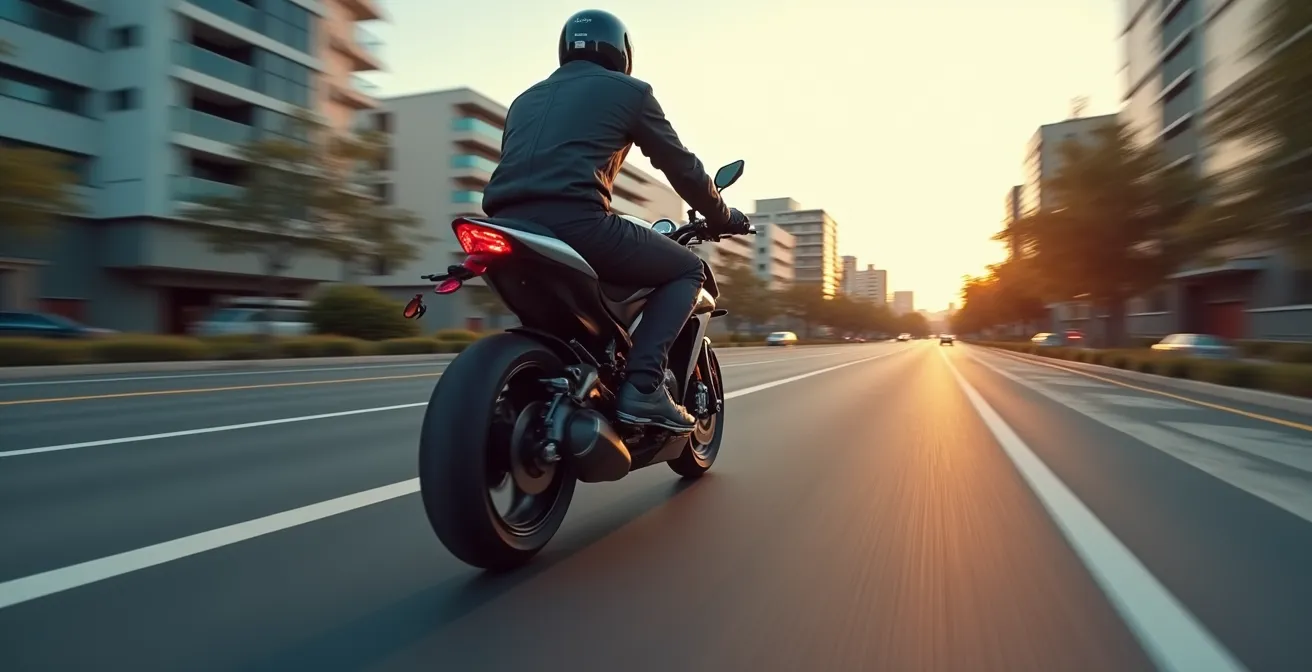
The spec sheet is misleading: an electric motorcycle’s “fast” sensation comes not from horsepower, but from a perfectly flat, unwavering torque curve that combustion engines cannot replicate.
- Electric motors deliver 100% of their torque from 0 RPM, eliminating the build-up phase (drivetrain latency) inherent to gas engines.
- This “torque plateau” provides a constant, powerful push that your brain perceives as more intense acceleration than a surging, peaking ICE powertrain.
Recommendation: Stop comparing HP numbers directly. Instead, focus on the torque delivery method to truly understand a bike’s character and real-world performance.
If you’re a rider who lives by the spec sheet, the rise of electric motorcycles presents a fascinating paradox. You see a bike with a horsepower figure that might be matched by a midrange gas-powered cousin, yet on the road, the EV launches with a ferocity that feels like it’s rewriting the laws of physics. This common experience leads to the core question: why does an electric motorcycle feel so much faster than its numbers suggest? The typical answer you’ll hear is a simple, almost dismissive platitude: “instant torque.”
While true, that phrase barely scratches the surface. It fails to explain the fundamental difference in how these two types of powertrains deliver force. An internal combustion engine (ICE) is a complex beast of explosions and mechanics; it needs to build revolutions to find its power band. An electric motor is a creature of pure physics, operating on an entirely different principle. Understanding this difference is the key to resolving the power-to-sensation mismatch.
This isn’t just about straight-line speed. This shift in powertrain philosophy impacts everything from rider engagement and maintenance to on-road safety and long-term value. It demands a cognitive recalibration from the rider. To truly grasp why the EV feels different, we must look beyond a single number and explore the entire ecosystem of the electric powertrain. This article will deconstruct that feeling, exploring the interconnected facets that define the modern electric riding experience.
To fully explore this powertrain revolution, we will dissect the key aspects that define the electric motorcycle experience, from the nuanced changes in rider engagement to the practical realities of maintenance, safety, and financial value. The following sections break down each component of this new paradigm.
Summary: Understanding the Electric Powertrain Shift
- No Clutch, No Gears: Does Removing Shifting Ruin the Engagement of Riding?
- The End of Oil Changes: How Much Money/Time Does an EV Powertrain Save?
- The Silent Danger: How to Ride When Pedestrians Can’t Hear You Coming?
- Depreciation Anxiety: Do Electric Motorcycles Hold Value Like Gas Bikes?
- Why Are Hybrid Motorcycles So Rare Compared to Hybrid Cars?
- How an ECU Flash Smoothes Out Jerky Throttle Response at Low RPM?
- The Instant Torque Shock: How to Re-Calibrate Your Right Hand for EV Riding?
- Real-World Range vs Spec Sheet: Can You Actually Commute 50 Miles on Highway Speeds?
No Clutch, No Gears: Does Removing Shifting Ruin the Engagement of Riding?
For many veteran riders, the rhythmic dance of clutch, shift, and throttle is the very soul of motorcycling. The idea of a “twist-and-go” bike can feel like a dilution of that cherished engagement. However, this perspective often misses the opportunity that a simplified drivetrain presents. By removing the mental and physical load of managing gears, a rider’s cognitive bandwidth is freed up. This isn’t a loss of engagement; it’s a reallocation of it.
Instead of focusing on being in the right gear for a corner, you can dedicate 100% of your attention to perfecting your line, braking points, and body position. The direct connection between your right hand and the rear wheel becomes the new skill to master. Modulating the throttle with micro-adjustments to manage the immense, ever-present torque becomes an art form in itself. Furthermore, learning to use regenerative braking effectively is an active skill, turning deceleration into a planned, efficient part of your riding flow.
The result is a different kind of “flow state.” It’s less about mechanical coordination and more about pure riding dynamics—road perception, hazard identification, and chassis feedback. For many, this shift elevates the riding experience, trading the satisfaction of a perfect downshift for the sublime feeling of tracing a perfect, uninterrupted arc through a series of turns. It’s not less engaging; it’s just a different, more fluid dialect of the language of riding.
The End of Oil Changes: How Much Money/Time Does an EV Powertrain Save?
One of the most tangible benefits of switching to an electric powertrain is the radical simplification of maintenance. An internal combustion engine is a symphony of controlled explosions, requiring a host of fluids, filters, and mechanical adjustments to keep it happy. An electric motor has one primary moving part. This fundamental difference translates into significant savings in both time and money over the life of the motorcycle.
The list of eliminated maintenance tasks is extensive: no oil and filter changes, no valve adjustments, no new spark plugs, no air filter cleaning, and no clutch cable adjustments or replacements. Compared to combustion engines, studies suggest that electric motorcycles require 50-70% less maintenance. The only routine items are typically tire checks, brake fluid, and brake pads—and even brake pad wear is reduced thanks to regenerative braking.
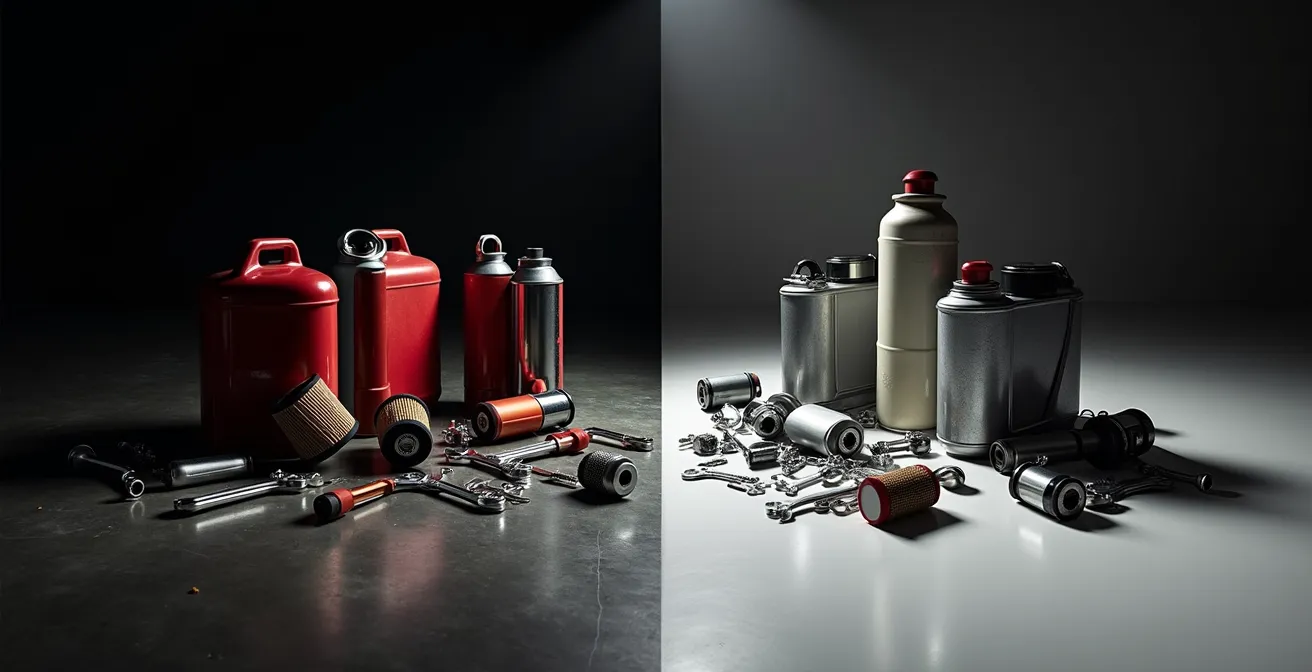
This translates directly to your wallet and your weekend. The time you would have spent in the garage or at a dealership is now yours to spend riding.
Case Study: Real-World Total Cost of Ownership
Analyzing the total cost of ownership reveals a stark contrast. Electric motorcycles typically consume 2.8-4 kWh of electricity per 100 km, resulting in an annual “fuel” cost of around $70-$200 for 10,000 km of riding. A comparable gas motorcycle, averaging 2.5-3 L/100 km, would incur fuel costs of $1,600-$2,400 over the same distance. The elimination of oil changes, spark plugs, and valve adjustments saves an additional 8-12 hours of maintenance time annually. While the eventual cost of battery replacement (typically every 5-8 years) is a major factor, it is often comparable to the cost of a major engine rebuild required for a high-mileage ICE bike.
The Silent Danger: How to Ride When Pedestrians Can’t Hear You Coming?
The same lack of combustion that provides silent, smooth power also creates one of the electric motorcycle’s biggest challenges in urban environments: acoustic invisibility. For a century, pedestrians and other drivers have been conditioned to associate the sound of an engine with the presence of a vehicle. The near-silent hum of an EV at low speeds breaks this fundamental safety cue, requiring the rider to adopt a new level of defensive awareness.
You can no longer assume that a pedestrian looking at their phone or a car preparing to pull out of a driveway is aware of your approach. The burden of being “seen” falls entirely on the rider. This means riding with a heightened sense of prediction, constantly scanning for potential conflicts and making your presence known visually. Positioning yourself in a lane to maximize your visibility in others’ mirrors and actively seeking eye contact with pedestrians before crossing their path become critical habits.
Since electric models are ‘silent and armed’ with instant torque, take care to check you switch it off whenever you get off. Be mindful of that instant speed too, especially on congested roads or around busy pedestrian areas.
– Bennett’s BikeSocial, How to adjust to riding an electric motorcycle
Many riders find themselves covering their horn far more frequently than on an ICE bike, using short, polite beeps to announce their presence rather than as a warning. Some newer models are being equipped with an Acoustic Vehicle Alerting System (AVAS) that emits a subtle, speed-sensitive sound at low speeds, but for models without it, the rider’s vigilance is the primary safety system. It’s a mental shift from being passively heard to being actively seen.
Depreciation Anxiety: Do Electric Motorcycles Hold Value Like Gas Bikes?
While the savings on fuel and maintenance for an electric motorcycle are clear, the other side of the financial coin—depreciation—presents a more complex picture. Currently, the market trend shows that electric motorcycles tend to depreciate faster than their gasoline-powered counterparts. This isn’t due to a lack of quality, but is primarily driven by the rapid pace of technological evolution, especially in battery technology.
Just like with early smartphones, potential buyers of used EVs are often wary of “older” battery technology, fearing diminished range and longevity. A gas bike from five years ago is mechanically very similar to a new one, but a five-year-old EV can feel a generation behind in terms of battery capacity and software features. As a result, current market data suggests that while gas bikes may retain 60-70% of their value after three years, electric motorcycles show a residual value closer to 40-50% in the same timeframe.
The table below breaks down the key factors influencing the resale value of both types of motorcycles. It highlights how the primary value driver for an EV is its battery health, whereas for an ICE bike, it’s traditional mechanical wear and mileage.
| Factor | Electric Motorcycles | Gas Motorcycles |
|---|---|---|
| First Year Depreciation | 30-50% | 20-30% |
| Annual Depreciation After Year 1 | 15-20% | 10-15% |
| Primary Value Driver | Battery health & software updates | Mechanical wear & mileage |
| Technology Impact | Rapid obsolescence risk | Stable technology |
| Future Outlook | Improving with 8-year battery warranties | Stable but emission zones may impact |
However, this trend is likely to stabilize. As battery technology matures and manufacturers offer longer, more comprehensive battery warranties (some now extending to eight years), consumer confidence will grow, and residual values are expected to improve. For now, early adopters are trading a higher depreciation risk for access to cutting-edge technology and lower running costs.
Why Are Hybrid Motorcycles So Rare Compared to Hybrid Cars?
Given the distinct advantages and disadvantages of both electric and combustion powertrains, a logical question arises: why aren’t hybrid motorcycles as common as hybrid cars? The answer lies in a series of unique engineering challenges dictated by the compact nature of a motorcycle. A car has ample chassis space to accommodate both an engine and an electric motor/battery system. A motorcycle does not.
The primary obstacles have always been weight and packaging. Adding an electric motor, a battery, and the associated control systems to an already-cramped motorcycle frame without upsetting its delicate weight balance and handling characteristics is an immense engineering feat. Until recently, the added weight and complexity were seen as prohibitive, negating the benefits. For a vehicle where a few dozen pounds can drastically alter its feel and performance, the idea of adding a second powertrain seemed impractical.
However, technology is catching up. Component miniaturization and more efficient packaging are beginning to make hybrids viable. Some engineering firms are developing highly integrated systems, and according to Vitesco Technologies, their hybrid package can add less than 50 pounds to a conventional motorcycle. This progress is paving the way for major manufacturers to enter the space.
Case Study: The Kawasaki Ninja 7 Hybrid
The 2024 Kawasaki Ninja 7 Hybrid stands as the world’s first mass-production “strong hybrid” motorcycle, proving these challenges are surmountable. Engineers cleverly packaged a 451cc twin-cylinder engine with a compact, water-cooled electric motor located just behind the cylinders. This design maintains proper weight distribution while offering three distinct drive modes: a performance-oriented SPORT-HYBRID, a fuel-sipping ECO-HYBRID, and a short-range, silent EV-only mode. The successful launch of the Ninja 7 Hybrid signals that the era of the hybrid motorcycle, while late to arrive, may finally be dawning.
How an ECU Flash Smoothes Out Jerky Throttle Response at Low RPM?
To fully appreciate the inherent smoothness of an electric motor, it’s fascinating to look at the lengths we go to perfect the throttle response on a gas engine. Many modern ICE motorcycles, especially those tuned to meet strict emissions standards, suffer from a jerky, on/off throttle feel at low RPMs. This is often caused by lean fuel maps in the Engine Control Unit (ECU) that prioritize emissions over rideability. An ECU flash is a popular aftermarket solution where a technician rewrites these maps.
By richening the fuel mixture and adjusting ignition timing at low throttle openings, an ECU flash can dramatically smooth out this jerky behavior. It’s essentially a digital “tune-up” that tells the engine to behave more gracefully. However, it’s important to recognize this is a *corrective measure*. It’s a patch applied to a system with inherent mechanical and combustion latency.
An electric motor needs no such correction because it operates on a completely different principle. There is no fuel to map or ignition to time. The control is “torque-by-wire,” not “fuel-by-wire.” When you twist the throttle, you are directly commanding the motor controller to send a precise amount of electrical current to the motor. The response is not just fast; it’s infinitely granular and naturally smooth from 0 RPM. An electric motor is never “out of the power band” or “bogging down.” It is always ready to deliver exactly what you ask of it, with zero hesitation.
This table highlights the fundamental differences between trying to fix an ICE throttle and the native perfection of EV control.
| Aspect | ICE with ECU Flash | Electric Motor Control |
|---|---|---|
| Control Method | Fuel-by-wire (modifying maps) | Torque-by-wire (direct current control) |
| Response Time | Milliseconds delay | Near-instantaneous |
| Precision | Limited by mechanical systems | Infinite granularity |
| Adaptability | Fixed after flash | Real-time adjustable |
| Low RPM Behavior | Improved but imperfect | Naturally smooth |
Key Takeaways
- An EV’s “faster” feel is due to its torque plateau—100% torque from 0 RPM—not its peak horsepower figure.
- The absence of gears and a clutch reallocates the rider’s mental focus from mechanical coordination to pure riding dynamics like line choice and hazard perception.
- While EV’s have significantly lower maintenance costs, they currently face higher depreciation due to rapid advancements in battery technology.
The Instant Torque Shock: How to Re-Calibrate Your Right Hand for EV Riding?
The first time you twist the throttle on a performance electric motorcycle is a moment you never forget. Your brain is conditioned by years of riding gas engines to expect a slight delay—a momentary lag as the engine revs, the clutch engages, and the drivetrain takes up slack. The EV has none of this. The connection is absolute and instantaneous. This “instant torque shock” can be jarring, even for experienced riders. The bike doesn’t just accelerate; it teleports forward.
This phenomenon is beautifully illustrated by performance figures from bikes like the Ultraviolette F77. While its horsepower might be comparable to a 300-400cc gas bike, its acceleration is not. The ability of an EV to achieve 0 to 60 kmph in just 2.8 seconds is a direct result of its ability to deliver peak torque at 0 RPM. A gas engine has to climb a curve of RPMs to reach its peak torque, whereas an electric motor provides a massive, unwavering “torque plateau” from the very first degree of throttle twist.
This requires a complete cognitive recalibration of your right hand. Your muscle memory must unlearn the habit of a large initial throttle input to “get the bike moving” and learn a new language of smooth, precise micro-movements. Most electric motorcycles offer different ride modes (like Eco, Street, Sport) for this exact reason. They aren’t just changing peak power; they are softening the initial throttle map to help you adapt to this zero-latency world.
Your Action Plan: Re-Calibrating for Instant Torque
- Initial Assessment (First 3 Days): Ride exclusively in the softest mode (Eco/Rain). Your goal is not speed, but to consciously analyze the zero-latency response and the effect of tiny throttle inputs.
- Muscle Memory Development (Week 1): Move to the standard ‘Street’ mode. In a safe, open area, practice extremely smooth throttle roll-ons from a standstill, focusing on making the initial launch seamless, not abrupt.
- Comparative Analysis (Week 2): During a single ride, switch between Eco, Street, and Sport modes. Actively feel and mentally note the difference in throttle response and power delivery in each mode to build a sensory map.
- Controlled Environment Testing (Week 3): Only now, begin using ‘Sport’ mode in a controlled environment like an empty parking lot. Practice sharp, but controlled, acceleration bursts to understand the bike’s ultimate potential safely.
- Integrated Skill Plan (Ongoing): Start blending your new throttle control with regenerative braking. Practice “one-pedal riding,” modulating your speed in traffic using only the throttle and the automatic regen, rarely touching the brake levers.
Real-World Range vs Spec Sheet: Can You Actually Commute 50 Miles on Highway Speeds?
For all the thrilling performance of an electric motorcycle, the most persistent question from potential riders revolves around range. Specifically, can you trust the number on the spec sheet? The answer is complex. While advertised range figures are often achievable—and sometimes beatable—in city riding, they can be notoriously optimistic for highway commuting. The promise of a 100-mile range might not translate to a 50-mile round-trip commute at 70 mph.
The culprit is physics, specifically aerodynamic drag. Air resistance doesn’t increase linearly; it increases with the square of velocity. This means that doubling your speed from 35 mph to 70 mph doesn’t double the energy required to push through the air—it quadruples it. For an EV, this effect is devastating to the battery life. At a steady 70 mph on the highway, the motor is under a constant, heavy load with almost zero opportunity for regenerative braking to recapture energy, which is a huge source of efficiency in stop-and-go city traffic.
Case Study: The Physics of Highway Range Depletion
Real-world testing consistently demonstrates this principle. A motorcycle with an advertised range of 100 miles (typically tested under mixed, lower-speed conditions) will often see that range plummet by 40-50% when ridden exclusively at sustained highway speeds of 70 mph or more. As a result, that 100-mile bike effectively becomes a 50-60 mile highway machine. This isn’t a fault of the motorcycle; it’s an immutable law of physics that affects all electric vehicles, but is especially pronounced on motorcycles which are less aerodynamic than cars.
So, can you commute 50 miles at highway speeds? It depends entirely on the bike’s battery capacity and the *real* highway range, not the advertised one. A bike with a 150-mile advertised range could likely handle it with ease, while a 90-mile city-focused bike would leave you stranded. Diligent research into real-world highway tests for a specific model is crucial. For highway warriors, choosing a model with a larger battery pack is non-negotiable.
The transition to electric powertrains is about more than just swapping a gas tank for a battery; it’s a fundamental shift in the very definition of motorcycle performance and ownership. By understanding the beautiful physics of the torque plateau, you can look past the spec sheet and appreciate these fascinating machines for what they truly are. The next step is to experience it for yourself and feel the future of two-wheeled motion.