
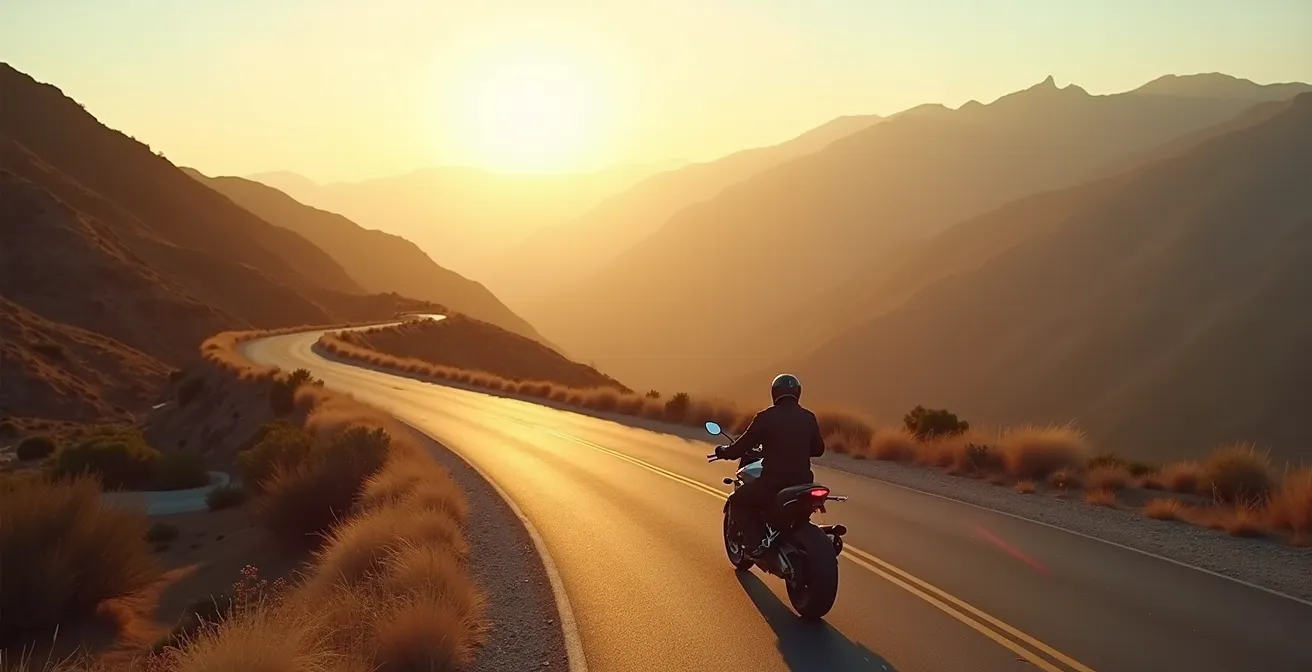
To a non-rider, the sight of a motorcyclist filtering through traffic or leaning into a curve on a mountain road often sparks a single, visceral question: “Why take the risk?” It’s a fair question. Stripped of the steel cage, airbags, and climate control of a car, a rider is undeniably vulnerable. They are exposed to the elements, to the road surface, and to the actions of every other vehicle. The conventional wisdom is that freedom comes from safety and insulation. But what if that’s fundamentally wrong? What if the profound sense of freedom that riders describe isn’t found in spite of the vulnerability, but directly because of it?
The philosopher Robert Pirsig captured this essence perfectly in his seminal work, “Zen and the Art of Motorcycle Maintenance.” He observed, “In a car you’re always in a compartment, and because you’re used to it you don’t realize that through that car window everything you see is just more TV. You’re a passive observer… On a cycle the frame is gone. You’re completely in contact with it all. You’re in the scene, not just watching it anymore, and the sense of presence is overwhelming.” This “overwhelming presence” isn’t a poetic flourish; it’s a precise description of a psychological state. It’s a state of forced mindfulness, where the constant, low-grade risk demands 100% of your cognitive and sensory attention. There is no mental bandwidth left for ruminating on yesterday’s argument or worrying about tomorrow’s deadline. There is only now. This is not about an adrenaline rush; it is about achieving a state of mental quiet through total engagement.
This article explores this paradox. We will delve into the culture, the science, and the lived experience of riding. We won’t dismiss the risks, but instead, we will reframe them as the catalyst for the very mental health benefits that make motorcycling a therapeutic practice for millions. From the subtle nod between strangers to the mechanics of urban commuting, we will examine how this act of vulnerable engagement with the world is not a flight from reality, but a profound immersion into it.
In the sections that follow, we will break down the various facets of the rider’s mindset. We will explore the rituals that bind the community, the practical realities of life on two wheels, and the scientific evidence that supports the claim that motorcycling is, for many, a form of active meditation.
Summary: The Philosophy and Psychology of Riding
- Why Do Riders Wave at Each Other and Does It Matter If You Don’t?
- The Sidewalk Gray Area: Where Can You Legally Park When Spots Are Full?
- Organ Donors and Outlaws: How to Handle Anti-Motorcycle Comments from Family?
- Solo vs Club: Do You Need a Group to Enjoy Motorcycling?
- The Flow State: How Riding Forces Mindfulness and Reduces Stress?
- Rider Fatigue: How to Recognize the Mental Fog Before You Make a Mistake?
- The Rusty Rider: How to Rebuild Confidence After 10 Years Off the Bike?
- How to Cut Your Morning Commute Time by 20% in Heavy City Traffic?
Why Do Riders Wave at Each Other and Does It Matter If You Don’t?
It’s one of the first cultural quirks a non-rider notices: two motorcyclists, complete strangers heading in opposite directions, almost always acknowledge each other with a subtle wave. It might be a full hand, two fingers pointing down, or a simple nod. To an outsider, it can seem like a secret society. In a way, it is. This small gesture is a powerful symbol that goes to the heart of the riding philosophy. It’s an acknowledgment of shared vulnerability and a mutual respect for the choice to be fully exposed on the road. It’s a non-verbal way of saying, “I see you. I understand the risks you’re taking and the joy you’re feeling. Stay safe.”
This silent camaraderie is born from a shared experience that car drivers simply don’t have. As the editors at Saint Motorcycle Gear Journal put it, “Us bikers are often outnumbered on the road and it sometimes feels like car drivers have it out for us, so it’s nice to be acknowledged by other riders. It’s a simple way of letting a fellow biker know that someone out there has their back.” The wave is a micro-moment of human connection in an increasingly isolated world, a recognition that you are both part of a tribe defined not by what you ride, but by the fact that you ride at all.
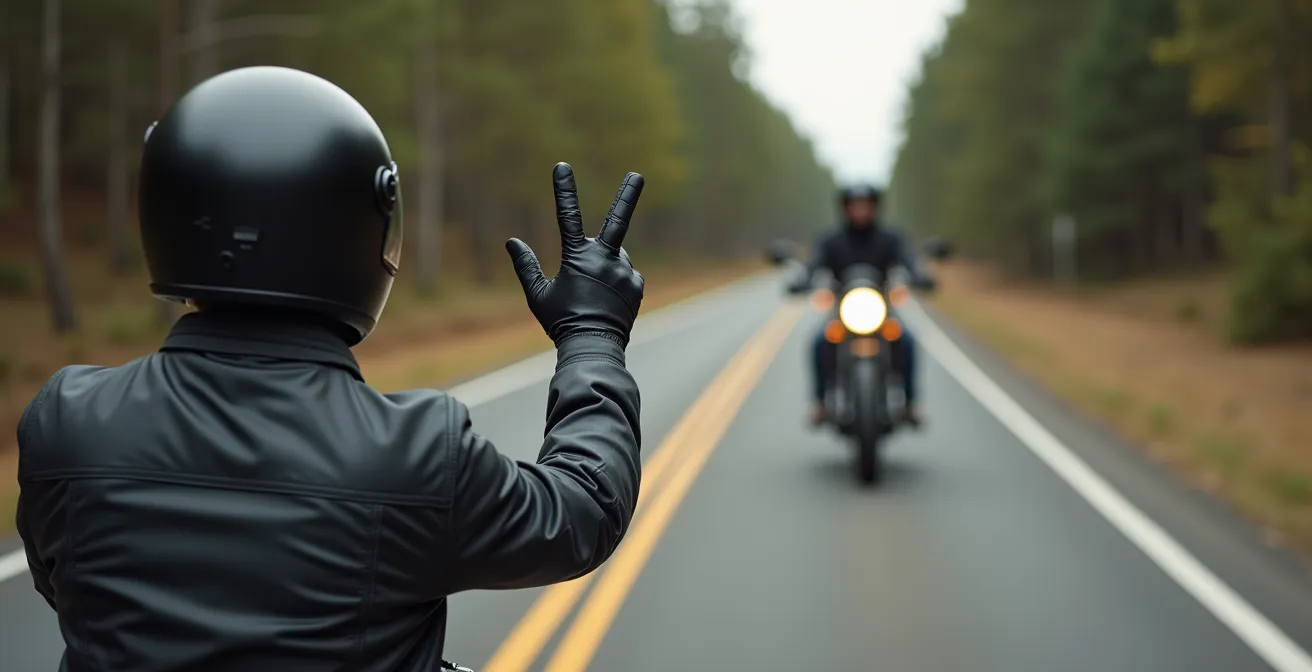
So, does it matter if you don’t wave back? To the community, it can be seen as a slight, though most riders understand that a beginner might be too focused on the controls or that a complex traffic situation demands full attention. But the act of waving is less an obligation and more an opportunity—an opportunity to reinforce the unspoken bond and to feel part of something larger than yourself. It’s the first and most basic expression of the community and mutual support that underpins the world of motorcycling.
The Sidewalk Gray Area: Where Can You Legally Park When Spots Are Full?
While much of riding is about philosophy, there are also stark practicalities. Parking is a prime example. For the non-rider, a motorcycle seems to offer a magical solution to urban congestion—just park it anywhere! The reality is a complex web of laws, etiquette, and common sense. The number one rule, universally, is that sidewalks are for pedestrians. Parking a motorcycle on a sidewalk is illegal in almost every jurisdiction and is a major source of friction between riders and the public. It obstructs access for pedestrians, wheelchairs, and strollers, and it reinforces the negative “outlaw” stereotype.
So, what are the options when designated motorcycle parking is full? The key is to be both legal and considerate. When using a standard car parking space, multiple motorcycles can often share one spot. Etiquette dictates parking in a way that allows others to easily get in and out. When using parallel or angled street parking, specific techniques are required. The goal is always to maximize stability and minimize the vehicle’s footprint, ensuring it doesn’t become a hazard.
Understanding these rules is part of the responsibility that comes with riding. It’s an extension of the on-road awareness required every second of a journey. Here are some fundamental guidelines for legal and considerate motorcycle parking:
- Never park on sidewalks, as they are strictly reserved for pedestrians.
- When using angle parking, position the motorcycle at a 45-degree angle with the back tire touching the curb to maximize space and stability.
- On hills, always park with the back of the bike facing downhill if possible, use the center stand for better stability, and leave the bike in gear on steep inclines to prevent rolling.
- When sharing a space with other bikes, leave enough room for riders to mount, dismount, and maneuver safely.
- Always be mindful of local regulations, such as staying at least 15 feet from fire hydrants and parking within 18 inches of the curb.
These practical skills are part of the broader discipline of motorcycling, where mindfulness extends from the open road to the final parking spot.
Organ Donors and Outlaws: How to Handle Anti-Motorcycle Comments from Family?
Every rider has heard them. The concerned but cutting remarks from family and friends: “You know they call those ‘donor-cycles,’ right?” or “I just don’t understand why you need to do something so dangerous.” These comments, while often well-intentioned, stem from a fundamental misunderstanding of the rider’s motivation. They focus solely on the risk while being completely blind to the reward. Handling these conversations requires not defensiveness, but a calm reframing of the activity—moving it from the category of “reckless thrill-seeking” to “mindful practice.”
One of the most effective approaches is to gently introduce the science. Motorcycling isn’t just a passive activity; it’s a full-body and mind engagement. Research has shown that riding has measurable physiological effects. For instance, UCLA research shows riding produces an 11% heart rate increase and a 27% adrenaline boost, effects similar to light exercise. More importantly, that same study found riding a motorcycle for 20 minutes decreased biomarkers of stress by 28%. You can explain that the “danger” they perceive is precisely what forces a state of heightened awareness that is, paradoxically, calming. It’s a form of active meditation that leaves no room for the mental clutter of everyday anxiety.
As neuroscientist Dr. Don Vaughn, who was involved in the study, noted, “The brain is an amazingly complex organ and it’s fascinating to rigorously investigate the physical and mental effects riders report.” The science is beginning to validate what riders have known intuitively for decades. When confronted with anti-motorcycle comments, the best response is not to argue about risk, but to explain the experience. It’s a tool for mental clarity and stress reduction, a deliberate choice to engage with the world in a way that is more demanding, and therefore, more rewarding. It’s not about being an outlaw; it’s about pursuing a unique path to well-being.
Solo vs Club: Do You Need a Group to Enjoy Motorcycling?
The popular image of motorcycling is often one of extremes: either the lone wolf, carving a solitary path across a deserted landscape, or the tight-knit club, riding in a formidable pack. The truth, as always, lies in the vast space between. The question of whether to ride alone or with a group isn’t about right or wrong, but about what kind of psychological benefit a rider is seeking at any given moment. Both paths offer a valid and powerful form of therapy.
Solo riding is an exercise in profound self-reliance and introspection. It is the ultimate expression of freedom, where every decision—the route, the pace, the destination—is yours alone. This is where the meditative aspect of riding truly shines. With no one to follow and no one to lead, the rider can fully immerse themselves in the rhythm of the road and their own thoughts. It’s an opportunity to connect with oneself, to solve problems in the back of your mind, or simply to empty the mind altogether. This solitary journey is where many riders find the “flow state,” a deep sense of focus and immersion that is both exhilarating and deeply calming.
On the other hand, group riding offers a powerful sense of connection and shared purpose. Belonging to a club or even an informal group of friends provides a crucial support network. Far from the stereotypical “outlaw” image, many modern riding groups are founded on positive principles. Organizations like the Mental Health Motorbike and Motorcycle Therapy are testaments to the outsized support within the community. These groups create a safe space for riders to discuss mental health issues, combat stigma, and build a network of support. The shared passion for riding becomes a bridge to open dialogue and mutual aid. Ultimately, the choice isn’t “solo or club,” but “solo *and* club.” A rider can be a lone wolf on Tuesday and find strength in the pack on Saturday, tailoring the ride to fit their psychological needs.
The Flow State: How Riding Forces Mindfulness and Reduces Stress?
If there is a single, universal concept that explains the profound psychological draw of motorcycling, it is the “flow state.” Coined by psychologist Mihaly Csikszentmihalyi, flow is the experience of being “in the zone”—a state of complete immersion in an activity, where time seems to fade away and your skills are perfectly matched to the challenge at hand. While a flow state can be achieved in many activities, motorcycling is a uniquely effective trigger for it. The reason is simple: the consequences of not paying attention are immediate and severe. This isn’t a choice; it’s a cognitive imperative.
The act of riding demands a constant, dynamic assessment of dozens of variables: speed, lean angle, road surface texture, traffic patterns, potential hazards. This high cognitive load fully occupies the brain’s executive functions, leaving no resources for anxiety, rumination, or self-consciousness. This is what can be called “forced mindfulness.” Unlike sitting meditation, where you must actively train your mind to return to the present moment, riding builds the present moment around you. Your focus is not optional. The result is a mental “cleansing” that is both powerful and restorative. As one psychiatric nurse practitioner and veteran noted, there is a striking similarity between the eye movements of a competent rider scanning the road and the techniques used in EMDR therapy for processing trauma.
This isn’t just anecdotal. A landmark neurobiological study funded by Harley-Davidson and conducted by UCLA researchers used mobile EEG technology to measure riders’ brain activity in real-time. The findings were remarkable. While riding, participants experienced a 28% decrease in cortisol levels, the primary stress hormone. Their brain activity also showed increased sensory focus and resilience to distraction. In fact, researchers noted the boost in alertness was equivalent to drinking a cup of coffee. As UCLA professor Dr. Mark Cohen stated, “No lab experiment can duplicate the feelings that a motorcyclist would have on the open road.” The unique combination of risk, skill, and sensory input makes riding a potent tool for managing stress and enhancing mental clarity.
Rider Fatigue: How to Recognize the Mental Fog Before You Make a Mistake?
The same intense focus that produces the blissful “flow state” also comes at a cost: cognitive fatigue. Holding a state of forced mindfulness is mentally taxing. Just as a muscle tires after a long workout, the brain can become exhausted from the constant vigilance required for safe riding. This “mental fog” is insidious. It creeps up slowly, degrading judgment, slowing reaction times, and increasing the likelihood of a critical error. Recognizing the early signs of rider fatigue is one of the most important safety skills a motorcyclist can develop.
The symptoms are subtle at first. It might start with a missed gear shift or braking slightly later than intended. You might find your mind wandering for a split second or realize you haven’t been actively scanning the road ahead. Other signs include feeling irritable, yawning, or having trouble keeping your head up. These are not minor annoyances; they are red flags indicating that your cognitive performance is declining. Pushing through fatigue is a dangerous gamble. Unlike driving a car, where you can zone out for a moment with fewer consequences, on a motorcycle, a lapse in concentration of even one second can be catastrophic.
The only cure for fatigue is rest. A short, 15-20 minute break every couple of hours can make a world of difference. It’s an opportunity to rehydrate, stretch, and allow your brain to reset. This isn’t a sign of weakness; it’s a mark of a smart, disciplined rider who understands their own limits. Managing energy is just as crucial as managing speed and lean angle. Having a simple routine for your breaks can make them more effective and help you get back on the road refreshed and sharp.
Your action plan: Cognitive Reset Toolkit for Breaks
- Practice 5 minutes of controlled breathing exercises to reset mental clarity and lower heart rate.
- Perform gaze-shifting exercises: focus on an object far away, then one up close, to rest and reset your eye muscles.
- Mindfully drink a full glass of water to rehydrate the brain and body, which is crucial for cognitive function.
- Walk around for 2-3 minutes to restore physical circulation and prevent stiffness before resuming your ride.
- Take a moment to appreciate the alertness boost that comes from riding, acknowledging that it requires energy to maintain.
Key Takeaways
- The risk and vulnerability of riding are not side effects to be tolerated, but the very mechanism that produces profound mental benefits.
- Scientific evidence shows riding measurably reduces stress hormones (cortisol) and increases alertness, similar to light exercise and coffee.
- The motorcycle community, from the simple rider wave to organized support groups, provides a powerful antidote to social isolation and mental health stigma.
The Rusty Rider: How to Rebuild Confidence After 10 Years Off the Bike?
Life happens. A career change, starting a family, or moving to a new city can lead to a motorcycle being parked in the garage for years, gathering dust. For the “rusty rider,” the desire to get back on the road is often mixed with a healthy dose of apprehension. The muscle memory is faint, traffic patterns have changed, and the confidence that once felt second nature is gone. Rebuilding that confidence is a journey that requires patience, humility, and a structured approach. It’s not about jumping back in where you left off, but about methodically re-learning the craft.
The first step is to acknowledge that you are a beginner again, at least for a while. Start small. Don’t plan a cross-country trip; plan a trip around the block. Practice fundamental skills in an empty parking lot: slow-speed maneuvers, braking, turning. Re-familiarize yourself with the feel of the clutch, the throttle response, and the bike’s balance. As your mechanical skills return, your confidence will begin to grow in tandem. Consider taking a refresher course, like the MSF’s Basic RiderCourse 2. It provides a safe, structured environment to shake off the rust under the guidance of a professional.
Most importantly, remember *why* you’re doing this. The mental health benefits of riding don’t disappear with age or time off. In fact, they may be more necessary than ever. A large-scale survey by Bikesure revealed that 90% of motorcyclists believe riding has a positive effect on their mental health and wellbeing. An incredible 78% would recommend it to friends or family suffering from mental health issues. This powerful social proof should serve as your motivation. You are not just re-learning a hobby; you are reclaiming a powerful tool for your own mental wellness. Take it slow, be deliberate, and soon the rust will give way to the familiar, confidence-inspiring shine of the open road.
How Does Riding Transform the Morning Commute into a Mindful Practice?
For most people, the morning commute is a soul-crushing low point of the day—a passive, frustrating experience spent in a steel box, stuck in traffic. It’s a source of stress, not a relief from it. For a motorcyclist, the commute is transformed. It becomes an active, engaging, and often shorter, part of the day. The ability to filter through traffic (where legal) or simply occupy a smaller footprint on the road can dramatically cut down on travel time. But the real benefit isn’t just about saving minutes; it’s about reclaiming your mental state.
Instead of the passive observation of a car commute, a motorcycle demands active mindfulness. You are not just a passenger in traffic; you are a participant in a dynamic, ever-changing environment. This forced engagement means your mind is on the road, not on the stressful meeting ahead or the argument from last night. It’s a built-in reset button for your brain at the beginning and end of each workday. The physical and mental benefits are not just a feeling; they are measurable. The same data that shows a reduction in stress hormones also highlights the fundamental difference in the commuting experience.
A direct comparison of the mental states involved in car vs. motorcycle commuting reveals the stark contrast. Where one fosters passivity and stress, the other cultivates active mindfulness and resilience. A table compiled from data in the Harley-Davidson funded UCLA study illustrates this difference clearly:
| Aspect | Car Commute | Motorcycle Commute |
|---|---|---|
| Stress Level | High cortisol maintained | 28% cortisol reduction |
| Mental State | Passive observation | Active mindfulness |
| Sensory Engagement | Limited, filtered | Full sensory immersion |
| Cognitive Load | Mind wandering possible | Forced present-moment focus |
| Physical Activity | Sedentary | Light exercise equivalent |
By choosing a motorcycle, a commuter isn’t just picking a different vehicle; they are choosing a different mental framework. They are trading the insulated, stressful bubble of a car for a direct, engaging, and ultimately more therapeutic experience. The commute is no longer a problem to be endured, but an opportunity to practice presence.
Ultimately, the choice to ride a motorcycle is not a denial of risk, but an embrace of a different kind of safety: the safety that comes from being fully present, fully engaged, and fully alive in the world. It’s about understanding that the mind is quietest when the task at hand demands everything you have. Whether for a commute or a cross-country journey, the real destination is always a state of clarity. The first step is to stop looking at the rider as a risk-taker and start seeing them as a practitioner of a demanding and rewarding mental discipline.