
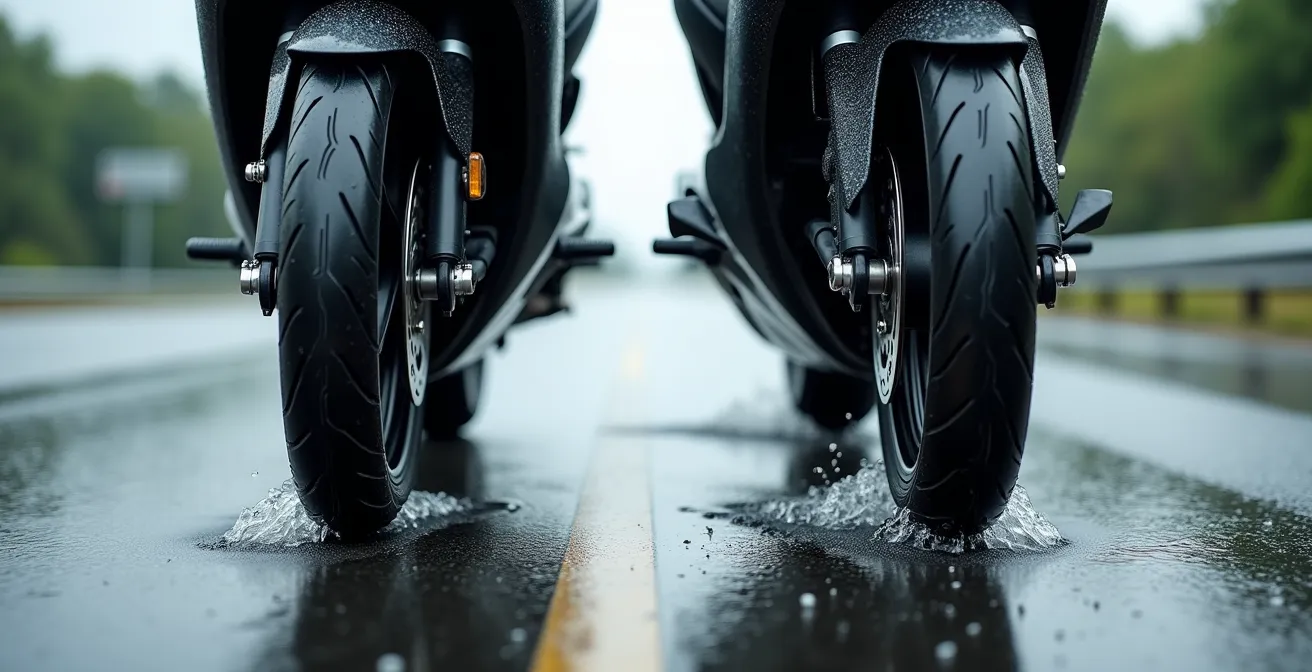
Anti-lock Braking Systems (ABS) do more than prevent lock-ups; they fundamentally alter the physics of braking to maximize available grip and maintain crucial steering control, a difference most critical on wet surfaces.
- ABS allows a rider to apply maximum braking force without needing to manually modulate at the threshold of traction, reducing cognitive load in a panic situation.
- By preventing wheel lock, ABS preserves the tire’s ability to provide lateral grip, enabling a rider to potentially steer around an obstacle while braking hard.
Recommendation: Evaluate a motorcycle’s braking not just on the presence of ABS, but as a complete system including pad compound, suspension behavior, and tire condition.
The debate between ABS and non-ABS motorcycles often simplifies to a single question: which stops shorter? For a buyer weighing the cost of this technology on a used motorcycle, this question is paramount, especially when considering unpredictable conditions like rain. The common wisdom suggests ABS is unequivocally superior, a failsafe against the dreaded wheel lock. While generally true, this perspective overlooks the complex physics at play. A motorcycle’s ability to stop is not merely a function of its brakes but a dynamic interplay of kinetic energy, load transfer, and the ever-changing coefficient of friction between the tire and the road.
The true value of ABS isn’t just in preventing a skid; it’s in how it manages energy at the absolute limit of traction. A non-ABS rider must use immense skill to find and hold the “threshold braking” point, a task made exponentially harder on a wet, inconsistent surface. An ABS-equipped bike automates this process, performing micro-adjustments far faster than any human can react. This doesn’t just shorten stopping distances in many scenarios; it fundamentally changes what is possible during an emergency maneuver. It frees up the rider’s cognitive capacity to focus on an escape path rather than on finessing the brake levers.
This analysis moves beyond the simple “ABS vs. non-ABS” comparison. We will deconstruct the entire braking event from an engineering perspective—from the initial reaction to the final moments of deceleration. We will examine the forces involved, the role of each component, and the techniques required to master this critical safety system. The goal is to provide a data-driven framework for understanding not just *if* ABS is better, but *how* and *why* it provides a quantifiable safety advantage, particularly when the grip is compromised.
To fully grasp the mechanics of stopping a motorcycle, we will explore the sequence of events and the variables that influence braking performance. The following sections break down everything from rider technique and reaction time to hardware choices and hazard perception.
Summary: ABS vs Non-ABS: How Much Shorter is Your Stopping Distance in the Rain?
- The “Lemon Squeeze” Technique: How to Brake Hard Without Locking the Wheel?
- The 1-Second Gap: Why You Travel 88 Feet Before You Even Touch the Brakes?
- When to Use the Rear Brake: Stability vs Stopping Power?
- Sintered vs Organic Pads: Which Bite Better When Cold?
- How to Practice Panic Braking in a Parking Lot Without Dropping the Bike?
- Deer Panic: Why They Freeze and How to Brake When You See Eyeshine?
- The Burnishing Process: Why New Brakes Feel Weak for the First 50 Miles?
- How to Read “Micro-Clues” in Urban Environments to Predict Jaywalkers?
The “Lemon Squeeze” Technique: How to Brake Hard Without Locking the Wheel?
Effective braking is a skill, not just a reaction. For non-ABS riders, the goal is “threshold braking”—applying maximum pressure just shy of the point where the tire loses traction and locks. The “Lemon Squeeze” technique is a mental model for this: you apply pressure smoothly and progressively, as if squeezing a lemon, rather than snatching at the lever. This loads the front suspension and tire gradually, increasing the contact patch and available grip before you demand maximum performance. You feel for the limit through feedback from the chassis and tire.
With an ABS-equipped motorcycle, the principle remains valuable for smooth riding, but the system acts as a safety net in an emergency. When you apply full, abrupt force, the ABS module detects imminent wheel lock and rapidly modulates brake pressure for you. This is the “ABS Stomp” for emergencies. You’ll feel a rapid pulsing in the lever and may hear a grinding sound—this is normal and indicates the system is actively managing the friction coefficient threshold. The key is to maintain firm pressure and let the system work. Studies confirm the effectiveness of this technology; an analysis by the Austrian Safety and Prevention Board found a 26% reduction in motorcycle accidents with injuries on bikes equipped with ABS.
Mastering both approaches is ideal. The progressive squeeze is for controlled, planned stops, preserving stability and comfort. The abrupt, full-force application is for panic situations where you need to shed maximum kinetic energy instantly, relying on the ABS to maintain control. Knowing that the system is there allows you to brake with the conviction needed in a true emergency, without the fear of a self-induced skid.
The 1-Second Gap: Why You Travel 88 Feet Before You Even Touch the Brakes?
Before any braking system can engage, a rider must first perceive a hazard, recognize the danger, and initiate a physical response. This sequence is not instantaneous. The widely accepted average perception-reaction time for a typical driver or rider is between 0.75 and 1.5 seconds. Using a conservative 1-second figure, a motorcycle traveling at 60 mph (or 88 feet per second) will cover 88 feet of ground before the brake pads even make contact with the rotors. This distance is a non-negotiable element of physics, independent of whether you have ABS or not.

This “thinking distance” is often the largest component of your total stopping distance, especially at highway speeds. It underscores why maintaining a safe following distance and scanning far ahead is more critical than the type of brakes you have. Your braking system can only dissipate the kinetic energy that remains *after* you’ve already traveled this significant gap. In the rain, when visibility is poor and road hazards are less apparent, your perception time may increase, further extending this initial, uncontrolled travel distance.
Real-World Emergency Braking Scenario at 135 km/h
This principle was starkly demonstrated in a real-world incident involving a rider on a KTM RC 390 traveling at 135 km/h (approx. 84 mph) at night. The rider encountered a truck that slowed suddenly without brake lights. Despite the high speed and minimal reaction time, the motorcycle’s dual-channel ABS allowed for a full-force emergency stop, bringing the bike to a halt just inches from the truck. Without ABS, the high likelihood of wheel-lock at that speed on an unknown surface would have almost certainly resulted in a collision, turning the reaction gap into an impact zone.
When to Use the Rear Brake: Stability vs Stopping Power?
A common misconception is that the front brake does all the work. While it provides the majority (around 70-80%) of the stopping power due to dynamic load transfer to the front wheel, the rear brake plays a critical role in stability and control. Using the rear brake correctly, especially at the initiation of a stop, helps to manage the motorcycle’s chassis dynamics. It settles the suspension and prevents excessive fork dive, keeping the bike more balanced as the load shifts forward.
As experts from the Fundación MAPFRE road safety campaign explain, the ideal sequence is to begin the braking process with the rear brake. This stabilizes the chassis and compresses the rear suspension, preparing the entire motorcycle for the much stronger forces of the front brake, which should be applied decisively just a fraction of a second later.
You should first brake with the back brake to stabilize and compress the back axle and for the car to adhere to the asphalt. Only a few tenths of a second later, decisively apply pressure to the front brake which is the main brake that helps us stop the motorcycle.
– Fundación MAPFRE, Goal Zero Road Safety Campaign
In a panic stop with ABS, the best practice is to use both brakes simultaneously and forcefully. The system will manage the distribution and prevent lock-up on either wheel. On bikes with linked or combined braking systems (CBS), applying the rear brake may also automatically apply a certain amount of front brake. The following table breaks down the distinct roles of each brake in various scenarios.
| Scenario | Rear Brake Role | Front Brake Role | ABS Impact |
|---|---|---|---|
| Initial Braking | Apply first to stabilize and compress rear axle | Apply decisively after 0.1-0.2 seconds | CBS may apply front automatically |
| Emergency Stop | 30% of braking force | 70% of braking force | Prevents lock-up on both wheels |
| Cornering | Light touch for line correction | Minimal use to avoid upset | Modern systems adapt to lean angle |
| Low Speed | Primary control and balance | Minimal to prevent front dive | Less likely to activate |
Sintered vs Organic Pads: Which Bite Better When Cold?
The brake pads are the component responsible for converting kinetic energy into thermal energy through friction. The material they are made from—the pad compound—has a profound impact on braking performance, especially in wet and cold conditions. The two most common types for street motorcycles are organic and sintered.
Organic pads (also known as resin pads) are made from a mix of fibers and fillers bound with resin. They offer a softer, more progressive initial bite and excellent modulation (feel). This makes it easier for a skilled non-ABS rider to stay near the threshold of lock-up. However, their performance can diminish in heavy rain as they can absorb water and require a moment of heat to “dry out” and regain full friction. Sintered pads are made by fusing metallic particles together under high heat and pressure. They offer a much stronger initial bite, work exceptionally well from cold, and are far more resistant to fade under heavy use and in wet conditions. Their downside is that they can be “grabbier” and offer less feedback before locking, which can be a challenge for non-ABS riders. With ABS, sintered pads allow the rider to access maximum braking force immediately, though their aggressive nature might trigger the ABS more readily on slick surfaces.
The choice of pad directly influences the effectiveness of the entire braking system. A system with high-performance sintered pads and ABS is engineered to provide maximum deceleration under the widest range of conditions. This synergy is designed to shorten stopping distance and, critically, reduce impact speed in a non-avoidable collision. For instance, data shows that ABS was found to reduce collision speed in accidents with injuries by 31%, a direct result of the system maximizing deceleration right up to the point of impact.
| Characteristic | Sintered Pads | Organic Pads | ABS Interaction |
|---|---|---|---|
| Cold Bite | Strong initial bite | Softer, progressive bite | Sintered may trigger ABS prematurely on damp surfaces |
| Modulation | Less feedback before lock | Superior modulation and feel | Organic allows staying closer to threshold |
| Wet Performance | Better in heavy rain | Requires warming | Both benefit from ABS in wet |
| Heat Dissipation | Excellent | Good for street use | Less fade means consistent ABS calibration |
How to Practice Panic Braking in a Parking Lot Without Dropping the Bike?
Understanding braking theory is one thing; executing a panic stop under pressure is another. Building muscle memory in a controlled environment is the only way to ensure you will react correctly when a real emergency occurs. An empty, clean parking lot is the perfect laboratory for this. The goal is not just to stop short, but to learn the feeling of maximum deceleration and, if you have ABS, to become comfortable with its activation.
A structured drill is the most effective way to practice. By using cones to create a defined braking zone and starting at a controlled speed, you can build confidence and skill incrementally. For non-ABS riders, this is where you learn to feel for the chatter of the front tire that signals the limit of grip. For ABS riders, this is where you train yourself to overcome the instinct to release the brake when you feel the lever pulse. You must learn to trust the system and maintain pressure.
A key physical technique during hard braking is to lock your arms straight. This braces your body against the handlebars, preventing you from sliding forward in the saddle and helping to maintain control of the motorcycle as the massive forces of deceleration act upon you. By practicing this, you integrate the correct physical posture with the braking action.
Action Plan: Parking Lot Emergency Braking Drill
- Set up entry gate markers using cones in a clean parking lot with no gravel or oil patches.
- Measure exactly 62 feet from the entry gate and place end gate markers; this is your target stopping zone from 20 mph.
- Approach the entry gate at a steady 20 mph. Critically, do not “cover” the brakes in anticipation.
- As soon as your front wheel crosses the entry gate, apply approximately 70% front brake and 30% rear brake simultaneously and forcefully.
- As you apply the brakes, lock your arms straight to brace against the handlebars and practice staying on the edge of ABS activation to feel the threshold. Gradually increase entry speed to 30-35 mph as your confidence builds.
This drill is based on a methodology from Law Abiding Biker to systematically build emergency braking skills.
Deer Panic: Why They Freeze and How to Brake When You See Eyeshine?
An encounter with wildlife, particularly deer, presents a unique braking challenge. Deer often freeze in headlights due to a phenomenon called “tonic immobility,” a predator-avoidance response that is tragically ineffective against a two-ton car or a 500-pound motorcycle. When you see the telltale eyeshine, you must assume the animal will not move, or will move erratically. Your immediate response must be to initiate a maximum-performance stop.
If you are in a turn when the hazard appears, your first action is to straighten the bike. A motorcycle has significantly more braking traction when it is upright than when it is leaning. Once upright, apply maximum force to both brakes. With ABS, this is straightforward: brake as hard as possible and focus your attention on steering toward an escape path if one exists. The system will prevent the wheels from locking, allowing you to retain steering control even under full braking.
For a non-ABS rider, the situation is more perilous. You must brake as hard as you can in a straight line, as attempting to brake and swerve simultaneously is a near-certain recipe for a locked wheel and a low-side crash. The focus must be entirely on scrubbing speed in a straight line. In either case, using the horn aggressively may help break the animal’s frozen state. Finally, always be aware of the “Plus-One Rule”: where there is one deer, there are often more following behind. Once you have avoided the initial animal, continue to scan and control your speed.
Emergency Wildlife Response Protocol
- Immediately straighten the bike if you’re in a turn to access full braking capability.
- Apply maximum braking force using both brakes (a 70% front, 30% rear bias is a good starting point).
- With ABS: Maintain firm brake pressure and use steering input to aim for an escape path.
- Without ABS: Focus exclusively on straight-line braking to maximize deceleration without locking a wheel.
- After clearing the first animal, scan immediately for others that may be following (the Plus-One Rule) and reduce speed significantly.
The Burnishing Process: Why New Brakes Feel Weak for the First 50 Miles?
A common and unsettling experience for any rider is the feeling of weak or ineffective brakes immediately after installing new pads or rotors. This is not a sign of a defective part; it is a normal and necessary phase known as the burnishing, or “bedding-in,” process. New brake pads and rotors are not perfectly flat on a microscopic level. The burnishing process is designed to mate these two surfaces together and, more importantly, to lay down an even transfer film of pad material onto the face of the rotor.

This thin, uniform layer is what creates the optimal friction coefficient for powerful, consistent braking. Without a properly established transfer film, braking performance will be inconsistent and significantly reduced. The process involves a series of controlled, hard decelerations designed to generate enough heat to transfer the pad material without overheating and “glazing” the pads, which would permanently reduce their effectiveness. It requires patience and a specific procedure to execute correctly.
Ignoring this process means your brakes will not be able to provide their designed stopping power, which could have dangerous consequences if you need to perform an emergency stop during those first 50-100 miles. Whether you have ABS or not, the system can only work with the amount of friction the pads and rotors can generate. A non-burnished system is a compromised system.
Action Plan: The 6-to-2 Motorcycle Brake Burnishing Method
- In a safe area, perform six hard decelerations from 60 mph down to 20 mph. These should be hard stops but not full emergency stops.
- Use progressively harder braking pressure with each repetition to gradually build heat.
- Allow at least 30 seconds of riding between each deceleration for the components to cool slightly.
- After the sixth deceleration, ride for 5-10 minutes at a moderate, steady speed without using the brakes at all. This is the crucial cooling phase where the transfer film solidifies.
- During this entire period, avoid dragging the brakes or holding the bike at a stop with the brakes applied, as this can cause uneven material deposits. This process is detailed in Harley-Davidson’s expert advice on brake maintenance.
Key Takeaways
- ABS provides a dual advantage in wet conditions: it allows maximum braking force while simultaneously preserving the ability to steer around a hazard.
- Your total stopping distance is dominated by your reaction time; at 60 mph, you travel a fixed 88 feet before your brakes even engage.
- The performance of your entire braking system is dependent on its components; pad choice and proper burnishing are critical for achieving the designed friction coefficient.
How to Read “Micro-Clues” in Urban Environments to Predict Jaywalkers?
In dense urban environments, the greatest braking challenge often comes from pedestrians. A rider’s ability to predict a person’s movement seconds before they act is a skill that can be more effective than any braking system. This involves reading a series of subtle “micro-clues” in a pedestrian’s body language. By systematically observing their head, hips, and feet, you can anticipate their intentions with a high degree of accuracy.
This predictive ability allows you to preemptively manage your risk. The moment you spot the first clue—such as a pedestrian’s head turning to look across the street—you can prepare to brake by covering your levers. This action alone can shave critical milliseconds off your reaction time. You are no longer just reacting to a person in the road; you are reacting to the *probability* of a person entering the road. This proactive mindset is essential for urban survival.
In addition to pedestrians, a rider must also learn to read the road surface itself. Wet urban streets are a minefield of “grip traps.” Manhole covers, which often appear darker and shinier than the surrounding asphalt, offer near-zero friction. The same applies to the thermoplastic road markings used for crosswalks and lane dividers. Dark patches at intersections are another red flag, often indicating oil and coolant deposits from stopped vehicles, creating an incredibly slick surface when mixed with rain. Identifying these hazards in advance allows you to adjust your line and avoid needing to brake on them at all.
Your 5-Point Urban Hazard Audit
- Points of Contact (Head): Constantly scan pedestrians’ heads. Is their gaze directed across the street? This is the first indicator of intent to cross.
- Collecte (Hips): Inventory the orientation of their hips. Hips squared up to the road signal a higher level of commitment than hips angled along the sidewalk.
- Cohérence (Feet): Confront their foot position with their hip orientation. A leading foot stepping off the curb or a weight shift onto the front foot is the final commitment to movement.
- Mémorabilité/émotion (Grip Traps): Spot unique, low-grip surfaces against the generic asphalt. Mentally flag manhole covers, painted lines, and dark, oily patches as “no-brake zones.”
- Plan d’intégration (Action): Upon spotting the first micro-clue, immediately apply the two-finger cover technique on your brake lever. Your plan is to be ready to brake *before* the hazard fully materializes.
To make an informed decision on your next motorcycle, the final step is to synthesize this engineering analysis with the specific demands of your riding style and environment. A purely data-driven choice is only effective when contextualized by real-world application.