
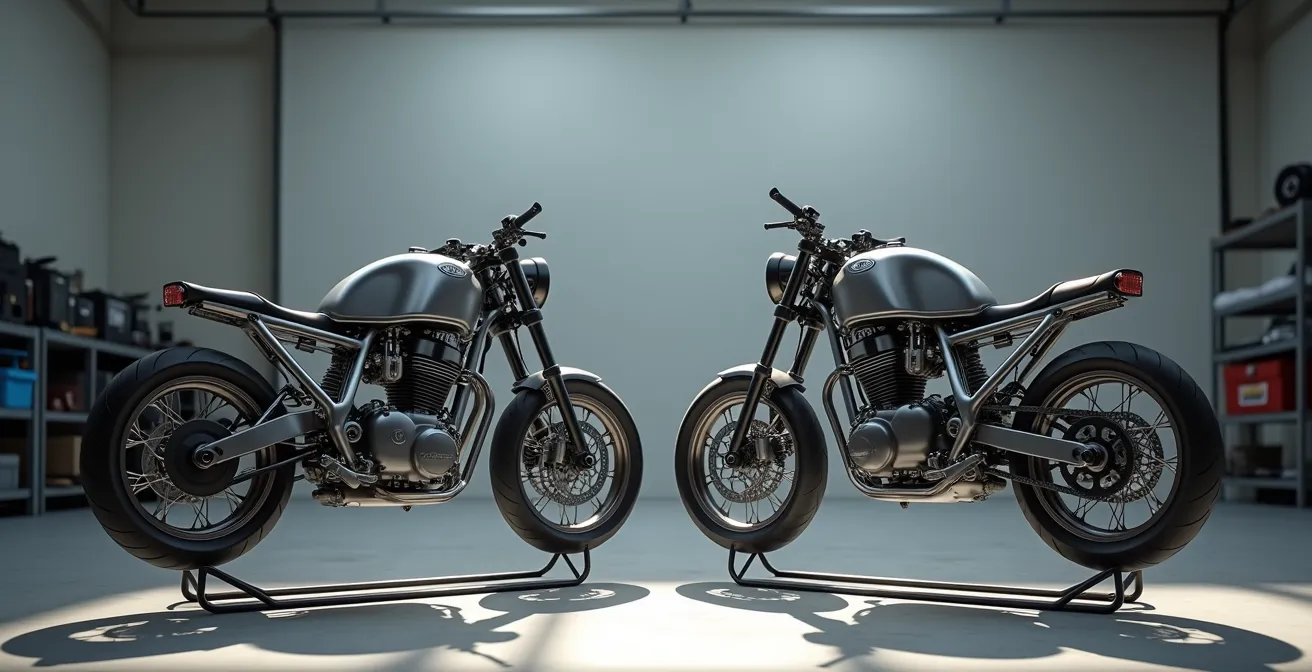
The debate over frame material is a distraction; a motorcycle’s handling character is dictated by the entire chassis functioning as an integrated dynamic system, not just the metal it’s made from.
- Engineered flex is a design tool for managing grip and providing feedback, where “stiffer” is not always better.
- Vibrations and component failures are not just problems; they are valuable data streams that reveal how forces are being managed (or mismanaged) throughout the chassis.
Recommendation: Instead of focusing on material labels, learn to interpret how your bike communicates grip and stability through its frame, suspension, and engine—treating the entire machine as a single, communicative system.
For any rider invested in the art of cornering, the question of “road feel” is paramount. It’s that nebulous, almost psychic connection that tells you exactly what the contact patches are doing. For decades, the conversation about this feeling has been dominated by a simple, almost tribal debate: the brute strength of a steel trellis frame versus the lightweight rigidity of an aluminum beam frame. Riders and manufacturers alike tout the benefits of their chosen material, creating a narrative that pits tradition against technology, and flex against stiffness.
This common discourse, however, misses the forest for the trees. While material properties are a factor, they are merely one input in a far more complex equation. The truth, as any chassis designer knows, is that a motorcycle’s handling is the result of a complete, integrated system. The engine is not just a power source but a structural member. The swingarm is not just a lever but a critical link in managing lateral forces. Even the weight of your luggage can fundamentally alter the bike’s dynamic stability at speed.
This article moves beyond the simplistic “steel vs. aluminum” argument. We will adopt the perspective of a chassis designer to explore how a motorcycle’s character is truly forged. We will analyze how flex is engineered, how vibration is used as information, and how every component, from the engine mounts to the fork seals, plays a role in the dynamic conversation between the rider, the machine, and the road. This is not about which material is “best,” but about understanding the holistic system that creates a bike that feels alive beneath you.
To fully grasp these engineering principles, this guide breaks down the key subsystems and dynamic effects that contribute to a motorcycle’s handling. The following sections explore specific components and phenomena, revealing how each one is a piece of a much larger puzzle.
Summary: The Rider’s Guide to Chassis Dynamics and Handling Feedback
- How to Check for Hairline Cracks in Aluminum Frames After a Drop?
- What Does “Stressed Member” Engine Mounting Mean for Vibration?
- Do Fork Braces Actually Improve Steering Precision on Vintage Bikes?
- Why Loose Swingarm Bearings Cause High-Speed Weaving?
- Single-Sided Swingarms: Are They Just for Looks or Do They Add Stiffness?
- The High-Speed Wobble: How Top Cases Affect Stability Above 70 mph?
- Center of Gravity: How Does a 200lb Battery Change Handling Compared to a Gas Tank?
- Fork Seals Leaking: Why Hitting Potholes is Costing You $300 a Year?
How to Check for Hairline Cracks in Aluminum Frames After a Drop?
After a drop, a steel frame might bend, but an aluminum frame is more likely to crack. This isn’t a defect; it’s a fundamental difference in material science. Steel has an “endurance limit,” meaning that if stresses stay below a certain threshold, it can theoretically endure an infinite number of cycles. Aluminum has no such limit. This crucial distinction means that, according to material science research, 100% of aluminum frames will eventually fail under any repeated stress, making post-impact inspection critical.
A visual check is often insufficient as hairline cracks, especially in welds or high-stress areas like the headstock, can be nearly invisible. These micro-fractures compromise the entire chassis’s integrity, turning predictable handling into a dangerous liability. The professional method for detecting these is a dye penetrant test, a process that can be performed in a home workshop with a dedicated kit.
The test works by using a low-viscosity colored dye that seeps into surface-breaking defects through capillary action. After a “dwell time,” the excess surface dye is cleaned off, and a white developer is applied. The developer acts like a blotter, drawing the trapped penetrant out of the crack. The result is a crisp, visible line of color against the white background, revealing the exact location and extent of a fracture that would otherwise be missed. This diagnostic isn’t just about safety; it’s a direct look at how stress was distributed through the frame during an impact, offering valuable insight into the chassis’s design.
What Does “Stressed Member” Engine Mounting Mean for Vibration?
In modern chassis design, the engine is rarely just a passenger. In a “stressed member” or “diamond” frame configuration, the engine becomes an integral, load-bearing part of the structure. This philosophy eliminates redundant frame spars, saving significant weight and creating a more direct path for forces to travel from the headstock to the swingarm pivot. The character of the motorcycle is fundamentally altered by how the engine is integrated into this system, turning it into a key element of the chassis’s structural and dynamic behavior.
This design choice creates a direct trade-off between unfiltered feedback and rider comfort. Every power pulse, every vibration, and every torsional force from the engine is transmitted directly through the chassis. This “vibration as information” can provide a savvy rider with a granular feel for engine load and traction, but it can also lead to fatigue on longer rides.
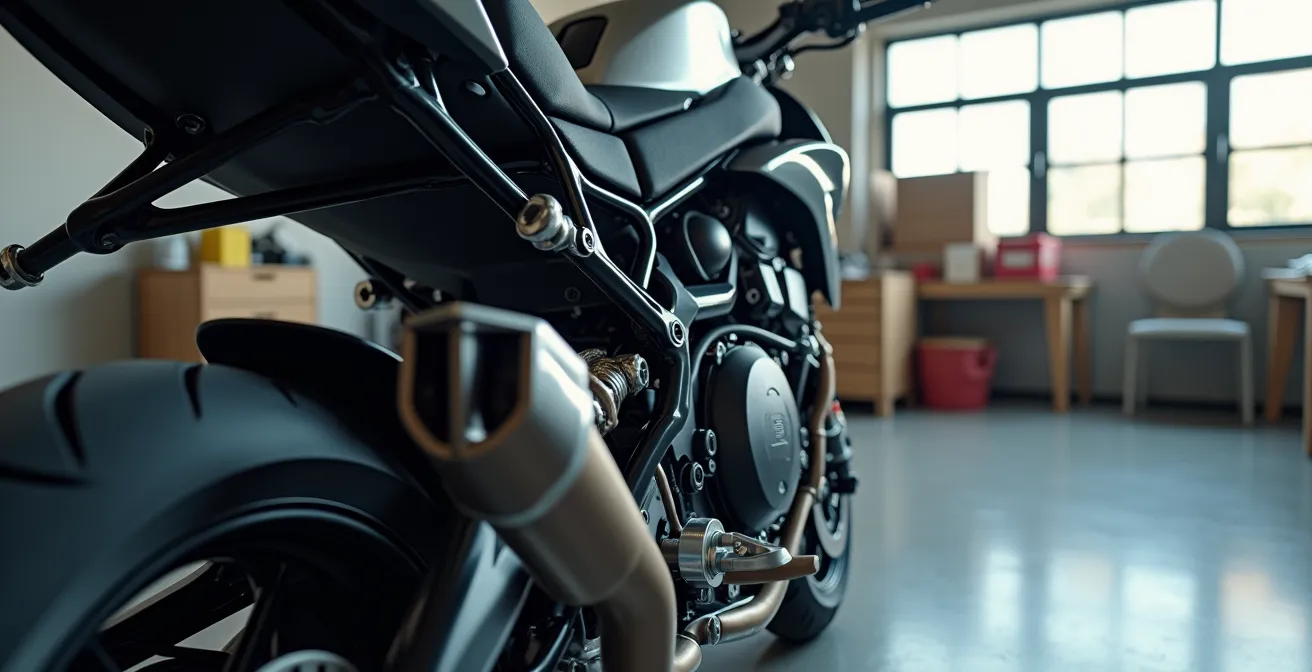
This illustration of engine mounting points highlights the critical connection points where mechanical forces are transferred to the frame. The design of these mounts—whether they are solid aluminum or use rubber dampers—is a key part of tuning the bike’s personality.
Case Study: Ducati Panigale vs. Yamaha R1
The contrast between two top-tier superbikes perfectly illustrates this concept. The Ducati Panigale’s “frameless” design uses its V2 engine as the primary structural element, connecting the headstock directly to the swingarm. This makes the chassis incredibly light and provides visceral, unfiltered feedback to the rider. In contrast, the Yamaha R1’s iconic aluminum Deltabox beam frame is a complete structure that cradles the engine. This allows Yamaha’s engineers to isolate specific vibration frequencies for maximum stability at race pace, sacrificing some of the raw mechanical connection for a more filtered and composed feel.
Do Fork Braces Actually Improve Steering Precision on Vintage Bikes?
On many vintage and standard motorcycles equipped with conventional “right-side-up” telescopic forks, riders often report a vague or wandering sensation during hard braking or aggressive turn-in. This is not necessarily a sign of worn components but a symptom of torsional flex inherent in the fork’s design. The two fork stanchions, connected only at the yokes (triple clamps) and the front axle, can twist independently relative to each other. This slight twisting action changes the front wheel’s alignment mid-corner, creating imprecise steering.
A fork brace, or “fork stabilizer,” is a simple yet effective engineering solution to this problem. It is a rigid bracket that clamps across both fork sliders, typically just above the front fender. By connecting the two sliders, it creates a “box” structure, dramatically increasing the assembly’s resistance to twisting forces. This doesn’t affect the suspension’s ability to compress and rebound, but it forces the two fork legs to remain parallel under torsional load. The result is a more direct and precise feeling at the handlebars.
The improvement is not merely subjective. According to engineering analysis, a properly installed fork brace can lead to an up to 30% reduction in torsional flex. For a rider, this translates into a front end that feels more planted and communicates road texture and grip levels more clearly. It allows them to brake later and harder into a turn with more confidence, as the front wheel’s geometry remains consistent. On bikes with thinner, longer fork tubes, the effect is even more pronounced, turning a previously vague front end into a sharp, communicative tool.
Why Loose Swingarm Bearings Cause High-Speed Weaving?
A high-speed weave, where the rear of the motorcycle feels like it’s trying to overtake the front, is one of the most unsettling dynamic problems a rider can face. While often blamed on tires or aerodynamics, a primary mechanical culprit is often overlooked: minuscule play in the swingarm pivot bearings. This pivot is the critical joint connecting the rear suspension and wheel to the main frame, and it’s designed to allow for vertical movement only. Any lateral play, or side-to-side movement, allows the rear wheel to act as a rudder, steering independently of the chassis.
The forces at play are immense. During acceleration, the drive chain exerts a constant forward pull on the swingarm. If the pivot bearings have even a tiny amount of wear, this powerful force vector is no longer perfectly aligned with the bike’s centerline. Instead of just pulling the bike forward, it can now pull the swingarm slightly to one side. As the bike moves and the suspension reacts, this misalignment oscillates, initiating the characteristic “weaving” motion. The effect is amplified at higher speeds, where aerodynamic forces and road imperfections add to the instability.
Case Study: The 1mm Weave
Professional race teams have documented that even 1mm of lateral play at the swingarm pivot is enough to create a dangerous weave at speeds over 70 mph. The chain’s pull, which can easily be 200-400 lbs under hard acceleration, exploits this play, causing the rear wheel to effectively “steer” left and right. This creates the unnerving sensation riders describe as the bike feeling hinged in the middle or trying to “swap ends,” a direct consequence of the rear contact patch no longer tracking perfectly behind the front.
Your 5-Minute Swingarm Bearing Diagnostic Plan
- Stabilize the bike: Place the motorcycle securely on its center stand or a rear paddock stand to lift the rear wheel off the ground.
- Position your hands: Firmly grab the rear wheel at the 12 o’clock and 6 o’clock positions.
- Apply lateral force: Vigorously push and pull the wheel from side to side, perpendicular to the motorcycle’s centerline.
- Feel for movement: Pay close attention to the swingarm pivot area where it meets the frame. You are feeling for any discernible ‘clunk’ or ‘knock’. There should be absolutely zero perceptible play.
- Differentiate the source: If you feel play, confirm its origin. If the movement feels like it’s at the wheel’s hub, the issue is likely a wheel bearing. If the entire wheel and swingarm assembly moves relative to the frame, the swingarm bearings are the culprit.
Single-Sided Swingarms: Are They Just for Looks or Do They Add Stiffness?
The single-sided swingarm (SSS) is an iconic piece of motorcycle design, often associated with high-performance European machines. Its cantilevered design, exposing one side of the rear wheel, is undeniably dramatic. This has led many to believe it’s a purely aesthetic choice, or conversely, a functionally superior design that adds stiffness. The reality is more nuanced; the SSS is an engineering trade-off that balances manufacturing complexity, weight, and function.
From a pure stiffness-to-weight perspective, a conventional dual-sided swingarm is superior. It forms a braced, triangular structure that is inherently more rigid for a given weight. To achieve comparable stiffness, a single-sided swingarm must be significantly overbuilt, making it heavier. In fact, engineering analysis reveals that single-sided swingarms are typically 15-20% heavier than a dual-sided equivalent designed for the same load. The primary functional benefit is not stiffness, but rapid wheel changes, a feature derived from endurance racing where every second in the pits counts. For road riders, this translates to easier chain maintenance and rear wheel cleaning.
The choice of material and construction method also plays a huge role in the final character of a single-sided swingarm, as shown by the differing philosophies of major manufacturers.
| Feature | Honda Pro-Arm (Cast Aluminum) | Ducati Trellis (Welded Steel) |
|---|---|---|
| Manufacturing | Mass-produced casting | Hand-welded tubes |
| Weight | Moderate (optimized) | Heavier |
| Stiffness | Very high, uniform | Tuned flex zones |
| Aesthetic Integration | Modern, technical | Matches main frame design |
| Repair Cost | Replace entire unit | Can be welded/repaired |
| Chain Adjustment | Eccentric hub (maintains geometry) | Traditional adjuster |
The High-Speed Wobble: How Top Cases Affect Stability Above 70 mph?
A motorcycle is a finely balanced dynamic system. Adding weight, especially when it is high up and far from the bike’s center of gravity, can have a profound and often negative impact on stability. A top case, while immensely practical for touring and commuting, is a prime example of this. When loaded, it can introduce a pendulum effect that may lead to a dangerous high-speed wobble, particularly at speeds above 70 mph where aerodynamic forces come into play.
The instability arises from two main factors. First, the mass of the top case and its contents raises the motorcycle’s overall center of gravity, making it more sensitive to roll inputs and crosswinds. Second, and more critically, its position far behind the rear axle creates a “moment of inertia.” When the bike hits a bump or is buffeted by wind, this rearward mass wants to swing from side to side, initiating an oscillation that can overwhelm the chassis’s natural damping characteristics. The frame and steering geometry are designed to be self-stabilizing, but adding a heavy pendulum at the rear can introduce a wobble that the system cannot correct.
The method of attachment is also a critical factor. Manufacturer-designed luggage systems are integrated into the chassis design process. The mounting points are placed on reinforced sections of the subframe, and the system is tested as part of the bike’s overall dynamic package. Universal, aftermarket mounting systems, however, may attach to weaker points and lack the same structural rigidity. This is reflected in the fact that manufacturer specifications often show 33% lower weight limits on universal mounting systems compared to their factory-integrated counterparts, acknowledging their lesser ability to manage dynamic loads without compromising stability.
Key Takeaways
- A bike’s handling is a product of the entire chassis as a system, where frame, engine, and suspension work in concert.
- Material choice (steel vs. aluminum) is just one variable; geometry, construction, and “engineered flex” are more influential on road feel.
- Vibrations, flex, and even component failures are not just issues to be fixed but are data streams that communicate how forces are being managed by the chassis.
Center of Gravity: How Does a 200lb Battery Change Handling Compared to a Gas Tank?
The rise of electric motorcycles is creating the most significant shift in chassis design in a century. It’s not just about swapping a gas engine for an electric motor; it’s about fundamentally rethinking mass centralization and structural integration. The single heaviest component in an EV—the battery—has a dynamic effect on handling that is completely different from that of a gasoline fuel tank, forcing designers to abandon old paradigms.
A 40lb tank of gasoline is a “live” mass located high in the frame. As fuel is consumed, the bike’s weight and center of gravity change, affecting its agility. The liquid sloshing within the tank also acts as a minor damper for certain high-frequency vibrations. In contrast, a 200lb battery pack is a solid, fixed mass, typically mounted as low as possible to create an ultra-low center of gravity for enhanced stability. However, this large, often wide mass dramatically increases the bike’s roll inertia, meaning it requires more physical effort from the rider to lean it into a corner compared to a narrow internal combustion motorcycle.
This difference in dynamic mass is forcing a complete re-evaluation of frame design itself.
| Characteristic | 40lb Fuel Tank | 200lb Battery Pack | Handling Impact |
|---|---|---|---|
| Mass Type | Liquid (sloshing) | Solid (fixed) | Fuel acts as vibration damper |
| Center of Gravity | High (tank level) | Low (floor level) | Battery improves stability |
| Roll Inertia | Low (narrow) | High (wide skateboard) | Battery harder to lean |
| Weight Change | -6lbs per hour riding | Constant | No ‘light tank’ agility with battery |
| Frame Integration | Separate component | Structural member | Battery can BE the frame |
As renowned technical editor Kevin Cameron notes, the future of chassis design is being rewritten by this new approach. In a technical analysis for Cycle World, he points out the paradigm shift:
“The massive, structural battery pack can become the entire frame. This makes the traditional ‘steel vs. aluminum’ debate obsolete and opens the door for radical designs like ‘exoskeleton’ frames.”
– Kevin Cameron, Cycle World Technical Analysis
Fork Seals Leaking: Why Hitting Potholes is Costing You $300 a Year?
A weeping fork seal might seem like a minor annoyance, but from a chassis dynamics perspective, it’s a critical failure that signals a cascading degradation of front-end performance and can lead to expensive repairs. The fork is not just a spring; it’s a sophisticated hydraulic damper. The oil inside serves two purposes: it lubricates moving parts and is forced through valving to control compression and rebound speed. When a seal fails, this vital hydraulic fluid begins to leak out.
The immediate consequence is a loss of damping control. With less oil, the fork becomes “spongy” and more prone to bottoming out over bumps, upsetting the chassis’s stability. However, the secondary effects are far more destructive. The leaked oil creates a sticky film on the fork stanchion that attracts road grit, dust, and grime. With every compression cycle, this abrasive slurry is dragged past the compromised seal and into the fork’s internals. This “liquid sandpaper” effect quickly scores the precision-ground surface of the stanchion tubes and contaminates the remaining fork oil, accelerating wear on the internal bushings and valving.
Case Study: The Cascading Failure
Workshop analysis reveals the true cost of ignoring a minor leak. The abrasive slurry created by leaked oil and road grit can, within just 500 miles, cause visible scoring on expensive stanchion tubes. More importantly for handling, the contaminated oil can degrade damping performance by up to 40%. The rider may not notice the gradual “sponginess,” but the front end’s ability to keep the tire in contact with the road over bumps is severely compromised, destroying feel and grip long before the problem becomes obvious. This is why service data shows urban riders, who frequently encounter potholes, can spend $300-500 per year on fork seal replacements and related repairs.
By viewing the motorcycle not as a collection of parts but as a complete dynamic system, you can begin to decode its language. Every vibration, every flex, and every squeak is a piece of data. Learning to interpret this data is the true path to mastering your machine and understanding the intricate engineering that defines its soul on the road. The next step is to apply this system-level thinking every time you ride, paying attention to how each part of your bike works together to talk to you.