
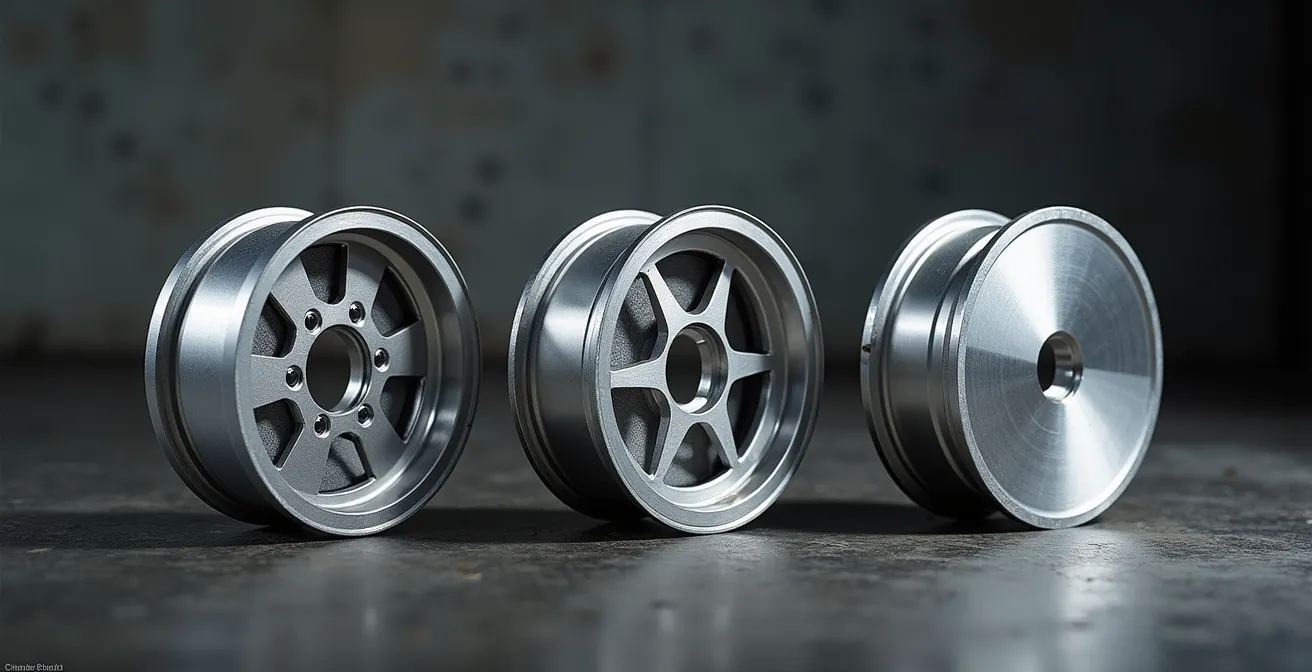
The strongest wheel isn’t just about resisting a bend; it’s about its failure mode. A forged wheel’s ductile nature means it bends under severe impact, while a cast wheel’s brittle structure can lead to catastrophic cracks.
- Forged wheels offer a predictable bend-not-break failure, which is often repairable and less likely to cause a sudden loss of control.
- Cast wheels, while cost-effective, are prone to brittle fracture upon sharp impacts, creating a higher risk of immediate, unrideable failure.
Recommendation: For urban riders facing frequent pothole hazards, prioritize forged wheels for their superior ductility and predictable failure characteristics over the lower cost of cast wheels.
The sickening thud of a pothole impact, followed by a new vibration or a slow leak, is a scenario every urban rider dreads. You’ve experienced it: a stock rim, likely a cast aluminum alloy, has deformed under an impact it was never truly designed to withstand. The immediate question isn’t just about repair or replacement; it’s about prevention. The common advice is a simple hierarchy: forged wheels are strong, cast wheels are cheap. But this oversimplification misses the critical engineering principle that determines your safety and whether you ride home or call a tow truck.
This isn’t a discussion about aesthetics or brand names. It’s a deep dive into material science. The true difference between a cast, forged, or billet wheel lies in its microscopic grain structure, which dictates its behavior under stress. It’s a choice between ductility (a material’s ability to bend and deform without breaking) and brittleness (a tendency to fracture with little to no warning). A bent rim is an inconvenience; a shattered one is a catastrophic failure.
Instead of just repeating that “forged is better,” we will analyze *why*. We will explore the failure modes of each construction type, the hidden dangers in refinishing, and how even small components play a role in the overall resilience of your wheel system. By understanding the metallurgy, you move from being a consumer to an informed engineer of your own motorcycle, capable of making a choice based on safety and performance, not just price.
This article provides a comprehensive analysis of motorcycle wheel durability from a material science perspective. Follow along as we dissect each component and consideration, empowering you to choose the right wheel for ultimate pothole survival.
Summary: A Material Science Guide to Motorcycle Wheel Durability
- Why Vintage Magnesium Wheels Can Be Dangerous to Ride On Today?
- The Spacer Puzzle: How to Center an Aftermarket Wheel Perfectly?
- 90-Degree Valve Stems: Why This $10 Upgrade Changes Your Maintenance Life?
- Straightening vs Replacing: When Is a Bent Aluminum Rim Safe to Repair?
- Spokes on a Sportbike: Does Retro Style Ruin Modern Performance?
- Spoked vs Cast Wheels: Which Survives Potholes Better?
- Can Powder Coating Heat Treat Weaken Your Aluminum Rims?
- The Penny Test is Obsolete: How to Measure Tread Depth Like a Pro?
Why Vintage Magnesium Wheels Can Be Dangerous to Ride On Today?
The allure of vintage magnesium wheels, often called “mag” wheels, is undeniable. They represent a golden era of racing, promising ultra-low weight. However, mounting a set of decades-old magnesium rims on a modern bike is a significant gamble. The primary danger isn’t just age, but a material-specific form of degradation: intergranular corrosion. Unlike surface rust on steel, this corrosion attacks the boundaries between the grains within the metal, compromising the wheel’s structure from the inside out. A wheel can look visually acceptable on the surface while being dangerously fragile.
Early magnesium alloys were notoriously susceptible to this hidden decay, especially if their protective coatings were breached by tire changes or stone chips over the years. This process is accelerated by moisture, turning a seemingly solid wheel into a ticking time bomb. The failure mode is often catastrophic, with the wheel fracturing suddenly under load, rather than bending like a modern aluminum alloy. For a street rider, this represents an unacceptable level of risk for what is primarily an aesthetic choice.
If you are considering vintage wheels, a thorough inspection is non-negotiable. Look for any signs of bubbling or flaking paint, particularly around the bead seat and hub, as this can indicate underlying corrosion. A professional should conduct a dye penetrant or eddy-current inspection to reveal microscopic cracks invisible to the naked eye. Without this level of scrutiny, you are trusting your safety to a material known for its unstable aging properties.
A basic safety inspection for any vintage wheel should include these steps:
- Check for surface corrosion patterns, which may indicate deeper internal degradation.
- Use magnification to look for hairline cracks, especially around spoke bases and lug holes.
- Test for any unusual flexibility or deformation when applying light pressure to different areas of the rim.
- Verify any visible manufacturing date codes to confirm the wheel’s age.
- For true peace of mind, consider professional dye penetrant testing to uncover invisible micro-cracks before mounting.
The Spacer Puzzle: How to Center an Aftermarket Wheel Perfectly?
When fitting aftermarket wheels, achieving perfect centering is not just about aesthetics; it’s fundamental to safety and performance. The debate often revolves around two types of mounting: hub-centric and lug-centric. A hub-centric setup uses a precisely machined ring on the spacer or wheel that fits snugly over the motorcycle’s axle hub. This mechanically centers the wheel *before* the lug nuts are tightened, ensuring perfect alignment and a vibration-free ride. The wheel is supported by the hub, which is designed to bear the vehicle’s weight.
In contrast, a lug-centric setup relies solely on the tapered seats of the lug nuts to center the wheel as they are tightened. While common in some applications, this method is less precise and places all the stress of centering on the lug studs, which are primarily designed for clamping force, not lateral positioning. Any slight imperfection in the tightening sequence can result in an off-center wheel, leading to vibrations that can damage bearings and create unsafe handling characteristics.
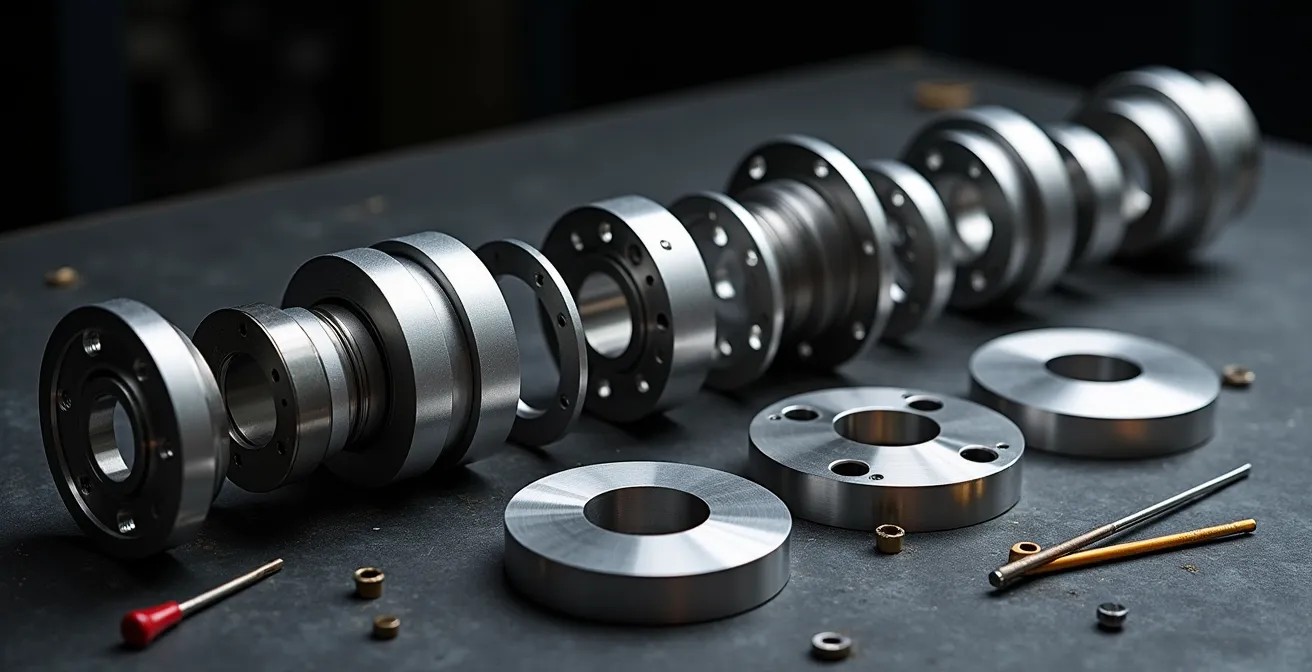
For a motorcycle, where dynamic balance is paramount, hub-centricity is the only acceptable engineering solution. Aftermarket wheels or spacers must have a hub bore that matches the vehicle’s hub diameter with sub-millimeter precision. This creates a solid mechanical connection that eliminates any possibility of movement or imbalance. As the Maximum Motorsports Technical Department notes in their analysis, even with this precise fit, the final security comes from clamping force. Their experts state:
The hub center of a hubcentric spacer serves only as an aid for wheel installation. The clamping force created by properly torqued lug nuts maintains integration even under extreme forces.
– Maximum Motorsports Technical Department, Wheel Spacer Safety and Physics Analysis
This highlights a dual system: the hub provides the precise location, and the properly torqued lugs provide the immense clamping force that prevents any slippage. Skipping the hub-centric step introduces an unnecessary variable into a critical safety system.
90-Degree Valve Stems: Why This $10 Upgrade Changes Your Maintenance Life?
Tire pressure is one of the most critical and frequently checked maintenance items on a motorcycle. However, on many bikes, especially those with large brake discs, accessing the straight valve stem with a pressure gauge or air chuck is a frustrating exercise in scraped knuckles and awkward angles. A simple, inexpensive upgrade to 90-degree valve stems completely transforms this experience, promoting more frequent and accurate pressure checks.
The ergonomic benefit is obvious: the outward-facing stem provides clear, unobstructed access. But the engineering advantages go deeper. Standard rubber pull-through stems are prone to degradation from ozone and UV exposure, and they can deflect or even tear at very high speeds due to centrifugal force. While straight aluminum stems are an improvement, they offer the same poor access as their rubber counterparts.
Forged aluminum 90-degree stems, which are bolted in place with a rubber gasket, offer the best of all worlds. They provide superior rigidity and are not subject to centrifugal deflection, making them a safer choice for high-performance applications. Their robust construction and secure mounting method also minimize the risk of a slow leak developing at the stem base, a common failure point on older rubber stems. This small upgrade enhances safety, simplifies maintenance, and adds a touch of high-performance aesthetic.
The performance differences between valve stem types are significant, especially when considering factors beyond simple air retention. As this comparison from Vivid Racing’s analysis shows, the trade-offs in weight, stability, and failure risk are clear.
| Type | Weight | High-Speed Stability | Failure Risk | Maintenance Access |
|---|---|---|---|---|
| Rubber Pull-Through | Lightest | Poor above 100mph | Deflection/tearing | Standard |
| Forged 90-Degree | Heaviest | Excellent | Minimal | Superior |
Straightening vs Replacing: When Is a Bent Aluminum Rim Safe to Repair?
After a hard pothole impact, discovering a bent rim presents a critical decision: attempt a repair or invest in a replacement? The answer depends almost entirely on two factors: the material construction of the wheel (cast vs. forged) and the severity of the damage. A crucial mistake is to treat all aluminum wheels the same. Their manufacturing process dictates their ability to be safely repaired.
Cast wheels are created by pouring molten aluminum into a mold. This process can create microscopic voids and a random, non-uniform grain structure. As a result, cast aluminum is relatively brittle. When it bends, it also develops micro-cracks that are often invisible to the naked eye. Attempting to straighten a cast wheel, especially using heat, can exacerbate these cracks, leading to a catastrophic failure later on. As the experts at Mario’s Wheel Repair UK state, “Cast wheels should almost never be straightened due to their brittle nature and high risk of micro-cracks.”
Forged wheels, on the other hand, are made from a solid billet of high-grade aluminum that is heated and pressed into shape under immense pressure. This process aligns the grain structure of the metal, making it incredibly dense and strong. This aligned grain structure also imparts superior ductility. A forged wheel is more likely to bend under an impact that would crack a cast wheel. This “bend-not-break” characteristic is a key safety feature. Because the material is more malleable and has a uniform structure, a skilled specialist can often safely straighten a bent forged wheel, as its risk of hidden cracks is much lower.
The inherent properties of forged aluminum make it the superior material for durable wheels. In fact, engineering data shows that forged wheels are 20-30% lighter yet significantly stronger than their cast counterparts. This isn’t just a performance advantage; it’s a fundamental difference in survivability. A slight bend in a forged wheel is a repairable event; a crack in a cast wheel is the end of its service life.
Spokes on a Sportbike: Does Retro Style Ruin Modern Performance?
Spoked wheels are making a comeback, even on high-performance retro and adventure bikes. This often sparks debate: is it a case of style over substance, sacrificing modern handling for a classic look? The traditional view holds that spoked wheels are heavier, more flexible, and require more maintenance (truing, tube management) than modern cast or forged wheels. While this was historically true, modern engineering has largely closed the gap.
Today’s premium spoked wheels often feature tubeless designs with spokes mounted on the outer edge of the rim, eliminating the need for a heavy inner tube. This significantly reduces rotational mass. Furthermore, the materials have evolved. High-strength steel or aluminum spokes combined with lightweight aluminum rims create a wheel that can be surprisingly competitive on weight. The inherent compliance of a spoked wheel, once seen as a weakness for on-road precision, is now appreciated for its ability to absorb sharp impacts from broken pavement without transferring the entire shock to the suspension, a valuable trait for real-world riding.
The ultimate performance, however, still comes down to material and manufacturing. A modern, lightweight forged aluminum wheel will almost always be lighter and stiffer than a spoked equivalent, offering the ultimate in handling precision for track use. But the weight difference is not as dramatic as many assume. For instance, a comparison highlighted by CanyonChasers showed that a high-end 6-inch wide forged wheel was a full kilogram lighter than a standard 5.5-inch cast wheel, despite its larger size. This demonstrates that the manufacturing process (forged vs. cast) often has a greater impact on weight than the design (spoked vs. solid).
For a street-focused sportbike, a modern, high-quality spoked wheel does not ruin performance. It offers a different character: a blend of retro style with a tangible increase in ride comfort and impact absorption on imperfect roads. It may give up the last tenth of a second on a perfectly smooth racetrack, but for the pothole-strewn urban environment, that added compliance can be a significant advantage in both comfort and wheel survivability.
Spoked vs Cast Wheels: Which Survives Potholes Better?
When a motorcycle encounters a sharp-edged pothole, the wheel’s ability to survive is a direct function of its material properties and design. The two most common options, spoked and cast wheels, fail in fundamentally different ways. This difference is the key to understanding which is better suited for the harsh realities of urban riding.
A cast wheel is rigid and unforgiving. Its brittle nature means it has very little ability to flex. When faced with an impact that exceeds its structural limit, the energy has nowhere to go but into a fracture. As Clean Fleet Report notes, “Cast wheels tend to crack catastrophically; one big impact and you’re shopping for a replacement.” This brittle failure is dangerous, as it can lead to a rapid loss of tire pressure and vehicle control. The advantage of a cast wheel is its stiffness, which provides precise handling feedback on smooth surfaces, but this becomes a liability on broken pavement.
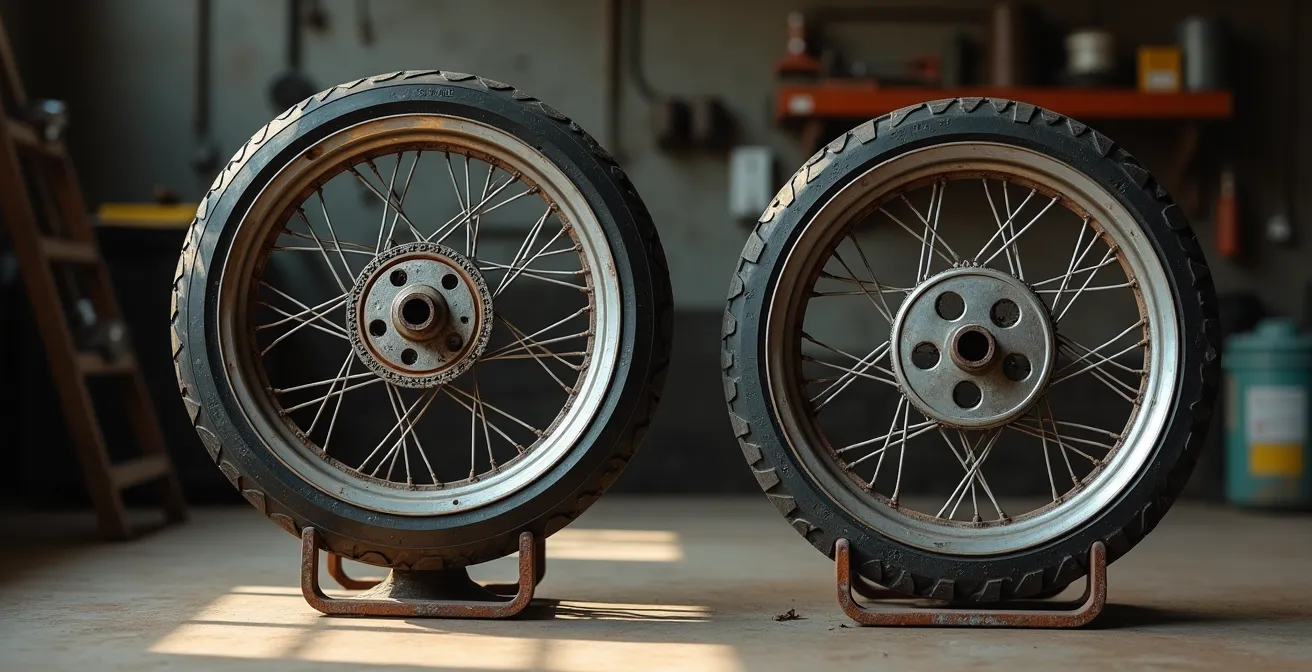
A spoked wheel, by contrast, is a compliant system. The dozens of steel spokes act like springs, allowing the rim to deflect slightly and absorb a portion of the impact energy. This flexibility is its greatest strength in surviving potholes. Instead of cracking, the rim is more likely to bend. While a bent rim is still a problem, it is often a less severe failure. It may result in a slow leak or a vibration, but it’s less likely to cause the immediate, catastrophic tire deflation that a cracked cast wheel can. This ductile failure mode often allows the rider to bring the bike to a safe stop.
Furthermore, wheel weight plays a crucial role. Lighter wheels have less inertia, which means the suspension can react more quickly to keep the tire in contact with the road surface. This is known as reducing unsprung weight. A lighter wheel is more easily “pushed” back down into the pothole by the spring, maintaining traction. Crucially, performance testing demonstrates that reducing unsprung weight by 5 pounds can improve suspension response by as much as 15%. In this regard, a lightweight forged or modern tubeless spoked wheel has a distinct advantage over a heavy, budget cast wheel in tracking over rough surfaces.
Key Takeaways
- The primary choice for pothole survival is not just weight, but failure mode: ductile (bends) vs. brittle (cracks).
- Forged wheels offer the best combination of strength, low weight, and a predictable, ductile failure mode, making them the safest and most durable option.
- Powder coating at standard temperatures can weaken heat-treated aluminum alloys, compromising the integrity of your rims. Always use a low-temperature cure process.
Can Powder Coating Heat Treat Weaken Your Aluminum Rims?
Refinishing your wheels with powder coating seems like a durable and attractive option. However, for high-performance aluminum wheels, this process hides a significant metallurgical danger. Most aluminum motorcycle wheels are made from heat-treated alloys, such as 6061-T6 or 7075-T6. The “T6” designation signifies a specific tempering process of solution heat-treating and artificial aging that gives the alloy its high strength. The problem is that this temper is sensitive to heat.
A standard powder coating process involves curing the part in an oven at temperatures around 200°C (400°F). This temperature is high enough to effectively “over-age” or anneal the aluminum, undoing the T6 temper and significantly reducing its tensile and yield strength. Your strong, resilient forged or cast wheel can become soft and weak, making it far more susceptible to bending and cracking from future impacts. The very process intended to protect the wheel can permanently compromise its structural integrity.
The effect is well-documented. For instance, a study in the Journal of Materials Engineering found that standard 204°C powder coating significantly reduces the mechanical properties of 6061-T6 aluminum. More sensitive alloys are at even greater risk; research shows that the same 204°C process dramatically reduces 7075-T6 aluminum tensile strength. This is not a theoretical risk; it’s a predictable metallurgical outcome.
If you must refinish your wheels, it is imperative to use a low-temperature cure powder or a high-quality liquid paint process that does not require high heat. For safety, you must inform the coating specialist that the part is a heat-treated T6 aluminum alloy and must not exceed its safe temperature threshold. The following table, based on data from Finishing.com, illustrates the risk.
| Alloy Type | Safe Temperature | Standard Powder Cure | Strength Loss Risk |
|---|---|---|---|
| 2024-T81 | Below 175°C | 200°C | High |
| 6061-T6 | Below 160°C | 200°C | Moderate |
| 7075-T6 | Below 120°C | 200°C | Very High |
The Penny Test is Obsolete: How to Measure Tread Depth Like a Pro?
For decades, riders have used the “penny test” as a quick gauge of tire life. This imprecise method is obsolete and fails to provide the accurate data needed for modern performance and safety. A tire’s tread doesn’t just provide grip in the wet; it’s also a crucial part of the bike’s suspension system and the first line of defense for your wheels against impact damage.
A tire with deep tread has a thicker, more compliant carcass. This added layer of rubber provides more cushioning, absorbing a significant portion of the energy from sharp impacts like pothole edges. This absorption reduces the force transmitted directly to the rim, decreasing the likelihood of a bend or crack. As the technical team at Tire Rack notes, “A tire with deep tread doesn’t just clear water better; its thicker carcass provides more cushioning and structural resistance to pinch flats and impact damage to the wheel itself.” Relying on a worn tire is a false economy, as it puts your expensive wheels at much greater risk.
Measuring tread depth professionally requires a digital tread depth gauge, an inexpensive tool that provides accuracy to a fraction of a millimeter. Proper measurement isn’t a single poke in the center. Wear patterns are rarely uniform, especially on a motorcycle that leans in corners. You must measure at three points across the tread’s width—the center and both shoulders—and repeat this check at several locations around the tire’s circumference to get a complete picture of its health.
Documenting these measurements allows you to track wear over time, identify potential alignment issues, and make an informed decision about replacement. For wet conditions or high-performance riding, replacing tires when they reach 4/32″ (about 3mm) of tread is a smart safety investment, not just for grip, but for the protection of your entire wheel assembly.
Action plan: Professional Tread Depth Measurement Protocol
- Use a digital tread depth gauge for accuracy to 0.1mm, ensuring a precise reading.
- Measure at three distinct points across the tread width: the center, the inside shoulder, and the outside shoulder to identify uneven wear.
- Check tread depth at multiple locations around the tire’s circumference to account for inconsistencies.
- Document your measurements in a log to track wear patterns over time and anticipate replacement needs.
- Plan to replace tires when any measurement reaches 3/32″ for general wet conditions, and consider replacement at 4/32″ for optimal performance riding.
Now that you understand the material science behind wheel construction and maintenance, the next step is to apply this knowledge. Evaluating your current setup and making an informed choice for your next set of wheels is the best way to ensure your rides are both safe and enjoyable, free from the worry of pothole-induced failures.