
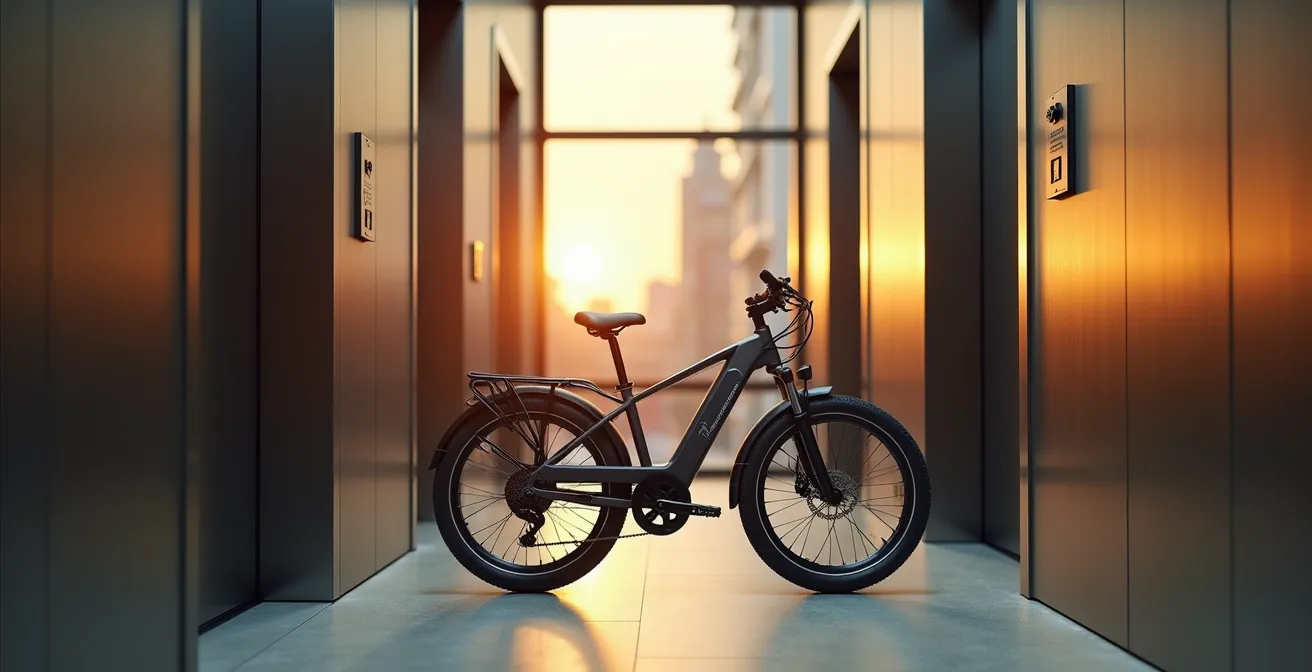
The best vehicle for apartment life isn’t about top speed, but the ease of moving it from the street to your closet.
- Folding e-bikes excel in multi-modal travel and indoor charging convenience thanks to removable batteries.
- Compact motorcycles offer better stability and passenger capability, but at a significantly higher storage and logistical cost.
Recommendation: Your choice depends on your personal “transition footprint.” Prioritize a removable battery and a minimal folded volume over raw power for a truly seamless urban living experience.
For the urban apartment dweller, the dream of personal mobility often crashes into a harsh reality: the complete lack of a garage or dedicated parking spot. The daily dance of circling the block for a space, the anxiety of street parking, and the sheer cost have pushed many to seek smarter, more compact solutions. The conversation often revolves around folding e-bikes and compact motorcycles—two seemingly ideal answers. Yet, most comparisons stop at generic metrics like speed and range.
This approach misses the single most important question for anyone living above the ground floor: how do you get it from the street into your living space? The true measure of a vehicle’s suitability is not just its dimensions, but its entire transition footprint—the total spatial, temporal, and social cost of moving it through lobbies, into elevators, and around your furniture. It’s a question of vertical logistics, not just horsepower.
Instead of just comparing specs, we will analyze these options through the lens of daily, practical use. This is about understanding the subtle friction points that can turn a convenient vehicle into a daily frustration. By evaluating the entire journey, from combining with public transport to carrying groceries, we can determine which solution truly integrates into a modern, high-rise urban lifestyle.
This article provides a comprehensive comparison based on the real-world challenges faced by city residents. Explore the detailed breakdown of each scenario to make an informed decision that enhances, rather than complicates, your life.
Summary: A Practical Guide to Apartment-Friendly Transport
- The Multi-Modal Commute: Can You Take a Full-Size Motorcycle on a Train?
- Backpack vs Cargo Bike: When Do You Need a Dedicated Machine for Groceries?
- Subscription Models: Is It Better to “Subscribe” to a Bike for Summer Only?
- The U-Turn Advantage: Why Short Wheelbase Matters More in the City?
- The Occasional Pillion: Solutions for Carrying a Passenger on a Commuter Bike?
- Backpack or Top Case: Which Suits a Laptop-Carrying Professional Best?
- The Beater Bike Strategy: Does Riding a Cheap Moto Save Your Expensive Truck?
- Battery Swapping vs Charging: Which Model Wins for Urban Scooters?
The Multi-Modal Commute: Can You Take a Full-Size Motorcycle on a Train?
The concept of the “last mile” is the cornerstone of modern urban commuting. The most efficient journey often involves a blend of transport modes. While the question in the title is rhetorical—no, you cannot take a full-size motorcycle on a commuter train—it highlights the fundamental advantage of a folding e-bike: multi-modal fluidity. This ability to seamlessly integrate with public transit dramatically expands your operational range and flexibility. An e-bike isn’t just a vehicle; it’s a key that unlocks the entire city network.
This isn’t just a theoretical benefit. Public transport systems globally are adapting to this trend. For example, Deutsche Bahn railway allows folding bicycles free of charge, recognizing them as essential commuter tools. This policy removes a significant barrier, making the combination of a long train ride and a short bike trip a financially and logistically sound choice. The bike folds down into a manageable package, causing minimal disruption to other passengers—a stark contrast to the impossibility of bringing a gasoline-powered machine on board.
Case Study: Parisian Commuters Embrace Bike-Rail Synergy
In Paris, a city that has been aggressively expanding its cycling infrastructure, a noticeable trend has been the increased presence of commuters with folding bikes on the RER and Métro systems. This allows them to combine regional rail and inner-city cycle travel for a faster, more flexible journey, bypassing traffic-choked streets and reducing their overall commute time.
For the apartment dweller, this means a folding e-bike can solve both the commute to the station and the journey from the destination station to the office. A compact motorcycle, by contrast, is a single-mode solution. It’s excellent from door to door, but it offers no flexibility to integrate with faster, long-distance public transport, limiting its utility in a truly multi-modal strategy.
Backpack vs Cargo Bike: When Do You Need a Dedicated Machine for Groceries?
A vehicle’s utility is measured not only by its ability to transport you, but also your belongings. For the urban resident, a weekly grocery run is a non-negotiable part of life. Here, the practical differences between a folding e-bike and a compact motorcycle become starkly apparent. While a determined motorcyclist can certainly manage groceries with a large backpack, the experience is often a compromise in comfort, capacity, and stability. Sweat-soaked backs and crushed bread are common complaints.
Folding e-bikes, on the other hand, are often designed with modular cargo solutions in mind. Their lower center of gravity and integrated rack systems make them surprisingly capable haulers. The ability to attach and detach baskets or panniers as needed means the bike can transform from a sleek commuter to a practical utility vehicle in seconds. This adaptability is key for apartment living, where a single vehicle must often serve multiple purposes.
A compact motorcycle’s cargo capacity is inherently limited by its design. While tank bags and tail bags can hold small items, they are not suited for bulky groceries. This forces the rider to become the cargo system, which is neither safe nor practical for significant loads. The e-bike’s dedicated cargo options keep the weight on the frame, preserving rider balance and comfort. This distinction is crucial when evaluating the vehicle’s role as a true car replacement for daily errands.
Ultimately, the choice depends on your lifestyle. If your transport needs are limited to yourself and a laptop, a motorcycle and a good backpack suffice. But if you envision your vehicle handling grocery runs, trips to the farmer’s market, or carrying any significant load, the dedicated cargo capabilities of a folding e-bike make it a far more practical machine.
Subscription Models: Is It Better to “Subscribe” to a Bike for Summer Only?
The traditional model of vehicle ownership is being challenged by flexible, subscription-based services. For the apartment dweller, who may have seasonal needs or be wary of a large upfront investment, this model presents a compelling alternative. Subscribing to a folding e-bike for the summer months, for instance, eliminates the need for year-round storage and maintenance—two major pain points for those with limited space.
A subscription service essentially outsources the headaches of ownership. Maintenance, repairs, and even theft protection are typically included in the weekly or monthly fee. This provides peace of mind and a predictable cost, unlike ownership, where a sudden repair bill can be a significant financial hit. Furthermore, subscriptions often allow for easy upgrades to the latest models, so you’re never stuck with outdated technology. For someone testing the waters of two-wheeled commuting, a subscription is a low-risk way to validate the lifestyle before committing to a purchase.
Conversely, compact motorcycles are almost exclusively an ownership proposition. The high upfront cost, mandatory insurance, and registration fees represent a significant commitment. While the long-term cost of ownership can be competitive, it lacks the flexibility that many urbanites crave. If you decide after one season that motorcycling isn’t for you, selling the vehicle involves hassle and depreciation loss. The “try before you buy” nature of e-bike subscriptions simply doesn’t exist in the motorcycle world in the same accessible way.
For the undecided or seasonally-inclined rider, the subscription model is a clear winner in terms of flexibility and low commitment. It allows you to enjoy the benefits of a personal transport vehicle during peak season without the long-term burdens of storage and maintenance during the cold, wet months.
Your 3-Year Total Cost of Ownership Checklist
- Calculate upfront costs: Compare the purchase price of a folding e-bike ($1,000-$3,000) versus a compact moto ($4,000-$8,000) against the weekly cost of a subscription ($45-$100).
- Factor in maintenance: Account for the fact that e-bike owners are responsible for all upkeep, whereas a subscription typically includes service and repairs.
- Include insurance costs: Add the cost of required motorcycle insurance to the moto’s total, compared to the often minimal insurance needs for an e-bike.
- Consider depreciation: Acknowledge that rapidly advancing technology can make purchased models feel outdated in 2-3 years, a factor mitigated by subscription model upgrades.
- Evaluate flexibility needs: honestly assess if you will use the vehicle year-round or if a seasonal subscription better fits your lifestyle and avoids off-season storage issues.
The U-Turn Advantage: Why Short Wheelbase Matters More in the City?
In the tight confines of a city, agility is king. A vehicle’s ability to navigate narrow alleys, filter through gridlocked traffic, and execute a tight U-turn is often more valuable than its top speed. This is where wheelbase—the distance between the front and rear axles—plays a crucial role. While this metric is important on the road, it’s even more critical in the context of our “transition footprint”: navigating the vehicle into and through a residential building.
The true “elevator test” isn’t just about whether the vehicle fits. It’s about the entire process of vertical logistics. Can you maneuver it through the lobby doors? Can you pivot it into the elevator car without a three-point turn? This is where the ultra-compact nature of a folding e-bike shines. When folded, its footprint becomes a small, manageable block. In fact, testing reveals that premium folding e-bikes achieve compact dimensions as small as 25.3 inches high by 23 inches wide, making them no more obtrusive than a large suitcase.
However, the world of compact motorcycles is evolving to meet this exact challenge. The traditional motorcycle, even a small one, has a long wheelbase and a fixed shape that makes it a nightmare for indoor navigation. But innovative designs are changing the game.
Case Study: The Icoma Tatamel Redefines Motorcycle Portability
The Icoma Tatamel electric motorcycle is a prime example of this innovation. Its entire purpose is to solve the apartment storage problem. The machine shrinks to just 69 × 69 × 26 cm, allowing it to be rolled around like carry-on luggage. As a review on Electrek notes, “For urban apartment dwellers who’ve dealt with ‘no bikes inside’ policies, this solves a major headache.” It demonstrates that the core benefits of a folding design are not exclusive to e-bikes, even if such solutions in the motorcycle space are currently niche and expensive.
Ultimately, a short wheelbase and, more importantly, a small folded footprint, dramatically reduce the “transition footprint.” They minimize the social friction of wrestling a large object through common areas and make the daily process of storing the vehicle effortless. While most compact motos fail this test, the existence of models like the Tatamel proves the industry recognizes the problem.
The Occasional Pillion: Solutions for Carrying a Passenger on a Commuter Bike?
The need to carry a passenger, even occasionally, is a significant factor that can tip the scales in favor of a compact motorcycle. Motorcycles are fundamentally designed to carry two people. They have dedicated passenger footpegs, a proper seat, and a frame built to handle the extra weight with stability. From a performance and safety standpoint, a compact moto is the clear winner for two-up riding.
However, this capability comes with a hidden cost for the apartment dweller: increased storage density. Carrying a passenger means owning and storing a second helmet, gloves, and jacket. This extra gear consumes valuable closet space, adding to the overall footprint of the motorcycling lifestyle. It’s a trade-off between on-road capability and in-home convenience.
Folding e-bikes are primarily designed as single-person vehicles, but the market is adapting. Some more robust models are now offering passenger solutions. For instance, an analysis of the market shows that modern folding e-bikes can accommodate an optional passenger seat on their rear cargo rack. These are typically suitable for short, low-speed trips and are not comparable to the comfort and safety of a motorcycle pillion seat. They are a solution for the “5% of trips” scenario—a quick lift for a friend from the subway station, not a weekend tour.
For the rider who anticipates frequently carrying a passenger, a compact motorcycle remains the most practical and responsible choice. But for those whose passenger needs are rare and spontaneous, the emerging options on heavy-duty folding e-bikes might be “good enough,” avoiding the commitment to a full motorcycle setup. It requires an honest assessment of how often you’ll truly be riding with a pillion.
Backpack or Top Case: Which Suits a Laptop-Carrying Professional Best?
For the commuting professional, the primary cargo is often a laptop and a few work essentials. The method of transporting these items has a direct impact on comfort, security, and professional appearance. The choice between a backpack and a hard-mounted top case encapsulates a core difference in philosophy between the e-bike and motorcycle commuter.
The motorcycle, with its rigid frame, is the perfect platform for a top case. This lockable, weatherproof hard case offers unparalleled security and protection for a laptop and other valuables. You can leave it on the bike while you pop into a coffee shop, and your gear stays dry in a downpour. The downside is its permanence and the added “transition footprint.” The box adds bulk, and you still need a separate bag to carry your laptop from the parking spot to your desk.
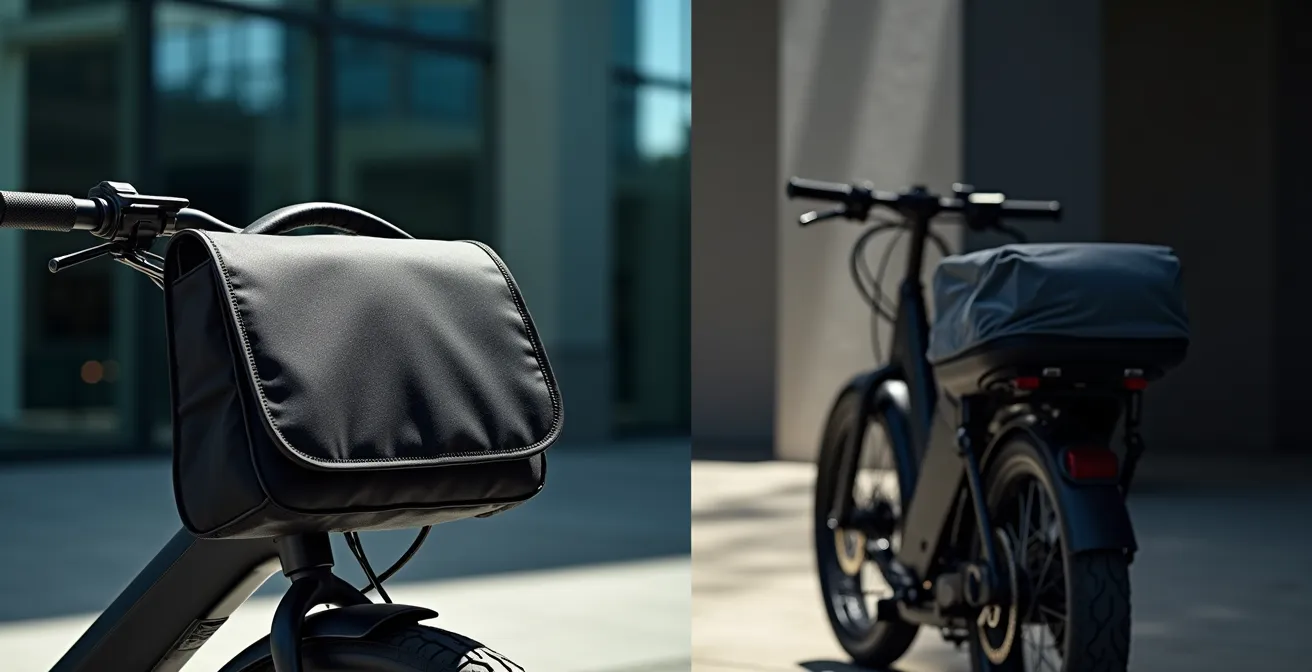
The folding e-bike user, by contrast, almost always relies on a personal bag—a backpack or a messenger bag. This approach offers ultimate flexibility. The same bag you use on your commute is the one you carry into the office. It’s part of your personal attire. This system aligns perfectly with the vertical logistics of apartment life; when you bring your bike inside, your bag simply comes with you. There’s no need to unload a separate case.
The trade-off is in weather protection and on-bike security. While many modern commuter bags are highly water-resistant, they may not offer the same absolute protection as a hard case. More importantly, you can’t leave your valuables in a backpack on a parked bike. The security is tied to you, not the vehicle. For the professional whose bike comes all the way into the office, this is a non-issue. For the one who parks on the street, the top case offers superior peace of mind.
The Beater Bike Strategy: Does Riding a Cheap Moto Save Your Expensive Truck?
Many urban dwellers who own a primary vehicle, like a truck or SUV, adopt a “second vehicle strategy” for daily city errands to save on fuel, parking, and wear and tear. Traditionally, this might have been a cheap scooter or an old “beater” motorcycle. However, the folding e-bike is emerging as a far more strategic choice for this role, especially for apartment residents.
The core benefit is the massive reduction in operating costs and logistical hassle. As noted by experts in multimodal transport, choosing car alternatives such as public transport or cycling over driving significantly lowers your carbon emissions and vehicle expenses like fuel, parking fees, and maintenance. A folding e-bike amplifies these savings. There’s no gasoline, no oil changes, no expensive insurance, and, most importantly for the apartment dweller, no need for a second parking space.
A “beater” motorcycle, while cheaper than a new one, still carries most of the same logistical burdens. It requires insurance, registration, and a place to park it. It introduces a second set of maintenance routines and potential repair costs. For the person trying to simplify their urban life and save money, adding a second combustion-engine vehicle can be counterproductive. The e-bike, stored indoors and charged from a standard wall outlet, keeps the entire transport ecosystem self-contained within the apartment.
Adopting a folding e-bike as a “beater” or primary urban vehicle isn’t about replacing your truck for a weekend getaway; it’s about optimizing 90% of your city trips. It preserves your more expensive vehicle for the times you actually need it, while providing a near-zero-cost, zero-hassle solution for the daily grind, perfectly aligned with the constraints of apartment living.
Key Takeaways
- Transition Footprint is Key: The real test is the entire journey from street to apartment, not just folded size. This includes navigating lobbies, elevators, and hallways.
- Removable Batteries are a Game-Changer: For apartment dwellers, the ability to charge a battery indoors is infinitely more convenient than finding a place to charge an entire vehicle.
- Flexibility vs. Power: Folding e-bikes offer supreme flexibility (multi-modal travel, cargo options), while compact motos provide more power and passenger stability at the cost of a larger storage and logistical footprint.
Battery Swapping vs Charging: Which Model Wins for Urban Scooters?
For any electric vehicle, the question of refueling—or recharging—is paramount. For the apartment dweller, this becomes the single most critical element of vertical logistics. The convenience of your chosen vehicle can be completely negated by a cumbersome charging process. The debate often centers on battery swapping services versus personal charging, but for the individual owner, it boils down to one thing: can you get the power from the wall to your vehicle?
This is where the removable battery of most folding e-bikes provides an almost insurmountable advantage. The ability to unlock a 5-10 lb battery, carry it upstairs, and charge it in your kitchen overnight is the peak of convenience. It completely decouples the vehicle from the charging location. In contrast, a vehicle with a fixed or non-removable battery, common on many electric scooters and motorcycles, creates a major logistical challenge. It requires you to bring the entire vehicle inside and near an outlet, which can be impractical or even impossible depending on your apartment layout.
This challenge is clearly outlined when comparing the two systems directly.
This table from bike experts breaks down the practical considerations of managing battery power for apartment living, showing the clear convenience of a removable system.
| Aspect | Removable E-Bike Battery | Fixed Battery System |
|---|---|---|
| Apartment Charging | Bring battery inside to charge | Must bring entire bike inside |
| Elevator Policy | Generally allowed if undamaged | May face building restrictions |
| Safety Considerations | Charge on non-flammable surface | Requires dedicated bike storage area |
| Convenience | Independent charging location | Tied to bike storage location |
Furthermore, the issue of building policy and social friction cannot be ignored. Some buildings or even public transport systems have strict rules regarding batteries due to safety concerns. As one safety guide notes:
Most modern e-bike batteries are designed to be removable and portable, meaning you can carry them in elevators—if they’re undamaged and properly stored. However, some high-rise buildings or public transport systems may restrict them due to fire safety concerns.
– Favorite Bikes Research, E-Bike Battery Elevator Safety Guide 2025
This highlights that even with a removable battery, awareness of local rules is key. However, the prospect of getting a small battery approved is far greater than getting permission to park and charge an entire motorcycle in a common area or service elevator. For the urban apartment dweller, the removable battery isn’t just a feature; it’s the enabling technology that makes electric vehicle ownership practical.
Frequently Asked Questions on Commuter Bikes
Can folding e-bikes legally carry passengers?
Some models like the Lectric XP4 include optional passenger seats and can support up to 330 lbs total payload, though local regulations vary.
What’s the storage burden for passenger gear?
Compact motorcycles require storing extra helmets, gloves, and jackets in apartments. E-bikes mainly need to account for reduced battery range with extra weight.
Are there alternatives for occasional passenger needs?
For the 5% of trips requiring passengers, combining solo e-bike ownership with ride-share services offers maximum flexibility.