
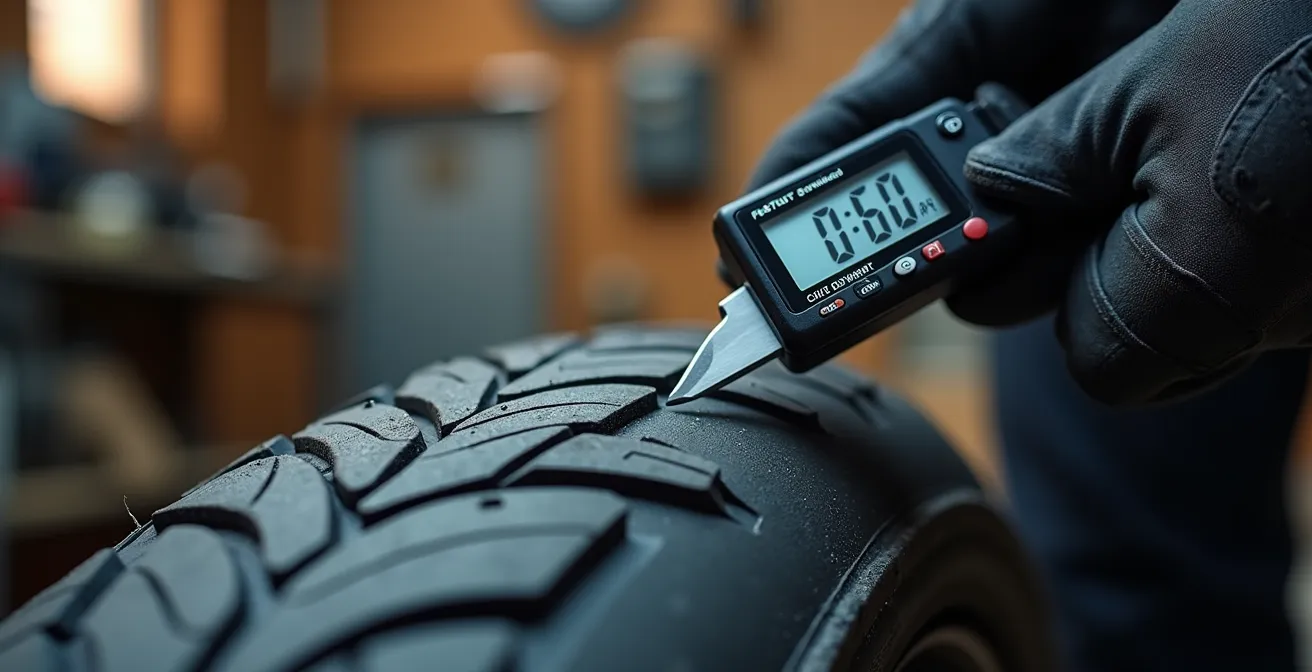
A legally compliant tire is not necessarily a safe tire; critical performance degradation occurs long before reaching the legal minimum tread depth.
- Tire age and environmental exposure (dry rot) are as critical to safety as tread depth.
- A squared-off tire profile, while common, severely compromises handling stability and turn-in response.
- Tread depth below 3mm drastically reduces water evacuation, creating a high risk of hydroplaning in wet conditions.
Recommendation: Adopt a professional inspection methodology. Use a dedicated depth gauge, inspect DOT date codes for age, and meticulously check for structural flaws beyond simple tread measurement.
For decades, the humble penny has been the trusted tool in a rider’s pocket, a simple gauge for a complex safety question: are my tires worn out? This ritual, passed down through generations, is built on the premise that if Lincoln’s head is covered, you’re good to go. It’s a convenient piece of folklore, but in the world of modern tire engineering and vehicle dynamics, it is a dangerously oversimplified and obsolete practice.
The “legal is safe” mindset this promotes ignores the nuanced reality of tire degradation. As a safety inspector, my tools are not coins, but calipers, depth gauges, and a critical eye for details the penny test completely misses. True safety lies not in meeting a bare minimum legal requirement, but in understanding the specific performance thresholds where a tire’s ability to grip, handle, and disperse water begins to critically fail. A tire does not go from safe to unsafe in the span of a millimeter; it is a gradual, measurable decline.
This guide dismantles the outdated myths and equips you with a professional’s methodology. We will move beyond the single data point of tread depth to conduct a complete system inspection, analyzing the crucial indicators of a tire’s true condition: the function of tread wear indicators, the hidden danger of dry rot, the dynamic impact of a flattened profile, and the non-negotiable physics of water dispersion. It is time to replace folklore with facts and inspect your tires like a pro.
To navigate this comprehensive inspection process, we will systematically break down the key areas of tire assessment. The following sections provide a detailed look at each critical component, moving from common indicators to the more subtle, but equally important, aspects of tire health and performance.
Contents: A Professional Guide to Motorcycle Tire Inspection
- What Are Those Little Rubber Bridges in Your Tire Grooves?
- Dry Rot Cracks: Why a Tire with Great Tread Can Still Blow Out?
- The Flat Spot: Is It Safe to Ride on a Squared-Off Rear Tire?
- Why 2mm of Tread is Not Enough for heavy Rain Dispersion?
- Front vs Rear Wear Rates: Can You Replace Just the Rear Tire Safely?
- The 200mm Tire Myth: Why Putting a Fat Tire on a Stock Rim Kills Handling?
- Rubber Waste: Why Motorcycle Tires Are Harder to Recycle Than Car Tires?
- Sport vs Hypersport Tires: How Many Miles Can You Really Expect from a Soft Compound?
What Are Those Little Rubber Bridges in Your Tire Grooves?
Those raised rubber bars, located inside the main circumferential grooves of your tire, are known as Tread Wear Indicators (TWIs). They are often marked on the sidewall by a small triangle or the letters “TWI”. Their function is commonly misunderstood. They are not a suggestion or a guide; they are a definitive, legal termination marker. When the tread surface becomes flush with the top of a TWI bar, the tire has reached its legal wear limit, typically 1/32″ or 0.8mm.
However, relying on the TWI as your primary indicator for replacement is a reactive and unsafe strategy. The core issue is that critical performance degradation happens long before this point. According to Michelin’s technical guidelines, performance degrades significantly well before the tread reaches this minimum depth. The tire’s ability to disperse water, maintain stability, and provide predictable grip diminishes progressively with wear. The TWI simply marks the point of absolute failure, not the beginning of the danger zone.
An inspector’s approach is to use a proper tread depth gauge to monitor wear across multiple points of the tire. This allows for the tracking of wear rates and the identification of uneven wear patterns, such as center flattening or scalloping on the edges. The TWIs should be viewed as a final, non-negotiable backstop, but your decision to replace a tire should be based on measured performance thresholds, not just legal minimums.
Dry Rot Cracks: Why a Tire with Great Tread Can Still Blow Out?
A tire with deep, seemingly perfect tread can still be a ticking time bomb. The most overlooked factor in motorcycle tire safety is age. Over time, the rubber compounds that give a tire its flexibility and grip begin to break down due to exposure to UV light, ozone, and simple oxidation. This process is known as dry rot, and it compromises the tire’s structural integrity from the inside out.
Initial signs of dry rot are often subtle: fine, hairline cracks appearing on the sidewalls or at the base of the tread blocks. As the condition worsens, these cracks become deeper and more pronounced, indicating that the rubber has lost its essential oils and elasticity. This brittle state makes the tire highly susceptible to catastrophic failure, such as a sudden blowout under load, even if it has ample tread depth. For this reason, motorcycle safety experts recommend that tires should be replaced every 5-6 years regardless of mileage or visible tread wear. You can identify your tire’s manufacturing date by reading the four-digit DOT code on the sidewall; the first two digits represent the week, and the last two represent the year.
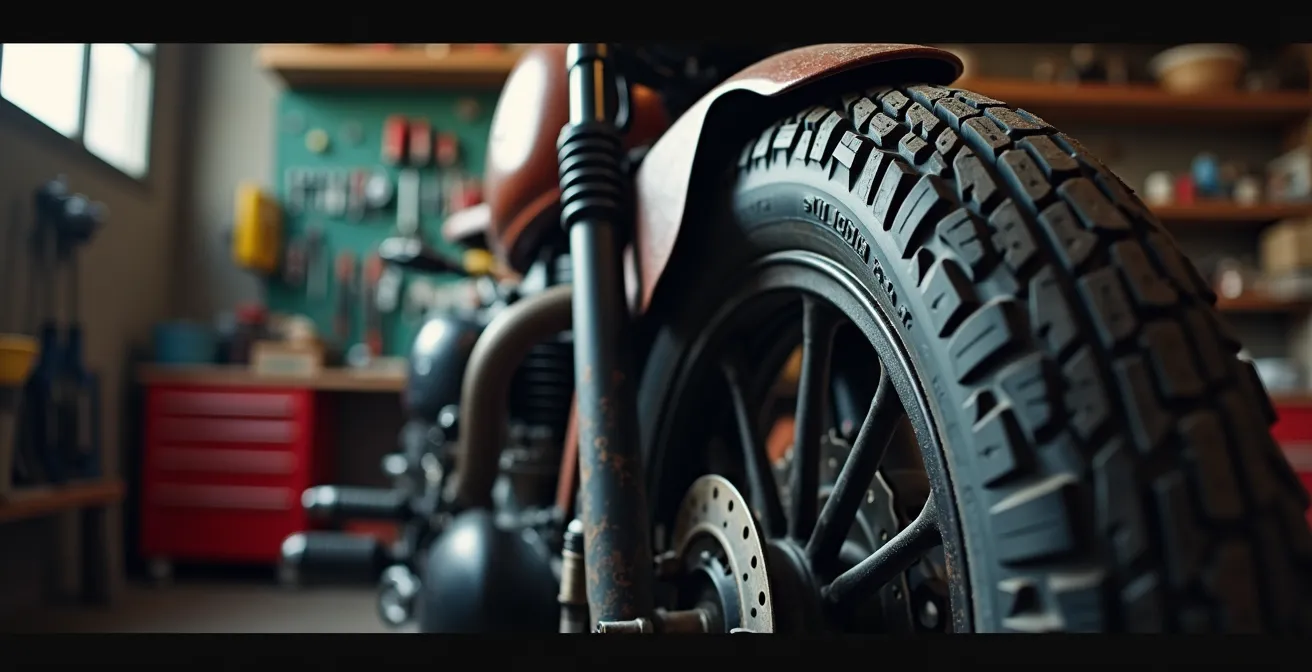
This risk is particularly high for bikes that are ridden infrequently. The “Garage Queen Syndrome” describes how motorcycles that sit for long periods can experience accelerated tire degradation. Regular riding actually helps circulate the protective oils within the rubber compound, maintaining its pliability. Without this circulation, the oils settle, and the exposed surfaces dry out faster. This makes a low-mileage older bike paradoxically more dangerous than a well-ridden one of the same age.
The Flat Spot: Is It Safe to Ride on a Squared-Off Rear Tire?
The squared-off rear tire is the tell-tale signature of a motorcycle used primarily for commuting or long-distance highway touring. While it may seem like a simple consequence of wear, this change in the tire’s profile represents a critical compromise in its dynamic performance. A motorcycle tire is engineered with a rounded profile to allow for smooth, progressive, and predictable lean angles when cornering. A flat spot fundamentally alters this geometry.
When a squared-off tire is leaned over, it doesn’t roll smoothly onto its edge. Instead, it rides on the flat center patch until it abruptly “falls” off the edge and onto the remaining rounded shoulder. This creates a highly unsettling and unstable feeling during turn-in, disrupting the rider’s confidence and control. The transition from upright to leaned is no longer linear, forcing the rider to make sudden steering corrections to manage the bike’s tendency to drop into the corner.
A professional inspection involves more than a glance. To quantify this wear, place a straight edge across the tire’s tread. On a new tire, the gap between the straight edge and the tread at the shoulders will be minimal. As the tire squares off, this gap increases significantly. A difference of more than 2mm between the center tread depth and the shoulder tread depth is a strong indicator that handling has been dangerously compromised. While it may be tempting to “use up” the remaining rubber on the sides, the risk associated with unpredictable handling far outweighs the perceived value.
Why 2mm of Tread is Not Enough for heavy Rain Dispersion?
The primary function of a tire’s tread grooves is not to grip the road, but to evacuate water from the contact patch. This water evacuation capability is what prevents hydroplaning, a dangerous situation where a wedge of water builds up between the tire and the road surface, causing a complete loss of traction and control. The volume and efficiency of these grooves are directly proportional to their depth. A new tire has deep, wide channels capable of pumping away gallons of water per second. As the tread wears down, this capacity diminishes exponentially.
While many jurisdictions consider 1.6mm (2/32″) as the legal minimum tread depth, operating a tire at this level in wet conditions is reckless. At this depth, the grooves are too shallow to effectively clear water at anything beyond city speeds. In fact, safety research indicates that at 2/32″ tread depth, hydroplaning can occur at speeds as low as 40 mph. A tire with 2mm of tread has already lost the majority of its wet-weather performance and offers a dangerously small margin of safety.
For a clear perspective on this performance drop-off, consider the direct relationship between tread depth and a tire’s ability to function in the rain. An inspector does not see 2mm as a usable amount of tread; they see it as a tire that has already failed its most critical safety function in adverse conditions.
| Tread Depth | Water Evacuation Capability | Safe Wet Speed | Recommendation |
|---|---|---|---|
| 6mm (New) | Excellent | 70+ mph | Optimal performance |
| 4mm | Good | 60 mph | Still safe |
| 3mm | Marginal | 50 mph | Plan replacement |
| 2mm | Poor | 40 mph | Replace immediately |
| 1.6mm (Legal minimum) | Dangerous | 30 mph | Illegal in many areas |
The data is unequivocal. Waiting until you are near the legal limit means you have been riding with severely compromised wet-weather safety for thousands of miles. A professional standard dictates replacing tires when they reach 3mm to maintain a safe performance buffer.
Front vs Rear Wear Rates: Can You Replace Just the Rear Tire Safely?
It is a common scenario for motorcyclists: the rear tire wears out significantly faster than the front, often at a rate of two-to-one. This is due to the rear tire bearing the load of acceleration and carrying a larger percentage of the bike’s static weight. This leads to the frequent and economically tempting question of whether it’s acceptable to replace only the rear tire. While technically possible, it must be done with extreme caution and adherence to strict protocols.
A motorcycle’s handling is engineered as a balanced system, with front and rear tires designed to work in concert. Their profiles, construction, and compounds are matched to provide harmonious performance. Introducing a new rear tire with its full, rounded profile while retaining a partially worn, slightly squared-off front tire creates a dynamic mismatch. This can lead to instability, as the rear of the bike will want to turn-in much more quickly than the front, resulting in a disconnected and unpredictable feeling. As the Total Motorcycle Technical Guidelines state:
Precise matching of front and rear tyres is necessary to obtain optimum performance and handling. A new front tyre combined with worn rear tyre may cause instability.
– Total Motorcycle Technical Guidelines, Motorcycle Tire/Tyre Tech 101
If replacing only one tire is unavoidable, the replacement must be an identical make and model to the remaining tire. Mixing brands, models, or even tire types (e.g., a sport-touring front with a hypersport rear) is a recipe for dangerous handling characteristics. Furthermore, the age and wear difference should be minimal. An inspector would advise against this practice unless absolutely necessary and would verify that the remaining front tire has a perfectly maintained profile and sufficient tread.
Action Protocol: Safe Single Tire Replacement
- Verify Model Congruence: The replacement tire must be the exact same make and model as the tire remaining on the bike. No substitutions.
- Audit Date Codes: Check the 4-digit DOT manufacture date codes. Never mix tires that are more than two years apart in age to ensure similar compound characteristics.
- Measure Depth Differential: Use a tread depth gauge on both tires. If the depth difference between the new tire and the remaining tire exceeds 3mm, replace both to maintain handling balance.
- Inspect Profile Mismatch: Visually and with a straight edge, compare the profiles. A new, round rear tire paired with a squared-off front creates a dangerous handling conflict.
- Execute Cautious Break-In: After installation, perform a careful break-in period of 100-200 miles with gentle cornering and acceleration to scrub off the mold-release agents and get accustomed to the new handling dynamics.
The 200mm Tire Myth: Why Putting a Fat Tire on a Stock Rim Kills Handling?
The desire for a wider, more aggressive-looking rear tire is a common aesthetic modification. However, fitting a wider tire than specified onto a stock rim is a classic case of aesthetics overriding engineering, creating a dangerous system mismatch. Tires and rims are designed by manufacturers as a matched pair, a system where the rim width is precisely calculated to hold the tire beads in a way that produces the intended profile.
When an overly wide tire (e.g., a 200mm tire on a rim designed for a 180mm) is installed, the narrower rim pinches the tire beads together. This deforms the tire’s engineered round cross-section into a more triangular, “pinched” shape. This deformation has severe consequences for handling dynamics. The contact patch, the small area of rubber touching the road, is compromised. While the tire may look wider when upright, the pinched profile actually reduces the size of the contact patch at lean angles, leading to a sudden loss of grip when cornering.
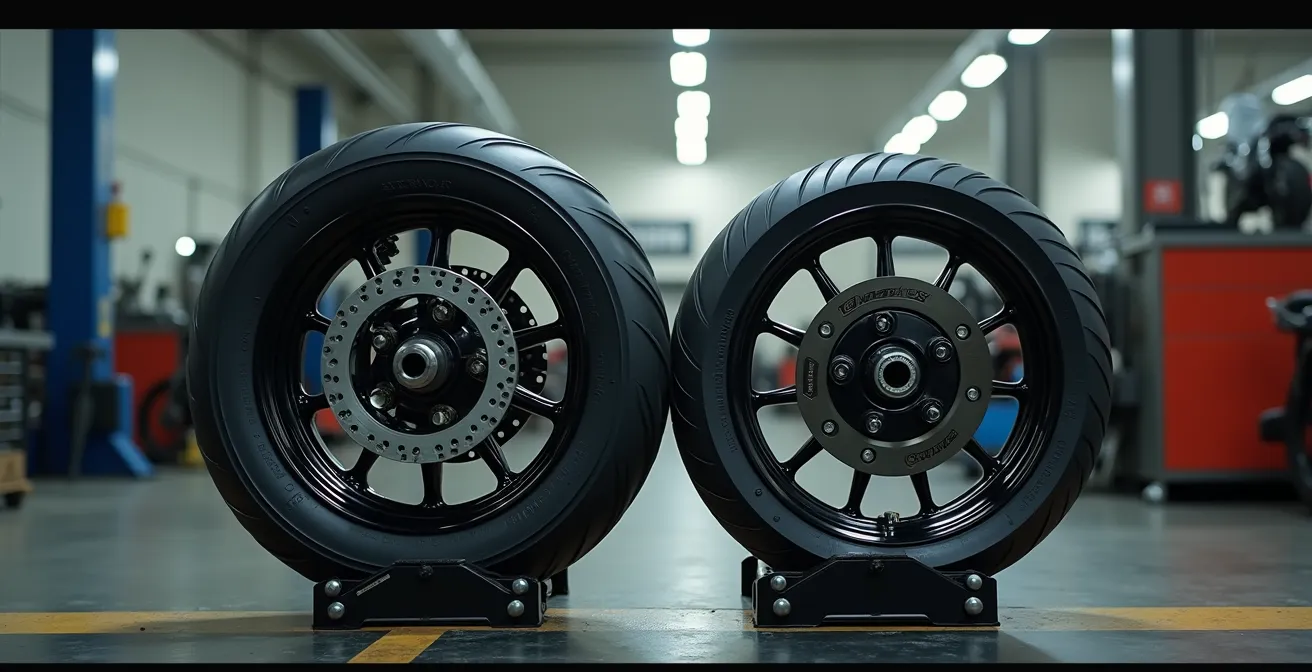
Engineering Analysis: Tire-Rim Compatibility
Manufacturers’ engineering data consistently shows that installing a wider tire on a narrower rim fundamentally alters the tire’s dynamic properties. The pinched profile not only reduces the contact patch at lean but also stiffens the sidewalls unnaturally, preventing them from flexing as designed to absorb bumps and maintain contact with the road. This leads to a harsh ride, unpredictable handling, and accelerated, uneven wear in the center of the tread. For safety and performance, an inspector always verifies that the installed tire size conforms strictly to the vehicle manufacturer’s specifications for that specific rim width.
The “fatter is better” look comes at the direct cost of safety and performance. The bike’s turn-in becomes heavy and sluggish, and its stability at lean is compromised. Always adhere to the tire sizes specified by the motorcycle manufacturer; they have been chosen to optimize the handling and safety characteristics of the machine.
Rubber Waste: Why Motorcycle Tires Are Harder to Recycle Than Car Tires?
In an era of increasing environmental awareness, the disposal of end-of-life products is a major concern. While the automotive industry has developed a relatively robust infrastructure for recycling car tires, motorcycle tires present a unique and more complex challenge. The difficulty lies in their highly specialized and heterogeneous construction, a direct result of the extreme performance demands placed upon them.
Unlike a standard car tire, a modern motorcycle tire is a sophisticated composite structure. It is not made of a single type of rubber. High-performance tires often feature multi-compound technology, with a harder, more durable rubber in the center for mileage and softer, grippier compounds on the shoulders for cornering. These different rubber formulations are vulcanized together into a single unit. Furthermore, the tire’s casing is reinforced with a complex matrix of materials, including steel belts, nylon, rayon, or aramid plies, all bonded together.
This intricate layering of different polymers and reinforcing materials makes separation for recycling incredibly difficult and cost-prohibitive. The lower volume of motorcycle tires produced compared to car tires also means there is less economic incentive to develop specialized recycling streams. Consequently, most used motorcycle tires end up being shredded and used as tire-derived fuel (TDF) in cement kilns or processed into crumb rubber for low-grade applications like playground surfaces, rather than being part of a true circular, tire-to-tire recycling process.
Key Takeaways
- Tire safety is a function of both age and wear; a tire older than six years is a risk regardless of its tread depth.
- The legal minimum tread depth is a point of failure, not a performance benchmark. Safe wet-weather operation requires significantly more tread.
- The tire’s profile and its compatibility with the rim are non-negotiable elements of handling dynamics that must adhere to manufacturer specifications.
Sport vs Hypersport Tires: How Many Miles Can You Really Expect from a Soft Compound?
The question of tire longevity is one of the most common, yet most difficult, to answer with a single number. The expected operational lifespan of a motorcycle tire is not a fixed value but a variable heavily influenced by compound, riding style, road conditions, and maintenance. While industry data reveals that motorcycle tyres typically last between 3,000 to 15,000 miles, this wide range highlights the critical difference between tire categories. A durable touring tire is engineered for mileage, while a soft-compound hypersport tire prioritizes maximum grip at the expense of longevity.
For high-performance sport and hypersport tires, mileage is a direct function of the operational demands placed upon them. The soft, sticky compounds that provide phenomenal grip are, by their very nature, less resistant to abrasion. Aggressive acceleration, hard braking, and high lean angles generate heat and forces that rapidly wear away the tread. A rider who uses their bike for spirited canyon carving or track days will consume a set of hypersport tires in a fraction of the time it would take a gentle commuter.
To provide a realistic expectation, an inspector would analyze the rider’s specific use case. The same set of tires can have drastically different lifespans depending entirely on how they are used, as illustrated by the following profiles.
| Rider Profile | Riding Characteristics | Expected Mileage (Hypersport Tire) |
|---|---|---|
| The Commuter | Gentle acceleration, mostly upright, highway speeds | 5,000-7,000 miles |
| The Canyon Carver | Hard acceleration/braking, frequent lean angles, spirited pace | 2,500-4,000 miles |
| The Track Day Hero | Maximum lean angles, hard braking, heat cycles, aggressive compounds | 1,000-2,000 miles |
Ultimately, choosing a hypersport tire is a conscious decision to trade longevity for peak performance. There is no magic number for mileage; there is only the reality of rubber meeting road, and the more aggressively it meets it, the faster it will disappear.
Conduct a thorough inspection of your tires today using this professional methodology. Your safety, and the performance of your machine, depend not on outdated myths, but on precise, informed assessment.
Frequently Asked Questions About The Penny Test is Obsolete: How to Measure Tread Depth Like a Pro?
Can motorcycle tires be recycled like car tires?
Motorcycle tires face unique recycling challenges due to their complex multi-compound construction and lower volume compared to car tires, making specialized recycling less economically viable.
What happens to old motorcycle tires?
Most are processed into Tire-Derived Fuel (TDF) for cement kilns, or shredded into crumb rubber for playground surfaces and asphalt additives.
Are there eco-friendly disposal options?
Some manufacturers offer take-back programs, and specialized recyclers are developing devulcanization processes for true tire-to-tire recycling, though these remain limited.