

The choice between engines isn’t just technical; it’s a decision about the kind of conversation you want to have with your motorcycle’s mechanical soul.
- Desirable vibration is engineered character that connects you to the combustion event; bad vibration is just noise that fatigues and distracts.
- Increasingly strict emissions regulations are systematically erasing the raw, air-cooled character many riders cherish, threatening the sensory diversity of motorcycling.
- The art of manual control—mastering the clutch and gearbox—offers a level of precision and engagement that modern, seamless powertrains cannot replicate.
Recommendation: When choosing your next bike, prioritize the engine that provides the most engaging sensory feedback for *you*, the one whose mechanical language you’re most excited to learn and master.
There’s a moment on a perfect ride where the world fades away. It’s not just the speed or the lean angle; it’s a deep, resonant connection with the machine beneath you. At the heart of this connection is the engine’s pulse, a mechanical heartbeat that communicates directly with your senses. For decades, riders have debated the merits of different engine layouts, often boiling it down to a simple comparison of V4 versus Inline-4, focusing on raw horsepower and torque curves. They talk about the screaming top-end of an I4 or the mid-range grunt of a V4.
These discussions, while valid, often miss the point. They treat the engine as a simple power generator, a list of specifications on a page. But what if the true essence of a motorcycle’s character lies not in its peak power, but in its sensory fingerprint? What if the vibrations, the intake roar, and the exhaust note are not byproducts, but the very language the machine uses to speak to its rider? The real choice isn’t about which is objectively ‘better’, but about which mechanical dialogue you find more compelling.
This guide abandons the sterile spec-sheet comparison. Instead, we will delve into the soul of the machine, exploring the nuances that define its character. We will decode the language of vibration, understand the external forces threatening this mechanical diversity, and celebrate the intricate dance of rider and machine that defines the art of motorcycling. It’s time to listen to what the engines are truly telling us.
To navigate this exploration of mechanical soul, this article is structured to guide you from the fundamental feelings of an engine’s vibration to the practical realities of preserving these machines for the future. The following summary outlines the key topics we will cover.
Summary: Decoding the Sensory Language of Motorcycle Engines
- Good Vibes vs Bad Vibes: Why Some Engine Vibration Is Desirable?
- Chain, Belt, or Shaft: Which Final Drive System Fits Your Riding Style?
- The Art of the Clutch: Why Manual Control Offers Precision EVs Can’t Match?
- No Clutch, No Gears: Does Removing Shifting Ruin the Engagement of Riding?
- Euro 5 Regulations: Why Air-Cooled Engines Are Disappearing Forever?
- e-Fuels: Can Synthetic Gasoline Save Your Classic Engine from Extinction?
- Where to Find Factory Parts for Motorcycles Older Than 20 Years?
- Sensory Diagnostics: How to Smell a Rich Mixture or Hear a Loose Cam Chain?
Good Vibes vs Bad Vibes: Why Some Engine Vibration Is Desirable?
In the world of engineering, vibration is typically the enemy—a sign of inefficiency, wear, and discomfort. Yet, for a motorcycle connoisseur, a total absence of vibration creates a sterile, lifeless experience. The key is understanding the difference between chaotic, high-frequency buzzing that numbs your hands, and the rhythmic, characterful combustion pulse that connects you directly to the engine’s power strokes. This is the difference between noise and music. A lumpy V-twin at idle, a V4’s hardened growl, or an inline-four’s building hum are all forms of desirable kinesthetic feedback.
This intentional shaping of sensation is a core part of modern motorcycle design, blending engineering with art. Engineers don’t just seek to eliminate vibration; they seek to tune it. By manipulating firing orders, crankshaft design, and balancing shafts, they create a specific sensory fingerprint. For instance, specific firing patterns like the 270°/450° intervals create a distinct, off-beat thrum in certain V-twins and parallel-twins, mimicking the feel of a V-twin while offering unique packaging advantages. This isn’t an accident; it’s a deliberate choice to craft an emotional response.
The science behind this is known as psychoacoustics, which studies how humans perceive sound and vibration. It’s not just about volume, but about the texture and quality of the sensory input. As experts in the field of Noise, Vibration, and Harshness (NVH) confirm, the goal is often not just reduction, but transformation.
The field of psychoacoustics is partly concerned with this correlation. In some cases the NVH engineer is asked to change the sound quality, by adding or subtracting particular harmonics, rather than making the vehicle quieter.
– Engineering Analysis, Dark Side Developments NVH Analysis
This approach acknowledges that a motorcycle’s sound and feel are integral to the experience. Certain frequencies can heighten focus, while a satisfying exhaust note on overrun provides crucial feedback. The “good” vibes are a form of mechanical dialogue, a constant, tactile stream of information about what the engine is doing. It’s a language that, once learned, makes the ride infinitely richer and more engaging.
Chain, Belt, or Shaft: Which Final Drive System Fits Your Riding Style?
The engine’s character doesn’t end at the crankcase. The final drive system—the mechanism that transfers power to the rear wheel—plays a crucial and often overlooked role in shaping the bike’s overall feel, maintenance demands, and even its sound. The choice between a chain, belt, or shaft is a fundamental engineering trade-off that directly impacts your riding experience. Each system offers a distinct blend of efficiency, weight, and kinesthetic feedback.
The traditional roller chain is the lightweight champion, offering the most direct connection and minimal power loss. This immediacy is what makes it the universal choice for sport and racing applications. The downside is its high-maintenance nature, requiring regular cleaning, lubrication, and adjustment. A poorly maintained chain not only wears out quickly but also introduces a significant amount of driveline snatch and vibration. As one technical expert noted in Motorcycle Mojo, “That uneven wear produces a remarkable amount of vibration and can be felt especially as the bike slows to a stop.” This feedback, while undesirable when caused by wear, highlights the chain’s transparent nature.
Belt drives, common on cruisers and some standards, offer a smoother, quieter alternative. They are low-maintenance and absorb more of the powertrain’s pulses, resulting in a less “mechanical” feel. This refinement comes at the cost of a slight increase in weight and power loss compared to a chain. Finally, the shaft drive is the king of low-maintenance convenience, often lasting the life of the motorcycle with little more than occasional fluid changes. However, it is the heaviest system and incurs the highest parasitic power loss, which can subtly blunt the engine’s raw edge. The comparison below breaks down the key attributes.
| System | Maintenance | Power Loss | Weight | Longevity |
|---|---|---|---|---|
| Chain | High (cleaning/adjustment) | 2-3% | Lightest | 15-20k miles |
| Belt | Low | 3-4% | Medium | 60-100k miles |
| Shaft | Minimal | 5-10% | Heaviest | Lifetime |
Ultimately, your choice depends on your priorities. If you crave the most direct, unfiltered connection to the engine and are willing to perform the maintenance ritual, the chain is unparalleled. If you prioritize smooth, quiet, and reliable mileage for touring, a shaft or belt is the more logical choice. Your decision here tunes the final layer of the motorcycle’s mechanical voice.
The Art of the Clutch: Why Manual Control Offers Precision EVs Can’t Match?
In an age of seamless automatics and twist-and-go electric vehicles, the manual clutch and gearbox can seem like an anachronism. Yet, for the engaged rider, it remains the ultimate tool of expression and control. The clutch is not merely an on/off switch; it’s a fader, a rheostat that allows the rider to minutely modulate the engine’s power. It is the conductor’s baton, orchestrating the engine’s symphony with a level of nuance that a simple algorithm cannot replicate. This is the true art of manual control.
Mastering the clutch transforms the rider from a passenger into an active participant in the powertrain’s work. The ability to feather the lever for perfect low-speed balance, to slip it for optimal drive on a loose surface, or to execute a flawless, rev-matched downshift is a deeply satisfying skill. It’s a physical dialogue between hand, engine, and road that builds a profound sense of connection. This intricate dance is something that single-gear electric powertrains, by their very nature, cannot offer. While impressive in their own right, their silent, linear acceleration removes this entire layer of rider engagement.
This loss of mechanical feedback is a common point of discussion in the development of electric vehicles. Engineers are actively working to re-introduce sensory cues, as the absence of a combustion engine’s masking noise makes other, less desirable sounds more apparent. As a study from Hyundai noted regarding electric motor noise, “…the powertrain noise without engine firing can be easily perceptible to customers, since masking effect from the internal combustion engine is weakened.” This highlights how much we rely on the familiar sounds and feelings of an internal combustion engine to feel connected and in control.
The manual transmission offers a rich palette of techniques that are simply absent in a clutchless world. These skills are not just for performance; they are fundamental to the craft of riding:
- Feathering the clutch for low-speed maneuvers and precise control
- Rev-matching during downshifts for smooth deceleration
- Using engine braking to modulate corner entry speed
- Slipping the clutch to manage power delivery on loose surfaces
- Quick-shifting techniques for maintaining momentum
Each of these actions is a micro-decision, a moment of skill that deepens the bond between rider and machine. The clutch is the bridge between the rider’s intent and the engine’s soul, and its mastery is a reward in itself.
No Clutch, No Gears: Does Removing Shifting Ruin the Engagement of Riding?
The rise of electric motorcycles poses a fundamental question: what happens to rider engagement when you remove the clutch, the gearbox, and the sound of combustion? The experience is undeniably different. The seamless, silent, and often violent acceleration of an EV offers a thrill of its own, but it replaces the rich, multi-layered kinesthetic feedback of a traditional motorcycle with a more one-dimensional experience. The mechanical dialogue becomes a monologue.
Without the need to manage revs, select gears, or modulate a clutch, a significant portion of the rider’s cognitive and physical workload disappears. For some, this is a welcome simplification, making riding more accessible. For the connoisseur, however, it removes the very challenges that make mastery so rewarding. The intricate dance of shifting, braking, and throttle control is replaced by a simpler twist-and-go interface. The engine’s voice, with its rising and falling crescendo, is replaced by a high-frequency electric whine, which our ears are particularly sensitive to.
The perception of sound is not linear. As research in psychoacoustics shows that a 10 dB increase in sound pressure level is generally perceived as a doubling in loudness. This is why the character and frequency of a sound matter as much as its volume. The complex harmonics of an exhaust note provide a rich tapestry of information, whereas the relatively simple sound of an electric motor can become monotonous or even irritating over time, especially in the sensitive 1 kHz range. The loss of auditory feedback reduces the rider’s sense of speed and connection to the machine’s effort.
This isn’t to say electric motorcycles lack merit. Their performance is staggering, and they represent a remarkable feat of engineering. However, in celebrating their strengths, we must also acknowledge what is lost. The raw, visceral, and sometimes imperfect character of the internal combustion engine provides a sensory experience that is, for now, irreplaceable. The lack of shifting, the absence of a pulsing engine, and the replacement of a throaty exhaust with an electronic hum fundamentally changes the nature of the ride. It may still be riding, but the conversation has been silenced.
Euro 5 Regulations: Why Air-Cooled Engines Are Disappearing Forever?
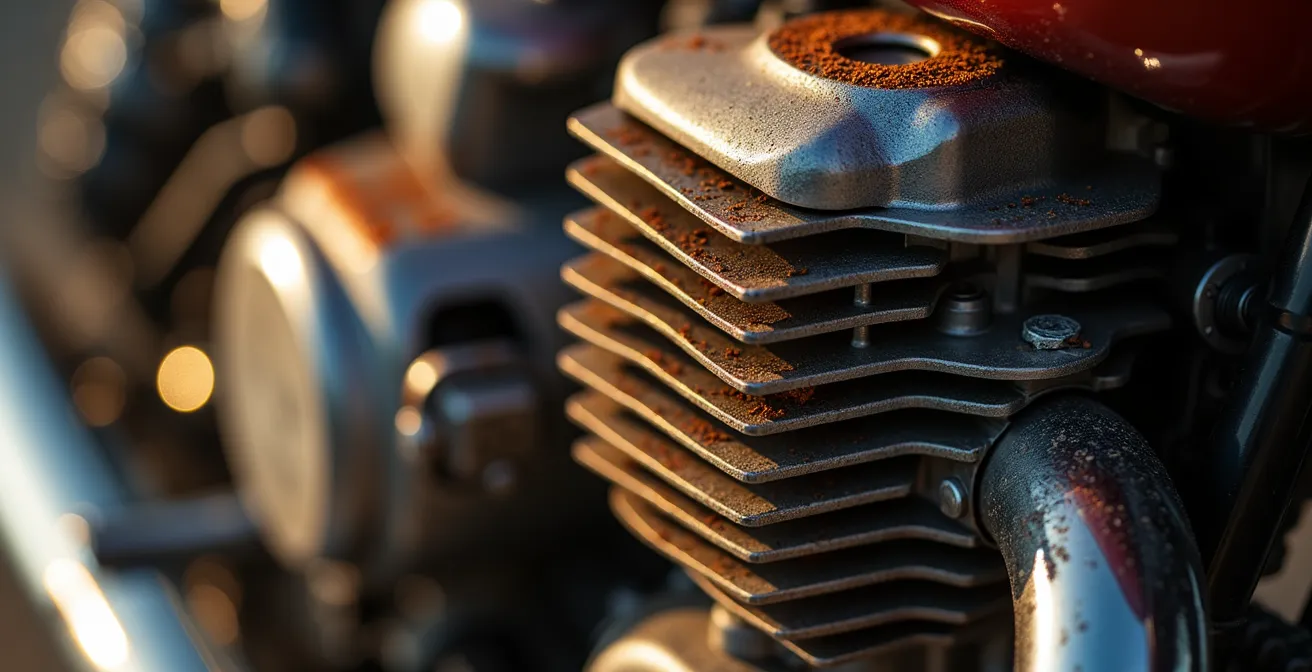
The raw, mechanical beauty of an air-cooled engine is iconic. Those intricate cooling fins are not just functional; they are a visual representation of the engine’s direct connection to the elements. They are the lungs of the machine, breathing the air around them. This design, however, is becoming an endangered species, a casualty of a force far more powerful than rider preference: global emissions standards. Specifically, the Euro 5 and Euro 5+ regulations have sounded the death knell for many classic air-cooled designs.
Air-cooled engines, by their very nature, have a harder time maintaining a stable operating temperature compared to their liquid-cooled counterparts. This temperature fluctuation makes it incredibly difficult to manage the combustion process with the precision required to meet modern emissions targets. To be compliant, manufacturers must drastically cut down on unburnt hydrocarbons (HC), oxides of nitrogen (NOx), and carbon monoxide (CO). As an analysis by Motorcycle.com noted, “Air-cooled motorcycles in particular are becoming endangered with stricter emissions standards. This is especially noticeable in the disappearance of several cruisers from Yamaha and Honda.”
The numbers tell the story. The move from Euro 4 to Euro 5 was not an incremental step; it was a giant leap. These new rules forced a massive reduction in pollutants, with the Euro 5 standards mandate a drastic 38% cut in hydrocarbons and a 33% reduction in NOx compared to Euro 4. Achieving this requires the kind of tight thermal control that liquid cooling provides, allowing for more complex fuel injection maps, catalytic converters that operate in their ideal temperature window, and consistent performance in all conditions. While some manufacturers have achieved Euro 5 compliance with highly advanced, oil-and-air-cooled designs (like BMW’s latest boxers), the classic, simple air-cooled twin is largely a thing of the past for mass-market production.
This regulatory pressure forces a shift not just in technology, but in character. Liquid-cooling adds complexity, weight, and the visual clutter of radiators and hoses, fundamentally changing the minimalist aesthetic. It also dampens the raw, mechanical sounds that emanate directly from the engine block. We are trading a certain raw, authentic character for a cleaner, quieter, and more thermally-efficient future.
e-Fuels: Can Synthetic Gasoline Save Your Classic Engine from Extinction?
With the regulatory walls closing in on traditional combustion engines, a glimmer of hope is emerging from an unexpected source: synthetic fuels, or e-Fuels. The core idea is compellingly simple: what if we could create a carbon-neutral gasoline that works in any existing engine? If successful, this technology could offer a lifeline to the millions of classic, air-cooled, and character-rich motorcycles that would otherwise be legislated into obsolescence. It poses the question: can we save the soul of the machine by changing what it drinks?
E-Fuels are produced by combining hydrogen (created using renewable electricity) with carbon dioxide captured from the atmosphere. The resulting liquid hydrocarbon is, in essence, a synthetic gasoline or diesel that is chemically similar to its fossil-fuel counterpart. The promise is a “drop-in” solution that requires no engine modifications and is carbon-neutral over its lifecycle, as the CO2 released during combustion is equivalent to the amount captured during production. For owners of vintage bikes, this could be a game-changer, allowing them to continue riding while complying with future environmental goals.
The pressure to find such solutions is immense, driven by ever-tightening emissions standards. The table below, showing the progression of Euro standards, illustrates just how dramatically the requirements have evolved, making it nearly impossible for older engine designs to remain compliant without significant and often character-robbing modifications.
| Standard | Year | CO (g/km) | HC (g/km) | NOx (g/km) |
|---|---|---|---|---|
| Euro 4 | 2016 | 1.14 | 0.16 | 0.09 |
| Euro 5 | 2020 | 1.00 | 0.10 | 0.06 |
| Euro 5+ | 2024 | 1.00 | 0.10 | 0.06 |
This data, sourced from a comprehensive analysis of European motorcycle emissions standards, shows the stringent limits that new bikes must meet. E-fuels offer a path for classic bikes to exist alongside a cleaner future. However, the technology faces major hurdles. The primary challenges are scale and cost. Producing e-Fuels is currently an energy-intensive and extremely expensive process, making it far from a commercially viable alternative to gasoline at the pump. While major players like Porsche and Bosch are investing heavily, it remains a long-term prospect rather than an immediate solution. Yet, for the enthusiast desperate to preserve the mechanical heritage of motorcycling, it represents a vital spark of hope.
Where to Find Factory Parts for Motorcycles Older Than 20 Years?
Keeping a classic motorcycle on the road is an act of passion, but that passion is often tested by the daunting challenge of sourcing parts. As bikes age, manufacturers gradually discontinue the production of original equipment manufacturer (OEM) parts. For motorcycles over 20 years old, finding that specific gasket, relay, or piece of trim can feel like a treasure hunt. This is the practical reality of preserving the mechanical soul of a vintage machine: you must become a resourceful detective.
The good news is that for many iconic models, a robust ecosystem of support exists outside of official dealer networks. The enduring popularity of certain bikes means that both the demand and the community knowledge are strong. For example, many beloved motorcycles have enjoyed a 20+ year lifespan, creating a large pool of used parts and a dedicated following of owners who have already solved the problems you’re facing. The key is knowing where to look and who to ask. Your first stop should no longer be the dealership, but the global community of fellow enthusiasts.
The internet has revolutionized vintage parts sourcing. Model-specific forums and Facebook groups are invaluable resources, connecting you with experts and hobbyists who may have the exact part you need sitting on a shelf. These communities are also a goldmine of information on compatible parts from other models or superior aftermarket solutions. International eBay searches, using the specific OEM part number, can uncover new-old-stock (NOS) parts from dealers around the world. Don’t be afraid to think globally.
Beyond the digital realm, the old-school methods still yield results. Attending local swap meets and vintage bike shows puts you face-to-face with vendors who specialize in older machines. Building relationships with specialized restoration shops can also open doors to their networks and parts stashes. The journey of maintaining an older bike is as much about building community and knowledge as it is about turning wrenches. Here are some key strategies:
- Join model-specific online forums and owners’ clubs for parts networks.
- Attend local motorcycle swap meets and vintage bike shows.
- Search international eBay listings using part numbers in multiple languages.
- Contact specialized vintage parts suppliers and restoration shops.
- Consider aftermarket reproduction parts from boutique manufacturers.
Patience and persistence are your greatest tools. The part is out there; finding it is part of the rewarding experience of classic motorcycle ownership.
Key Takeaways
- Engine vibration is not inherently bad; when engineered correctly, it becomes a desirable form of kinesthetic feedback that defines a motorcycle’s character.
- Strict emissions standards like Euro 5 are making traditional, simple air-cooled engines obsolete, threatening the sensory diversity of motorcycling.
- The nuanced control offered by a manual clutch and gearbox is an art form, providing a level of rider engagement and precision that automated systems cannot replicate.
Sensory Diagnostics: How to Smell a Rich Mixture or Hear a Loose Cam Chain?
The ultimate expression of a rider’s connection with their machine is the ability to diagnose its health through senses alone. Long before a catastrophic failure, a motorcycle will whisper, and sometimes shout, warnings about its condition. A true connoisseur learns to listen to this language. This is sensory diagnostics: the art of using sight, sound, smell, and feel to understand the intricate workings of the engine and chassis. It transforms you from a mere operator into a mechanical empath.
Every unusual sound is a clue. A new, high-pitched “sewing machine” ticking might point to valve clearances that need adjustment. A sudden low-end rumble or knock that rises with RPM could signal dangerous wear in the crank bearings. Even vibrations, our constant companions, tell a story. As one case study on vibration diagnostics notes, “Chain wear produces a remarkable amount of vibration felt especially as the bike slows to a stop.” Learning to distinguish this from normal engine pulse is a vital skill. Is there a new buzz through the footpegs at a specific RPM? It could be as simple as a loose engine mount.
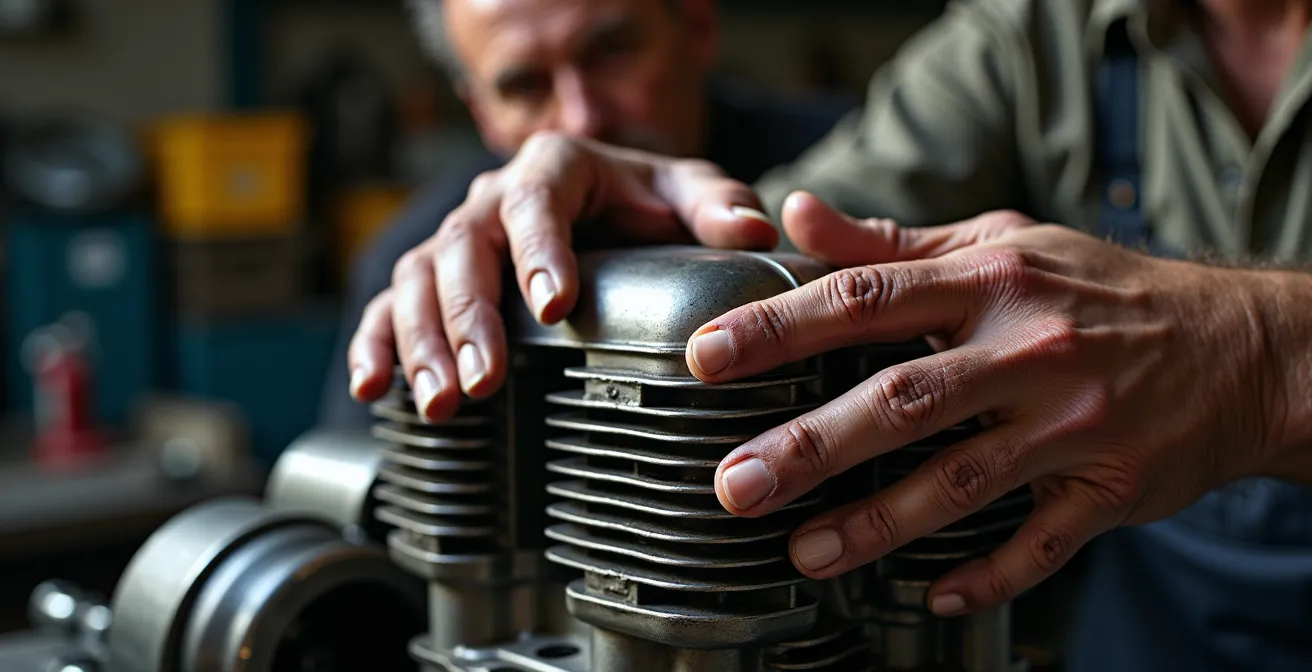
Your nose is also a powerful diagnostic tool. The sweet, cloying smell of maple syrup is the unmistakable sign of a coolant leak. A sharp, acrid odor can indicate an electrical short, while the smell of raw gasoline suggests a rich fuel mixture or a leak in the fuel system. This ability to read the sensory fingerprint of your motorcycle not only makes you a better, more self-reliant owner but also deepens your appreciation for the machine as a living, breathing entity. It’s an intimate dialogue that builds trust and confidence.
Developing this intuition requires mindfulness and practice. It means paying attention on every ride, noting the normal baseline of your bike’s sounds and feels, so that any deviation immediately stands out. The following checklist can help you start to categorize and interpret the signals your motorcycle is sending you.
Your Action Plan: The Sensory Fault-Finding Chart
- Listen for New Sounds: Isolate the sound’s character (tick, knock, whine, rumble) and when it occurs (at idle, under load, at a specific RPM). A high-pitched tick often points to the top end (valves), while a low-end knock suggests the bottom end (crank).
- Feel for New Vibrations: Note where you feel the vibration (handlebars, pegs, seat) and at what speed or RPM it appears. A pulsing at the brake lever indicates a warped disc, while a new chassis buzz could be a loose fastener.
- Use Your Sense of Smell: Before, during, and after a ride, be aware of any unusual odors. Sweet indicates coolant, acrid points to electrical issues, and raw fuel or heavy exhaust smells suggest fueling problems.
- Check for Visual Cues: Regularly inspect for new fluid weeps or leaks. Look at the color of your exhaust smoke. Blue smoke is burning oil, black is a rich mixture, and white could be burning coolant.
- Correlate the Senses: The most powerful diagnosis comes from combining clues. A ticking sound combined with a slight loss of power points more strongly to valve clearance. A vibration felt through the pegs that coincides with a worn-looking chain confirms the diagnosis.
By actively engaging your senses, you are doing more than just maintenance; you are continuing the conversation with your machine on the deepest level possible.
The next time you ride, go beyond simply operating the controls. Listen for the specific texture of the exhaust note, feel the engine’s pulse through the frame, and appreciate the symphony of mechanical processes working in harmony. This is the path to truly understanding and preserving the soul of the machine.