
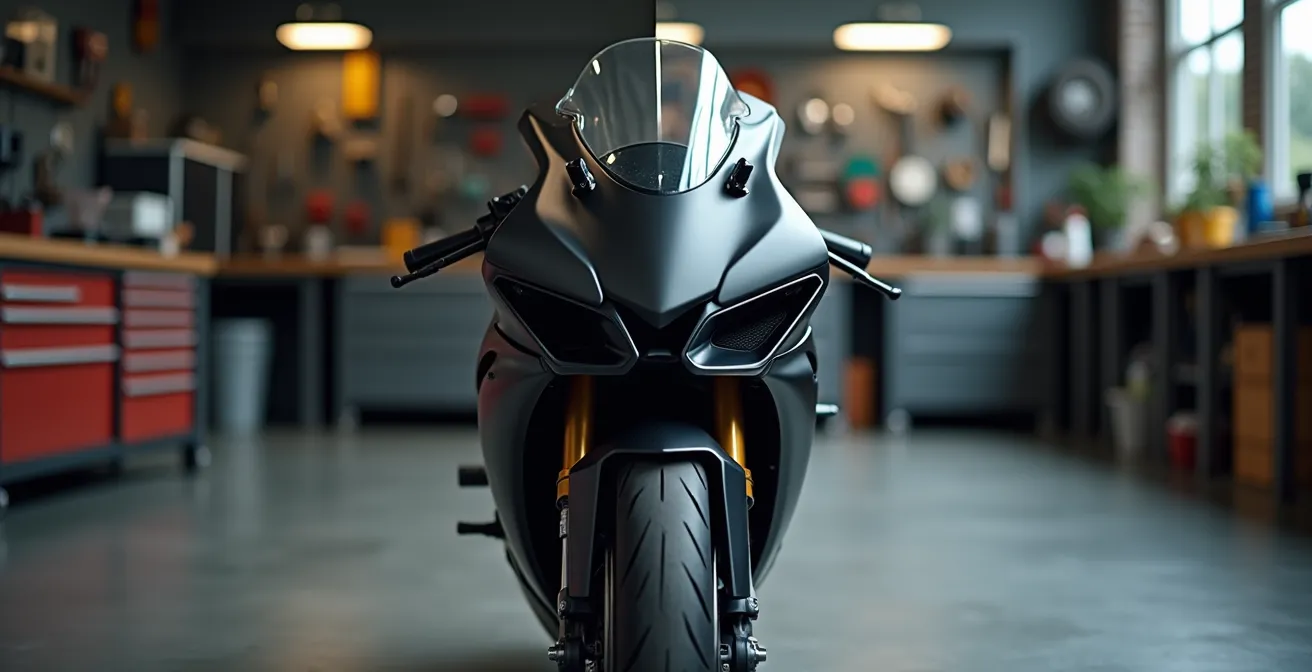
The smartest customization for resale value isn’t about choosing between wrap or paint—it’s about maximizing “Aesthetic Liquidity,” the power to adapt your bike’s look to the market on demand.
- A professional vinyl wrap acts as a shield, preserving the pristine factory paint underneath, which is the gold standard for most buyers.
- Paint is a high-risk, high-reward venture where subpar preparation or a niche color choice can permanently destroy value, while a wrap’s flaws are reversible.
Recommendation: Prioritize high-quality, professional-grade reversible modifications. A wrap offers the best balance of personalization and financial protection, making it the superior strategic choice for value-conscious riders.
For any rider, the urge to make a motorcycle truly their own is powerful. You envision a new color, a unique finish, a statement that sets your machine apart from the factory floor. But this desire is immediately met with a critical question from the business-minded part of your brain: will this modification destroy my bike’s resale value? The debate often boils down to a classic showdown: a permanent, custom paint job versus a modern, reversible vinyl wrap. Riders argue about durability, cost, and looks, often missing the most critical factor.
The common advice suggests that wrap protects the original finish while paint is a permanent commitment. This is true, but it’s a surface-level understanding. It fails to account for the nuanced financial implications of each choice, from the hidden costs of proper preparation to the psychological “red flags” that send potential buyers running. The real conversation isn’t about which material is “better,” but which one offers superior financial flexibility and risk management.
The key to unlocking maximum resale value lies in a concept we’ll call Aesthetic Liquidity. This is your ability to quickly and cost-effectively adapt your bike’s appearance to appeal to the broadest possible market at the exact moment of sale. It’s about maintaining the bike’s core integrity while allowing for personal expression. A customization that looks great but alienates 90% of buyers or signals hidden damage has negative liquidity and will cost you money.
This guide will move beyond the superficial wrap-versus-paint debate. We will dissect each option through the lens of an appraiser, analyzing preparation costs, the impact of repairs, the risks of bold color choices, and the crucial difference between professional and amateur execution. By the end, you’ll be equipped to make a strategic decision that satisfies both your creative impulse and your wallet.
To help you navigate this decision, we’ve broken down the key appraisal points. This framework will guide you through the critical factors that determine whether your customization adds or subtracts from your motorcycle’s final sale price.
Summary: Wrap vs. Paint: Which Customization Method Holds Better Value for Resale?
- Why You Can’t Wax Matte Paint and How to Clean It Correctly?
- Touch-Up vs. Panel Repaint: When Is a Scratch Too Deep to Buff Out?
- Does Painting Your Bike Neon Yellow Actually Reduce Accident Risk?
- Police Impersonation: Which Color Schemes Are Illegal for Civilians?
- Sanding and Priming: Why 90% of the Paint Job Quality Is in the Prep Work?
- How to Add Wind Protection to Your Roadster Without Ruining Its Aesthetics?
- Why Used OEM Fairings Fit Better Than New Chinese Aftermarket Kits?
- Wet vs. Dry Application: How to Install Vinyl Decals Without Bubbles?
Why You Can’t Wax Matte Paint and How to Clean It Correctly?
Matte finishes have become a popular factory option, offering a stealthy, modern aesthetic. However, from a resale value perspective, they represent a significant liability. Unlike glossy paint, a matte finish is a porous, textured surface designed to scatter light. Applying traditional wax fills these microscopic pores, creating an uneven, blotchy sheen that permanently ruins the flat effect. There is no going back; you cannot “un-wax” a matte finish. This fragility makes potential buyers extremely wary, as they know any cosmetic damage is difficult and expensive to fix.
Maintaining a matte finish to preserve value requires a strict, specialized regimen. Any neglect, such as allowing bird droppings or bug splatters to sit, can lead to permanent etching. According to matte paint care specialists at Dr. Beasley’s, a bi-weekly washing schedule is often necessary to prevent this kind of irreversible damage. This high-maintenance reality is a major deterrent for many second-hand buyers who prefer a finish they can easily care for. A vinyl wrap, in contrast, can mimic a matte look perfectly while being far more durable and forgiving. If a wrapped matte panel is damaged, it can be replaced without affecting the rest of the bike, offering far greater Aesthetic Liquidity.
Your Action Plan: Matte Finish Preservation Protocol
- Use only pH-neutral, matte-specific motorcycle shampoos that are free of wax, silicone, or glossing agents.
- For general cleaning, use warm water and a mild detergent with soft, dedicated microfiber sponges to avoid polishing the surface.
- For stubborn stains like tar or tree sap, apply a citrus-based cleaner, let it dwell for up to two minutes without scrubbing, and then gently wipe away.
- Apply a high-quality, SiO2-based matte sealant at least once a year to provide a protective barrier against UV rays and contaminants.
- For quick spot cleaning between washes, use an ammonia-free detailer or glass cleaner to lift grime without leaving streaks or altering the finish.
Touch-Up vs. Panel Repaint: When Is a Scratch Too Deep to Buff Out?
Scratches are an inevitable part of riding, but how you address them has a monumental impact on resale value. The critical factor is the depth of the damage. A light scratch that is only in the clear coat can often be buffed out by a professional detailer, leaving no trace. However, once a scratch penetrates the color coat (revealing the primer underneath) or goes down to the bare metal or plastic, you enter a territory of difficult decisions. This is where many owners make a costly mistake: the amateur touch-up.
Applying touch-up paint with a small brush might seem like a cheap fix, but to a discerning buyer, it’s a massive perceptual red flag. The resulting “blob” of paint rarely matches the factory finish in texture or color depth and often looks worse than the original scratch. It signals that the owner opted for the cheapest possible solution, leading buyers to wonder what other corners were cut on maintenance. A professional panel repaint is the correct solution for deep scratches, but this introduces its own problems of color matching and raises questions about a potential accident.
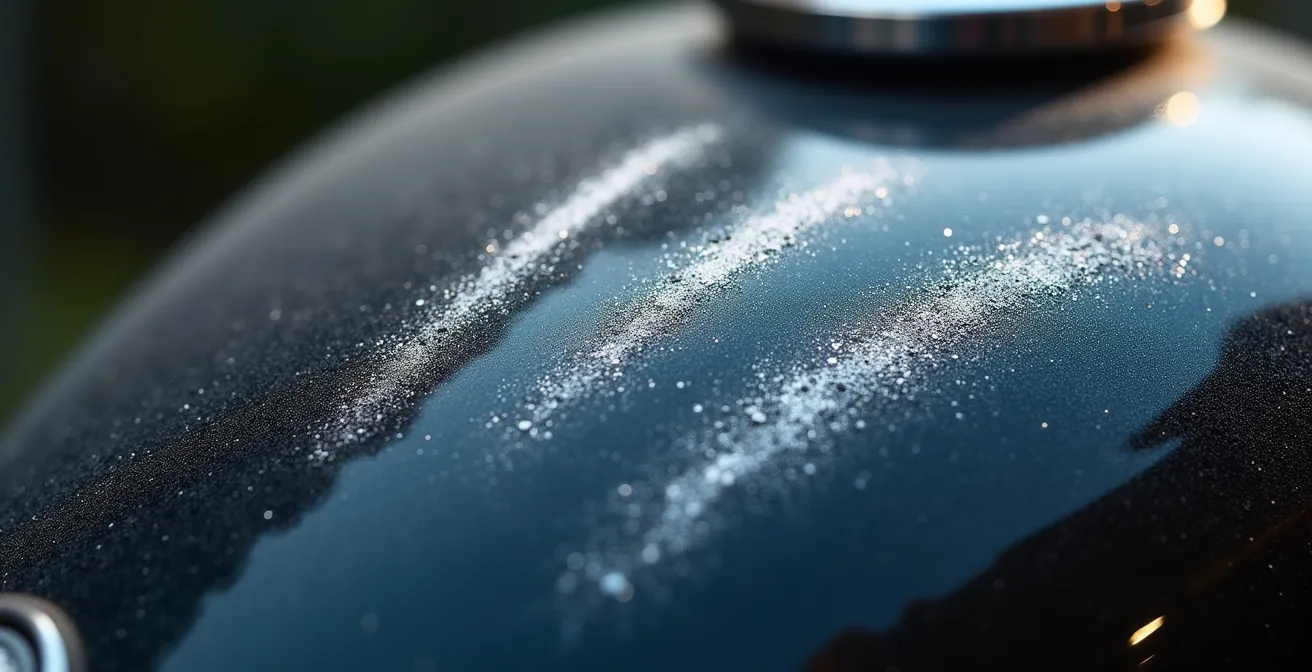
This is where vinyl wrap demonstrates its superior financial resilience. If a wrapped panel gets a deep scratch, the solution isn’t a complicated and suspicious repaint. You simply remove the damaged vinyl and re-wrap the single panel. The cost is predictable, the color match is perfect, and most importantly, the pristine factory paint underneath remains untouched and protected. This preserves the bike’s core value and avoids any awkward conversations with potential buyers about “repairs.”
The financial implications of repairing a painted surface versus a wrapped one are stark. A painted panel requires a significant investment to fix correctly, and any amateur attempt actively works against you at resale, as detailed by a comparative analysis of deep scratch repair costs.
| Repair Type | Paint Cost | Wrap Solution | Resale Impact |
|---|---|---|---|
| Minor Scratch (Buffable) | $75-$150 | Often self-heals or is invisible | Minimal |
| Touch-up Paint Blob | $150-$400 (for pro fix) | N/A – Panel is protected | Major red flag |
| Professional Panel Repaint | $500-$1,500 | Panel re-wrap $200-$400 | Raises accident concerns |
| Deep Scratch to Metal | $800+ per panel | Simple re-wrap | Significant value loss (if painted) |
Does Painting Your Bike Neon Yellow Actually Reduce Accident Risk?
High-visibility colors like neon yellow or bright orange are often promoted for their safety benefits. While a brighter bike may be more conspicuous, choosing such a polarizing color as a permanent paint job is a high-risk gamble for resale. The pool of potential buyers who want a neon motorcycle is exceptionally small. You are betting that you will find that one specific person who shares your exact taste, and you’ll likely have to offer a significant discount to attract them. This severely limits your Aesthetic Liquidity.
A custom paint job can, in some cases, add value, but only if it’s executed flawlessly and aligns with popular market tastes. A high-quality repaint in a classic, desirable color scheme might fetch a premium. However, a unique or eccentric color choice almost always results in a net loss. This is where a wrap truly shines. You can have your neon yellow for the years you own the bike, enjoying the style and potential visibility benefits. When it’s time to sell, you can have the wrap removed, revealing the perfectly preserved and universally appealing factory paint underneath. This gives you the best of both worlds: personalization during ownership and maximum market appeal at resale.
Case Study: Resale Impact of Custom Finishes on a Yamaha R6
Consider a five-year-old Yamaha R6 with original blue paint, which typically sells for around £5,500 in good condition. According to a resale value impact analysis, if that same bike has a professional custom paint job in a popular scheme (like a MotoGP replica), it might sell for up to £6,000. However, if it’s painted a niche color, the value could drop below the original £5,500. A bike with a high-quality wrap, on the other hand, would likely sell in the £5,500-£5,700 range. The wrap itself adds little direct value, but the fact that it protected the OEM paint is a major selling point that buyers are willing to pay a slight premium for.
Police Impersonation: Which Color Schemes Are Illegal for Civilians?
Beyond personal taste, certain color choices can land you in legal trouble. Most jurisdictions have laws against civilian vehicles mimicking the appearance of police or other emergency services. While painting your bike in a black-and-white scheme or using specific shades of blue might seem stylish, it could lead to hefty fines or even charges of impersonation. The problem is that these laws can be vague and vary dramatically from one state or country to another. A color scheme that is perfectly legal in one area might be prohibited just a few miles down the road.
Furthermore, international travel or even accessing a military base can become complicated. Certain patterns, like the “Battenburg” checkerboard design common in the UK and Commonwealth countries, are instantly associated with emergency vehicles and can cause issues abroad. A permanent paint job in a legally ambiguous color scheme is a fixed liability. You are locked into that risk. If laws change or you move to a new area, you could be forced into an expensive and complete repaint.
This is a scenario where the low reversibility cost of a wrap provides an invaluable safety net. If you discover your wrap is problematic, the fix is simple and quick. As reported by Full Throttle Wraps installation specialists, a full vinyl wrap removal can be completed in just a couple of days, restoring the bike to its original, legally compliant state. This flexibility protects you from unforeseen legal headaches and ensures you can easily sell the bike to a risk-averse buyer without any legal baggage attached.
Sanding and Priming: Why 90% of the Paint Job Quality Is in the Prep Work?
A stunning paint job is not about the final coat of color; it’s about the painstaking foundation laid beneath it. Professional painters know that up to 90% of the quality and longevity of their work comes from meticulous preparation. This involves completely disassembling the bike, stripping the old finish, sanding every surface through multiple grits to create a perfectly smooth and uniform texture, and applying layers of primer to ensure adhesion. This process is incredibly labor-intensive and is the primary driver of the high cost of a quality paint job.
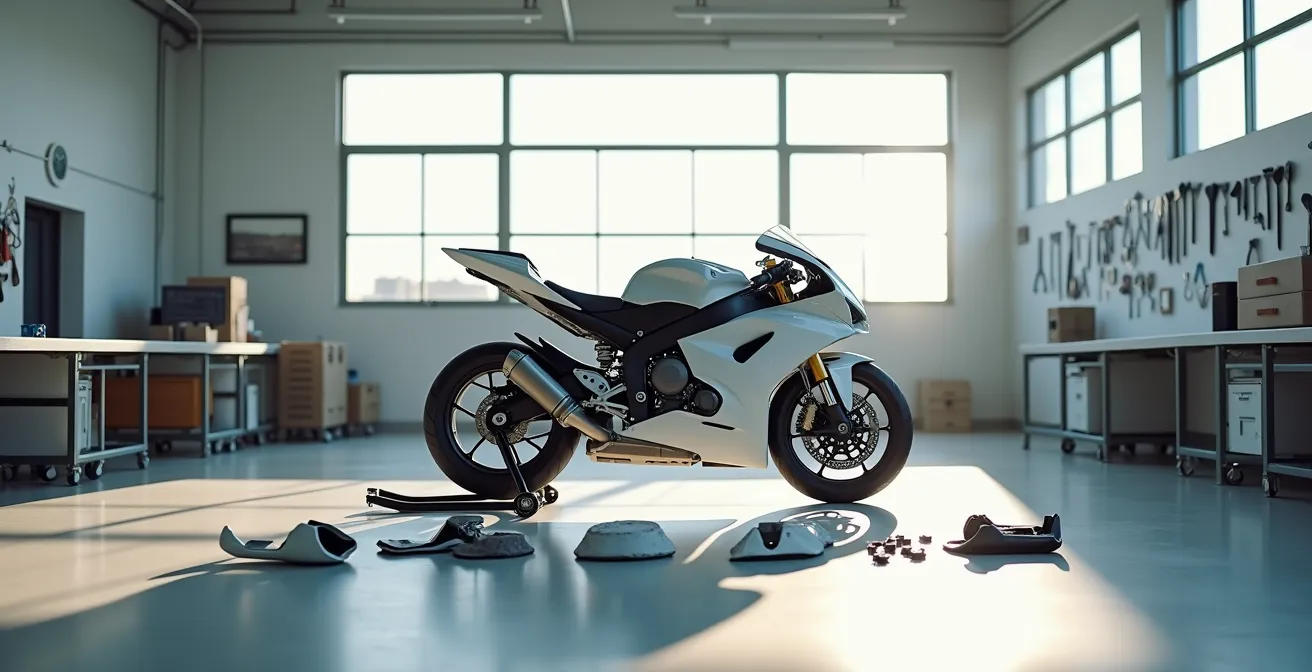
Any shortcuts in this phase will inevitably show in the final product. Poor sanding leads to visible scratches under the new paint, while inadequate priming can cause peeling and chipping down the line. From a resale perspective, these flaws are catastrophic. They tell a buyer that the job was done by an amateur, and the “custom paint” becomes a massive liability rather than an asset. In contrast, preparing a bike for a vinyl wrap is far simpler. The surface needs to be immaculately clean and smooth, but it doesn’t require the complete stripping and multi-stage sanding of a repaint. The bulk of the sunk cost in painting is in this non-recoverable prep labor.
Cost-Benefit Analysis: The Labor of Prep Work
An analysis by customization experts reveals the stark difference in preparation requirements. A professional paint job demands stripping, extensive multi-grit sanding, and priming, which can easily amount to 20-30 hours of skilled labor before any color is even applied. This prep work alone can cost between $500 and $1,000. In stark contrast, preparing a bike for a vinyl wrap requires only a perfectly clean, smooth surface, typically involving 4-6 hours of labor costing $100-$300. While a wrap won’t hide existing deep scratches (which must be filled first), the initial investment to get to a “ready” state is significantly lower, reducing the overall financial risk.
How to Add Wind Protection to Your Roadster Without Ruining Its Aesthetics?
The principle of preserving resale value extends beyond surface finishes to all modifications, including practical accessories like windscreens. A common dilemma for roadster or cruiser owners is the need for wind protection on long rides versus the desire to maintain the bike’s clean, classic lines. Bolting on a large, permanent windscreen can drastically alter the bike’s character and may not appeal to a future buyer who loves the original roadster look. Just like a polarizing paint color, a permanent windscreen shrinks your potential market.
The solution, once again, lies in reversibility. The best modification from a resale standpoint is one that can be easily removed, returning the bike to its desirable stock configuration. This applies to luggage racks, engine guards, and especially windscreens. Opting for a windscreen with a quick-release mounting system is the smartest financial move. It allows you to enjoy the comfort and protection when you need it, and in minutes, you can remove it to restore the bike’s intended aesthetic for city cruising or for showing it to a potential buyer.
The best windscreen from a resale perspective is one that’s not there. Quick-release mounting systems allow sellers to present the bike in its clean, original roadster form while offering the windscreen as a high-value, practical add-on.
– RevZilla Product Specialists, RevZilla Used Motorcycle Pricing Trends Report
When it comes time to sell, you can present the bike in its purest form, which holds the broadest appeal. The quick-release windscreen then becomes a separate negotiation point—a valuable, practical accessory that you can include to sweeten the deal or sell independently. This strategy of “modular” customization enhances the bike’s Aesthetic Liquidity by allowing it to be multiple things to multiple buyers.
Why Used OEM Fairings Fit Better Than New Chinese Aftermarket Kits?
When a fairing is damaged beyond repair, owners face a choice that significantly impacts resale value: replace it with a used Original Equipment Manufacturer (OEM) part, or opt for a cheap, new aftermarket kit, often from China. While the low price of aftermarket kits is tempting, it is almost always a disastrous choice for the bike’s value. These kits are notorious for their poor fitment. Mounting holes don’t line up, panels leave uneven gaps, and the plastic is often thinner and more brittle than the original.
To an experienced buyer, these flaws are immediately obvious and act as a giant perceptual red flag. Poorly fitting fairings scream “crashed bike repaired on the cheap.” It completely undermines a buyer’s confidence and will lead to a drastically lower offer, if they don’t walk away entirely. A used OEM fairing, even with minor cosmetic blemishes, will fit perfectly because it was made from the original factory molds. This preserves the bike’s structural integrity and clean lines.
This is where paint and wrap strategies intersect with hardware choices. Finding a used OEM panel in the correct factory color can be difficult and expensive—a new OEM pre-painted fender alone can cost over $900. A much better strategy is to find a used OEM panel in *any* color and then wrap it. A wrap can perfectly match the color of the rest of the bike, covering any cosmetic imperfections on the used part while ensuring the flawless fitment that only an OEM part can provide. This combination offers the best of both worlds: perfect fit and perfect finish, all while protecting the bike’s value.
| Fairing Type | Fit Quality | Paint Match Difficulty | Wrap Compatibility | Resale Impact |
|---|---|---|---|---|
| Used OEM | Perfect | Can be difficult/expensive | Excellent | Maintains value |
| New Aftermarket | Requires modifications | Very difficult | Stress points can cause lifting | Significant value loss |
| Repaired OEM | Good (if professional) | Moderate | Good with proper prep | Neutral if disclosed |
Key Takeaways
- Value Is in the Original: A wrap’s primary benefit is protecting the factory paint, which is the most valuable finish to the majority of buyers.
- Quality Over Material: A professional wrap is always better than an amateur paint job, and a professional paint job is better than a DIY wrap. Execution is everything.
- Reversibility Is Your Safety Net: A wrap allows you to experiment with bold or niche styles without taking a permanent financial hit, providing superior “Aesthetic Liquidity.”
Wet vs. Dry Application: How to Install Vinyl Decals Without Bubbles?
Ultimately, the entire value proposition of a vinyl wrap hinges on one thing: the quality of its installation. A poorly installed wrap with bubbles, lifted edges, or stretched-out patterns is just as detrimental to resale value as a bad paint job. It broadcasts an amateur job and suggests the owner cut corners. The debate between wet and dry application methods is central to this, but professional quality goes far beyond that single choice. It’s about meticulous surface prep, understanding the material’s properties, and crucial post-installation heat treatment.
Buyers can instantly spot a DIY wrap. Tiny bubbles indicate a failure to properly squeegee out air, a “silvering” effect shows trapped moisture from an improper wet application, and lifted edges reveal a lack of post-heating to set the adhesive. According to a detailed analysis by RAXTiFY, a professional installation that includes post-heating the vinyl to the manufacturer’s recommended temperature results in 90% better adhesion longevity. A professional wrap maintains its appearance for 5-7 years, effectively acting as a protective skin for the duration of ownership. A DIY attempt often shows signs of degradation, like peeling and fading, within just 1-2 years, making it a clear liability at resale.
Therefore, the final appraisal is clear. While a wrap is strategically superior to paint for preserving value due to its protective and reversible nature, this advantage is completely negated by poor execution. The choice is not simply “wrap vs. paint.” It is “professional job vs. amateur job.” Investing in a professional wrap installation is an investment in your bike’s future value. It ensures the finish is flawless, durable, and fully realizes the promise of Aesthetic Liquidity by being a desirable, protective feature rather than a glaring flaw.
Therefore, before committing to any aesthetic change, appraise your options not by their initial sticker price, but by their total return on investment at the point of resale. A calculated, professional choice today ensures maximum value and marketability for your motorcycle tomorrow.
Frequently Asked Questions on Wrap vs. Paint
What international color patterns should I avoid?
Certain combinations are universally associated with emergency services and should be avoided to prevent legal issues, especially during international travel. Key examples include the “Battenburg” blue-and-yellow or black-and-yellow checkerboard pattern used in the UK and Commonwealth countries, as well as specific red-and-white combinations used on police vehicles in Japan. Using these can create liability issues and may restrict access to sensitive areas like military bases.
How does wrap protect me from legal issues?
The primary legal protection offered by a wrap is its reversibility. If you discover that your chosen color scheme violates a local ordinance, or if laws change during your ownership, you can have the wrap removed quickly and affordably. This immediately returns the motorcycle to its original, compliant factory color, resolving the legal issue without the need for a costly and permanent repaint.