
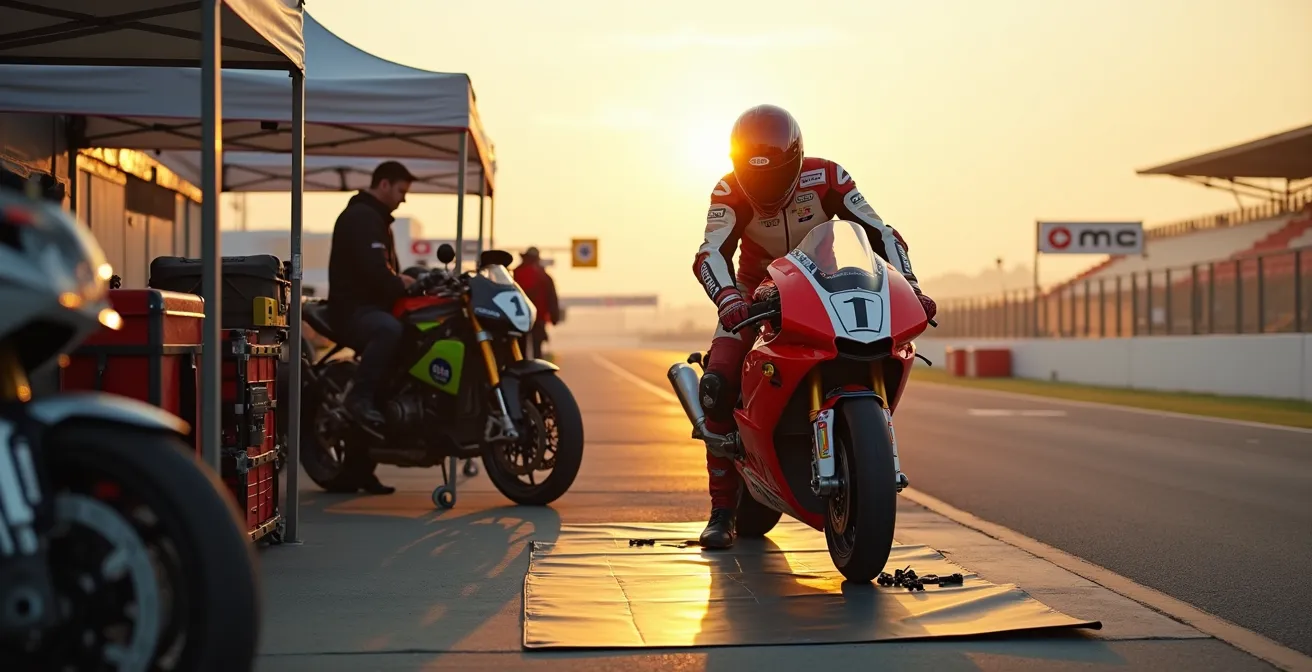
The key to a successful first track day isn’t being the fastest, but the best prepared—mentally and physically.
- Focus on being a predictable rider, not a competitive one.
- Manage your personal energy (hydration, focus) as carefully as your bike’s fuel.
- Trailering your bike is a non-negotiable safety measure against post-track fatigue.
Recommendation: Invest in a structured environment like a novice group or racing school to build a strong foundation for a safe and enjoyable experience.
Welcome! The fact that you’re reading this means you’ve felt the pull of the racetrack—a place of pure, uninterrupted riding bliss. But for many street riders, that excitement is mixed with a healthy dose of intimidation. You see images of racers with tire warmers and complex bike setups and think, “That’s not for me.” The common advice is to get the best gear and learn the track map, but this often misses the most critical point.
As a track day organizer, I can tell you a secret: your first day has nothing to do with speed. It’s not a race or a test. But what if the real key to a great first track day wasn’t in your toolbox or your engine, but in your head? The true goal is to build a foundation of safety, confidence, and control. It’s about shifting your mindset from street survival to circuit predictability. It’s about managing your own energy with the same precision you use for your motorcycle.
This guide is designed to reframe your approach. We’ll walk you through preparing your mind as much as your machine, transforming that feeling of intimidation into one of empowered readiness. We will cover the essentials of track etiquette, personal preparation, and the mental strategies that separate a stressful day from a transformative one. Let’s get you ready to have the most fun you’ve ever had on two wheels, safely and with confidence.
To help you navigate this new environment, this guide breaks down the most critical aspects of your preparation, from understanding the rules of the road to managing your own mental and physical state. Explore the sections below to build your confidence step by step.
Summary: Your First Motorcycle Track Day: A Welcoming Guide to Preparing Your Mind and Machine
- Flags and Passing Rules: How to Stay Safe and Predictable in the C-Group?
- Why You Need to Drink More Water Than Fuel During a Track Day?
- Riding to the Track vs Trailering: Why You Should Never Ride Your Bike Home?
- The Red Mist: How to Avoid Chasing Faster Riders and Crashing?
- Open Track Day vs Racing School: Which Is the Better Investment for Your First Time?
- What to Remove First: Mirrors, Lights, or Kickstand for Track Use?
- Why Tucking In Saves You More Fuel Than Any Engine Modification?
- Track Day Prep: How to Safety Wire Your Oil Drain Bolt Correctly?
Flags and Passing Rules: How to Stay Safe and Predictable in the C-Group?
On the street, your riding is defensive and reactive. On the track, the goal is to be offensive and, most importantly, predictable. The flags and passing rules aren’t just regulations; they are the language we use to communicate and ensure everyone’s safety. In the novice group (often called the C-Group), the rules are strictest for a reason: to create a low-pressure environment where you can focus on your lines and technique without worrying about someone making an aggressive pass. Your primary job is to hold your line and be smooth. Faster riders are responsible for making a safe pass around you.
Think of yourself not as a competitor, but as a fellow dancer on a shared floor. Your movements should be clear and consistent. This mindset is the single most important safety tool you have. Understanding the flags is non-negotiable, as they are your direct line of communication with the corner workers who are watching over you. Internalize their meanings before you even think about turning a wheel on track.
Here are the essential flags you must know:
- Green Flag: The session is live and the track is clear. You can ride at full speed, but always remain aware.
- Yellow Flag (Stationary): Caution, there is a hazard ahead off the racing line. Reduce your speed and do not pass until you are clear of the incident.
- Yellow Flag (Waving): Immediate danger on or near the racing line. Significantly reduce your speed, be prepared to stop, and absolutely no passing.
- Red Flag: The session is stopped immediately. Safely and gradually slow down, do not pass, and exit the track at the next available entrance to the paddock.
- Checkered Flag: The session is over. Complete one cool-down lap at a reduced pace without racing to the finish line, and exit the track smoothly.
- Black Flag (Pointed at you): There is an issue with you or your bike (a mechanical problem, or you’ve broken a rule). Acknowledge the flag, stay on your line, and safely exit the track on your next lap to see an official.
Embracing these rules allows you to build a solid foundation, ensuring your first experience is not just thrilling, but fundamentally safe.
Why You Need to Drink More Water Than Fuel During a Track Day?
Riding a motorcycle on a track is a surprisingly physical activity. Wrestling a 400-pound machine around corners while wearing full leathers under the sun is physically demanding. Many first-timers focus intently on their bike’s fuel level but completely neglect their own. This is a critical mistake. Your body’s fuel is water and electrolytes, and managing your personal energy and hydration is paramount to safety and performance. Dehydration leads to a loss of concentration, slower reaction times, and muscle cramps—all things that have no place on a racetrack.
The feeling of thirst is a lagging indicator; by the time you feel thirsty, your performance is already compromised. Even short 20-minute sessions require continuous hydration. The goal is to stay ahead of dehydration by drinking small amounts of water or an electrolyte drink after every single session, even if you don’t feel like it. Avoid energy drinks high in sugar and caffeine, which can lead to a crash in energy levels later in the day. Think of hydration as part of your mental toolkit; a well-hydrated brain is a focused brain.
To stay on top of your hydration, follow a structured plan:
- The Day Before: Pre-hydrate by drinking 3-4 liters of water throughout the day.
- Morning Of: Start with at least 500ml of water with a light breakfast. Avoid too much coffee, as it’s a diuretic.
- Between Sessions: This is the most crucial time. Drink 250-500ml of water or a sports drink after every session.
- Lunch: Have a light meal to avoid feeling sluggish and continue to drink fluids.
- Post-Track: Before you even think about packing up or driving home, drink at least another liter of water to combat the fatigue from the day.
Treating your body like the high-performance machine it is will ensure you have the mental and physical stamina to learn and enjoy the entire day.
Riding to the Track vs Trailering: Why You Should Never Ride Your Bike Home?
It’s the most common question from first-timers: “Can I just ride my bike to the track?” While technically possible, it’s one of the biggest gambles you can take. A track day is intensely draining, both physically and mentally. After five or six 20-minute sessions, your focus will be depleted, and your body will be tired. The ride home, often in traffic and fading light, becomes the most dangerous part of your day. You’re far more likely to make a simple, fatigue-induced mistake on the street after a track day than you are to crash on the track itself.
Furthermore, what happens if you have a minor tip-over? A broken lever or rearset could leave you stranded, turning a fantastic day into a logistical nightmare. Renting a small trailer or a pickup truck is a small investment in guaranteed peace of mind. As the experts at Damon Motorcycles note, this is a non-negotiable safety measure.
Track days are draining. Therefore, adding a long return journey at the end of your day only increases your chances of an accident.
– Damon Motorcycles Editorial Team, The Ultimate Guide to Your First Motorcycle Track Day
The cost is often less than you think; for instance, U-Haul rents motorcycle trailers for approximately $15 per day in many areas. This small price buys you the freedom to push yourself to your *personal* limit (not the bike’s), the security of knowing you have a guaranteed ride home, and a comfortable paddock space to relax and prepare between sessions.
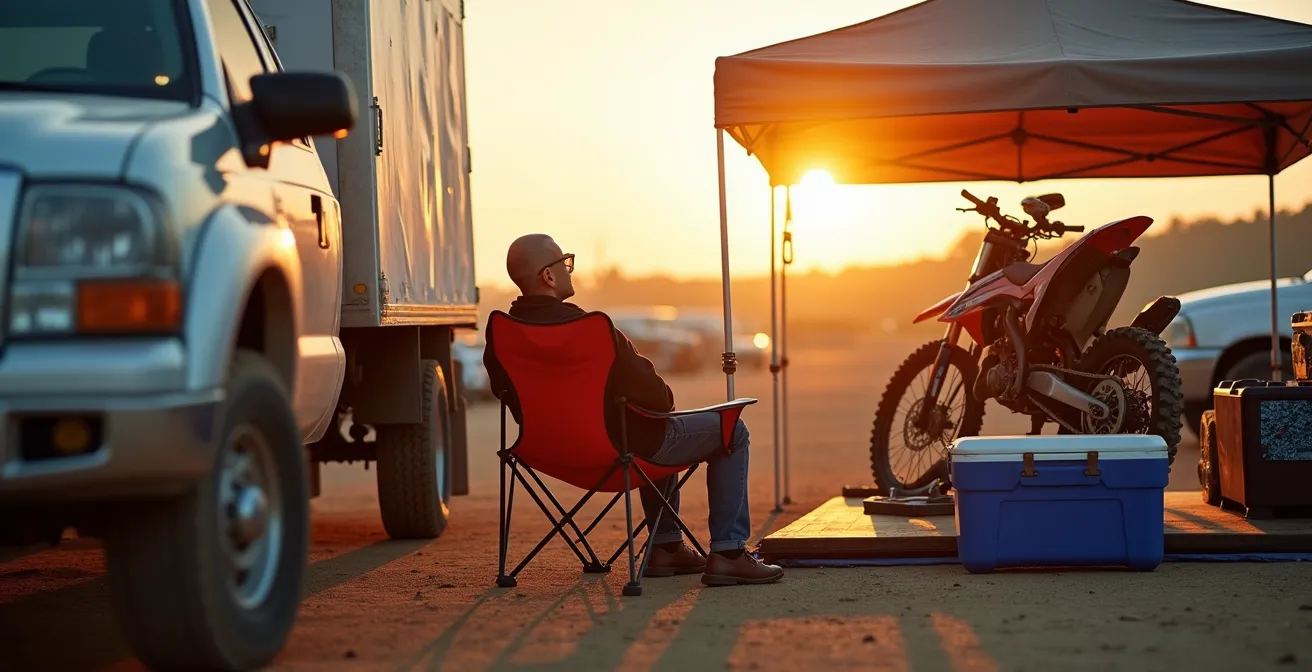
Visualizing this setup—a comfortable chair, a cooler with drinks, and your bike safely waiting—is the picture of a well-managed and stress-free day. It allows you to focus 100% on the riding experience.
Don’t let the last hour of your day ruin the first eight. Plan for your fatigue and give yourself the gift of a safe and relaxing journey home.
The Red Mist: How to Avoid Chasing Faster Riders and Crashing?
There’s a phenomenon well-known to track riders called the “Red Mist.” It’s that moment when someone on a similar bike passes you, and an instinctive, competitive urge takes over. You forget your plan, abandon your technique, and start chasing them, often riding beyond your ability. This is the single most common cause of crashes in the novice group. The goal of your first track day is not to be fast; it is to be smooth, learn the line, and build confidence. Chasing another rider is a direct path to failure on all three counts.
Accept this now: you *will* be passed. By faster riders, by slower riders on faster bikes, and maybe even by riders you think you should be faster than. It does not matter. Your journey is your own. Every lap is an opportunity to practice one small thing: hitting an apex, being smoother on the brakes, or improving your body position. Competing with others robs you of this learning opportunity.
As one beginner wisely reflected after their first day, true progress is about self-awareness, not speed: “I got so much track time that day that the phrase ‘know your limit’ finally makes sense. At the very last opportunity to ride, I confidently opted out. I’ll never forget removing myself from it because I’d had my fill.” This is the mindset of a successful learner.
Your Action Plan: Taming the Red Mist
- Recognize Your Triggers: Before you ride, identify what might make you competitive. Is it being passed by a certain type of bike? A specific rider? Knowing your triggers is the first step to managing them.
- Set a Pre-Session Intention: Before each session, declare one, single technical goal. For example, “In this session, I will only focus on looking through the turn” or “I will focus on smooth brake application.”
- Use an On-Track Reset: When you feel the pressure building after being passed, consciously take three deep breaths on the next straightaway. Verbally remind yourself of your intention for the session.
- Master the Cool-Down Protocol: Immediately after being passed, your focus should snap back to YOUR next braking marker or turn-in point, not the taillight of the rider ahead.
- Conduct a Post-Session Debrief: When you get back to the paddock, ask yourself, “What did I learn?” not “How many people did I pass?” or “How fast was I?”
Ride your own ride. The only person you are there to impress is the version of yourself that showed up in the morning, and the best way to do that is to leave safer and more skilled than when you arrived.
Open Track Day vs Racing School: Which Is the Better Investment for Your First Time?
As you plan your first venture onto the circuit, you’ll encounter two primary formats: an open track day and a dedicated racing school. While they might seem similar, they represent different philosophies of learning. Choosing the right one depends on your personal learning style and budget. This isn’t just a choice of activity; it’s a decision about your initial learning investment. An open track day is a fantastic environment for self-directed learning, where you get lots of track time to figure things out at your own pace, with some basic instruction and on-track coaches.
A racing school, on the other hand, is a highly structured curriculum. It involves more classroom time, a much lower instructor-to-student ratio, and a series of specific, progressive drills. It’s often more expensive but can accelerate your learning curve significantly by instilling fundamentals from day one. Organizations like Evolve GT have built their reputation on complete beginner programs that provide a controlled, educational environment to learn track etiquette and technique from the ground up.
There is no single “best” answer, only what is best for you. Consider this breakdown to make an informed decision:
| Factor | Open Track Day | Racing School |
|---|---|---|
| Cost | $150-300/day | $400-800/day |
| Structure | Self-directed with basic guidance | Formal curriculum with progression |
| Instructor Ratio | 10-15:1 typical | 3-5:1 typical |
| Bike Rental Available | Sometimes ($100-200 extra) | Often included |
| Classroom Time | 30-60 minutes | 2-3 hours |
| Best For | Riders who learn by doing | Riders who prefer structured learning |
This comparative analysis highlights the trade-offs. If you are confident in your ability to learn through repetition and observation, a novice group at a track day offers incredible value. If you thrive on clear instruction and want to ensure you’re building perfect habits from the start, a school is a worthwhile investment.
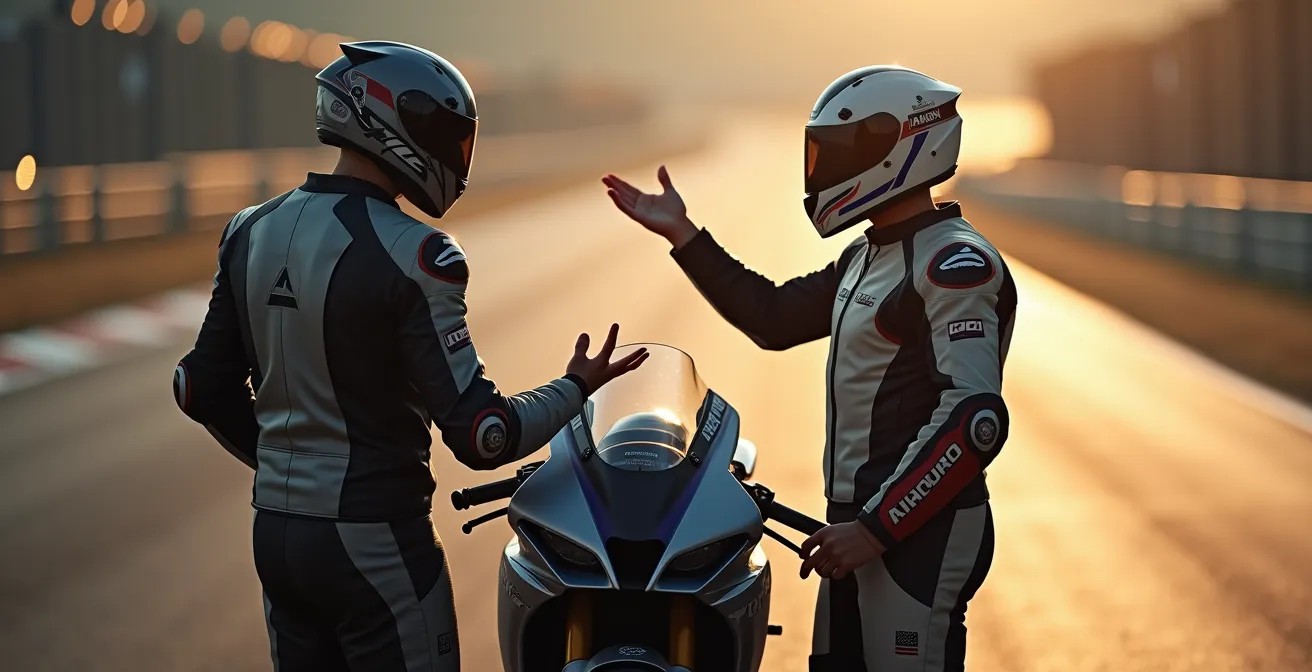
Ultimately, both paths lead to the same goal: becoming a safer, more confident rider. For the truly intimidated, a school provides a level of hand-holding that can make all the difference.
Either option is a fantastic step forward in your riding journey, offering a controlled environment to explore the limits of your bike and your skill.
What to Remove First: Mirrors, Lights, or Kickstand for Track Use?
Preparing your street bike for the track can seem daunting, but for a novice, the focus should be on a simple risk mitigation hierarchy. You are not trying to build a race bike; you are temporarily making your street bike safer for a closed-circuit environment. The priority is to remove or secure anything that could become a hazard to yourself or others. This means focusing on things that can shatter, fall off, or become a distraction.
The number one priority is taping up your lights and mirrors. Why? If you have a minor fall, broken glass and plastic on the track can cause major problems for other riders and lead to lengthy session delays for cleanup. Painter’s tape (the blue or green kind) is perfect for this as it holds well and comes off cleanly. Mirrors should be removed or taped over not just for debris risk, but to remove a major distraction. On the track, you should be looking forward to where you are going, not worrying about who is behind you. It is the responsibility of the passing rider to do so safely.
Follow this risk-based checklist for a stress-free tech inspection:
- Priority 1 (Debris Risk): Tape all lights (headlight, taillight, signals) and any other glass or plastic lenses. Use a high-quality painter’s tape like Frogtape to avoid leaving residue.
- Priority 2 (Distraction/Debris Risk): Remove mirrors completely if possible. If not, fold them in and tape them securely.
- Priority 3 (Projectile Risk): Remove your license plate or ensure it is fastened with more than just two bolts. Zip-ties can add extra security.
- Priority 4 (Ground Clearance/Safety): Zip-tie your kickstand in the “up” position. This prevents it from accidentally deploying and causing a crash.
- Priority 5 (Ground Clearance): If they are easily removable, take off your passenger pegs to gain a little extra lean angle.
- Bonus (Mental Focus): Tape over your speedometer. Your speed is irrelevant; your focus should be on technique, not numbers.
Finally, before you even start taping, check your consumables. Your tires and brakes are your most important safety equipment. Most track day organizations require at least 50% tread life remaining and brake pads with plenty of material. Fresh brake fluid is also a wise investment.
This methodical approach ensures your bike will pass tech inspection with ease and allows you to focus on the more important part: your riding.
Why Tucking In Saves You More Fuel Than Any Engine Modification?
Many new track riders are obsessed with horsepower and engine mods, believing that’s the key to speed. In reality, for a novice, your biggest source of drag isn’t the bike—it’s your body. At track speeds, your body acts like a giant parachute. Learning to get into a proper aerodynamic tuck on the straights does more than just save a little fuel or add 1-2 mph; its real benefit for a beginner is found in stability and energy management. When you are properly tucked in, you present a smaller profile to the wind, which makes the bike significantly more stable at high speeds. This reduces the physical effort required to hold on, saving precious energy for braking and cornering.
As one rider noted after their first track day, the surprising benefit of good body position wasn’t speed, but an overwhelming sense of composure: “The CBR was rock solid on Snetterton’s straight and never shook its head once.” This stability comes directly from reducing aerodynamic turbulence. It allows the chassis to work as designed, giving you more confidence and feedback from the motorcycle.
However, there’s a right way and a wrong way to tuck. A “passive” tuck, where you just lie on the tank with your weight on your arms, leads to tension and poor control. An “active” tuck engages your core and legs, leaving your arms relaxed and ready to give subtle inputs to the handlebars.
- Active Tuck Step 1: Squeeze the tank with your knees. This stabilizes your entire lower body and connects you to the bike.
- Active Tuck Step 2: Engage your core muscles (your abs and lower back) to support the weight of your upper body. Your arms should be free.
- Active Tuck Step 3: Keep your elbows bent and your grip on the handlebars light and relaxed. Your hands are for steering, not for holding you up.
- Active Tuck Step 4: Bring your chin down close to the tank and look far ahead through the top of your windscreen.
Mastering this position will make you feel more connected to the bike, reduce fatigue, and provide a massive boost in confidence when speeds increase.
Key Takeaways
- Your first track day is about learning and safety, not speed or competition.
- Mental and physical preparation (hydration, focus) are more critical than bike modifications.
- Being a predictable rider is the highest form of respect and the most important safety skill.
Track Day Prep: How to Safety Wire Your Oil Drain Bolt Correctly?
You may have seen race bikes with intricate networks of “safety wire” on various bolts and wondered if you need to do the same. This is a common point of anxiety for first-timers, so let’s clear it up: for your first track day in the novice group, you almost certainly do not need to safety wire anything. Safety wiring is a measure to prevent critical fasteners, like the oil drain bolt or oil filter, from vibrating loose and spilling oil on the track—an extremely dangerous situation.
However, this is a requirement for licensed racers and, in some cases, advanced-group track day riders. For beginners, organizers understand this is an intimidating and specialized skill. A recent check of popular organizers confirms that safety wiring is typically not required for novice groups at most organizations. Your focus should be on simpler, more effective safety checks. The single most important thing you can do is check the torque on these critical bolts with a torque wrench before you leave for the track.
Instead of wrestling with safety wire pliers, you can use a much simpler and highly effective technique called the “torque stripe.”
Alternative Safety Measures for First-Time Track Riders
After ensuring your oil drain bolt and filter are torqued to the manufacturer’s specification, use a paint marker or even nail polish to draw a straight line from the head of the bolt onto the engine case. Do the same for your oil filter, brake caliper bolts, and axle nuts. This creates a simple visual indicator. Between sessions, a quick glance is all you need to confirm that nothing has loosened. If the line is broken, a fastener is coming loose and needs immediate attention. This method provides 90% of the benefit of safety wire with 1% of the effort and is perfectly acceptable for novice riders.
Your time is better spent reviewing the track map and hydrating than stressing over advanced prep you don’t need yet. Focus on checking torque, using torque stripes, and you’ll be safer and more prepared than most. Now, get ready to have an amazing, worry-free day at the track!