
The ECE 22.06 sticker on a helmet signifies more than just a “stricter” standard; it represents a fundamentally more modern and data-driven philosophy of testing for real-world crash scenarios, particularly concerning rotational forces that cause brain injury.
- ECE 22.06 mandates testing for rotational impact and uses multiple impact speeds, reflecting a wider range of accident types than the US DOT standard.
- The standard treats the helmet as a complete system, rigorously testing visors, sun shields, and even official accessories for structural integrity and safety.
Recommendation: For US riders, prioritizing an ECE 22.06-certified helmet for your next purchase is the single most effective way to ensure you are wearing head protection tested against the most current understanding of motorcycle accident physics.
As a US rider, you’re familiar with the simple “DOT” sticker on the back of a helmet. It’s the seal of approval, the legal requirement for riding on public roads. But lately, another certification has been appearing on helmet store shelves and online listings: ECE 22.06. This European standard often comes with a higher price tag and claims of superior safety. The common wisdom is that “ECE is stricter,” but this simplification misses the crucial point. The difference isn’t just about passing a harder test; it’s about an entirely different approach to evaluating how a helmet manages the destructive energy of a crash.
While the DOT (Department of Transportation) FMVSS 218 standard provides a solid baseline for impact protection, it has remained largely unchanged for decades. ECE 22.06, in contrast, is the result of analyzing thousands of real-world accident data points. It goes beyond simple drop tests to address the complex, multi-stage forces involved in a crash, particularly the dangerous rotational acceleration that is a primary cause of concussion and severe brain trauma. Understanding this new standard isn’t about navigating bureaucracy; it’s about understanding the physics of brain protection.
This article will deconstruct the key technical differences that matter to you as a rider. We will move beyond marketing claims to examine the specific tests for impact absorption, fitment science, rotational force mitigation, and material degradation. By understanding *why* these new tests were implemented, you’ll be equipped to see a helmet not as a piece of mandatory equipment, but as a highly engineered, single-use safety system designed to save your life.
To fully grasp the technical advancements in modern helmet safety, this guide breaks down the critical components, from material science to the nuances of insurance claims. Explore the topics below to build a comprehensive understanding.
Summary: ECE 22.06 vs. DOT: A Rider’s Technical Safety Guide
- Why You Must Replace Your Helmet Every 5 Years Even If It Looks New?
- The “Chipmunk Cheeks” Test: How Tight Should a New Helmet Really Be?
- MIPS and Turbines: Do Rotational Impact Systems Actually Reduce Concussion Risk?
- Polycarbonate vs. Composite Shells: Which Absorbs Energy Better in a Crash?
- How to Tell If a Dropped Helmet Is Trash or Still Safe to Use?
- Does Painting Your Bike Neon Yellow Actually Reduce Accident Risk?
- Helmet and Leathers Coverage: Will Insurance Replace Your $800 Shoei After a Crash?
- CE Level 1 vs. Level 2: How to Cut Your Morning Commute Time by 20% in Heavy City Traffic?
Why You Must Replace Your Helmet Every 5 Years Even If It Looks New?
The five-year replacement rule is one of the most debated topics in motorcycling. It seems wasteful to discard a perfectly good-looking, unscratched helmet. However, this rule isn’t about aesthetics; it’s about the invisible degradation of the most critical component: the Expanded Polystyrene (EPS) foam liner. This is the material that actually absorbs and dissipates impact energy by crushing. Over time, this liner is compromised by a combination of factors. Glues and resins used in its construction can weaken, and daily exposure to sweat, hair oils, and atmospheric pollutants can slowly break down the foam’s structure. For polycarbonate shells, there’s the added factor of UV light slowly making the plastic more brittle.
However, the science isn’t as simple as a fixed expiration date. A groundbreaking 2015 study on bicycle helmet aging challenged the universal five-year rule. MEA Forensic’s extensive testing showed that even helmets over 20 years old showed little to no degradation in EPS energy absorption when stored properly and not subjected to impacts. This highlights that the primary factors are use and exposure, not just age. A helmet used daily for a 10,000-mile year will degrade far faster than one sitting in a climate-controlled closet. The five-year mark is a conservative, “safe-side” guideline from manufacturers who cannot control how their product is used or stored.
Ultimately, the decision to replace a helmet is a risk assessment. You are betting the replacement cost against the catastrophic cost of liner failure in a crash. Given that the liner’s integrity is invisible from the outside, sticking to the manufacturer’s recommended lifespan is the most prudent course of action for any active rider.
Your 5-Point Helmet Integrity Audit
- Check the Clock: Locate the manufacture date sticker, usually under the comfort liner. The countdown starts from this date, not the day you bought it.
- Inspect for Environmental Damage: Look for signs of UV degradation on the shell, like faded paint, chalky texture, or yellowing on clear coats. Check the chin strap for any fraying, tears, or loose stitching at the anchor points.
- Test the Liner Bond: Gently press around the inside of the EPS liner. It should feel firmly bonded to the outer shell with no give or creaking sounds, which could indicate a delamination of the adhesive.
- Evaluate the Fit: Notice if the helmet has become looser over time. The comfort padding compresses with use, which can create a dangerously loose fit that compromises safety in a crash.
- Compare the Standards: Check the safety sticker on the back. If your helmet is certified to an older standard like ECE 22.05, replacing it with an ECE 22.06 model is a significant safety upgrade, regardless of its age.
The “Chipmunk Cheeks” Test: How Tight Should a New Helmet Really Be?
Finding the correct helmet fit is the most critical safety check a rider can perform. A helmet that is too loose is arguably more dangerous than wearing no helmet at all. In an impact, a loose helmet can shift or even fly off before it has a chance to do its job. More insidiously, a small gap between your head and the liner allows for a “running start” during a rotational impact, dramatically increasing the acceleration forces exerted on the brain. The goal is a fit that is uniformly snug, with no specific pressure points or “hot spots.”
This is where the famous “chipmunk cheeks” test comes in. When you put on a new, correctly sized helmet, the cheek pads should be tight enough to noticeably compress your cheeks, pushing them inward. It might feel slightly uncomfortable at first, but this is by design. The comfort liner and cheek pads are designed to break in and conform to your face shape over the first 15-20 hours of riding, eventually relaxing into a perfectly snug fit. If a new helmet feels perfectly comfortable in the store, it will be far too loose after a month of use.
To test the fit, fasten the chin strap and try to rotate the helmet side-to-side and front-to-back. The helmet and your skin should move as one unit. If the helmet slides independently across your skin, it is too loose. Wear the helmet in the store for at least 15 minutes to see if any painful pressure points develop, particularly on the forehead, which can indicate the wrong head shape (e.g., a round helmet on an oval head).

As the image demonstrates, this visible compression is the hallmark of a secure fit. It ensures the helmet will stay perfectly positioned during the violent and chaotic forces of a crash, allowing the EPS liner to manage impact energy exactly as the engineers intended. A systematic check is the best way to confirm this.
This table breaks down the key fitment checks, providing clear indicators for assessing whether a helmet is too loose, too tight, or just right, based on guidelines from expert fitment analysis.
| Fit Check Point | Too Loose | Correct Fit | Too Tight |
|---|---|---|---|
| Cheek Pads | Can chew freely | ‘Chipmunk cheeks’ | Painful pressure |
| Forehead | Finger fits easily | Uniform pressure | Red marks after 15min |
| Crown | Helmet rocks | Snug contact | Pressure headache |
| Rotation Test | Skin doesn’t move | Skin moves with helmet | Can’t rotate at all |
MIPS and Turbines: Do Rotational Impact Systems Actually Reduce Concussion Risk?
For decades, helmet testing focused almost exclusively on linear impacts—direct, perpendicular hits against a flat or curved surface. This produced helmets that were very good at preventing skull fractures. However, modern accident analysis has shown that nearly every motorcycle crash involves an angled impact, which generates rotational acceleration. This violent twisting motion of the head is a primary cause of concussions and traumatic brain injuries (TBI). To combat this, technologies like MIPS (Multi-directional Impact Protection System) and 360° Turbine Technology were developed.
These systems work on a simple principle: they introduce a low-friction layer between the helmet’s comfort liner and the EPS foam. During an angled impact, this layer allows the helmet’s outer shell to rotate a few millimeters independently of the rider’s head. This small amount of slip is just enough to redirect and reduce the dangerous rotational forces before they are transmitted to the brain. While it seems minor, lab studies and real-world testing support that rotational impact protection systems can meaningfully reduce the risk of certain brain injuries. This is a key reason why ECE 22.06 broke new ground by becoming the first major government standard to mandate testing for it.
The standard is performance-based, not prescriptive. It sets a threshold for how much rotational force can be transmitted to a headform during a test but doesn’t require a specific technology to achieve it. This crucial distinction comes directly from regulatory experts.
ECE 22.06 mandates testing for rotational impact performance, but it does not mandate a specific technology like MIPS.
– FEMA (Federation of European Motorcyclists’ Associations), ECE 22.06 Standard Implementation Guidelines
This approach drives innovation, allowing manufacturers to develop their own proprietary solutions to meet or exceed the standard. For a rider, the presence of a system like MIPS, Leatt’s Turbines, or Shoei’s “Motion Energy Distribution System” in an ECE 22.06 helmet is an assurance that the helmet has been specifically designed and proven to address the physics of angled impacts.
Polycarbonate vs. Composite Shells: Which Absorbs Energy Better in a Crash?
The outer shell of a helmet has two primary jobs: to prevent sharp objects from penetrating through to your skull and to spread the force of an impact over the widest possible area of the EPS liner. The material used to construct this shell has a significant effect on its weight, durability, and how it performs in a crash. The two main categories are polycarbonate (a type of thermoplastic) and composite (layers of woven material like fiberglass, carbon fiber, or aramid set in resin).
Polycarbonate shells are formed by injecting molten plastic into a mold. This process is inexpensive and produces a tough, resilient shell. Polycarbonate’s strength lies in its flexibility; it tends to flex and deform to absorb impact energy. However, this material is heavier than composites and is more susceptible to degradation over time. A key vulnerability is that polycarbonate will degrade from the effect of photo-oxidative degradation caused by prolonged UV exposure, which is why polycarbonate helmets typically have a shorter recommended lifespan of 3-5 years.
Composite shells, on the other hand, are constructed by hand-laying woven fabrics (like fiberglass or carbon fiber) into a mold and infusing them with resin. This labor-intensive process results in a much lighter and more rigid shell. Instead of flexing, a composite shell is designed to crush and delaminate upon impact, actively dissipating energy through its own destruction. Carbon fiber is the pinnacle of this technology, offering the highest strength-to-weight ratio, but at a significant cost. Ultimately, both material types can be engineered to pass the rigorous ECE 22.06 tests, but they manage energy in fundamentally different ways.
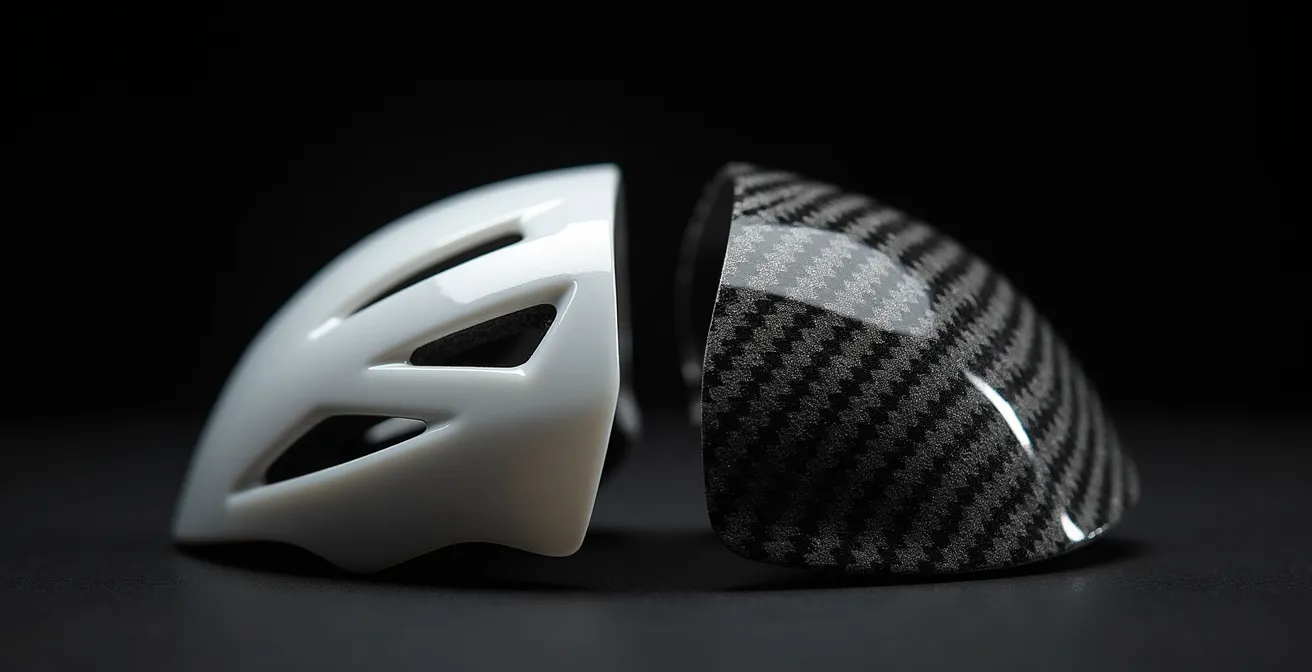
The choice between them often comes down to a trade-off between cost, weight, and long-term durability. While a premium carbon fiber helmet offers superior weight savings, a well-engineered polycarbonate helmet can provide an equivalent level of ECE 22.06-certified impact protection for a fraction of the price.
The following table, based on general material properties, outlines the key differences a rider should consider when choosing their next helmet, particularly in the context of long-term ownership and ECE 22.06 compliance.
| Material | Weight | Durability | UV Resistance | Price Range | Typical Lifespan |
|---|---|---|---|---|---|
| Polycarbonate | Heavy | Good | 3-5 years | $100-300 | 3-5 years |
| Fiberglass | Medium | Very Good | 5-7 years | $300-600 | 5-7 years |
| Carbon Fiber | Light | Excellent | 7+ years | $600+ | 7+ years |
How to Tell If a Dropped Helmet Is Trash or Still Safe to Use?
Every rider has experienced it: the sickening clatter of their expensive helmet falling off a seat or mirror and hitting the pavement. The immediate question is always, “Is it still safe?” The frustrating answer is: it depends. A helmet is a single-use safety device. The EPS liner is designed to crush permanently to absorb one significant impact. It does not “bounce back.” The problem is that this critical damage can be completely invisible from the outside, hidden beneath an unscratched shell.
The outcome of a drop depends on a few key variables: the drop height, the impact surface, and whether the helmet was empty. A helmet falling from a handlebar onto grass is unlikely to sustain structural damage. However, that same helmet falling from head height onto concrete is a much more serious event. The hard, unforgiving surface means very little energy is absorbed by the ground, concentrating the full force of the drop on the helmet’s structure. If the helmet had something heavy inside, like a disc lock or a bottle of water, the added inertia can easily be enough to compress the EPS liner, rendering it useless in that spot for a future crash.
Inspecting a dropped helmet requires careful detective work. Remove the comfort liner and cheek pads completely. Using a bright light, meticulously examine the entire surface of the white or gray EPS foam. Look for any cracks, hairline fractures, or, most commonly, compression marks—dents or flat spots where the foam has been crushed. Pay special attention to the area that hit the ground. If you find any deformation whatsoever, the helmet’s integrity is compromised. It has done its job once, and it must be retired. When in doubt, always err on the side of caution. The cost of a new helmet is insignificant compared to the cost of a brain injury.
Does Painting Your Bike Neon Yellow Actually Reduce Accident Risk?
The premise of painting a motorcycle a high-visibility color to reduce accidents is rooted in the principle of conspicuity—simply being seen by other drivers. While a brightly colored bike certainly doesn’t hurt, modern safety research indicates that focusing on the rider’s gear is a far more effective strategy. The highest points on the moving vehicle—the rider’s helmet and shoulders—are the most effective places for bright, contrasting colors. White, fluorescent yellow, and orange helmets have been shown to be the most conspicuous in daytime traffic.
The ECE 22.06 standard takes this concept of visibility and system safety even further. While it doesn’t mandate helmet color, it imposes incredibly strict requirements on the components that affect a rider’s own vision and their ability to be seen. A key part of the new standard is visor integrity. A visor on an ECE 22.06 helmet is not just a piece of plastic; it’s a structural component. According to the regulations, the visor must not burst after the impact of a steel test bullet shot at over 130 mph (60 m/s). It’s also tested for optical quality, scratch resistance, and distortion.
Furthermore, any accessory sold with the helmet, such as an internal sun visor or an external peak, must be tested along with the helmet. This ensures that these accessories do not compromise the helmet’s structural integrity or create a hazard in a crash. The standard also includes testing for reflective elements to enhance nighttime visibility. This holistic approach ensures that every part of the helmet system, from its impact absorption to its optical clarity and conspicuity features, works together to maximize rider safety in a way that simply painting a fender neon yellow cannot.
Helmet and Leathers Coverage: Will Insurance Replace Your $800 Shoei After a Crash?
After a crash, your first priority is your health. But soon after, financial concerns arise, including the cost of replacing damaged gear. Many riders assume their expensive helmet and leathers are covered under their motorcycle insurance policy, but the reality is more complex. Most standard policies cover damage to the motorcycle itself, but coverage for safety apparel—known as “Custom Parts and Equipment” (CPE) or “Accessory” coverage—is often an optional add-on that you must specifically select and pay for.
Without this specific coverage, an insurer may deny a claim for your $800 Shoei or $1200 jacket, arguing they are personal belongings, not part of the vehicle. To successfully claim for your gear, you must treat the process with the same diligence as a personal injury claim. Documentation is everything. If it is safe to do so, photograph your gear at the crash scene. Take detailed photos of all damage before cleaning anything. Crucially, do not discard the damaged helmet. The insurer has the right to inspect it. You should also obtain an official statement from the helmet manufacturer confirming their policy that any helmet involved in an impact must be replaced.
When filing the claim, frame the helmet not as a luxury accessory but as a critical, single-use piece of medical safety equipment, destroyed in the act of preventing serious injury. Highlighting its ECE 22.06 certification can bolster this argument. The immense rigor of this standard is quantifiable; for a premium helmet with three shell sizes, manufacturers may have to destroy 135 helmets during the certification process before a single one is sold. This level of investment underscores its value as essential safety equipment, not a fashion item, which can be a powerful point in your negotiation with the insurance adjuster.
Key Takeaways
- Impact Philosophy: ECE 22.06’s primary advantage is its use of modern accident data to test for a wider range of impact scenarios, including low-speed, high-speed, and critical rotational impacts.
- System-Wide Testing: Unlike DOT, which primarily focuses on the shell and liner, ECE 22.06 treats the helmet as a complete system, rigorously testing visors, chin bars, and even official accessories for safety.
- Performance over Prescription: The standard mandates a specific level of performance (e.g., limiting rotational force) but allows manufacturers to innovate their own technologies (like MIPS or proprietary liners) to meet that goal.
CE Level 1 vs. Level 2: How to Cut Your Morning Commute Time by 20% in Heavy City Traffic?
The title’s promise of cutting commute time is a tempting but dangerous premise. The goal for any rider, especially in heavy city traffic, should never be to cut time, but to maximize safety and arrive at their destination unharmed. A smarter way to think about efficiency on a commute is to optimize your safety system for your specific environment. This is where understanding the difference between CE Level 1 and CE Level 2 armor becomes critical, a concept that runs parallel to the evolution in helmet standards.
CE-rated armor, found in jackets, pants, and standalone protectors, is tested for its ability to reduce the amount of force transmitted from an impact. The key difference is the amount of force allowed through: Level 1 armor allows a maximum of 18 kilonewtons (kN) of force, while the more protective Level 2 armor allows only 9 kN. In exchange for this doubled protective capability, Level 2 armor is typically thicker, stiffer, and less breathable. This creates a clear choice for the commuting rider: thin, flexible Level 1 armor is often sufficient and more comfortable for low-speed urban environments, while Level 2 is the unequivocal choice for highway speeds where impact energies are far greater.
This data-driven evolution from a basic standard to a more protective one mirrors the leap from older helmet standards to ECE 22.06. Just as Level 2 armor addresses higher impact forces, ECE 22.06 addresses a wider range of impact velocities and the critical rotational forces that older standards ignore. Choosing the right gear is not about enabling speed; it’s about intelligently mitigating the specific risks you face. For a city commuter, that means accepting the realities of traffic and investing in gear, like a well-fitted ECE 22.06 helmet and appropriate CE-rated armor, that provides the best possible protection for that environment.
The progression in protective standards for body armor offers a direct analogy to the advancements in helmet safety, highlighting a move towards mitigating higher forces for improved rider outcomes, as this comparative table shows.
| Protection Level | Impact Force Transmitted | Thickness | Best For | ECE 22.06 Parallel |
|---|---|---|---|---|
| CE Level 1 | Max 18kN | Thin/Flexible | Urban commuting | Like lighter city helmets |
| CE Level 2 | Max 9kN | Thicker/Stiffer | Highway/Track | Like track-spec helmets |
| Airbag Systems | Electronic activation | Minimal when inactive | All riding | Next evolution like 22.06 |
Ultimately, your safety on the road is a direct result of the choices you make before you even start the engine. Understanding the technical data behind your gear allows you to make an informed investment in your own well-being. For your next helmet purchase, look beyond the price tag and the paint job, and seek out the ECE 22.06 certification sticker as your primary indicator of modern, comprehensive, and data-proven protection.