
The anxiety over degrading your expensive electric motorcycle battery is valid, but the solution goes far beyond generic advice. True longevity doesn’t come from just following the “20-80%” rule, but from understanding the engineering principles behind it. This guide treats your battery as a complete system, revealing how minimizing electrochemical stress—influenced by everything from your charging plug and riding habits to your tire pressure—is the genuine key to achieving a decade of reliable performance.
The silent surge of an electric motorcycle is a unique thrill, but for many new owners, it’s accompanied by a quiet, persistent anxiety: the health of the battery. This single component, often costing thousands of dollars, is the heart of your machine, and the fear of premature degradation is a significant concern. You’ve likely heard the common wisdom—avoid extreme temperatures, don’t drain the battery completely, and, most famously, keep the charge between 20% and 80%. These are not wrong, but they are incomplete.
Treating these tips as a simple checklist misses the bigger picture. A battery’s lifespan isn’t governed by a few rules, but by the complex laws of physics and chemistry. True preservation involves thinking like a battery engineer. It requires understanding concepts like State of Charge (SoC), charge and discharge speeds (C-rates), and the subtle, cumulative stress that every ride and every charge cycle places on the cells. Your battery’s health is a holistic system, directly influenced by your riding style, the efficiency of your final drive, and even your choice of tires.
This guide moves beyond the “what” and dives deep into the “why.” We won’t just repeat the 20-80 rule; we’ll explain the electrochemical reasons it works. You will learn to see your battery not as a simple fuel tank to be filled and emptied, but as a dynamic system you can actively manage. By understanding the forces that degrade it, you gain the power to counteract them.
To provide a complete, system-level understanding, we will explore the entire ecosystem of battery health. We’ll start by looking at the future of solid-state technology and the critical importance of fire safety. Then, we will define what “end-of-life” truly means for a battery, how to assess the health of a used EV, and how seemingly unrelated factors like handling dynamics, drivetrain maintenance, and charging connectors all play a crucial role in reaching that 10-year goal.
Summary: Lithium-Ion Longevity: A Systems Approach to a 10-Year Battery Life
- Solid State Batteries: Will They Really Double Range and Cut Weight?
- Fire Safety: Is It Safe to Charge Your Electric Bike Inside Your Apartment?
- Second Life: What Happens to Your Motorcycle Battery When It Can’t Ride Anymore?
- Buying a Used EV: How to Test the Battery Health Before Handing Over Cash?
- Center of Gravity: How Does a 200lb Battery Change Handling Compared to a Gas Tank?
- Chain, Belt, or Shaft: Which Final Drive System Fits Your Riding Style?
- Rubber Waste: Why Motorcycle Tires Are Harder to Recycle Than Car Tires?
- Type 2 vs CCS vs J1772: Which Plug Does Your Motorcycle Actually Need?
Solid State Batteries: Will They Really Double Range and Cut Weight?
Before diving into the specifics of today’s lithium-ion (Li-ion) care, it’s important to understand the technological horizon. Solid-state batteries represent the next frontier, promising to solve many of the inherent limitations of current liquid-electrolyte batteries. The core innovation is replacing the flammable liquid electrolyte with a solid material, which fundamentally changes the battery’s characteristics. This isn’t just an incremental improvement; it’s a paradigm shift in energy storage that manufacturers are actively pursuing.
The primary benefits are compelling. Claims of energy density reaching 400 watt-hours per kilogram suggest batteries could be significantly lighter for the same range, or offer double the range for the same weight. Verge Motorcycles, for instance, announced a future model targeting a 370-mile range. Furthermore, the absence of a liquid electrolyte makes solid-state cells inherently safer, virtually eliminating the risk of thermal runaway that causes battery fires. They also boast superior stability across a wider temperature range, from -22°F to 212°F, and a theoretical cycle life of up to 100,000 cycles—an order of magnitude greater than today’s best Li-ion cells.
However, this technology is still in its nascent stages for mass production. While the promise is enormous, the reality for current EV owners is that we must master the care of the Li-ion batteries we have today. The principles of managing electrochemical stress, heat, and voltage in current-generation batteries will remain relevant for years. Understanding these fundamentals now is the best preparation for the technology of tomorrow.
Fire Safety: Is It Safe to Charge Your Electric Bike Inside Your Apartment?
Charging an electric motorcycle indoors, especially in a multi-family dwelling, raises valid safety concerns. The risk of fire, while statistically low for OEM batteries, is a catastrophic event that demands a proactive, engineering-based approach to safety. The root cause of most Li-ion battery fires is thermal runaway, a chain reaction where an increase in temperature causes a further increase, often initiated by an internal short circuit, overcharging, or physical damage. Therefore, safe indoor charging is not a matter of chance, but of diligent risk mitigation.
A high-quality Battery Management System (BMS) is your first and most critical line of defense. Research confirms that fires are most common in batteries with inadequate or non-existent BMS. A sophisticated BMS monitors the voltage and temperature of individual cell groups. If it detects a localized hot spot or a cell group’s voltage rising too quickly (a sign of overcharging), it can shut down the charging process entirely. This is why using only the manufacturer-provided battery and charger is paramount; they are designed to work together as a safe, certified system. Is it okay to leave it plugged in? Only if the BMS and charger are high-quality and designed to stop charging at 100%; however, for battery health, this is not recommended.
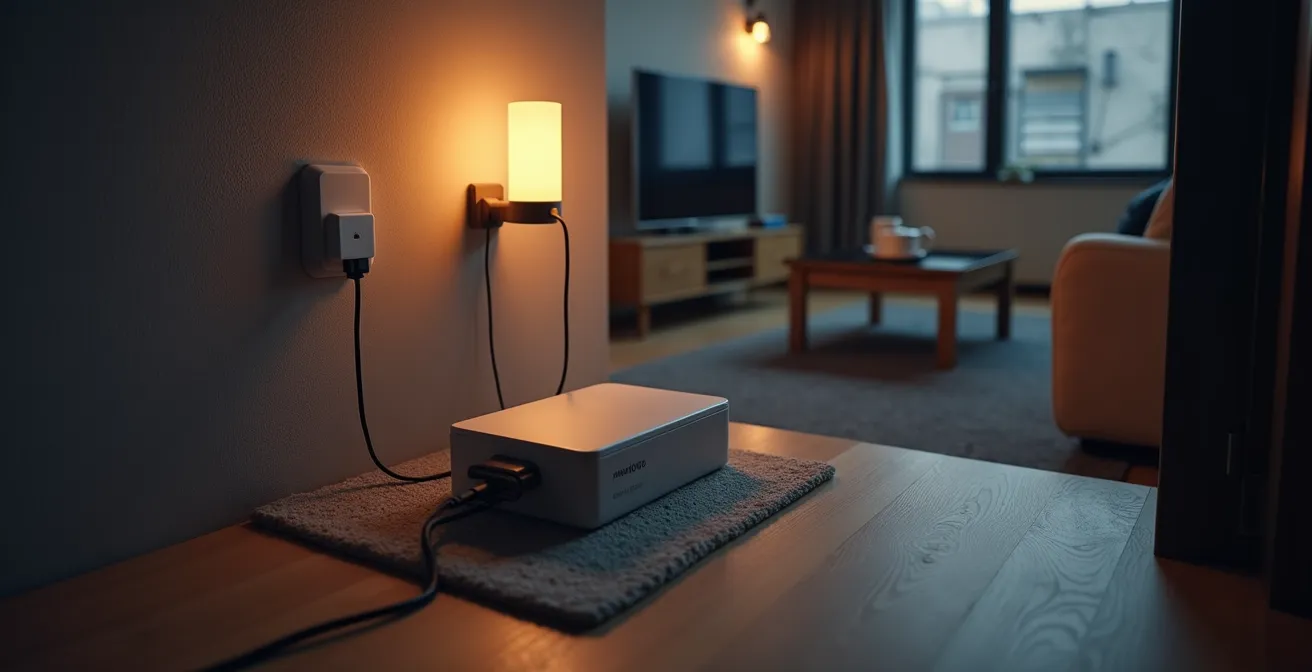
Beyond the BMS, your charging environment plays a vital role. Never charge a battery on a flammable surface like a rug, wooden floor, or near curtains. A concrete floor in a garage is ideal, but for an apartment, a non-flammable surface like a large ceramic tile or a specialized fireproof mat is a wise investment. The goal is to create a charging station clear of any combustible materials.
Your Action Plan: The Smart Charging Safety Toolkit
- Use a UL-certified smart plug to schedule charging and automatically cut power when the battery reaches its target SoC (e.g., 80%).
- Always charge on a hard, flat, and non-flammable surface such as concrete or a metal platform; actively avoid wood floors or carpets.
- If storing the battery for an extended period, keep it at room temperature (around 59°F is optimal) with a 40-50% charge.
- Monitor the battery’s temperature during charging. If it becomes noticeably hot to the touch, unplug it immediately to let it cool down.
- Perform a monthly “health check” charge in a safe, monitored environment where you can observe the battery’s behavior.
Second Life: What Happens to Your Motorcycle Battery When It Can’t Ride Anymore?
The term “dead battery” is a misnomer in the EV world. A motorcycle battery isn’t disposed of the moment it can no longer deliver peak performance. Its life is divided into two distinct phases: a first life as a motive power source and a potential “second life” in a less demanding role. The transition point is generally defined by its State of Health (SoH), which is a measure of its current capacity relative to its original capacity. For high-performance vehicles, this threshold is often set around 70-80% SoH.
At this stage, the battery can no longer provide the required range or acceleration for a motorcycle, primarily due to increased internal resistance and reduced capacity. However, it is far from useless. As one analysis highlights, a battery at 70% SoH is considered ‘dead’ for performance motorcycles but is perfectly viable for stationary energy storage. These second-life applications include home energy systems to store solar power, backup power supplies for grid outages, or load-balancing for commercial buildings. In these roles, the lower energy density and power output are not critical limitations.
The economic and environmental implications are significant. Repurposing batteries extends their usable lifespan, delaying the need for resource-intensive recycling and reducing the overall environmental footprint of the EV industry. A UK study on used Nissan Leaf batteries, for example, found them to be one of the most affordable forms of home energy storage, showcasing the viability of this model. Understanding that your battery has a future beyond the motorcycle reframes the goal of preservation: you are not just maintaining your vehicle’s performance, but also preserving the asset’s value for its next chapter.
Buying a Used EV: How to Test the Battery Health Before Handing Over Cash?
Purchasing a used electric motorcycle requires a different inspection mindset than buying a gasoline-powered bike. While you still check the frame, suspension, and brakes, the most crucial—and most expensive—component to evaluate is the battery. A battery that has been abused through improper charging or stored incorrectly can have a significantly reduced State of Health (SoH), which directly translates to less range and a shorter remaining lifespan. Assessing this is paramount before any money changes hands.
The most reliable method is a diagnostic test. Many dealers and specialized shops have equipment that can interface with the bike’s BMS to read the SoH directly. This provides a clear percentage of remaining capacity. If a professional test isn’t possible, a practical “full-to-empty” test is the next best thing. Ask the owner to charge the bike to 100%, note the bike’s estimated range, and then perform an extended test ride on a consistent route. Compare the actual miles covered to the initial estimate and the manufacturer’s original claimed range. A significant discrepancy (e.g., getting only 50 miles on a bike that was originally rated for 100) is a major red flag.
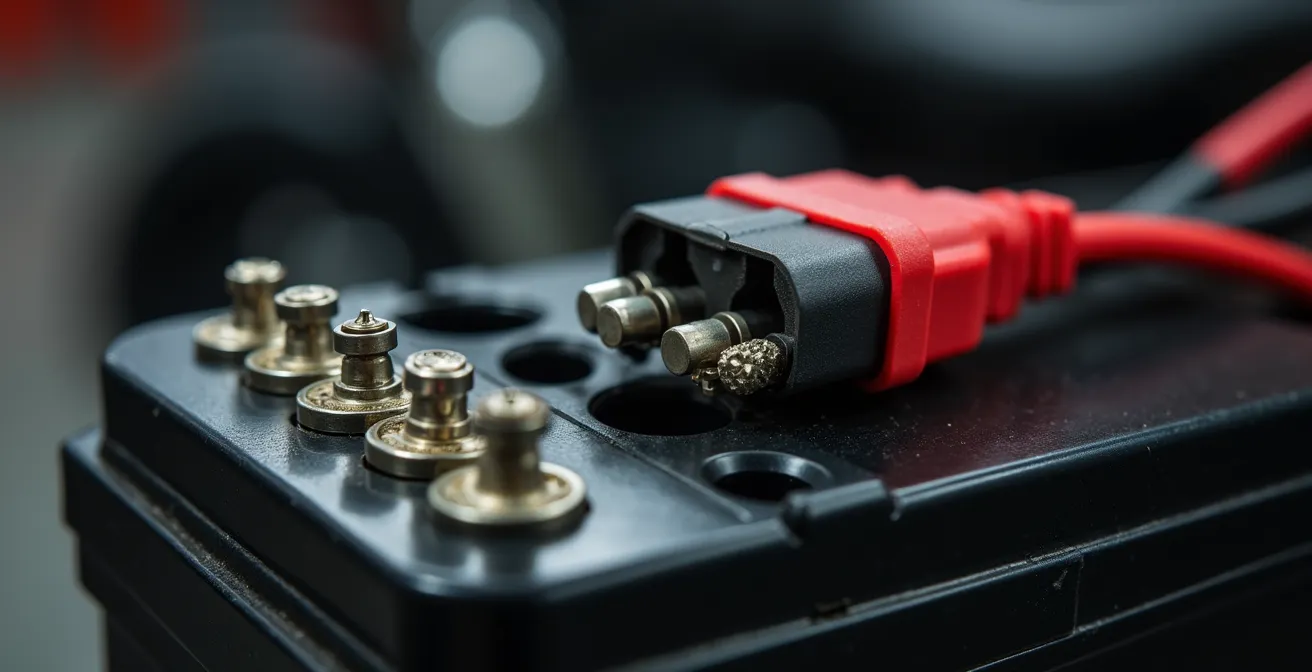
It’s also essential to understand the type of battery chemistry used, as this heavily influences its expected lifespan. While most modern EVs use a form of Li-ion, specific chemistries like Lithium Iron Phosphate (LiFePO4) offer superior longevity and safety compared to more common Nickel Manganese Cobalt (NMC) variants, albeit with slightly lower energy density.
This table outlines the general characteristics of common battery types, providing context for what to expect from a used vehicle. A bike with a LiFePO4 battery at 5 years old is likely in much better condition than a standard Li-ion battery of the same age, assuming similar care.
| Battery Type | Typical Lifespan | Charge Cycles | Key Advantage |
|---|---|---|---|
| Lead-Acid | 3-5 years | 300-500 | Low cost |
| Li-ion (Standard) | 2-10 years | 500-1000 | High energy density |
| LiFePO4 | 5-15 years | 1500-3000 | Safety & longevity |
Center of Gravity: How Does a 200lb Battery Change Handling Compared to a Gas Tank?
The placement and mass of a 200-pound battery pack fundamentally alters a motorcycle’s handling dynamics compared to a traditional gas tank. While a gas tank’s weight is high and diminishes as fuel is consumed, a battery’s mass is constant and typically mounted very low in the frame. This low, centralized center of gravity is a key enabler of the sharp, planted feel characteristic of many electric motorcycles. It allows for confident, aggressive cornering and stable, hard acceleration out of turns. However, this very handling advantage can become a hidden driver of battery degradation.
The riding style encouraged by a low center of gravity—frequent, hard acceleration and deep lean angles—places immense stress on the battery’s chemistry. This is measured by the C-rate, which represents the discharge current relative to the battery’s total capacity. A 1C rate means the entire battery is discharged in one hour. Aggressive riding can create discharge spikes of 5C, 10C, or even higher. These high C-rates generate significant internal heat and accelerate the wear of the battery’s internal components, directly shortening its lifespan.
As one expert analysis notes, this connection between handling and battery health is direct and unavoidable:
The low, centralized mass of a battery encourages aggressive cornering and hard acceleration out of turns. This riding style creates high discharge C-rates, which is a primary driver of battery degradation.
– Technical analysis, Electric motorcycle handling dynamics study
Furthermore, the battery’s placement within the frame impacts its thermal management. A battery pack shrouded for aesthetic reasons may have poorer cooling than one exposed to direct airflow, leading to higher operating temperatures during spirited rides. This temperature difference can account for a 5-10% variance in degradation rates over time. Therefore, how you use the bike’s handling characteristics is inextricably linked to the long-term health of its power source.
Chain, Belt, or Shaft: Which Final Drive System Fits Your Riding Style?
The final drive system—the mechanism that transfers power from the motor to the rear wheel—may seem like a purely mechanical component, but its efficiency has a direct impact on battery longevity. An electric motor’s efficiency means that even small losses in the drivetrain are magnified in terms of battery consumption over thousands of miles. The choice between a chain, belt, or shaft drive is therefore not just about maintenance and ride feel; it’s a decision that affects the number of charge cycles your battery will endure.
Each system presents a different trade-off between efficiency, maintenance, and its effect on the battery. A well-maintained chain is the most efficient, transferring power with minimal loss. However, a dirty, poorly lubricated chain can increase drivetrain drag significantly, forcing the motor to work harder and draw more power for the same speed. This added consumption forces more frequent charging, accumulating cycles and accelerating degradation. A belt drive is a close second in efficiency, offers a smoother and quieter ride, and requires far less maintenance, providing a more consistent and lower-stress load on the battery over its lifetime. A shaft drive offers the lowest maintenance but is the least efficient due to its complex gearing, consistently consuming more energy and thus contributing to faster battery wear.
Regenerative braking quality is also affected. Chains provide the most direct connection, but can feel jerky. Belts offer a much smoother, more predictable regenerative braking experience, which can encourage its use and slightly improve overall energy efficiency. This comparative table breaks down how each system impacts the battery.
| Drive Type | Maintenance | Efficiency | Regen Quality | Battery Impact |
|---|---|---|---|---|
| Chain | High | Highest (when clean) | Direct but jerky | Variable based on maintenance |
| Belt | Low | High | Smooth, predictable | Consistent, less stress |
| Shaft | Minimal | Lower (more drag) | Reduced net efficiency | Higher consumption |
Rubber Waste: Why Motorcycle Tires Are Harder to Recycle Than Car Tires?
While the complexities of recycling motorcycle tires—with their varied compounds and embedded materials—is an important environmental topic, the immediate concern for an EV owner is the tire’s direct impact on battery health. Specifically, a tire’s rolling resistance is a primary factor in your motorcycle’s energy consumption. Just as with final drive systems, an inefficient tire forces the motor to draw more current, leading to more frequent charging and accelerated battery degradation.
The choice between sport-oriented and touring-oriented tires provides a clear example. Soft-compound sport tires are designed for maximum grip, but this adhesiveness comes at the cost of higher rolling resistance. Comparative tests show that aggressive sport tires can increase rolling resistance by 15-20% versus harder-compound touring tires. Over the lifespan of a single set of tires, this can translate into 8-10% more total charge cycles. It’s a hidden “tax” on your battery’s lifespan, paid for with every mile ridden.
Tire pressure is another critical, and often overlooked, variable. An underinflated tire deforms more as it rolls, dramatically increasing its rolling resistance. Consistently riding on underinflated tires has the same effect as riding with the brakes lightly applied—it constantly wastes energy and puts unnecessary strain on the battery. Furthermore, the correlation between riding style, tire wear, and battery wear is direct. Aggressive acceleration and braking not only wears out your rubber faster, but the high C-rates involved also “wear out” your battery’s chemical structure. Choosing the right tire for your primary riding style and maintaining it meticulously is a powerful, yet simple, way to extend your battery’s life.
Key Takeaways
- The “20-80%” State of Charge (SoC) window is scientifically grounded in minimizing voltage stress on the battery’s cathode and anode.
- Battery health is a holistic system; your riding style (C-rate), drivetrain maintenance (efficiency), and tire choice (rolling resistance) all directly contribute to degradation.
- For maximum longevity, slow AC charging (Level 1/2) is always superior to DC Fast Charging (Level 3), as it generates less heat and places lower stress on the battery’s chemistry.
Type 2 vs CCS vs J1772: Which Plug Does Your Motorcycle Actually Need?
The array of charging plugs can be confusing, but from a battery longevity perspective, the choice is simple: the slowest charge rate your schedule allows is always the best. The difference between connectors like J1772/Type 2 (AC charging) and CCS (DC Fast Charging) is not just about speed; it’s about the level of stress placed on your battery. Understanding this is the final, crucial piece of the longevity puzzle. How often should you charge? It’s best to perform shallow charges frequently within the 20-80% window rather than deep cycles from 100% to 0%.
J1772 (Type 1) and Type 2 plugs are used for Level 1 (standard wall outlet) and Level 2 (240V) AC charging. In this process, the motorcycle’s onboard charger converts AC power from the grid to DC power to charge the battery. This is a relatively slow process, resulting in a low C-rate and minimal heat generation. This is the ideal method for regular, overnight charging as it is the gentlest on the battery chemistry. CCS (Combined Charging System), by contrast, enables DC fast charging. It bypasses the bike’s onboard charger and delivers high-voltage DC power directly to the battery. While incredibly fast, this process generates significant heat and involves very high C-rates, both of which are primary drivers of battery degradation. Does fast charging degrade the battery? Yes, unequivocally. It should be reserved for long-distance travel, not daily use.
The most important principle for extending battery life is avoiding high states of charge. Charging to 100% holds the cells at a high voltage (e.g., 4.2V), which accelerates the degradation of the cathode. Conversely, charging to only 80% might mean a peak voltage of only 4.0-4.1V. This seemingly small difference has a massive impact over time. In fact, cutting the peak voltage is the single most effective way to increase cycle life. As foundational research from the University of Michigan shows, every 0.10V reduction in peak charge voltage can double the battery’s cycle life. This is the scientific proof behind the 80% rule. It’s not arbitrary; it’s engineering.
Armed with this engineering perspective, you are no longer just a rider; you are the active manager of your motorcycle’s most vital component. By understanding the interplay of C-rates, thermal management, and system efficiency, you can make informed decisions every time you ride and charge. The first step is to implement a disciplined charging routine that respects the 20-80% window, not as a rule, but as a fundamental principle of electrochemical preservation. Your battery’s 10-year journey begins with the choices you make today.