
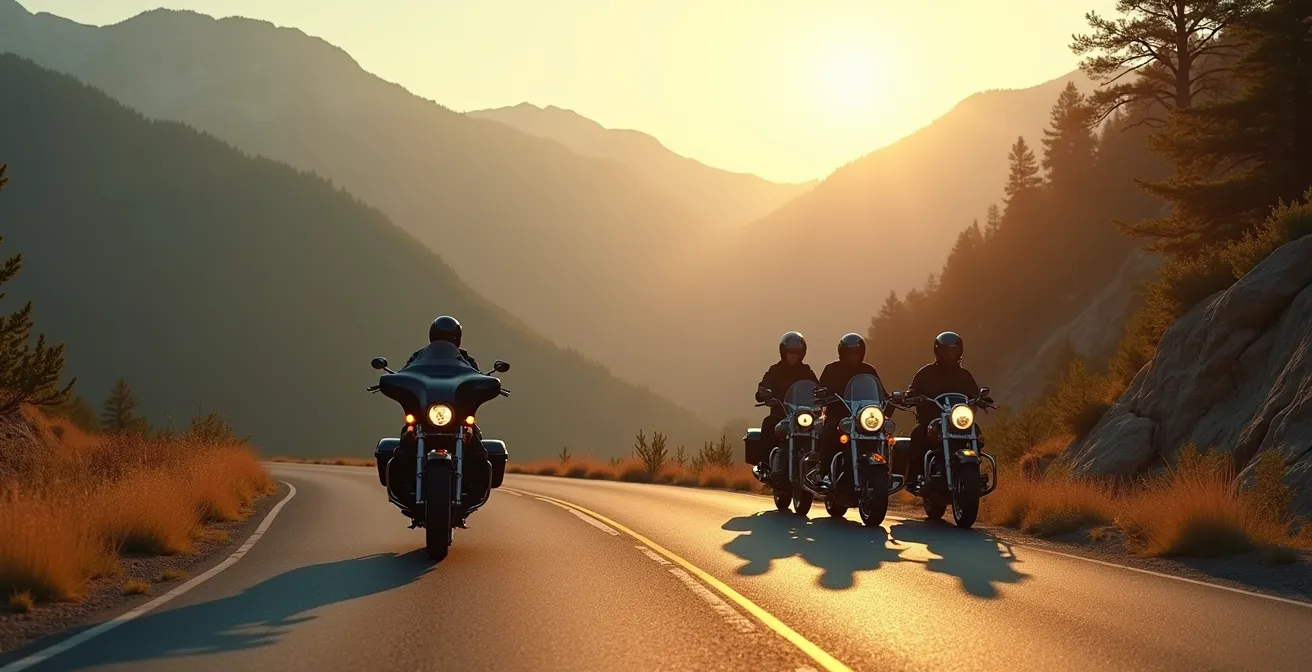
The real question isn’t whether to ride solo or with a group, but how well you manage your own internal psychology under pressure.
- Group riding tests your ‘friction threshold’ and social battery, demanding compromise and collaborative energy.
- Solo riding challenges your self-reliance and decision-making endurance, placing the entire cognitive load on you.
Recommendation: Choose the style that complements your personality’s need for control and social energy, not just the one that seems more adventurous on paper.
The map is spread across the table, a spiderweb of possibilities for your first cross-country motorcycle adventure. But before the route is plotted or the panniers are packed, a fundamental question arises: do you chase the horizon alone, or share the road with friends? The conventional wisdom pits the solitary rider’s absolute freedom against the safety and camaraderie of a pack. We’re told to weigh the pros of spontaneous detours against the cons of shared decision-making.
As an adventure travel psychologist, I suggest this is a superficial framework. This debate isn’t a simple logistical choice between freedom and safety; it’s a profound diagnostic tool for understanding your own personality. The real journey isn’t measured in miles covered but in how you maintain your internal equilibrium when faced with the inevitable friction of the road. The decision to ride solo or in a group is less about the destination and more about choosing the external structure that best supports your internal thresholds for patience, social energy, and control.
This article will deconstruct the common challenges of a long-distance tour—fatigue, planning, roadside repairs, and budgeting—not as practical problems to be solved, but as psychological tests. By understanding your own reactions to these pressures, you can move beyond the generic “solo vs. group” debate and make a choice that aligns with your deepest needs, ensuring the adventure is restorative, not draining.
Contents: Charting Your Inner Motorcycle Journey
- The 300-Mile Wall: Why Planning More Than 6 Hours a Day Ruins the Fun?
- Booking Ahead vs Winging It: Which Strategy Offers More Freedom?
- The Essential Tool Kit: What Can You Actually Fix on the Side of the Road?
- Hidden Trip Costs: How to Budget for Fuel, Food, and Surprise Tires?
- Eating for Endurance: Why Fast Food Lunches Make You Sleepy on the Bike?
- Solo vs Club: Do You Need a Group to Enjoy Motorcycling?
- How to Plan a Custom Route on Desktop and Transfer it to Your Bike?
- Smartphone vs Dedicated GPS: Which is Better for Adventure Touring?
The 300-Mile Wall: Why Planning More Than 6 Hours a Day Ruins the Fun?
Every long-distance rider eventually meets “The Wall.” It’s not a specific mileage marker but a psychological state where enjoyment curdles into exhaustion. It’s the point where the rhythmic hum of the engine becomes a grating drone, and the open road feels less like a promise and more like a punishment. This isn’t just a matter of feeling tired; it’s a critical safety issue. When mental and physical reserves are depleted, judgment falters and reaction times slow. In fact, data suggests that approximately 9.5% of motorcycle highway accidents in the US occur due to rider fatigue.
The temptation, especially in a group eager to “make good time,” is to push through. This is an ego-driven decision that ignores the body’s clear signals. A psychologically healthy approach to touring recognizes this wall not as an obstacle to be conquered, but as a boundary to be respected. The goal is to end the day with energy in reserve, not to collapse into a motel bed. This requires a shift from a mileage-focused mindset to an energy-management mindset. It means accepting that six hours of focused, enjoyable riding is infinitely more valuable than ten hours of grueling, joyless travel.
For the solo rider, this is a matter of self-discipline. For the group rider, it requires pre-trip agreement and a shared commitment to prioritize well-being over the itinerary. The rider who insists on “just one more hour” is not being tough; they are introducing a significant risk to themselves and everyone around them. True endurance is about sustainability, not brute force.
Booking Ahead vs Winging It: Which Strategy Offers More Freedom?
The romantic image of the motorcycle traveler is one of ultimate freedom, unbound by schedules, deciding on a whim where to sleep for the night. This “winging it” strategy is often contrasted with the perceived rigidity of booking every hotel in advance. From a psychological perspective, however, this isn’t a choice between freedom and constraint. It’s a trade-off between two different types of mental comfort: the security of a known outcome versus the autonomy of an open-ended plan.
Booking ahead drastically reduces the daily cognitive load. You are not spending precious mental energy at the end of a long riding day searching for a vacancy, comparing prices, or worrying about availability in a popular area. This pre-planned structure provides a scaffold of certainty that can be deeply comforting. On the other hand, it defines your path, making spontaneous detours or weather-related changes difficult and potentially costly.
Winging it maximizes flexibility, preserving the rider’s sense of control and spontaneity. This can be exhilarating but comes at the cost of increased uncertainty. The daily search for lodging can become a source of stress, especially in peak season or remote areas. The “freedom” to choose can feel like a burden when you’re tired and just want a hot shower. The best strategy is therefore deeply personal, tied to your own tolerance for uncertainty versus your need for structure.
| Factor | Booking Ahead | Spontaneous/Winging It |
|---|---|---|
| Cost Impact | Fixed rates, advance booking discounts | Can be ‘significantly more expensive’ especially in peak season |
| Flexibility | Limited, may lose deposits | Complete freedom to change plans |
| Stress Level | Lower – everything pre-arranged | Variable – finding accommodation daily |
| Weather Adaptation | Difficult – locked into routes | Easy – can avoid bad weather |
| Best For | Peak season, popular destinations | Off-season, remote areas |
The Essential Tool Kit: What Can You Actually Fix on the Side of the Road?
A breakdown on a deserted road is one of the greatest anxieties for any touring rider. The conversation around this often centers on what tools to carry, but the most essential tool is not in your pannier; it’s your own mind. The ability to stay calm, assess the situation rationally, and make a sound decision under pressure is far more valuable than a 10mm socket. Carrying a comprehensive tool kit can provide a sense of security, but it can also create a false sense of competence.
The real question isn’t just “what can I fix?” but “what *should* I fix?” Attempting a complex repair you’re not confident in can quickly turn a minor inconvenience into a trip-ending disaster. The psychological pressure to be self-sufficient, especially for a solo rider, can lead to poor choices. The most important skill is knowing the limits of your own ability and when to call for help. A group provides a safety net here, not just in pooled skills and tools, but in shared decision-making that can temper a single rider’s panicked or overconfident impulse.
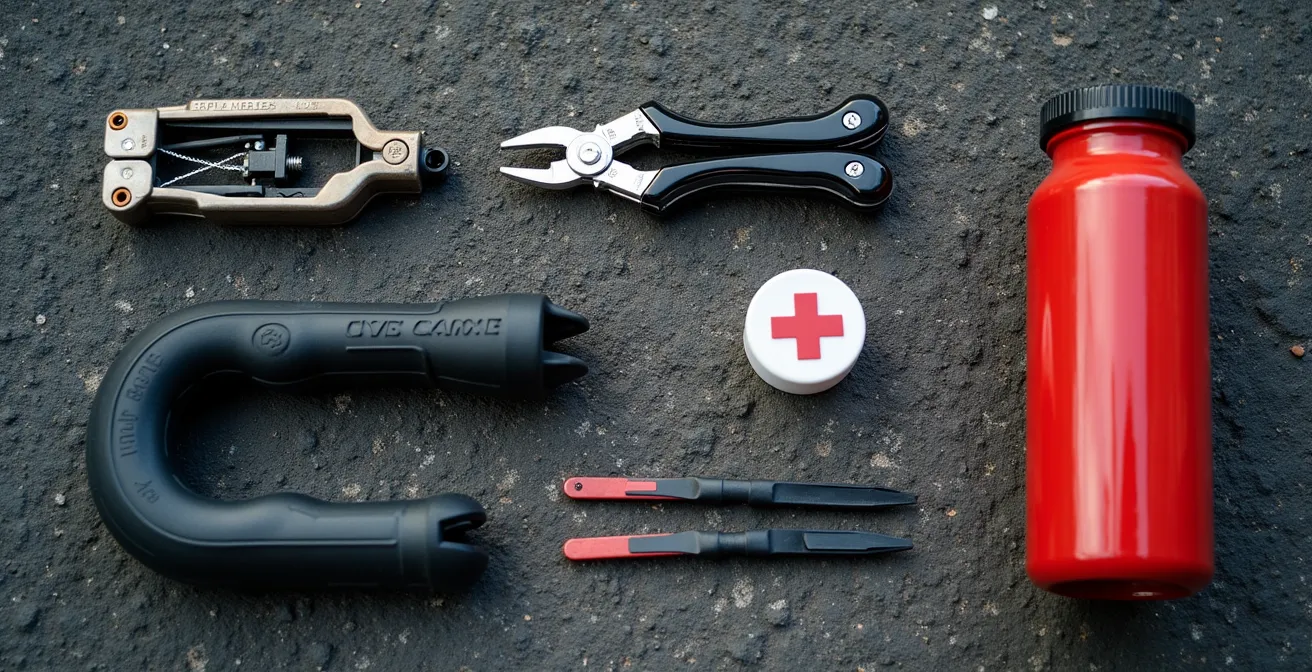
As the layout above suggests, a practical roadside kit focuses on high-probability, low-complexity fixes: a flat tire, a loose connection, a broken lever. Beyond that, the primary tool becomes your phone or satellite communicator. The following framework is a mental checklist, designed to guide your decision-making process from a state of panic to one of control.
Your Roadside Repair Decision Framework: Can I vs. Should I
- Assess Safety of Location: Is it safe to work here? Consider traffic, visibility, and the stability of the road shoulder. Your personal safety is the absolute first priority.
- Evaluate Time and Weather: Will you be working into the night? Is rain or extreme heat a factor? Environmental conditions dramatically increase the difficulty and risk of any repair.
- Honestly Assess Your Skill Level: Have you successfully performed this exact repair before in a controlled environment like your garage? If not, the side of the road is not the place to learn.
- Calculate Success Likelihood: Given the tools, your skills, and the conditions, what is the realistic chance of success? If you feel it’s under 70%, it’s often wiser to call for professional assistance.
- Know Your T-CLOCS: Before your trip, review the basic systems (Tires, Controls, Lights, Oil, Chassis, Stands) and be honest about which components you can realistically diagnose and fix.
Hidden Trip Costs: How to Budget for Fuel, Food, and Surprise Tires?
Financial stress is a silent killer of adventure. While we meticulously plan for the big-ticket items like fuel and lodging, it’s the steady drip of small, unplanned expenses that can create a persistent, low-grade anxiety. This financial pressure can subtly influence decisions on the road, pushing you to skip a meal, ride when tired to reach a cheaper town, or ignore a worrying engine noise to avoid a mechanic’s bill. Budgeting for a trip, therefore, is not just an accounting exercise; it’s a strategy for protecting your psychological well-being.
A purely logistical budget is brittle. A psychologically resilient budget has flexibility built in. This is where the concept of a “morale fund” becomes essential. This is a separate, no-questions-asked pool of money dedicated solely to lifting your spirits. It’s for the night you’re soaked to the bone and decide to splurge on a nicer hotel instead of camping. It’s for the surprisingly great restaurant you stumble upon. It’s for the day you’re simply feeling worn down and a good meal or a comfortable bed is the best medicine.
This fund acts as a psychological pressure-release valve. Knowing it’s there removes the guilt from these “unnecessary” expenses and reframes them as valid investments in the trip’s success. It acknowledges that human endurance is not infinite and that sometimes, comfort is a non-negotiable part of the journey. A group must agree on this concept beforehand, deciding how and when to deploy shared morale funds to prevent resentment over differing spending habits. This proactive financial planning is a powerful tool for reducing in-trip friction.
Eating for Endurance: Why Fast Food Lunches Make You Sleepy on the Bike?
On a long tour, food is not just sustenance; it is fuel for both body and mind. The temptation of a quick, cheap fast-food lunch is immense, especially when you’re trying to cover ground. However, the momentary convenience is paid for with a steep tax on your cognitive function. Heavy, processed, high-sugar meals trigger a post-meal slump, diverting blood flow to your digestive system and away from your brain. This “food coma” manifests as drowsiness, reduced focus, and slower reflexes—a dangerous combination on a motorcycle.
Choosing your meals is a strategic decision about managing your energy for the rest of the day. Opting for lighter, more nutrient-dense foods—proteins, complex carbohydrates, and healthy fats—provides a steady release of energy rather than a sharp spike followed by a crash. This isn’t about being a health fanatic; it’s about respecting the intricate connection between your gut and your brain. Similarly, hydration is critical. This isn’t mere thirst; it’s the beginning of a cognitive decline. Research shows that even a state of 2% dehydration can begin to impair performance, a subtle but significant tax on your decision-making faculties when you need them most.
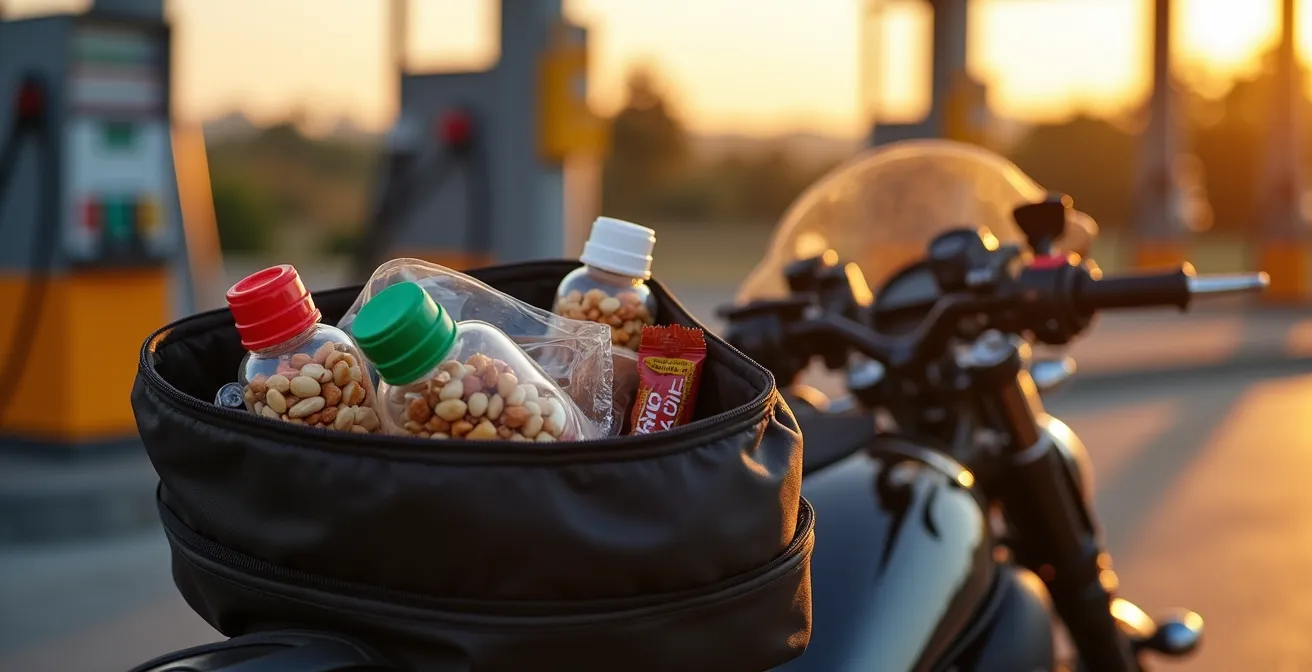
A solo rider has complete control over this, able to stop and snack as their body dictates. In a group, meal stops become a significant point of potential friction. Differing dietary needs, budgets, and taste preferences can turn a simple lunch break into a lengthy negotiation. The most successful groups establish a food strategy beforehand: agreeing on the types of places to stop, packing shared snacks, and respecting each other’s need to eat or hydrate on a personal schedule, even if it means an extra, brief stop.
Solo vs Club: Do You Need a Group to Enjoy Motorcycling?
We arrive at the heart of the matter. The decision to ride solo or with a group is the ultimate test of self-awareness. There is no universally “better” way; there is only the way that is better for *you*. The choice hinges on two core psychological concepts: your social battery and your friction threshold. How much social interaction energizes you versus drains you? And how much deviation from your own preferred pace, route, and schedule can you tolerate before enjoyment turns to resentment?
Solo riding offers an unfiltered experience. Every decision is yours, from the route to the rhythm of the day. This total autonomy can be liberating, allowing for deep introspection and a profound connection with your surroundings. It also places the entire weight of logistics, safety, and morale squarely on your shoulders. It is a true test of self-reliance. As The Riding Zebra points out, it can also lead to more authentic local interactions.
You are more likely to mingle with locals when you’re solo or with your partner rather than when you’re in a group that most likely already speaks your language.
– The Riding Zebra, Pros and Cons of Motorcycle Riding Solo/2-Up or in a Group
Group riding transforms a personal journey into a shared narrative. The highs are amplified through collective celebration, and the lows are buffered by mutual support. It provides a crucial safety net for mechanical issues or accidents. However, this comes at the cost of individual freedom. Every stop, every meal, and every mile is a potential negotiation. If your friction threshold is low, the constant small compromises required by group travel can erode the very joy you seek. The following table maps personality traits to the riding style they are best suited for, serving as a guide for your self-assessment.
| Personality Trait | Better Suited For | Key Consideration |
|---|---|---|
| Need for flexibility | Solo riding | Stop whenever you want without group consensus |
| Social energy needs | Group riding | Shared experiences and instant camaraderie |
| Decision-making style | Solo: Independent Group: Collaborative |
Solo requires all decisions; groups share responsibility |
| Risk tolerance | Group (beginners) | Safety in numbers, mechanical help available |
| Schedule preference | Solo: Flexible Group: Structured |
Groups require coordination and compromise |
How to Plan a Custom Route on Desktop and Transfer it to Your Bike?
Route planning is more than drawing lines on a map; it’s a proactive exercise in managing future stress. A well-planned route is a psychological safety net, a framework of certainty that frees up your cognitive bandwidth on the road to focus on riding and absorbing your surroundings, rather than navigating. This is true for a solo rider but becomes exponentially more critical for a group, where a lack of route cohesion is a primary source of friction.
The modern digital toolkit allows for a multi-layered approach. You can start with broad strokes on a tool like Google Maps for logistics and major waypoints, then zoom in with specialized apps like Calimoto or Rever to find those perfect, twisty backroads that make a trip memorable. This process allows you to build in contingencies—bailout points to major highways if time runs short, or alternate routes in case of bad weather. It’s about creating a plan that is both robust and flexible.
For group travel, route synchronization is non-negotiable. Nothing creates tension faster than a group getting separated because their GPS devices interpret the same GPX file differently. This is a common and frustrating issue that can derail a day.
The Group Sync Challenge Solution
As documented by professional tour operators on sites like Bennetts BikeSocial, route file incompatibility is a top trip-planning frustration. The professional solution is to designate a single “route master” for the group. This person is responsible for creating the master route and distributing it in multiple formats (e.g., GPX with both shaping points and waypoints). Crucially, the group must then conduct a “parking lot sync test” before departure, with everyone loading the route to ensure their device displays the exact same path. This five-minute check can save hours of on-road frustration.
Key Takeaways
- The true goal of a motorcycle tour is to manage your internal equilibrium, not just to accumulate miles.
- Both solo and group styles have unique psychological costs; the key is choosing the one that aligns with your personality’s needs for control and social energy.
- Self-awareness of your personal ‘friction threshold’ and ‘social battery’ is the most critical planning tool you possess.
Smartphone vs Dedicated GPS: Which is Better for Adventure Touring?
The final piece of the planning puzzle is the navigation tool itself. The debate between a smartphone and a dedicated motorcycle GPS is often framed around features and cost, but it’s more productively viewed through the lens of psychological resilience and cognitive load. Which device will be most reliable under duress, and which will demand the least of your precious mental attention while riding?
A smartphone is a marvel of versatility but is also a master of distraction. Its delicate nature, susceptibility to weather, and reliance on battery life and cell service make it a potentially fragile single point of failure on a long tour. A dedicated GPS, by contrast, is a purpose-built tool. It is rugged, weatherproof, and designed to do one job without interruption. Its software is optimized for route following, and features like satellite beacon capability can be a literal lifesaver in remote areas with no cell coverage.
However, the very complexity of a dedicated GPS can be its own form of cognitive load. As some experienced riders note, fiddling with a GPS unit while riding is a significant source of distraction. The choice, then, depends on the parameters of your trip and your tolerance for different kinds of risk. A short weekend trip in an area with good cell coverage may be perfectly suited to a smartphone, while a multi-week journey into the backcountry demands the robust reliability of a dedicated unit.
| Trip Factor | Smartphone Better | Dedicated GPS Better |
|---|---|---|
| Duration | Weekend trips (2-3 days) | Extended tours (1+ weeks) |
| Weather exposure | Fair weather only | All-weather touring |
| Remote areas | Urban/suburban with cell coverage | Backcountry/international |
| Redundancy needs | Multiple devices available | Single point of failure risk |
| Data logging | Basic tracking | Comprehensive route analysis |
| Emergency features | Cell service areas | Satellite beacon capability |
The choice between solo and group touring—and all the micro-decisions that follow—is a mirror reflecting your own personality. There is no right answer, only an honest one. Before you commit to a thousand-mile journey, perhaps the wisest first step is a short, weekend “diagnostic” trip. Ride one day solo, and one day with a friend. Pay close attention not to the road, but to your own internal reactions. That is where you will find the real answer.