
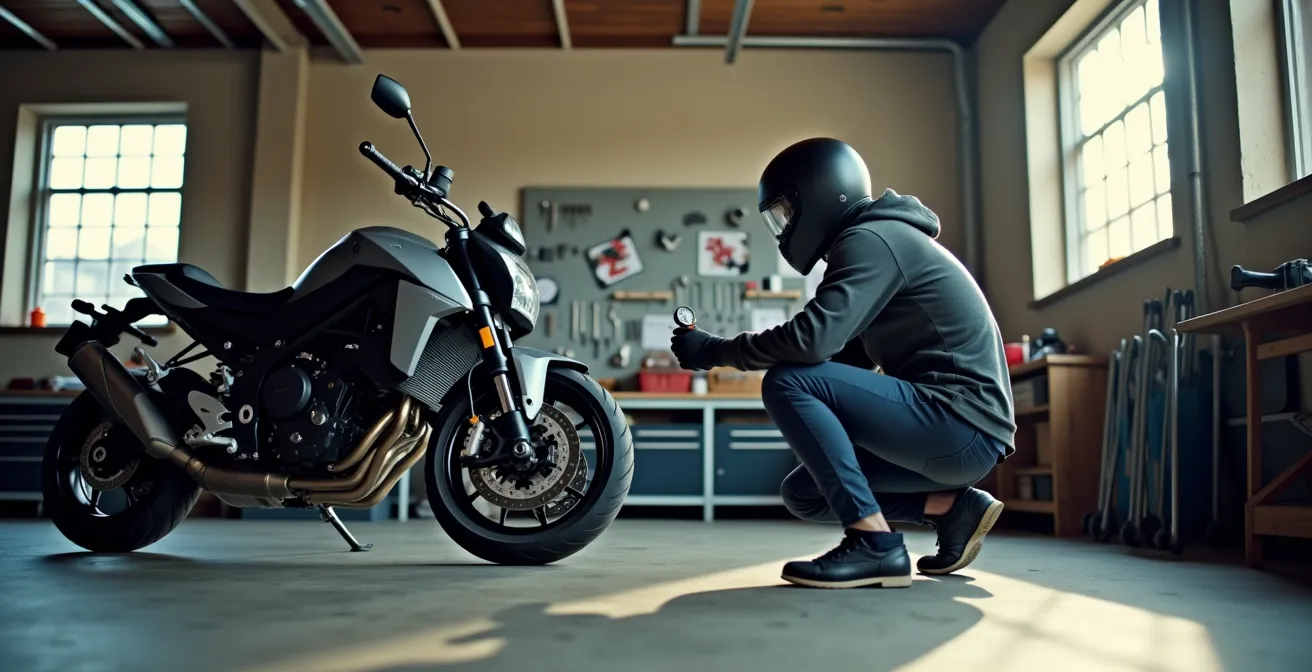
Skipping a pre-ride check is a gamble with your safety; mastering the 5-minute T-CLOCS inspection turns that gamble into a guarantee of mechanical discipline.
- Most catastrophic failures are preceded by small, detectable warning signs in your motorcycle’s Tires, Controls, Lights, Oil, and Chassis.
- A systematic scan, treated with the seriousness of a pilot’s pre-flight check, reveals these issues before they escalate on the road.
Recommendation: Adopt this non-negotiable procedure before every ride to ensure maximum reliability and the confidence that your machine is as ready as you are.
The temptation is always there: the open road calls, and you just want to hop on and go. For many riders, a pre-ride inspection is an afterthought—a tedious chore that stands between them and the freedom of the ride. They trust that the bike was fine yesterday, so it must be fine today. This assumption is the single greatest threat to a rider’s safety and a machine’s longevity. It replaces diligence with hope, a trade-off that has stranded countless riders and, in worst-case scenarios, led to catastrophic mechanical failure at speed.
While the T-CLOCS (Tires, Controls, Lights, Oil, Chassis, Stands) acronym is well-known, it’s often treated as a mere suggestion. The truth is, it’s a battle-tested system. Military installations use the T-CLOCS checklist as their non-negotiable safety standard, a testament to its effectiveness in demanding environments. The core issue isn’t a lack of information, but a lack of discipline. The key isn’t to simply know the checklist, but to adopt the mindset of a military safety officer: methodical, efficient, and uncompromising. This isn’t about a lengthy, garage-bound teardown; it’s a tactical procedure, a five-minute scan for critical failure points.
This article re-frames the pre-ride check. We will move beyond simply listing what to check and focus on *how* to check it with speed and precision. You will learn to spot the subtle signs of impending failure—the fraying cable, the weeping gasket, the loose fastener—before they become a crisis. By embracing this mechanical discipline, you transform your motorcycle from a potential liability into a reliable asset, ensuring every ride starts with confidence, not a coin toss.
This guide breaks down the most critical components of the T-CLOCS inspection. Each section provides a disciplined, no-nonsense approach to verifying the integrity of your motorcycle, allowing you to build a routine that is both fast and thorough.
Summary: A Disciplined Approach to Motorcycle Pre-Ride Checks
- Oil Sight Glass vs Dipstick: How to Read Levels on a Center Stand vs Side Stand?
- The Fraying Clutch Cable: How to Spot the Break Before It Snaps in Traffic?
- Brake Light Switches: How to Verify Both Hand and Foot Levers Trigger the Light?
- Vibration Loosening: Which Bolts Should You Check with a Torque Wrench Monthly?
- Ticking vs Knocking: How to Distinguish Normal Valve Noise from Rod Knock?
- The Burnishing Process: Why New Brakes Feel Weak for the First 50 Miles?
- Oil and Coolant: How to Ensure Your DIY Waste Doesn’t End Up in Groundwater?
- How to Check Brake Pad Thickness Without Removing the Caliper?
Oil Sight Glass vs Dipstick: How to Read Levels on a Center Stand vs Side Stand?
Engine oil is the lifeblood of your motorcycle. An incorrect level—either too low or too high—can lead to catastrophic engine failure. The inspection method differs based on your bike’s design, but the principle of accuracy is universal. The most common error is checking the oil while the bike is on its side stand, which gives a false reading. The motorcycle must be perfectly level and upright to get an accurate measurement. The engine should also be cold, or at least have sat for 30 minutes after a ride, to allow the oil to settle back into the sump.
For motorcycles with a sight glass, the process is visual. With the bike held vertically, either on a center stand or by an assistant, the oil level should sit between the MIN and MAX lines etched on the glass. The oil should be a clear amber color. If it’s dark brown or black, it’s time for a change. If it appears milky or creamy, this is a major red flag indicating a coolant leak into the oil system, a “go/no-go” condition that requires immediate mechanical attention.
For bikes equipped with a dipstick, the procedure is slightly different. Position the bike upright, unscrew the dipstick, and wipe it clean with a rag. Re-insert the dipstick fully, but do *not* thread it back in. Let it rest on the threads, then remove it again to check the level. The oil mark should fall between the designated high and low points on the dipstick. This systematic check ensures your engine is properly lubricated and protected for the ride ahead.
This simple, one-minute procedure is the first and most critical step in confirming your engine’s health before putting it under load.
The Fraying Clutch Cable: How to Spot the Break Before It Snaps in Traffic?
A snapped clutch cable renders your motorcycle’s transmission useless, a scenario that is merely inconvenient in a parking lot but potentially deadly in heavy traffic. Cables rarely break without warning. They fail progressively, and a disciplined inspection can spot the signs of fatigue long before a catastrophic failure. The most common failure points are areas of high stress where the cable bends sharply, primarily at the lever pivot and the engine actuator arm.
Your inspection should be both visual and tactile. Start at the clutch lever. Pull it in and look closely at the cable as it emerges from the housing and connects to the lever. Look for individual strands of the steel cable that have broken and are beginning to “bird-cage” or fray. This is the most obvious sign of impending failure. Run your fingers along the cable housing; feel for any cracks, kinks, or areas where the outer sheath is worn through, which can allow moisture to corrode the inner cable.
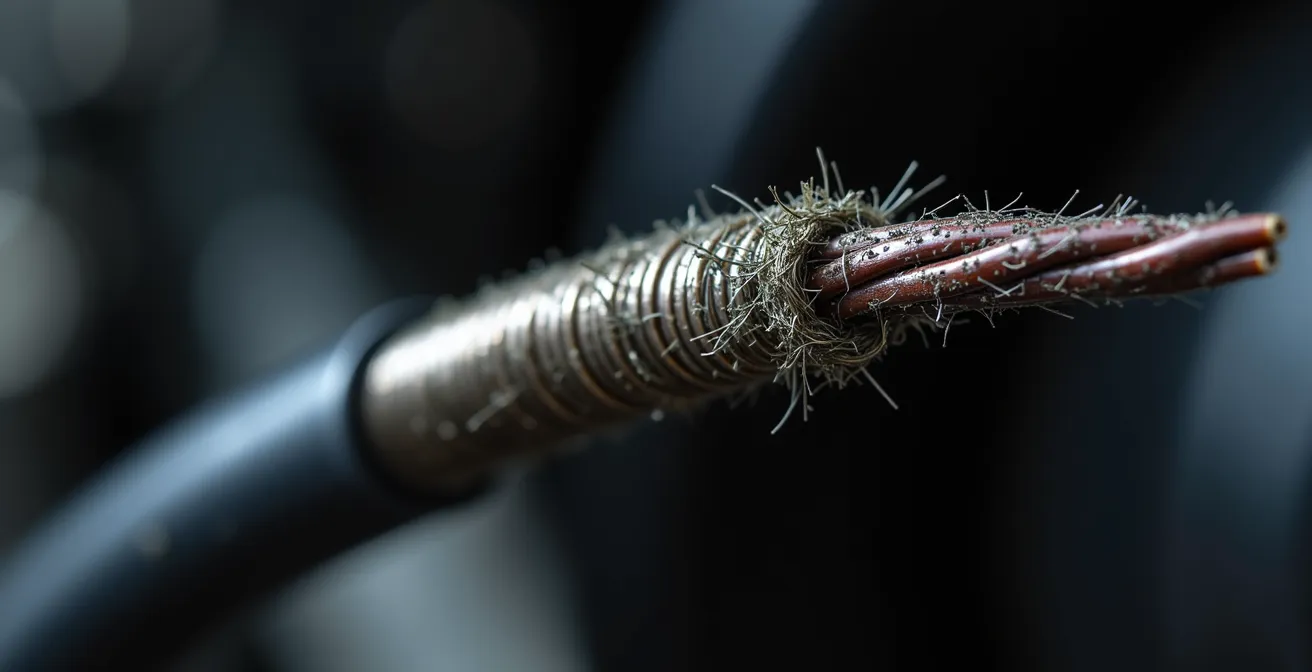
As the illustration highlights, the failure often begins with a single broken strand. At this microscopic level, the damage is already significant. The following table breaks down the key inspection points and their associated risk levels.
| Inspection Point | What to Look For | Failure Risk Level |
|---|---|---|
| Lever Pivot | Fraying, kinks at sharp bend | High – Most stress |
| Engine Actuator Arm | Cable stretch, worn housing | High – Heat exposure |
| Cable Housing | Cracks in sheath, corrosion | Medium |
| Cable Ends | Lubrication status | Low but affects feel |
A cable showing any sign of fraying is a “no-go” item. It must be replaced immediately. This simple check takes less than 30 seconds and can prevent a dangerous loss of control.
Brake Light Switches: How to Verify Both Hand and Foot Levers Trigger the Light?
Your brake light is your primary line of defense against being rear-ended. It’s not enough that it works; it must activate instantly from *both* the front brake lever and the rear brake pedal. Each has a separate switch, and the failure of one is a common and often unnoticed problem. A disciplined check ensures your intention to slow down is clearly communicated to the traffic behind you. The Motorcycle Safety Foundation insists this check should be as routine as checking the weather forecast, taking only a few seconds.
Testing this solo can seem tricky, but several effective methods require no assistance. The goal is to see your bike’s tail while operating the brakes. Here are some simple, tactical approaches:
- Garage Door Method: Before you leave, position your bike facing a closed garage door or wall. In your mirrors, you can easily see the reflection of the brake light as you apply the front and rear brakes independently.
- Shop Window Technique: When parked in front of a storefront, use the glass as a giant mirror to perform the same check.
- Traffic Light Method: While waiting at a stop, the reflective hood or bumper of the car behind you provides an excellent surface to confirm your brake light is functioning.
- Wall Shadow Test: At night, any wall behind you will clearly show the shadow of the bike and the bright activation of the brake light.
Integrate this into your mounting procedure. Before you even put the bike in gear, squeeze the front brake and glance at a reflective surface. Then, press the rear brake and do the same. This two-second verification confirms that your most critical safety signal is fully operational.
If either switch fails to activate the light, the motorcycle is not road-worthy. Do not ride it until the faulty switch is repaired or replaced.
Vibration Loosening: Which Bolts Should You Check with a Torque Wrench Monthly?
Vibration is the constant, invisible force working to disassemble your motorcycle on the move. Critical fasteners can and will loosen over time, posing a significant safety risk. While a daily visual scan is part of T-CLOCS, a more thorough, tactile check of key bolts with a torque wrench should be a monthly discipline. The focus must be on fasteners that secure high-stress components related to your wheels, steering, and braking systems.
Not all bolts require the same level of attention. Your monthly check should prioritize the most critical systems. Axle nuts, axle pinch bolts, and brake caliper mounting bolts are non-negotiable. A loose axle can cause a catastrophic loss of control. Next, verify the fasteners securing your handlebars and triple clamps, as these directly affect your steering. While less frequent, these checks are vital for long-term safety. A good practice is to perform this check after washing the bike, as you’re already looking at it closely.
Case Study: The Paint Pen Torque Seal Technique
A professional technique used in racing and aviation can dramatically simplify your visual checks. As recommended by sources like FortNine’s popular YouTube channel, after properly torquing a critical fastener, use a paint pen or “torque seal” to draw a straight line from the bolt head onto the non-moving component it’s attached to. During your daily pre-ride inspection, a quick glance is all it takes to see if the lines are still aligned. If the line is broken, the bolt has rotated and needs immediate attention. This transforms a time-consuming torque check into a simple, instant visual confirmation.
Action Plan: Critical Fastener Priority Check
- Primary (Monthly Torque Check): Focus on axle nuts and pinch bolts. These are your highest priority as they secure the wheels to the bike.
- Secondary (Quarterly Torque Check): Verify the torque on triple clamp bolts and handlebar clamps, which are essential for steering integrity.
- Post-Maintenance (As-Needed Check): Always verify the torque on the oil drain plug and filter housing after every oil change to prevent leaks.
- Vibration-Prone (Monthly Visual/Torque Check): For V-twins and singles, check exhaust header flanges and muffler hangers, which are subject to intense vibration.
- Accessories (Weekly Visual Check): Visually inspect mirror stalks, license plate brackets, and other bolted-on accessories for any signs of loosening.
This disciplined, tiered approach ensures that your efforts are focused where they matter most, maintaining the structural integrity of your motorcycle without turning every pre-ride check into a full maintenance session.
Ticking vs Knocking: How to Distinguish Normal Valve Noise from Rod Knock?
Engines talk. A disciplined rider learns to listen. Most engines produce a certain amount of mechanical noise, but it’s crucial to distinguish between the benign chatter of a healthy valvetrain and the sinister sound of a terminal engine problem. The two most common sounds are a “tick” and a “knock,” and they signal vastly different conditions. A light, rhythmic ticking sound, especially on an air-cooled engine, is often just normal valve noise. It’s the sound of the valvetrain operating and is usually consistent with engine RPM. It might be more pronounced when the engine is cold and quiet down as it warms up.
A rod knock, however, is a death rattle. This is a deep, heavy, metallic knocking sound that comes from the bottom end of the engine. It’s caused by excessive clearance in the connecting rod bearings. Unlike a tick, a knock will often get louder under load (when you accelerate) and may be more apparent at certain RPM ranges. If you hear a sudden, loud knock, your ride is over. Shut the engine off immediately to prevent further damage. Continuing to run an engine with a rod knock will lead to its complete destruction.

As this mechanic demonstrates, you can use a long screwdriver as a rudimentary stethoscope to pinpoint the source of a sound. By placing the tip on different parts of the engine and the handle to your ear, you can determine if the noise is coming from the top end (cylinder head) or the bottom end (crankcase). This diagnostic mindset is about proactive investigation, not passive acceptance. It embodies the very spirit of a pre-ride check, a concept eloquently captured by Ken Glaser of the MSF.
While I’m waiting at the airport gate, I’m always comforted when I see a pilot visually inspecting the aircraft. Motorcycles, like airplanes, have critical components that experience normal wear and tear. Detecting a minor change during inspection can prevent a costly repair or worse tomorrow.
– Ken Glaser, MSF Director of Special Projects
This auditory check should be part of your startup routine. Listen to your bike’s normal sounds, so you can immediately recognize when something is dangerously out of place.
The Burnishing Process: Why New Brakes Feel Weak for the First 50 Miles?
Installing new brake pads and expecting full stopping power from the first pull is a dangerous mistake. New brakes often feel weak, vague, and lack initial bite. This is not a sign of a defective product; it’s a normal and expected part of a critical process known as burnishing or “bedding-in.” This process is essential for achieving optimal braking performance and longevity from your new components. Ignoring it can lead to glazed pads and reduced friction for the life of the pads.
The bedding-in process involves creating a thin, even transfer layer of friction material from the new pads onto the surface of the brake rotor. This is achieved through a series of controlled heat cycles. When the pads and rotor are properly mated, they work together as a cohesive friction system, providing powerful, consistent, and predictable stopping power. Without this transfer layer, you have two dissimilar surfaces rubbing together, resulting in inefficient braking.
Case Study: The Street Brake Bedding-In Procedure
A proper street procedure for bedding in new pads is a controlled exercise in heat management. As outlined by experts at publications like Motorcyclist, the goal is to heat the system up and cool it down in a structured way. This typically involves a series of 6-8 moderate, firm stops from around 60 mph down to 20 mph. It is critical *not* to come to a complete stop with the brakes applied during this process, as this can leave an uneven deposit of pad material on the hot rotor, causing brake judder. After the series of stops, a final cool-down ride of about 10 minutes, using engine braking as much as possible, allows the system to normalize. This procedure ensures a perfect mating of pad and rotor surfaces.
Therefore, after installing new brake pads, plan your first ride accordingly. Dedicate the first 10-15 minutes to this procedure in a safe area with minimal traffic, and gradually build up to full braking force.
Oil and Coolant: How to Ensure Your DIY Waste Doesn’t End Up in Groundwater?
The discipline of a rider extends beyond the motorcycle itself; it includes the responsible management of its waste products. Performing your own maintenance, such as oil and coolant changes, is a rewarding aspect of ownership, but it comes with a significant environmental responsibility. Used motor oil, coolant, and brake fluid are hazardous materials that can cause severe damage to the environment if disposed of improperly. The environmental impact is staggering; according to some reports, even small amounts can cause lasting groundwater contamination, with a single quart of oil having the potential to contaminate up to a quarter-million gallons of water.
A systematic approach is required. Never pour these fluids down a drain, onto the ground, or into household trash. The key is containment and separation. Use clean, dedicated, and clearly labeled containers for each type of fluid—do not mix them. Used oil can be stored in the same container the new oil came in. Coolant (antifreeze) is particularly toxic and must be kept separate.
Proper disposal is often free and convenient. Most auto parts stores (like AutoZone or Advance Auto Parts in the US) have recycling programs and will accept used motor oil at no charge. For other fluids like coolant and brake fluid, your best resource is your local municipal hazardous waste collection facility. A quick search for “household hazardous waste disposal near me” will provide a location and schedule. In case of spills during the change, have a bag of cat litter on hand to quickly absorb the liquid before it spreads.
- Store used fluids in clean, sealed, and clearly labeled containers.
- Keep oil, coolant, and brake fluid separate from each other.
- Transport used oil to auto parts stores offering free recycling.
- Locate your municipal hazardous waste facility for coolant disposal.
- Keep receipts of proper disposal for compliance and peace of mind.
By treating fluid disposal with the same methodical discipline as your pre-ride check, you uphold your duty not only to your machine but to the environment as well.
Key Takeaways
- Mechanical discipline is a mindset, not a chore; it’s the foundation of rider safety.
- Most catastrophic failures are preceded by small, detectable warning signs that a systematic scan will reveal.
- The T-CLOCS system is a 5-minute investment that pays immense dividends in reliability and peace of mind.
How to Check Brake Pad Thickness Without Removing the Caliper?
Your brake pads are the single most important wear item on your motorcycle. Letting them wear down too far can result in metal-on-metal contact, which will destroy your brake rotors and lead to a dangerous loss of stopping power. A disciplined inspection of pad thickness is a critical part of the T-CLOCS check. While the most accurate measurement is taken with the caliper removed, a reliable visual inspection can be performed in seconds, and it is a skill every rider must possess. Most manufacturers and mechanics agree that brake pads should be replaced once they reach about 3mm of remaining friction material, or are 75% worn.
To perform the check, you need a flashlight and to get low enough to look into the brake caliper. You are looking for three things: the metal brake rotor (disc), and the two brake pads (one on each side) that squeeze it. Each brake pad consists of a metal backing plate and the friction material bonded to it. Your goal is to assess the thickness of the friction material. A simple rule of thumb is to compare the friction material’s thickness to that of its backing plate. If the friction material is the same thickness or thinner than the backing plate, it’s time to plan for a replacement.
Some brake pads come with built-in wear indicators to simplify this process. These indicators provide a clear visual cue that the pad has reached its service limit. Understanding which type your motorcycle uses can make the check even faster.
| Indicator Type | How It Works | When to Replace |
|---|---|---|
| Groove Indicators | Visible grooves cut into the pad material disappear as the pad wears. | When the grooves are no longer visible. |
| Squealer Tabs | A small metal tab contacts the rotor when the pad is worn, creating a high-pitched squeal. | When the squealing sound begins during braking. |
| Thickness Measurement | Direct visual assessment of the friction material’s remaining depth. | At approximately 2-3mm of remaining material. |
| Visual Rule | Comparing the friction material layer to the backing plate layer. | When the friction layer is equal to or thinner than the backing plate. |
By integrating this quick visual check into your routine, you ensure your motorcycle’s most critical safety system is always ready to perform. Do not gamble with your brakes. Integrate this tactical procedure into your pre-ride ritual. Treat your motorcycle with the respect it demands, and it will deliver the reliability you depend on. Start today.