
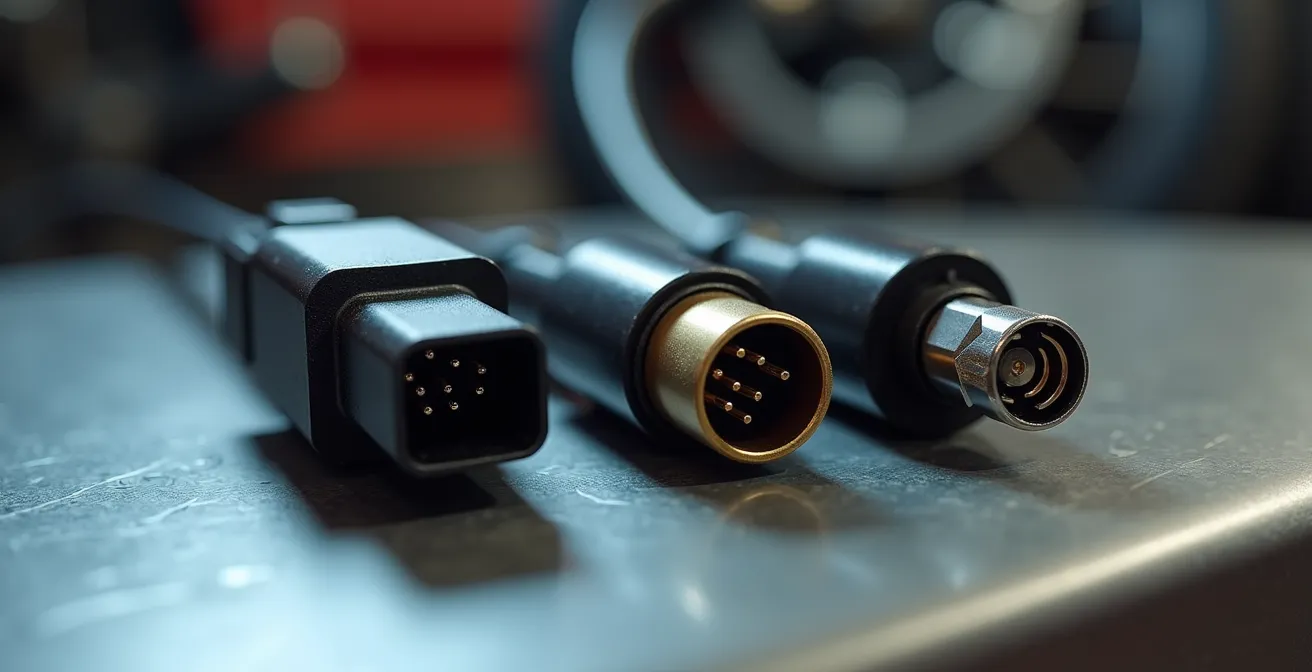
The confusion around electric motorcycle charging isn’t about memorizing an alphabet soup of plug types like J1772 or CCS. It’s about understanding the “conversation” happening between your bike and the charging station. This guide decodes that technical handshake, explaining why different plugs exist and how your bike’s Battery Management System (BMS) dictates charging speed. By understanding this logic, you move from a confused new rider to an empowered one who can confidently manage charging on any journey.
Getting the keys to your first electric motorcycle is a thrilling moment. The silent, instant torque and the promise of a simplified powertrain are intoxicating. But that excitement can quickly turn to anxiety at the first public charging station. You’re confronted with a wall of foreign-looking plugs labeled J1772, CCS, Type 2, and maybe even CHAdeMO. It feels less like refueling and more like a high-stakes compatibility test you didn’t study for. Many new riders simply try to memorize which plug fits, but this approach is fragile and leaves you stranded when the unexpected happens.
The common advice is to “just use an app,” but that ignores the reality of broken stations, blocked spots, or simply showing up to find a plug that fits but delivers a trickle of power. The core issue isn’t the physical shape of the connector; it’s the complex electrical conversation happening behind the scenes. Your motorcycle’s brain, the Battery Management System (BMS), is constantly talking to the charger, negotiating voltage, current, and temperature to protect your battery’s health. Understanding the basics of this “handshake” is the true key to charging freedom.
This guide isn’t another glossary of plug types. Think of me as the technician at the station, here to walk you through the logic. We’re going to move beyond the plastic shapes and delve into why your bike charges fast one day and slow the next, how to plan for trips through “charging deserts,” and what the unwritten rules of sharing public power are. By the end, you won’t just know which plug to use; you’ll understand *why* and be prepared for anything the public charging network throws at you.
This article breaks down the essential knowledge every new electric rider needs to master the logistics of fueling on the go. From the technical nuances of charging speeds to the practical strategies for long-distance travel, here is what we will cover.
Summary: Understanding Your Electric Motorcycle’s Charging Needs
- The Charging Desert: How to Plan a Trip When Chargers Are 80 Miles Apart?
- Level 1 vs Level 2: How to Cut Your Morning Commute Time by 20% in Heavy City Traffic?
- Why Your Bike Won’t Charge at 50kW Even at a Fast Charger?
- ICE-ing and Sharing: What Are the Unwritten Rules of Public Charging Spots?
- Destination Charging: How to Confirm a Hotel Actually Has a Working Plug?
- Smartphone vs Dedicated GPS: Which is Better for Adventure Touring?
- Booking Ahead vs Winging It: Which Strategy Offers More Freedom?
- Real-World Range vs Spec Sheet: Can You Actually Commute 50 Miles on Highway Speeds?
The Charging Desert: How to Plan a Trip When Chargers Are 80 Miles Apart?
The first reality every EV rider must accept is that charging infrastructure is not evenly distributed. You might be spoiled for choice in a city center but find yourself in a “charging desert” just 50 miles outside of town. In fact, recent infrastructure data reveals that 78% of public EV chargers are concentrated in just three regions: China, the EU, and the U.S. This geographic imbalance means that for any significant tour, you are not just a rider; you are a logistics planner. Relying solely on public networks without a backup plan is a recipe for disaster.
Planning a route through these sparse areas requires a shift in mindset. You can no longer think in terms of “the next gas station.” You must think in terms of “guaranteed electrons.” This means using apps like A Better RoutePlanner (ABRP) that factor in your bike’s specific consumption, elevation changes, and even weather to predict your state of charge at each waypoint. It also means having a robust Plan B, C, and D. What if the single charger in a 100-mile radius is broken or occupied? This is where being self-sufficient becomes a non-negotiable skill.
This self-sufficiency is built on carrying the right tools to turn any power source into a potential lifeline. Standard wall outlets, RV park hookups, and campground power pedestals become your private charging network. This preparedness transforms range anxiety into a solvable puzzle. The image below captures this spirit of resourcefulness, where the open road meets pragmatic preparation.
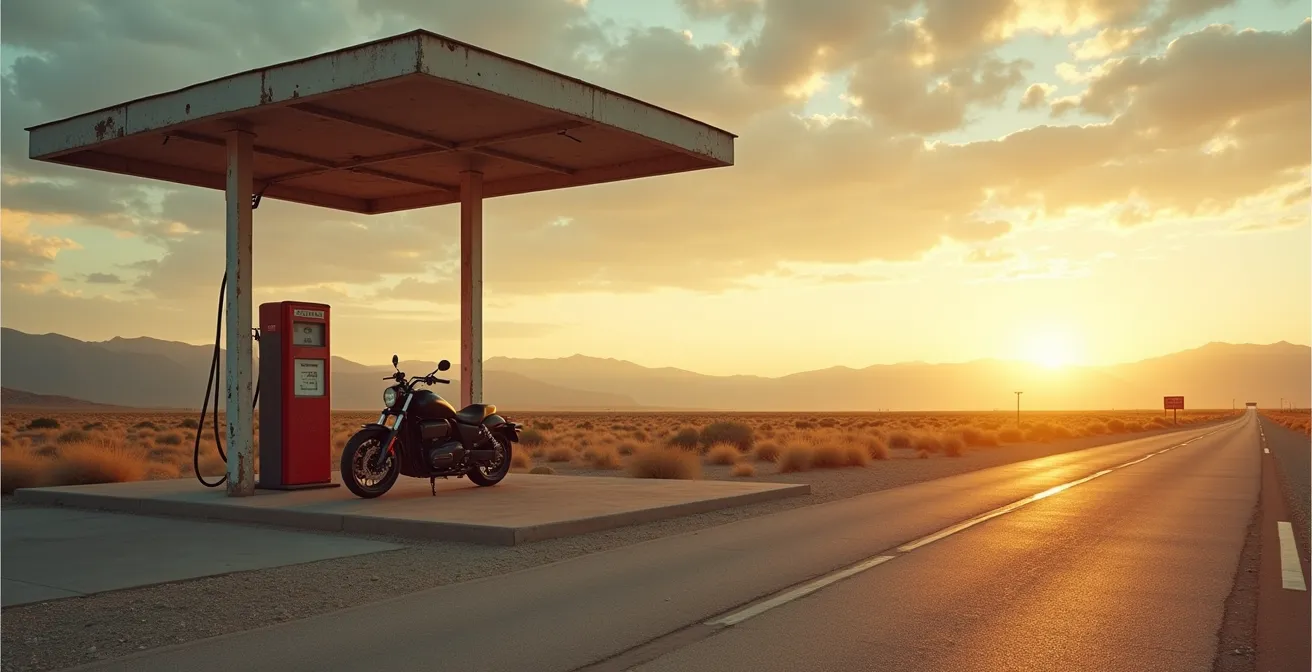
As you can see, the solution isn’t always a gleaming, high-tech station. Sometimes, it’s a simple, reliable connection in the middle of nowhere. Having the right adapters and equipment in your panniers means you carry your own security. It’s the difference between being stranded and enjoying a scenic, albeit slow, charge while you take in the view. The key is to be prepared to make your own luck when the public infrastructure falls short.
Your Charging Survival Kit Checklist
- Identify Power Sources: List all potential non-traditional charging points on your route, such as RV parks, campgrounds, and marinas.
- Inventory Adapters: Ensure your kit includes a NEMA 14-50 adapter for RV parks, a TT-30 for older campgrounds, and a portable EVSE to handle any standard outlet.
- Verify Equipment: Before your trip, test your 25-foot, outdoor-rated extension cord and portable EVSE to ensure they function correctly.
- Assess Outlet Viability: Pack a multimeter to check the voltage of unfamiliar outlets before connecting your bike, preventing potential damage from faulty wiring.
- Integrate into Route Plan: Mark these “self-sufficient” charging locations on your map as primary or backup options, turning potential dead zones into viable waypoints.
Level 1 vs Level 2: How to Cut Your Morning Commute Time by 20% in Heavy City Traffic?
While long-distance touring requires strategic planning, daily commuting is a game of efficiency. The two most common types of charging you’ll encounter are Level 1 and Level 2. Think of them as a garden hose versus a fire hose. Level 1 charging uses a standard 120V wall outlet, the same one your toaster uses. It’s incredibly convenient—you can do it anywhere—but it’s slow, adding only 2-5 miles of range per hour. It’s perfect for overnight top-ups but can be painfully slow if you arrive home with a nearly empty battery.
Level 2 charging is the sweet spot for most riders. It uses a 240V circuit, similar to an electric dryer, and requires a dedicated charging station (an EVSE). This is what you’ll find at workplaces, shopping centers, and what many riders install in their garages. A Level 2 charger can add 10-25 miles of range per hour, easily refilling your bike’s battery overnight or during a workday. For a commuter, this is a game-changer. An hour plugged in at the office during lunch could be enough to handle an unexpected errand after work without any range anxiety.
The time savings are significant, especially when you adopt an efficient charging habit. Most manufacturers, like Can-Am, recommend keeping your battery between 20% and 80% for daily use. This is the range where the battery cells absorb energy most quickly. Charging from 80% to 100% takes significantly longer as the BMS works to balance the cells. By topping up within this 20-80% window, you get the fastest, most efficient charge. The table below, using data from an analysis by LiveWire, illustrates the dramatic time difference.
| Model | Level 1 (20-80%) | Level 1 (0-100%) | Level 2 (20-80%) | Level 2 (0-100%) |
|---|---|---|---|---|
| LiveWire S2 | 5.9 hours | 8.4 hours | 78 minutes | 142 minutes |
| LiveWire One | 6 hours | 11 hours | Not compatible | Not compatible |
| Can-Am Pulse | 3.2 hours | 5.25 hours | 50 minutes | 90 minutes |
Why Your Bike Won’t Charge at 50kW Even at a Fast Charger?
You’ve planned your route, found a coveted DC Fast Charger (also known as Level 3), and plugged in, expecting a lightning-fast 0-80% charge in 30 minutes. But you look at your dashboard, and the bike is only drawing 25kW, not the 50kW (or more) the station advertises. This is a common and frustrating experience for new EV riders, but it’s not the charger’s fault. It’s your bike’s BMS acting as a diligent protector of your battery.
Several factors cause this “power tapering.” The most important are your battery’s current state of charge (SoC) and its temperature. A battery can accept a high rate of charge when it’s empty, but as it fills up, the BMS must slow the flow of energy to avoid overheating and damaging the cells. It’s like filling a glass of water: you can pour quickly at the start, but you must slow down at the end to avoid spilling. This is why charging from 80% to 100% can take almost as long as charging from 20% to 80% on a fast charger.
Temperature is the other critical variable. Batteries have an optimal temperature window for charging. If it’s too cold, the BMS will limit charging speed to warm the battery up safely. If it’s too hot (e.g., after a long highway ride on a summer day), the BMS will also limit speed to prevent further heat buildup. The intricate cooling systems, like the fins and thermal pads seen here, are working constantly to manage this.

Finally, remember that your motorcycle itself has a maximum charging rate. A bike with a max rate of 25kW will never draw 50kW, no matter how powerful the station is. And finding these high-power stations is a challenge in itself, as Zero Motorcycles reports that only 10% of charging network stations offer Level 3/DC fast charging. As the LiveWire Engineering Team explains, this is all part of a carefully managed process:
As a battery approaches full capacity, the charging process slows down to prevent overheating and to manage the battery’s health and longevity. The internal Battery Management System carefully controls the charging rate to ensure cells are charged uniformly.
– LiveWire Engineering Team, LiveWire Electric Motorcycle Charging Guide
ICE-ing and Sharing: What Are the Unwritten Rules of Public Charging Spots?
Mastering the technology is only half the battle. Public charging introduces a social component that can be just as challenging. The most infamous breach of etiquette is “ICE-ing,” where a driver of an Internal Combustion Engine vehicle parks in a designated EV charging spot, blocking access. While frustrating, the more common issues arise from interactions within the EV community itself. With a limited number of plugs, especially fast chargers, a set of unwritten rules has emerged to keep things civil and efficient.
The cardinal rule is: a charging spot is for charging, not for parking. Once your bike has reached a sufficient charge (ideally around 80% on a fast charger), you should move it, even if you plan to stay longer at the location. This frees up the charger for the next person, who might be desperate for a few electrons to get home. Many charging networks now enforce this with idle fees, which penalize you for every minute you stay plugged in after your session is complete. Setting a timer on your phone is a simple courtesy that can save you money and earn you goodwill.
As a motorcyclist, you have a unique advantage and responsibility. Your bike is small. If the space allows, park at the very edge of the charging stall. This often leaves enough room for a second EV (another motorcycle or a small car) to share the spot if the station has two plugs. It’s a small act that doubles the utility of the space. Furthermore, communication is key. Leaving a note with your phone number and expected return time on your dashboard can turn a potentially tense situation into a simple coordination. Here are some key etiquette points to follow:
- Park at the edge of the charging stall to allow a second vehicle access if space permits.
- Leave a visible note on your dashboard with your expected return time and contact number.
- Set a timer and move your bike promptly when charging completes to avoid idle fees.
- Use charging apps’ check-in feature to communicate your charging status to other users.
- When securing your gear, attach a cable lock to your bike’s frame, not the charger itself, which could be damaged.
Destination Charging: How to Confirm a Hotel Actually Has a Working Plug?
For any multi-day trip, “destination charging”—the ability to reliably charge overnight at your hotel—is the holy grail. It means you can explore during the day and wake up to a full battery every morning. Many hotel chains now advertise “EV Charging” as an amenity, but the reality on the ground can vary wildly. An “orphaned plug,” one that exists on a map but is broken, blocked, or incompatible, is a tour-ending problem. Verifying the charging situation before you book is a critical planning step.
Never trust the app or booking website alone. You must call the hotel directly and speak to the front desk. Ask specific questions: What type of plug is it (a standard wall outlet, or a J1772 Level 2)? Where is it located? Is it reserved for guests? Is there a fee? Is it currently operational? An employee who can confidently answer these questions is a good sign. If they sound unsure, ask if they can have someone physically check the charger and call you back. This ten-minute phone call can save you hours of frustration later.
Some hotel chains are making significant investments, which makes them a more reliable bet. For instance, Hilton is making a major push to standardize its charging infrastructure.
Case Study: Hilton’s Universal Charging Initiative
Recognizing the growing need for reliable charging, Hilton Worldwide has committed to installing up to 20,000 Tesla Universal Wall Connectors at 2,000 of its hotels. These new connectors are significant because they include a built-in J1772 adapter, making them compatible with both Teslas and any other EV, including your motorcycle, without you needing to carry your own adapter. This initiative, starting in 2024, signals a move toward more standardized and reliable destination charging, but it’s still crucial to call ahead to confirm a specific hotel’s status.
However, even with these positive trends, real-world experiences can be mixed, especially at smaller, independent properties. As one long-time rider noted, the personal touch often makes all the difference.
Where I’ve had trouble is at smaller boutique hotels and resorts, especially in areas that rarely see a cyclist. This can be especially difficult on very long trips to unfamiliar areas where you can’t precisely plan your itinerary.
Smartphone vs Dedicated GPS: Which is Better for Adventure Touring?
Navigating the charging landscape requires the right digital tools. For years, dedicated GPS units were the gold standard for motorcycle touring, prized for their ruggedness, glove-friendly screens, and offline map capabilities. However, the modern smartphone, armed with a suite of specialized apps, has become an indispensable tool for the EV rider, often eclipsing the dedicated GPS in utility.
The primary advantage of a smartphone is access to real-time, user-generated data. A dedicated GPS can tell you where a charger is supposed to be, but an app like PlugShare can tell you if it’s working *right now*. Users leave reviews, report broken stations, and even post photos of the plug’s location. This crowdsourced intelligence is invaluable for avoiding “orphaned plugs.” Another essential app is A Better RoutePlanner (ABRP), which creates routes based on your specific motorcycle model, your riding style, and even real-time weather, providing much more accurate range predictions than a generic GPS.
Of course, smartphones aren’t without their drawbacks. They can overheat in direct sunlight, their touchscreens are difficult to use with gloves, and a shattered screen can leave you digitally stranded. Many seasoned riders adopt a hybrid approach: a dedicated, rugged GPS for turn-by-turn navigation and a handlebar-mounted smartphone running the essential charging apps. This gives you the best of both worlds—the reliability of a dedicated device and the live intelligence of the connected ecosystem.
Ultimately, your phone is your connection to the charging network’s collective brain. Having the right apps installed is just as important as having the right adapters in your bag. The most effective riders use a combination of tools to stay informed and flexible on the road.
- PlugShare: Essential for its vast database and real-time user reviews on charger status and availability.
- A Better RoutePlanner (ABRP): The gold standard for route planning that accounts for your bike’s specific consumption and charging curve.
- ChargePoint/EVgo/Electrify America: Network-specific apps needed to activate and pay for charges at their respective stations.
- Google Maps: Increasingly useful for finding chargers along a route, though it lacks the detailed user feedback of PlugShare.
- Manufacturer App (e.g., LiveWire, Zero): Useful for remote monitoring of your bike’s state of charge.
Booking Ahead vs Winging It: Which Strategy Offers More Freedom?
The classic debate for any motorcycle tourer is planning versus spontaneity. For the EV rider, this question takes on a new dimension of consequence. “Winging it” on a gas bike might mean paying a bit more for fuel or staying in a less-than-ideal motel. “Winging it” on an electric bike can mean being completely stranded. The freedom of the open road is directly tied to the security of your next charge.
The core of the issue is that the public charging network is a secondary system for most EV owners. As industry data shows that 90% of electric vehicle charging is done at home overnight, the public infrastructure is not yet as robust or reliable as the gas station network we’ve taken for granted for a century. This reality heavily favors the planner. Booking your hotels in advance and confirming their charging situation provides a backbone of certainty for your trip. It allows you the freedom to improvise during the day, knowing you have a guaranteed charge waiting for you at night.
Winging it completely is a high-risk strategy best reserved for short trips in charger-dense urban areas. For any long-distance tour, a hybrid approach offers the best balance. Plan and book your overnight stops—your guaranteed “full tank” moments. This creates a safety net. Then, during the day, you can be more spontaneous, exploring side roads and unexpected detours, using apps like PlugShare to find opportunistic charges if needed. This strategy acknowledges the current limitations of the infrastructure while preserving the sense of discovery that makes motorcycle touring so special.
The alternative, arriving in an unfamiliar town at dusk with 10% battery, only to find the single charger is broken or the hotel won’t let you run a cord out a window, is a stressful experience that erodes the joy of the journey. Planning doesn’t restrict your freedom; it enables it by removing the most significant source of anxiety.
Key Takeaways
- Charging speed is a negotiation between the charger and your bike’s BMS, influenced by battery temperature and state of charge.
- For long-distance travel, self-sufficiency is key; carry adapters (NEMA 14-50, TT-30) to utilize RV parks and any standard outlet.
- Always call a hotel to verify the type, status, and cost of their EV charger before booking; don’t rely on app information alone.
Real-World Range vs Spec Sheet: Can You Actually Commute 50 Miles on Highway Speeds?
The most cited number on any electric motorcycle’s spec sheet is its range. However, this number, often calculated under ideal, low-speed “city” conditions, can be misleading. As a technician, I can tell you that the single biggest killer of range is speed. The energy required to overcome wind resistance increases exponentially with speed. A 50-mile commute at a steady 70 mph will consume far more energy than 50 miles of stop-and-go city traffic.
As Zero Motorcycles’ engineering team points out, many other variables are at play. Riding up steep hills, battling a strong headwind, carrying a heavy load or a passenger, and even having under-inflated tires will all reduce your effective range. You must learn to think of your range not as a fixed number, but as a dynamic budget that changes with conditions. This is where experience and observation become your most valuable tools. After a few weeks of commuting, you’ll develop an intuitive sense of how your riding style impacts your battery consumption.
Weather, particularly cold, is another major factor. A lithium-ion battery is a chemical reaction, and like all chemical reactions, it’s less efficient in the cold. Furthermore, your bike may use energy to heat the battery to its optimal operating temperature. As a result, field testing demonstrates that cold weather can reduce range by 20-40%. A trip you can easily make in the summer may require a charging stop in the winter. Ignoring this can leave you stranded.
The key is to treat the spec sheet number as a starting point, not a guarantee. The only number that matters is the one your bike shows you, based on your recent riding patterns. Most modern electric motorcycles have a “range to empty” estimator that is constantly learning and adjusting. Trust it, learn from it, and always give yourself a 20% buffer, especially when venturing into unfamiliar territory. This conservative approach is the hallmark of a smart, experienced EV rider.
By understanding the conversation between your bike and the charger, the logic behind charging speeds, and the real-world variables that affect your range, you are no longer at the mercy of the infrastructure. You are an informed, prepared rider ready to confidently explore the world on two silent wheels. The next step is to put this knowledge into practice on your own rides.
Frequently Asked Questions About Electric Motorcycle Charging
What specific type of charger does your hotel have – wall outlet, J1772, or other?
Hotels typically have Level 2 J1772 chargers, but some only offer standard wall outlets. Always verify the exact connector type matches your motorcycle.
Is the charger reserved for hotel guests only, and is there a booking system?
Some hotels allow advance charging spot reservations, but most operate on a first-come, first-served basis. Call the hotel directly to inquire.
What is the current operational status and are there any fees?
Charging policies vary significantly. Many luxury hotels offer free charging for loyalty members, while others charge per kWh or a flat daily rate.